Global soccer fans found out Friday which national teams will face off in the initial group stage of the FIFA World Cup 2026—while host cities will be waiting with eagerness and some anxiety to see which countries’ fans will be visiting.
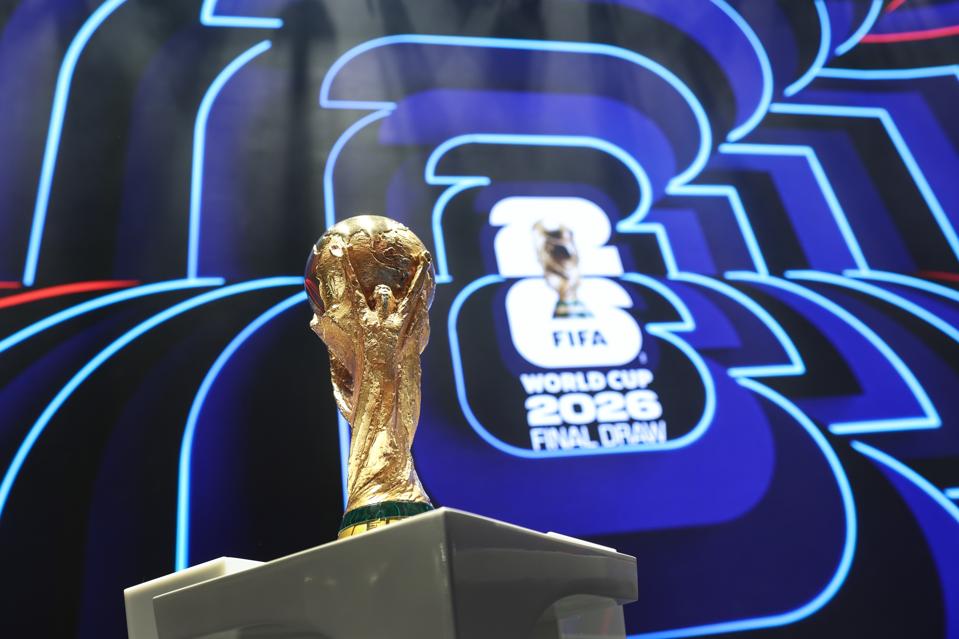
The FIFA World Cup 2026 draw will take place at the Kennedy Center in Washington, DC on Friday afternoon. (Photo: Michael Regan)
FIFA via Getty Images
Key Facts
The FIFA World Cup 2026 draw was held Friday at the Kennedy Center in Washington, D.C. to determine how 48 qualifying national soccer teams will be distributed in the initial group stage.
The United States will begin the tournament in a game against Paraguay on June 12 in Los Angeles.
The full list of kickoff times and locations of the group stage fixtures will be revealed in a separate ceremony on Saturday, Dec. 6.
Teams will play across 16 North American host cities—11 in the United States, three in Mexico and two in Canada—the first time three nations have hosted the tournament.
The U.S. host cities expect varying levels of economic boost, with visitor spending ranging from $400 million to $3.3 billion.
What Happened At The World Cup Draw?
The World Cup draw was attended by the leaders of the three countries hosting the event, including President Trump, Canadian Prime Minister Mark Carney and Mexican President Claudia Sheinbaum.
FIFA seeded the 48 national teams that will participate in the World Cup and then split them into 12 groups of four teams each. (Forty-two teams have secured their place in the tournament, with six more spots to be determined in a playoff matches next spring.) Meanwhile, host cities found out which national teams they will host in the early stages—and not all countries are created equal.
2026 World Cup: List Of Groups
Group A: Mexico, South Africa, South Korea, Winner Play-off D
Group B: Canada, Winner Play-off A, Qatar, Switzerland
Group C: Brazil, Morocco, Haiti, Scotland
Group D: United States, Paraguay, Australia, Winner Play-off C
Group E: Germany, Curacao, Ivory Coast, Ecuador
Group F: Netherlands, Japan, Winner Play-off B, Tunisia
Group G: Belgium, Egypt, Iran, New Zealand
Group H: Spain, Cape Verde, Saudi Arabia, Uruguay
Group I: France, Senegal, Winner Play-off 2, Norway
Group J: Argentina, Algeria, Austria, Jordan
Group K: Portugal, Winner Play-off 1, Colombia, Uzbekistan
Group L: England, Croatia, Ghana, Panama
These Countries Have The Most Passionate Fanbases
For host cities, the most coveted national teams—England, France, Brazil, Argentina and Portugal—have huge fan bases that have historically traveled en masse to similar events, Tourism Economics economist Laura Baxter told Reuters last month.
“Everyone wants those major South American and Western European teams,” an official at Meet Boston told Forbes, adding that President Trump’s repeated threats to pull the tournament from democratic-run cities, including Boston, Seattle and Los Angeles, has “definitely driven anxiety” for event planners.
“There could be some influence that we’re not privy to make sure that those premier teams and premium matchups go to places that are falling in line, if you will.” Notably, some of the most high-profile teams—like Argentina, the 2022 World Cup champions, and Brazil, which has the best overall performance in the tournament’s history—not only must jump through a series of hoops to apply for visas to travel to the U.S. but also must pay a new $250 visa integrity fee, which experts say will deter many would-be travelers.
The Countries Least Likely To Send Fans To The World Cup
Two of the countries on Trump’s travel ban list—Iran and Haiti—have qualified for the World Cup and one more—the Republic of the Congo—could yet qualify, leaving fans prohibited from traveling to the US to watch their teams.
How Much Is The World Cup Expected To Boost The Us Economy?
FIFA expects the World Cup to drive $30.5 billion in total economic output and create 185,000 jobs in the U.S. next year. That figure is predicated on the assumption that roughly 40% of the estimated 6.5 million tournament attendees will be international fans who will stay for an average 12 days, buy two tickets per person and spend about $416 daily. FIFA advised World Cup host cities to expect a 50/50 split between domestic and international visitors, tourism officials from Philadelphia and Kansas City, two World Cup host cities, told Forbes this summer.
Which U.S. Host Cities Expect The Biggest Economic Boost From World Cup 2026?
The 11 host cities expect the following impact to the local economy:
- New York/New Jersey – $3.3 billion (final on July 19)
- Miami – $1.5 billion (quarter-final on July 11)
- Houston – $1.5 billion
- Boston – $1.1 billion (quarter-final on July 11)
- Seattle – $929 million
- Philadelphia – $770 million
- Kansas City – $653 million (quarter-final on July 10)
- Los Angeles – $594 million (quarter-final on July 9)
- Atlanta – $503 million (semi-final on July 15)
- San Francisco and Bay Area – $480-$630 million
- Dallas – $400 million (semi-final on July 14)
What We Don’t Know
Whether international visitors will flock to the U.S. in the numbers necessary to reach the projected economic benefit. Tourism Economics, a division of Oxford Economics, projects the U.S. will see roughly 1.24 million international visitors for the tournament—less than half of FIFA’s projection of 2.6 million.
Even so, the tourism analysis firm expects the tournament will help reverse a dramatic 6.3% downturn in inbound international tourism since Trump took office, driven mainly by his tariffs, America First rhetoric and immigration policies. Tourism Economics projects international visitation to rebound 3.7% next year, with nearly one-third of that growth tied directly to the World Cup. Still, some tourism experts have expressed concern that ruffled geopolitical feathers could turn off some international soccer fans.
“The rhetoric from the administration against anything non-U.S. is just pretty prevalent,” Jan Freitag, national director of hospitality analytics at CoStar Group, said in October. “I think some people will say, ‘Look, if I’m from Europe and the next World Cup is in Europe, then maybe I’ll sit this one out.’”
Big Number
$1.2 billion. That’s how much Airbnb guests who travel for the World Cup are expected to drive in direct spending for the event, broken down to $865 million in the U.S., $177 million in Canada and $169 million in Mexico, according to an analysis by Deloitte.