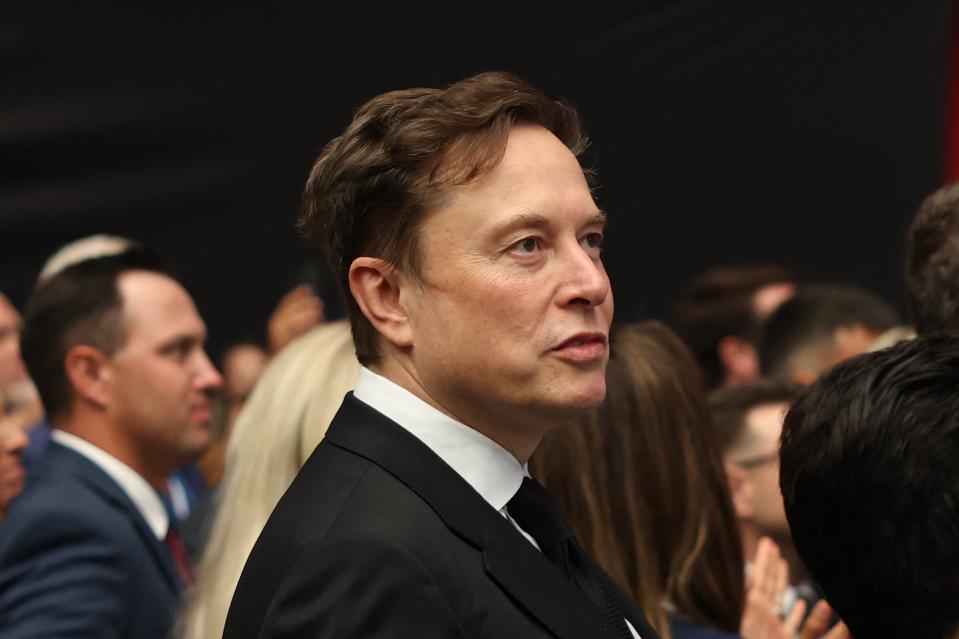
From frenemyship with Trump, the DOGE debacle, unmet self-driving car promises, chainsaws and “Mechahitler” to his controversial $1 trillion pay deal, 2025 was the billionaire’s most chaotic, controversial and lucrative year.

That what was arguably Elon Musk’s most unhinged, outlandish year to date ended with Tesla investors approving his Brobdingnagian pay package is a good reminder that in Silicon Valley, consequences are often theoretical and shareholder patience apparently compounds annually.
The hundreds of millions of dollars Musk shoveled into Donald Trump’s 2024 presidential campaign paid off, gaining his gratitude and a plum role in the administration. In January, he was tapped to lead the euphemistically named Department of Government Efficiency (DOGE), overseeing a group of mainly young, dilettante techies to scour the federal budget for waste. Musk’s constant appearance by Trump’s side in Oval Office meetings for a time elevated him to a kind of co-president. And though Tesla, key to his $745 billion fortune, booked its first-ever annual EV sales drop in 2024, Musk boasted that its progress in AI, robotics and especially self-driving cars could make it the world’s most valuable company someday.
Within weeks, things took a predictably messy turn.
“The picture of the world’s richest man killing the world’s poorest children is not a pretty one”
DOGE’s reckless cuts to agency budgets and staff saved just a tiny fraction of the $2 trillion Musk once promised – as little as $1.4 billion by some estimates or nothing at all by others – while proving to be wildly unpopular. In fact, rather than saving money, some estimates indicate it created $21.7 billion of additional costs in the short run and vastly more in the years to come from uncollected taxes due to IRS cuts DOGE pushed through. Over a decade, that could be a $2.4 trillion hit, according to Yale Budget Lab. Likewise, his elimination of USAID, which provided food and medicine to the world’s most impoverished regions for decades, has already led to hundreds of thousands of deaths, a Harvard study finds. It was a particularly bad look.
For the latest in cleantech and sustainability news, sign up here for our Current Climate newsletter.
“The picture of the world’s richest man killing the world’s poorest children is not a pretty one,” Bill Gates told the Financial Times.
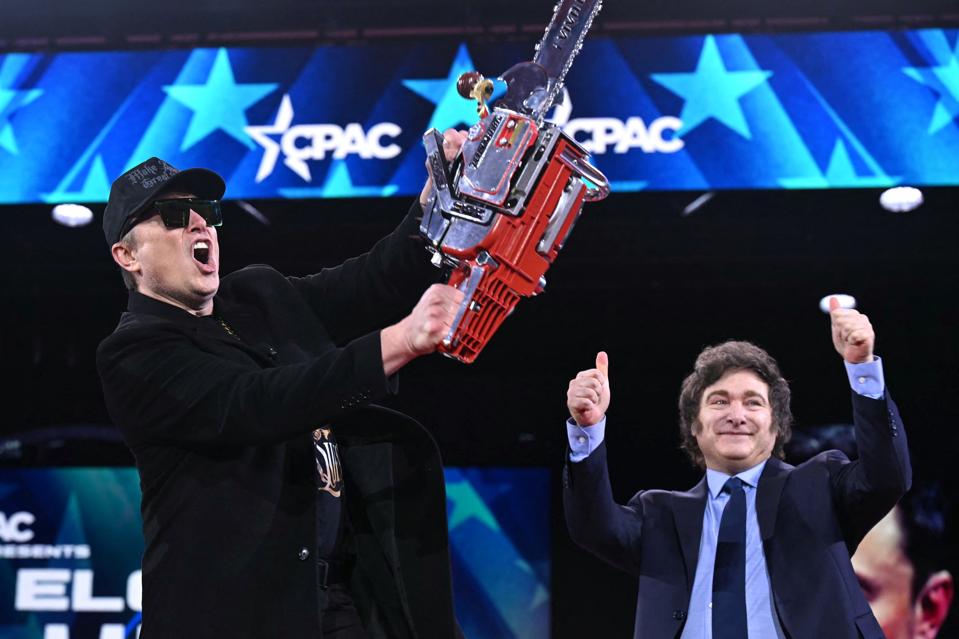
Elon Musk waves a chainsaw alongside Argentine President Javier Milei at CPAC.
AFP via Getty Images
Despite their similarities – a lack of impulse control, social media addiction, an unfortunate predilection for offensive public comments – the world’s richest man and the U.S. president soon wearied of each other. Musk departed Trump’s inner circle by May in a spectacularly crass tantrum that began with attacks on the so-called One Big Beautiful Budget Act, ended with accusations that Trump was in the Epstein files and included addled plans for a rival political party that, predictably, never happened. Two months later, the world’s wealthiest person was once again angling to get back into Trump’s good graces.
While Musk’s wealth has never been greater, the same can’t be said of his personal reputation. In addition to DOGE outrage, the stiff-armed gesture he made twice at a Trump inauguration party in January looked way too close to a Nazi salute. Musk denied that, but there’s little question he has upped his support for far-right, anti-immigrant politicians in Europe and promoted posts on his X social media platform echoing white supremacist views. In particular, he stokes fears of a growing non-white population.
His attacks on empathy and a bizarre chainsaw-waving stunt at a conservative political rally in February and reported drug use also haven’t helped his image. “He’s an avowed ketamine” user, Susie Wiles, Trump’s chief of staff, told Vanity Fair.
“Tesla is suffering from issues beyond Elon’s behavior. Its product lineup is really getting pretty crusty. There’s nothing new.”
But none of that has shaken his fans or Tesla’s board: In November, they rewarded him with a 10-year pay package potentially worth a record $1 trillion. And there’s even more wealth in the offing: he’ll see a massive financial windfall in 2026 if SpaceX moves ahead with an IPO that values the rocket company at $800 billion. In fact, he’ll likely be the world’s first trillionaire long before his new big Tesla stock payday arrives in 2035.
Controversial CEO
Musk isn’t the first CEO to become synonymous with his company’s brand. Virgin’s Richard Branson and Apple’s Steve Jobs did that long before he arrived on the scene. As for polarizing views on politics, social issues and even accusations of racism, he’s also not the first CEO or founder with that kind of baggage, said Andy Wu, who teaches business strategy at Harvard Business School, pointing to figures such as Henry Ford.
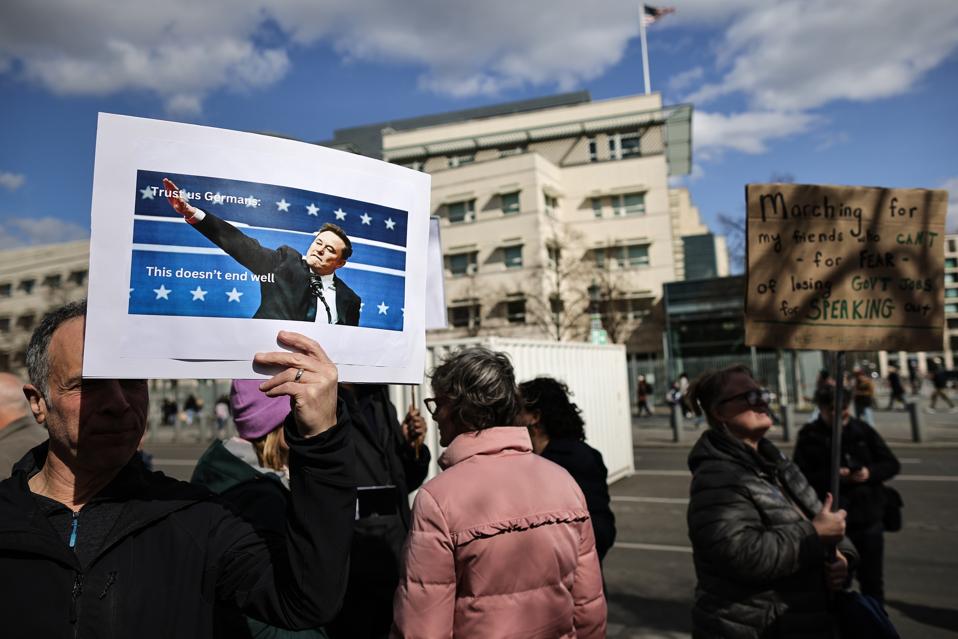
A demonstrator in Berlin with a photo of Elon Musk making a gesture resembling a “Nazi salute” in April 2025.
Getty Images
The difference is that “Henry Ford didn’t have access to social media and didn’t have to operate in a 24-hour media environment, he said. “The unpalatable parts of his personal life and beliefs were not widely known enough to completely define his public image.”
Another big difference is the reluctance of Tesla’s board to rein in Musk’s worst impulses to limit potential damage to the company, said Gautam Mukunda, a professor with the Yale School of Management.
“The relationship between a CEO and the board is a partnership,” he said. “It’s not the job of any responsible board to just nod like a bobblehead doll whenever the CEO asks them for something,” he said. “Especially when the CEO’s behavior is erratic at best.”
Musk hasn’t apologized for much of anything, but conceded in a recent podcast interview that his time at DOGE hurt Tesla and, in retrospect, he wouldn’t do it again. “Instead of doing DOGE, I would have…worked at my companies…and they wouldn’t have been burning the cars” at anti-Tesla takedown protests, he said.
Robots and Robotaxis
Tesla isn’t selling Optimus robots, but Musk claims that will happen by the end of 2026, though progress is hard to gauge. Production of what he calls his “robot army” is planned at Tesla’s Fremont, California, auto plant, with Musk claiming Optimus units could cost as little as $20,000. Videos of it glitching are easy to find, however, and it still appears to rely on remote operators.
For now, autos, batteries and charging services remain Tesla’s core moneymakers, and it’s on track for a second consecutive drop in EV sales in 2025, down about 6% through the third quarter from a year ago. That’s the result of fast-growing competition, especially in China, and antipathy to the brand by many carbuyers in the U.S. and Europe stemming from Musk’s embrace of far-right politics and views. The company’s U.S. sales in 2025 likely fell 8.9% to 577,097, led by a 22% drop in the fourth quarter, according to Cox Automotive.
“It’s easy to pivot to robots when nobody will buy your car.”
Musk’s behavior likely contributed to Tesla having the biggest drop in brand value in 2025 among global carmakers, as tracked by Interbrand. It plunged 35% from a year ago, according to the London-based research firm’s latest survey, which didn’t explicitly cite him as a factor.
As the year closes, the company’s robotaxi program also isn’t doing what Musk promised. “Teslas will be in the wild, with no one in them, in June in Austin,” he said on Tesla’s Jan. 29 results call. “This is not some far-off, mythical situation. This is literally five or six months away.”
For now, Tesla robotaxis in Austin are still operating with human safety drivers in the front seat, something Waymo, the leader in autonomous driving, moved beyond more than five years ago. Still, some autonomous Teslas, with no safety driver or passengers inside, were finally spotted in Austin in mid-December, helping boost the company’s shares to an all-time high of $489.88 on Dec. 16. Meanwhile, federal safety investigators have expanded an ongoing probe of the company’s Full Self-Driving software. Tesla also faces a sales suspension in California after its Department of Motor Vehicles and a state judge determined that its use of the terms Full Self-Driving and Autopilot for its partially automated driving features misled consumers.
Lousy Crystal Ball
Over many years, Musk observers have learned his crystal ball is historically lousy – and not just about robotaxis or robots. In March 2020, his Covid prediction proved profoundly unsound (“Based on current trends, probably close to zero new [Covid] cases in US too by end of April,” he tweeted). His claims about the superiority of Grok, the chatbot created by his artificial intelligence company xAI, have been undercut by its many flaws, including calling itself “Mechahitler,” spewing false and racist information and claiming Musk is fitter than NBA star LeBron James and smarter than Leonardo da Vinci. The Boring Co., which Musk once said would create a futuristic, high-speed underground transportation system, racked up environmental violations in the ongoing construction of its low-speed Las Vegas car tunnel network. And SpaceX, for all its IPO excitement, hasn’t proved it can successfully launch massive Starship rockets that are key to Musk’s long-held dream of colonizing Mars. It’s blown up about a dozen or so over the past year, each at an estimated cost of more than $90 million.
Like his bad behavior, that’s not a problem for fans. “Musk’s promises never happen on the timeline he says they’re going to happen,” said Wu. “But the reason we teach about him, as well as what excites investors, is the fact that he is passionately dedicated to building the future as opposed to squeezing money out of the past.”
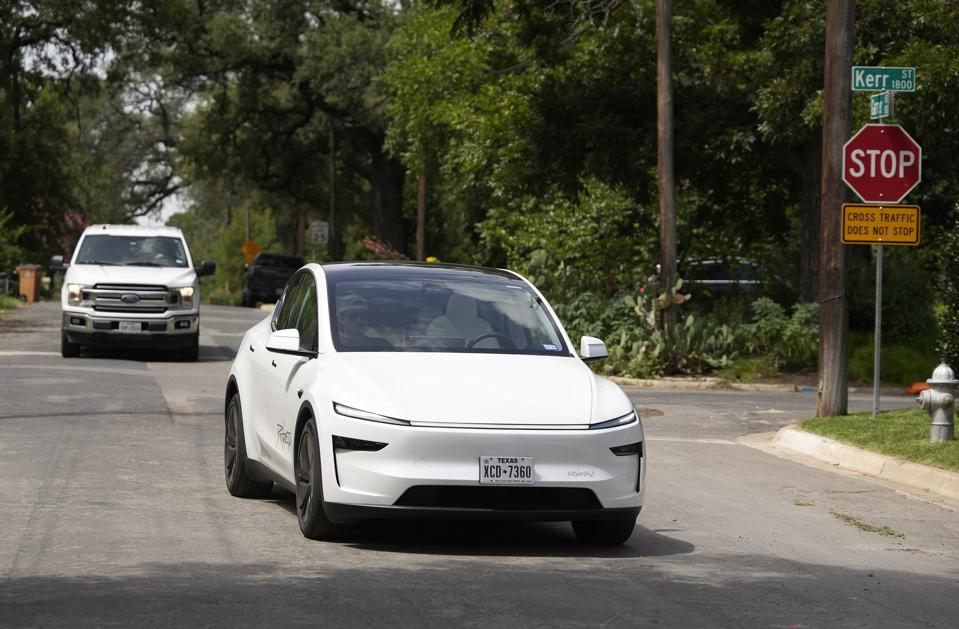
A Tesla Robotaxi with a safety driver in the front in Austin in July 2025.
The Austin American-Statesman via Getty Images
That’s clear when it comes to Tesla’s vehicle lineup. Its Model Y crossover and 3 sedan rank among the world’s top-selling cars, but they’re aging and the company hasn’t found new hits. Its newest entry, the Cybertruck, is a flop, and the upcoming Cybercab, due in the second quarter of 2026, faces potential regulatory and market challenges.
“Tesla is suffering from issues beyond Elon’s behavior,” said Ed Kim, president and chief analyst for industry researcher AutoPacific. “Its product lineup is really getting pretty crusty. There’s nothing new.”
Pivoting away from selling personal vehicles may not be a bad idea, said Wu. “The EV market, which he played a big role in launching, is going to be increasingly unattractive,” he said. “We anticipated a massive amount of entrants into the EV space, which is manifesting now, especially with the Chinese companies. To continue growing Tesla at the rate investors have become accustomed to requires diversifying into something else, perhaps humanoid robots or robotaxis.”
Trump Detente
For the moment, Musk and Trump appear to have achieved a detente after their summer feud, probably because both have something to gain from the other. Musk’s money, particularly for Republican congressional races in the 2026 midterms, could be helpful for Trump. And Musk must stay in Trump’s good graces owing to federal oversight of Tesla for safety and regulatory issues and because SpaceX is a huge federal contractor.
The billionaire entrepreneur has had wild years in the past. In 2018, he was hit with SEC fines and forced to step down as Tesla chair after falsely claiming he’d secured funding to take Tesla private. In 2020, emergency public health steps in California when the COVID-19 crisis began triggered a Musk freakout, highlighted by an earnings call meltdown when he decried the safety measures as “fascist.” That led him to move Tesla’s headquarters to Austin, Texas, from Palo Alto, California.
His chaotic 2025 revealed something new: Musk’s public behavior and controversies, even when they draw condemnation, don’t result in course corrections. And they definitely don’t slow the rapid increase in his wealth or diminish his appeal to many shareholders.
“One can make a meme stock argument: Retail investors want a piece of Tesla because they want to feel like they’re part of something,” Wu said. “But whether it’s a meme stock argument or a future growth argument, both of those require Musk.”
Others are frustrated with Tesla’s lax oversight and unwillingness to rein him in.
“The Tesla board, instead of upholding basic governance standards, wants to green-light an outrageous $1 trillion pay package for a CEO who spent most of the year engaged in childish political brawls, rather than working to create shareholder value,” said Randi Weingarten, president of the American Federation of Teachers, which holds the company’s shares in its pension portfolios.
“To reward this destructive behavior with an obscene salary is a slap in the face — not only to the federal workers he’s fired, but to the retirees whose pensions are invested in Tesla stock,” she said.
It’s too soon to say whether his robot and robotaxi dreams will pan out, though they’re already baked into Tesla stock, according to Morgan Stanley analyst Andrew Percoco, who recently downgraded the shares to a hold.
Certainly, some investors and analysts believe Musk can pull off Tesla’s transformation, but past fans and long-time shareholders don’t.
“The direction he’s chosen to move to, in my mind, is a result of the fact that people won’t buy the cars now,” said Ross Gerber, CEO of Gerber Kawasaki Wealth and Investment Management, which manages about $4 billion, including more than $80 million of Tesla stock. “It’s easy to pivot to robots when nobody will buy your car.”
Look back on the week that was with hand-picked articles from Australia and around the world. Sign up to the Forbes Australia newsletter here or become a member here.