The disease affects as many as 80 million in the U.S. alone. Now Apnimed, the $400 million company behind the first ever pill to treat it, is preparing to file for FDA approval.

In November 2016, Harvard researcher Dr. Luigi Taranto Montemurro was in a lab at Brigham and Women’s Hospital observing the sleep of a middle-aged man with obstructive sleep apnea, who lay in a bed attached to wires to track whether he stopped breathing overnight. Taranto Montemurro was testing a potential medication, but he didn’t expect much. Researchers had been trying for decades to come up with a drug that could fix the common condition—in which breathing pauses during sleep, sometimes lowering oxygen levels to a dangerous degree—and every earlier effort had failed.
Then he realized that the sleeping man was breathing normally.
“Usually this guy was full of apneas and suddenly he was breathing well. So I went to see if something was off on the equipment that it was not connected properly,” Taranto Montemurro told Forbes. But the hookup was fine. The combination of two existing drugs he’d been testing had worked. “It was like, ‘Wow, I can’t believe my eyes,’” he said.
Fast forward nine years later, and Cambridge, Mass.-based startup Apnimed, which acquired the rights to the potential medication from Harvard, is preparing to file for FDA approval for a nightly pill based on those two drugs for the breathing disorder. In very simplified terms, the medication works by waking up the brain stem, preventing full muscle relaxation in the throat, while allowing the brain itself to rest during sleep. If all goes well, it could be on the market in the first half of 2027, offering a potentially life-changing treatment for some of the estimated 80 million people in the U.S. with sleep apnea.
Right now, the primary treatment for the disease is a continuous positive airway pressure machine, known as a CPAP, which forces air down the wearer’s throat to keep it open. The device works. But, no surprise, it’s hated by most everyone who has to use it. Many people with sleep apnea refuse to try it or won’t even get diagnosed for fear they may have to. Yet sleep apnea isn’t just some minor annoyance. Research shows that people with untreated sleep apnea are more likely to develop heart trouble, strokes and perhaps even Parkinson’s and Alzheimer’s. A treatment that’s easier for patients to stomach could have a transformative impact on their overall health.
“A pill for sleep apnea has always been the holy grail.”
Apnimed is an early-stage biotech, which means that it’s losing money and has no revenue yet. But the promise of the pill has helped it to raise $260 million from investors that include Morningside, Alpha Wave Global and Sectoral Asset Management at a valuation of around $400 million. If it succeeds in releasing the drug, it could be worth a lot more. Launching a drug commercially is expensive, and Apnimed is now considering how to raise funds to do so, including the potential of an IPO, perhaps as early as this year. Even if a small percentage of people with sleep apnea were to take its drug, it would become a blockbuster with sales in the billions of dollars.
“The numbers are staggering,” said Dr. Larry Miller, Apnimed’s cofounder and CEO, a pulmonary doctor and serial entrepreneur who postponed his own retirement in order to launch the company. “I think people will be using it in the millions. Whether that’s one [million] or ten, we don’t know.”
Sleep medicine, until recently, has been something of a backwater. Even today, the buzz over sleep in Silicon Valley is more about high-tech mattresses and wearables that target consumers who want “optimized” sleep. Sleep apnea, despite there now being a handful of other early-stage startups focused on it, is a disease that’s under the radar. “It’s not an exciting disease,” Miller said. “Some diseases, like Alzheimer’s, capture the public imagination. This one never did.”
That may be because sleep isn’t that well understood, even though we spend about one-third of our lives doing it. Or it may be because of the false perception that it’s not a serious disease, or solely a problem for obese, middle-aged men. CPAP dates only to 1981; before that people with severe sleep apnea were treated with tracheostomy, a surgical hole in the windpipe.
“Obstructive sleep apnea is a massive public health problem that is underrecognized, undertreated and underdiagnosed,” said Dr. Nate Watson, a sleep medicine doctor and former president of the American Academy of Sleep Medicine (who has done some consulting with Apnimed).
A treatment for sleep apnea had long been a dream for Harvard sleep researcher Dr. Andrew Wellman, who runs the Sleep Disordered Breathing Lab at Brigham and Women’s Hospital where Taranto Montemurro was a post-doc. Even as a young research fellow 25 years ago, Wellman had hoped to come up with a treatment for sleep apnea. He knew that there had to be a chemical component to the disorder—and potentially a pharmaceutical fix—because even people who are extremely obese with large tongues and thick necks don’t suffer from sleep apnea when they’re awake. But at least 40 drug candidates have been tested for obstructive sleep apnea over the years without success, Miller said. “A pill for sleep apnea has always been the holy grail,” Wellman said.
That’s why he and Taranto Montemurro, 47, who’d grown up in the small Italian town of Rovato and come to the U.S. to work in his lab, were so shocked when the testing on patients showed signs that it worked. “I honestly didn’t believe our findings were real,” Wellman said. “I had been fooled so many times in the past with this.”
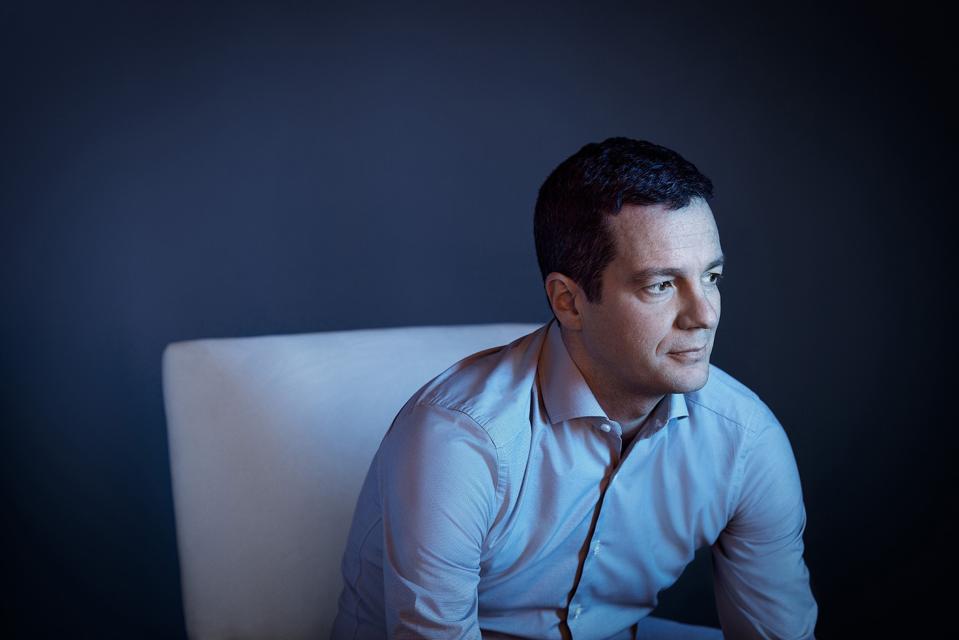
Apnimed cofounder and chief scientific officer Luigi Taranto Montemurro: “Sleep is for the brain. If you don’t sleep well, your brain doesn’t function well.”
Albie Colantonio for Forbes
When Taranto Montemurro told him about the results in the lab, he reached out to Miller, a pulmonologist and serial entrepreneur. Miller had already founded nine other companies since 1990, seven of which he ultimately sold, for an aggregate price of more than $1 billion. When he spoke with Wellman, he was at Macrolide Pharmaceuticals, which he’d launched in 2015 with $22 million in funding from the venture arms of Novartis and Roche and big plans to develop a new type of antibiotics. But the firm later struggled, and wound up being sold, under a new name and with a new business focus, to another early-stage pharma company, for some $25 million in 2021.
“It’s an addiction, look at it that way,” Miller said, eyes twinkling, of his startups. “Before this one, I thought I was done. … But when Andrew called me about the data, I thought, ‘This is too good. I have to do it.’” He now laughs that his kids call him “the world’s oldest startup CEO,” at age 72.
In 2017, Miller launched Apnimed, negotiating the rights to the patents from Harvard, with Taranto Montemurro joining as cofounder and, later, chief scientific officer. The startup raised $26 million from Morningside Group, the investment firm of Gerald Chan whose family made their fortune in Hong Kong real estate, in August 2019. Miller now owns what he calls a “small percentage” of the business.
“The numbers are staggering. I think people will be using it in the millions. Whether that’s one [million] or ten, we don’t know.”
“These guys are the real deal,” said Dr. John Cronin, who joined the company as senior vice president of clinical development in 2022 after working as chief medical officer in sleep and respiratory care at Philips Respironics, one of the two big CPAP makers. “I’ve seen a lot of different leaders in sleep medicine where it’s like, ‘Are they really going to deliver on the promise of this?’”
Raising that early financing from Morningside was easy, but as the Covid-19 pandemic hit and biotech fell out of favor, it got a lot harder, Miller recalled. He figures that he had “dozens and dozens” of meetings to raise subsequent rounds of investment. “They’d say, ‘You’re too risky,’ or ‘This isn’t a field,’ or ‘We’re interested in cancer or heart disease or something else.’ It’s not unreasonable from an investor’s point of view, but frustrating for us.”
For Chris Dimitropoulos, managing director at Alpha Wave, a global investment firm that’s also backed SpaceX and OpenAI, the decision to invest in 2022 started with anecdotes from family members with sleep apnea about the intrusiveness of wearing a mask to bed every night. “It was a cousin of mine, then two or three cousins of mine and a friend,” he said. “The more it was out in the open, the more people I learned it affected.” He soon realized both how widespread the disease was—and how serious its health impacts. “I don’t think the world really knows how severe it is,” he said.
Over the past eight years at Apnimed, Taranto Montemurro and his scientific team have tested and refined the two-drug pill. Phase 3 clinical studies, which wrapped up last year, showed that it worked to improve patients’ breathing overnight. In one of those studies, reported last July, the drug reduced a measure of the severity of sleep apnea, known as the apnea-hypopnea index, by 47% at 26 weeks (versus 7% for a placebo) with no serious adverse events. The drug’s side effects include minor issues such as dry mouth and insomnia.
“We believe the majority of people who are diagnosed are not being treated. That’s the fundamental absurdity of the category.”
There are no other pill treatments for sleep apnea that work for everyone. At the end of 2024, the FDA approved Eli Lilly’s weight-loss drug Zepbound for the treatment of moderate-to-severe sleep apnea in adults who are obese. Unlike Apnimed’s pill, Zepbound works for sleep apnea because people who are overweight are more likely to suffer from it, so losing weight can help their breathing overnight. It does not treat the sleep apnea directly, and is not approved for mild sleep apnea or for people who are not obese.
Apnimed figures that the number of untreated people with sleep apnea is so high that having more treatment options will only increase the potential market. An analysis the company did of five years of medical claims found 23 million people with a sleep apnea diagnosis—a small percentage of those believed to have the disease—but only 6.5 million people filing for treatment. “We believe the majority of people who are diagnosed are not being treated. That’s the fundamental absurdity of the category,” said Apnimed chief commercial officer Graham Goodrich.
The company is already talking with insurers about coverage, which is key to the pending drug’s success. And beyond its first pill for sleep apnea, Apnimed is working on two other potential molecules for sleep apnea in partnership with Japanese pharmaceutical firm Shionogi.
In the future, Miller believes that the millions of people with sleep apnea will have treatment options—just as they do for other major diseases and disorders. “It will be like asthma or high blood pressure,” he said, ticking off major chronic diseases for which pharmaceutical treatments are available. “As a physician you try to choose the best option for the patient. That hasn’t been possible until now.”
Look back on the week that was with hand-picked articles from Australia and around the world. Sign up to the Forbes Australia newsletter here or become a member here.