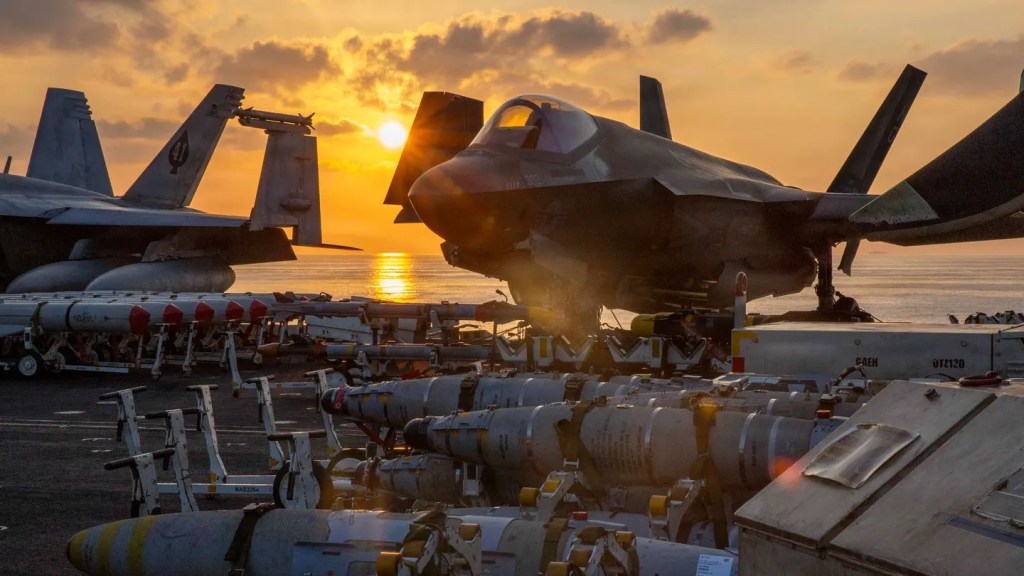
President Donald Trump’s strikes on Iran have spurred global uncertainty, but the prospect of a long-term conflict could prove lucrative for a range of sectors, with companies including Lockheed Martin, Raytheon, Boeing, Exxon and other defence and energy businesses potentially having the most to gain.
Getty Images
Key Takeaways
- U.S. military forces struck Iran early Saturday morning, starting a new conflict in the Middle East with no clear outlook over how long the military operations will last.
- The stock market has been volatile in the first few days of the war, with the Dow Jones Industrial Average, S&P 500 and Nasdaq Composite all opening down Thursday morning amid the continued uncertainty.
- Defence companies that contract with the U.S. military—like Lockheed Martin, Raytheon and Palantir—are the most direct beneficiaries of the conflict, with stock prices for the industry largely trending upward this week despite a brief downturn Tuesday.
- As the Middle East conflict impacts oil and gas production and shipping in the region, major oil companies like Exxon and Chevron also stand to benefit from oil prices already being higher, and the oil and gas industry has seen a bump in the stock market amid the conflict.
- On the opposite end of the spectrum, higher oil prices—with oil futures sharply up, including rising three to four points Thursday morning—and increased uncertainty are expected to be damaging for the travel industry, luxury goods and major shippers like FedEx and UPS.
Which Defence Companies Could Benefit From Trump’s Iran War?
U.S. Central Command, or CENTCOM, has identified more than 20 weapons systems being used in Iran, which are manufactured largely by Lockheed Martin, RTX and its subsidiary Raytheon, Boeing, Northrop Grumman, L3Harris Technologies and General Atomics Aeronautical, among others. Those stocks have broadly been boosted this week, though analysts note Boeing hasn’t risen as much because less of its business is dependent on its military contracts. Arizona-based SpektreWorks is behind the one-way “LUCAS” drones that the military said have been used to carry out strikes at a lower cost, while the higher-end Tomahawk missiles reportedly also being used in the region are produced by Raytheon. THAAD interceptors, a different type of missile used to intercept enemy fire, are produced by Lockheed Martin. Those companies and others in the drones and missile space potentially have the most to gain from the strikes, with Catalyst Funds’ chief investment officer David Burns telling Insider, “The companies that have the most exposure to missile defense systems are the ones that are gonna be the biggest beneficiaries of increased demand.” Software company Palantir has also seen its stock go up as the company provides services for the military, and analysts have suggested European Defence companies will also benefit, with analysts at JP Morgan identifying BAE Systems, Renk, Leonardo DRS and QinetiQ as the ones with the most exposure to the U.S. market.
Which Energy Companies Could Benefit From Trump’s Iran War?
Oil and gas prices are higher as traffic has been restricted in the Strait of Hormuz, the passage through which approximately 20% of the world’s oil flows. Those higher prices have been broadly good for U.S. oil companies: shares of major companies like Exxon, Chevron Corp. and Occidental Petroleum immediately shot up following the strikes over the weekend, though they’ve been more volatile in the days since amid uncertainty over the conflict and its impact on the industry. Burns noted to Insider that smaller-cap oil companies like Talos Energy are also well-positioned to benefit from higher prices and the ongoing conflict. While the higher gas prices immediately benefited oil producers, analysts predict that any sustained conflict could also be beneficial for the renewable energy sector, as people could seek out alternatives like solar and wind power to alleviate the burden of higher energy prices and avoid the volatility of oil and gas. “Renewables offer a fundamentally lower level of commodity risk compared to imports of fossil fuels, and reminders of that benefit can boost stocks in that industry,” Pavel Molchanov, a managing director at the investment bank Raymond James, told E&E News.
Shipping Companies Could Gain—and Lose
Major shipping companies like FedEx, UPS and DHL could be hurt by any long-term conflict, and its stock prices have reflected that, as the higher price of oil and potentially longer transit times—due to airspace closures in the Middle East—could drive up fuel prices, Bloomberg notes. Companies that manage shipping containers, meanwhile, could benefit from issues with transporting goods. Vessels are currently being rerouted away from the busy Suez Canal and Strait of Hormuz, the Wall Street Journal notes, which forces shipping containers to travel further distances and allows companies to charge higher prices for the longer journeys. Stock prices for companies like Danish shipping giant Maersk and German company Hapag-Lloyd have gone up amid the conflict as a result, though they are also at risk of losing business and property from the ongoing strikes. Maersk and other companies have suspended operations in Middle Eastern ports due to safety concerns amid the conflict, as other ships have been hit during the strikes, also closing offices and urging vessels in the area to “take shelter,” Agence France-Presse notes.
What We Don’t Know
How long the conflict in Iran will go on. The duration of the war could heavily impact how companies will fare, with any gains in the defense and energy sectors potentially being short-lived if the conflict is soon resolved or new measures are put in place to resolve high oil prices. Analysts speculated to AFP that any moves by the Trump administration to try and blunt the impact of the war on oil—like a promise to accompany ships through the Strait of Hormuz or tapping into emergency oil stockpiles—could bring down the gains that oil companies have seen. Renewable energy companies, meanwhile, will likely see the most benefit if the conflict gets dragged out and oil prices remain high. For Defence companies, Defence analyst Byron Callan told Air & Space Forces Magazine that while the war was good for the industry in the short term, it depends on how long the war goes on and whether the U.S. can “defang” Iran. A longer war means weapons stockpiles start to need replacing, which would be good for companies, Callan said, but if the U.S. decisively beats Iran, that could also hurt companies by lowering the military’s longer-term need for weapons in the region. “There are a whole range of warplans that included Iran” that will now change based on how this conflict unfolds, Callan said.
Which Companies Could Fare The Worst?
The travel sector has been particularly hard hit by the strikes in Iran so far, with stocks for major airlines, cruise lines and hotel groups posting losses this week as the conflict leads to higher fuel costs and makes people uncertain about booking vacations. The strikes themselves have also posed a threat to the industry, grounding flights in the Middle East as major hotel chains have already experienced properties in the region sustaining damage. Among the other sectors that could be hurt by any long-term military operations, analysts note, are tech companies—as investors prefer less-risky investments in times of conflict—and luxury goods. Shares of companies like LVMH, Burberry and Richemont, which owns Cartier, Van Cleef, and Chloé, fell this week amid the conflict, with analysts citing both the companies’ heavy investment in the Middle East and the fact luxury goods historically fare better during times of less economic uncertainty. Buyers are less open to making major discretionary purchases like luxury goods when the economy is worse, and luxury goods are typically most successful during “feel-good” times when there’s “positive consumer confidence and constructive outlook of one’s future prospects,” according to RBC Capital Markets analysts cited by CNBC. Despite the benefit for some industries, economists broadly predict the war will have a damaging economic impact overall, with Kent Smetters, director of the Penn Wharton Budget Model (PWBM), speculating to Fortune on Monday the conflict could trigger an economic loss for the U.S. of between $50 billion and $210 billion.
This story was originally published on forbes.com and all figures are in USD.
Want to see more Forbes articles on your feed? Tap here to make Forbes Australia a preferred source on Google.
Look back on the week that was with hand-picked articles from Australia and around the world. Sign up to the Forbes Australia newsletter hereor become a member here.