After Putin invaded Ukraine, Western governments grabbed almost two dozen luxury vessels to punish him and his cronies. Four years later many of them are still rotting in their berths and not a penny has gone to Kyiv.
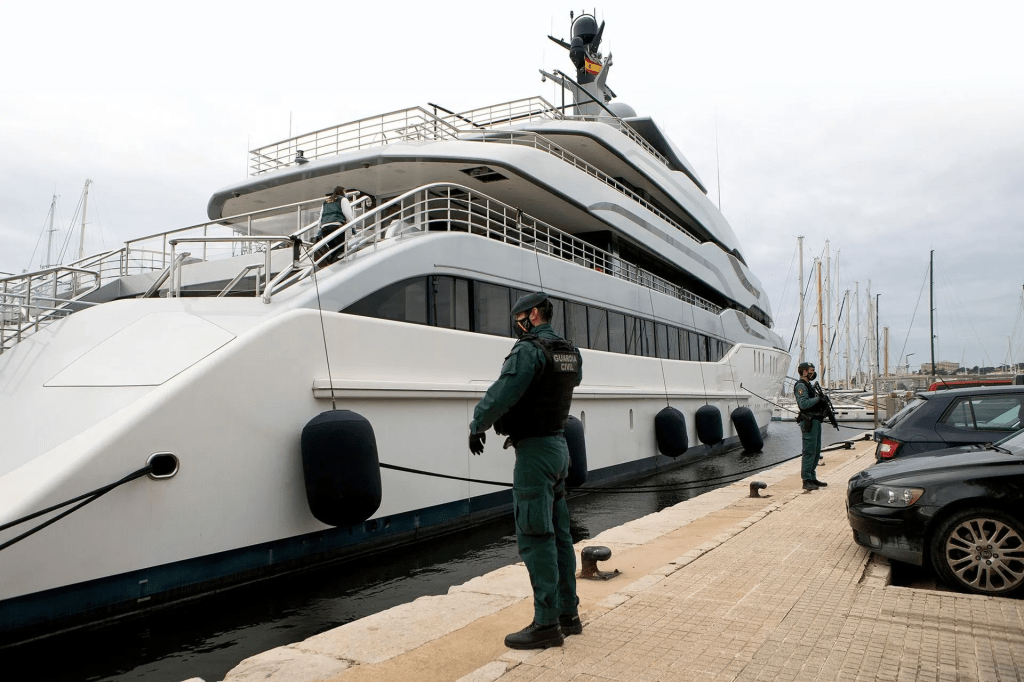
On April 4, 2022, less than six weeks after Russian forces launched their attack on Ukraine, officers from Spain’s Guardia Civil, the FBI and Homeland Security boarded Tango, a 255-foot super yacht in the Spanish port city of Palma de Mallorca.
Allegedly owned by sanctioned Russian billionaire Viktor Vekselberg (net worth: $9 billion), per the United States government, the US$90 million vessel was seized under a US warrant alleging bank fraud, money laundering and sanctions violations. It was the high-profile opening salvo in a Western campaign to punish the Russian oligarchs who “supported tyranny for financial gain”.
“Today marks our task force’s first seizure of an asset belonging to a sanctioned individual with close ties to the Russian regime,” boasted then US attorney general Merrick Garland. “It will not be the last.” Weeks later, Garland doubled down, promising to use all available Justice Department resources to seize the assets and transfer the proceeds directly to Ukraine.
More than four years later, Garland’s bold promises have dissolved into nothing but a big headache. Tango sits almost exactly where it was taken, in a costly, high-end berth in Palma.
Stuck in the dock
Washington is no closer to selling it, and not a penny has gone to Kyiv. Instead, American taxpayers have forked over an estimated US$14 million to cover the costs of a skeleton crew, insurance, fuel and maintenance. Without footing the bill for those expenses and keeping the engines and electricity running smoothly, these super yachts begin to deteriorate almost immediately.
“I can see it from my office window. It’s just been there for years, sitting outside in the sun,” says Sam Tucker, a yacht broker at Moravia Yachting in Palma, who says he often sees a skeleton crew of about ten people onboard the yacht. “The paint is getting old, underneath the boat is probably filthy. It’s just about legal and floating.”
Miguel Ángel Serra, the founding partner of Palma-based law firm Legalley, estimates that governments are learning the hard way just how expensive it is to manage an idle asset. “Non-operational superyachts cost a lot of money,” he says. “It’s tremendously expensive even if it doesn’t move.”
In the frantic months after Putin’s invasion, 11 Western governments froze or detained at least 20 Russian-linked super yachts valued at roughly US$4.3 billion at the time. It was a master class in wartime PR, suggesting swift justice: confiscate, sell and use the proceeds to help rebuild Ukraine.
That didn’t happen. Instead the campaign turned into a bureaucratic minefield. Legally speaking, “freezing” a yacht is not the same as “confiscating” it, which is required before it can be sold. Over the years, only four of those yachts have been confiscated, three of which were sold at discounts. According to Forbes estimates, only two governments, those of the US and Antigua and Barbuda, have received any cash from yacht sales after accounting for costs. None of it appears to have gone to Ukraine. Two other yachts were quietly unfrozen and released back to their owners.
The cost of an idle asset
Meanwhile, Western taxpayers continue to foot the bills for several of the remaining 15 yachts still tied up in ports across Europe. To uncover the true costs of this failed strategy, Forbes filed freedom of information requests with government agencies in 11 countries, scoured court records and spoke with lawyers, yacht brokers and shipyards. A number of American government agencies have not gotten back to us more than a month after our formal requests; several other nations including Italy and Germany refused to provide any information, citing confidentiality clauses or stating that to do so would violate state secrets.
Despite the secrecy, Forbes verified that governments have paid more than US$100 million maintaining just five yachts. For the remaining yachts, Forbes worked with super yacht market data firm Phronesis Superyacht Intelligence & Insight to come up with independent estimates of the costs. In total, the four-year yacht-freezing odyssey has so far cost an estimated US$390 million.
Italy has paid the most, nearly US$100 million so far, to keep up the four super yachts it froze. Among them is the 465-foot Scheherazade—which the late Russian opposition leader Alexei Navalny’s Anti-Corruption Foundation alleged is owned by Vladimir Putin himself—that was valued at US$510 million at the time it was frozen. It’s still stranded in the Italian port of Marina di Carrara, and has cost the nation about US$15 million and counting, according to the financial statements of the Italian Sea Group, which owns the shipyard where the yacht has remained since May 2022.
For the towns and cities stuck with the decaying vessels, it’s gone from a mild annoyance to downright irritating. In the northeastern Italian city of Trieste, residents have had their views of the Adriatic Sea marred by the 468-foot, Philippe Starck–designed Sailing Yacht A—once nicknamed the “ugliest yacht in the world” and worth an estimated $578 million when it was frozen—for four years. “This is a waste of public money—it’s a disgrace,” Trieste mayor Roberto Dipiazza told Italian newspaper Corriere della Sera in 2023. (He declined to speak to Forbes.)
On the other side of the country sits the 214-foot Lady M, allegedly owned by Russian steel magnate Alexey Mordashov, per the Italian government. Parked in the Italian port of Imperia for more than 200 weeks, it’s costing about US$700 a day for electricity and water and US$15,000 a month in mooring fees. Then there’s another US$57,000 a year for basic maintenance. “At the end of the month, we issue invoices and collect the money. The yacht is well maintained,” says Matteo Bonjean, vice director of the port of Marina di Imperia. It should be, given the more than $2 million billed so far to the Italian government.
Small number of yachts seized
Confiscating is trickier than it seems. Freezing an asset is one thing, but seizing implies a change of ownership. For that to happen, authorities must prove that the sanctioned person committed a crime, then obtain a warrant to seize their assets.
Of US$58 billion in blocked Russian oligarch assets—including yachts, real estate, planes, companies and bank accounts—only about US$3 billion (or 5 per cent) has been formally seized. It’s an even tinier number when it comes to yachts: of the 20 taken by governments, only four, worth about US$530 million, have been formally seized.
“I don’t think the authorities had a clue as to how much these things cost just to have there, doing nothing.”
Benjamin Maltby, superyacht lawyer
Even after obtaining a warrant, authorities must go through a civil forfeiture process to claim the asset and then sell it, something the U.S. still has not done for Tango. “One of the priorities was to pursue seizures and forfeitures, not just to lock down assets . . . but to fully and finally transfer ownership to the United States for the purposes of making some assets, as modest as they may have been, available for use in Ukraine,” says Andrew Adams, a partner at Washington, D.C., law firm Steptoe, who led the US Justice Department’s KleptoCapture task force from 2022 to 2023. President Trump dissolved the task force in February 2025 with many assets remaining in limbo. The Department of Justice did not respond to multiple requests for comment.
In the European Union, the picture is even more complicated because many countries lack a clear legal process (because of its experience in the drug wars, the U.S. is reasonably good at confiscating assets). “The laws were not properly drafted at the outset,” says Benjamin Maltby, a superyacht lawyer based in London. “I don’t think the authorities had a clue as to how much these things cost just to have there, doing nothing.”
Push to get owners to pay
Some countries are trying to get the sanctioned owners to pay the bills while their yachts remain detained.
The owner’s identity isn’t always clear, and some won’t bother to pay. Take the 353-foot Luminosity, which has been stuck in Montenegro since the day Andrei Guryev Jr., who has been linked to the yacht and is the son of fertilizer baron Andrei Guryev, was sanctioned by the European Union in March 2022. (Forbes could not reach him for comment.)
Its crew was dismissed soon after and has been seeking back pay ever since. Burgess Crew Services, the company that originally hired the crew on the owner’s behalf, obtained permission to transfer funds from the owner in October 2023—but nearly three years later, that money still hasn’t been paid because an intermediary bank froze the funds and won’t release them.
“There’s a Montenegrin crew appointed by the government that goes on the boat every now and then, but they don’t get paid,” says Russell Crump, a Monaco-based yacht broker who represents a buyer interested in purchasing the yacht. “So they took the television and the dining room table and all the equipment off the boat.”
It’s hard to imagine anyone wanting to buy it at full price now. Once described as a “floating glass palace,” it’s now rotting in the water, with barnacles growing on the underside and teak floors decaying in the sun.
“Any boat that’s left in the marine environment with no crew on it rapidly goes downhill,” says Robert Dolling, cofounder and CEO of Monaco-based yacht broker Verpeka Dolling, noting that Luminosity has already lost half its prewar value of $275 million. “If you’re not running engines or generators and the systems aren’t up and running, everything starts going to hell.”
The legal owner of Luminosity on paper is a company registered in the offshore tax haven of Guernsey—a common practice among tycoons who often own their vessels through a complicated chain of companies and trusts. That Guernsey-based company is facing lawsuits for years of unpaid bills from a yacht supply firm and the shipyard where it’s been stuck.
Over in Germany, superyacht manufacturer Lürssen has been caught in the crosshairs of this asset war. But the prestigious yachtmaker fought back. Sick of paying millions to keep up one of these frozen mega yachts—the 511-foot, $600 million Dilbar—it sued Germany’s Federal Office for Economic Affairs and Export Control last year. Lürssen built the yacht in 2016, and because of a stroke of bad luck—it was back at the shipyard for a refit when war broke out—it’s been there ever since.
While Dilbar has long been linked to metals mogul Alisher Usmanov (whose mother’s name is Dilbar), he and his lawyers have been fighting for years to prove he’s not the owner. At one point, Usmanov’s sister was the beneficiary of the trust that owned the yacht. (Usmanov established the trust in 2016, and both he and his sister have denied they own the yacht.) She too was on the EU sanctions list for a time but was taken off in 2025. That’s when Lürssen took the German government to court, arguing it should be repaid for maintenance costs since the owner was not under sanctions. In April, a Frankfurt court ruled in Lürssen’s favor.
Stalled sales and spewing sewage
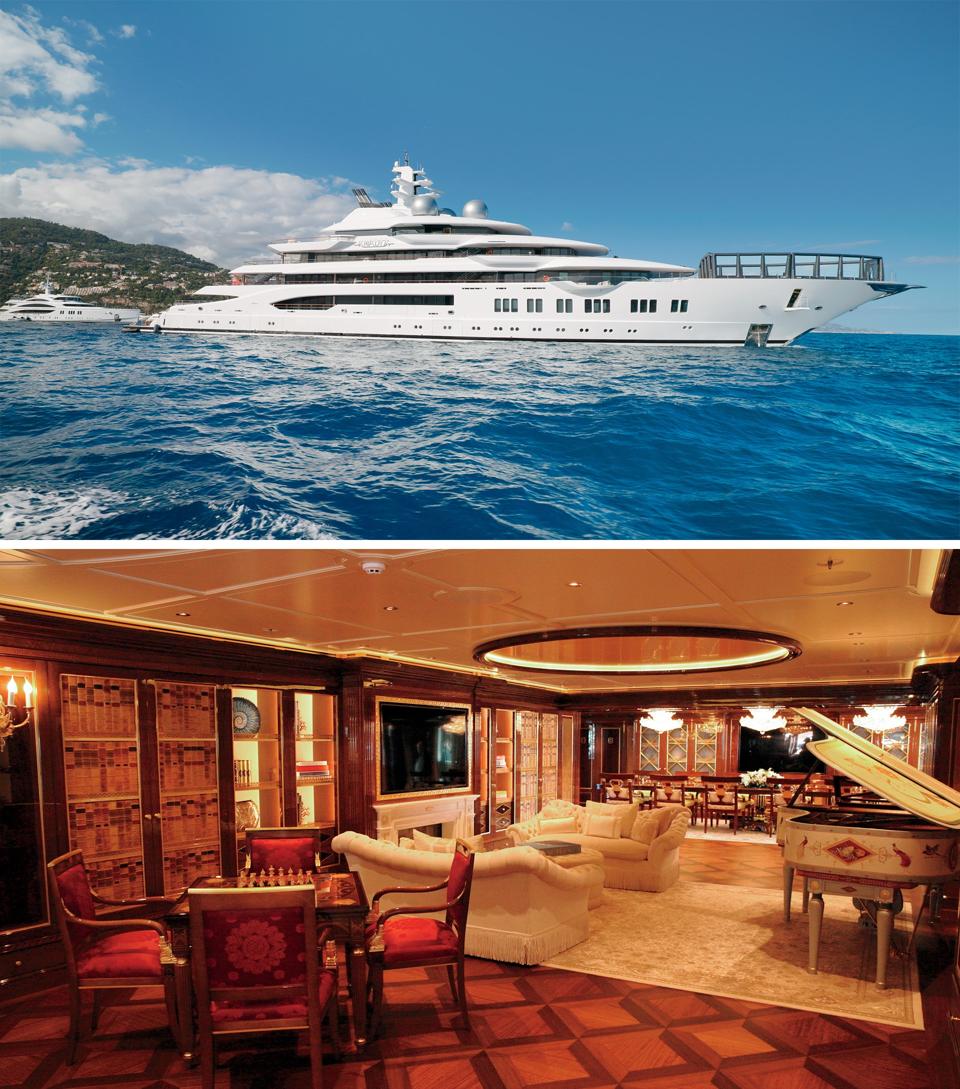
Even when government auctions of seized yachts were greenlighted, the sales were bungled. Until 2022, the 348-foot Amadea—a vessel with six decks, a helicopter pad, a ten-meter infinity pool, golden elevators and a hand-painted Pleyel grand piano—was allegedly owned, according to the U.S. government, by Suleiman Kerimov, a Russian gold tycoon and member of Russia’s upper house of parliament, whom the US first sanctioned in 2018.
Soon after Russia’s attack on Ukraine, the Amadea embarked on an 18-day journey from Mexico to Fiji. That May, Fijian authorities executed a seizure warrant on behalf of the FBI, who sailed it to San Diego a month later. It took another 16 months, until October 2023, for the Department of Justice to file a civil forfeiture case to formally seize the yacht from Kerimov.
What followed was a two-year legal battle between the US government and another Russian oligarch, Eduard Khudainatov, who claimed to be the real owner of the Amadea. Khudainatov—who does not have any apparent ties to Kerimov—sued to block the forfeiture while the US government maintained that Khudainatov was merely a “straw owner.”
During this time, American taxpayers spent US$36 million maintaining the vessel. Uncle Sam eventually prevailed, winning the case and selling the yacht at auction last September—but at a 37 per cent discount to its original prewar value of $300 million. After costs, Washington pocketed an estimated $150 million. The US Marshals Service, which was responsible for managing the yacht while it was in federal custody, declined to provide a full accounting but said it would go to “victim compensation, program expenses and other agency expenses.” None of it appears to be earmarked for Ukraine.
The winning bidder for the Amadea was 26-year-old Dubai real estate billionaire Abbas Sajwani, son of Hussain Sajwani, a billionaire developer and Trump pal also known as “the Donald of Dubai.” Abbas has been enjoying his new toy. Two days before the Formula 1 Grand Prix in Monaco, he invited Forbes to check out his latest luxury purchase. “A few things drew me to it. The layout, the interior style, the brand, the quality of the build, the way it’s been maintained,” Abbas explained while lounging on a cream-colored couch in the wood-paneled atrium. Visible through the window behind him, bobbing in the Mediterranean blue, were dozens of other super yachts including the Axioma and the Alfa Nero, both of which had been seized from Russian oligarchs and resold.
The 236-foot Axioma had been detained by officials in Gibraltar after Russian pipe billionaire Dmitry Pumpyansky was sanctioned by the EU in March 2022, which in turn breached the terms of a US$21 million loan from JPMorgan that was secured by the yacht. JPMorgan auctioned it five months later, selling it for US$37.5 million—a discount to its previous value of US$42 million—to Turkish industrial magnates Ali Riza and Robert Yuksel Yildirim.
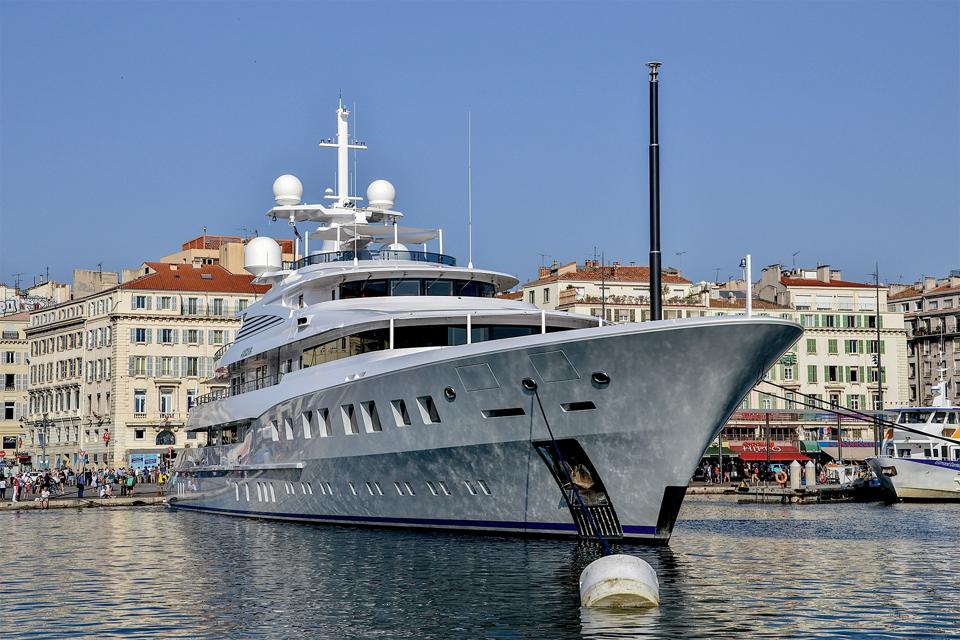
The 269-foot Alfa Nero—built in 2007 by Dutch shipyard Oceanco and the first yacht to feature a swimming pool that transforms into a helipad at the touch of a button—sailed into the tiny Caribbean nation of Antigua and Barbuda in March 2022. Five months later, the US designated it as the blocked property of Russian tycoon Guryev, whom it also sanctioned the same day. Antigua’s High Court ordered its seizure; local authorities and the FBI then boarded it and took it over.
By March 2023, the yacht was spewing untreated wastewater into the harbour after its onboard sewage treatment plant failed. That same month, Antiguan authorities passed a law enabling the government to sell any vessel that posed “an imminent threat to the harbour and to other vessels”. It quickly deemed the Alfa Nero a hazard and announced plans to sell it, claiming it had been abandoned by its owner.
Lawyers for Guryev’s daughter, Yulia Guryeva-Motlokhov, who claimed to be the yacht’s beneficial owner, challenged the sale, arguing the Antiguan government had no legal authority to confiscate the yacht. Still, Alfa Nero went up for auction in the summer of 2023. The highest bid came from billionaire ex–Google CEO Eric Schmidt, who offered $68 million but soon withdrew his offer as the legal battle between Guryev’s daughter and the Antiguan government escalated.
“Anyone buying one of those yachts is going to have to take some very, very strong legal advice. You don’t want to be looking over your shoulder.”
Richard Lambert, yacht broker
In July 2024, the government finally sold it to Yildirim, the same person who bought the Axioma. This time the Turkish industrialist got quite a bargain, paying US$40 million—less than half of what it was once worth. After considering the US$9 million the island government had shelled out on upkeep, the remaining proceeds were used to repay Antiguan government debt. Not a single cent went to Ukraine.
Guryev’s daughter is still battling in court in Antigua, the US, Russia and the United Arab Emirates, claiming that the Antiguan government was corrupt and obtained an illegal commission for the sale, which Antigua has denied. While Alfa Nero remains beyond her grasp, she has seen some success going after the new owner in Russia. Last July, a Russian court ordered the seizure of a ferrochrome plant belonging to Yildirim and his brother. Yildirim declined to comment, while representatives for Guryeva-Motlokhov and the Antiguan government didn’t respond to requests for comment.
‘Yachting is supposed to be fun’
These sorts of legal complications and opaque ownership structures have driven down the value of these assets. What if the yacht sails to a country that doesn’t recognise the sale, which leads to it being detained on the orders of its former owner? “Yachting is supposed to be fun,” says Richard Lambert, a sales broker at Burgess Yachts in Monaco. “You don’t want to be looking over your shoulder. Anyone buying any one of those yachts is going to have to take some very, very strong legal advice.”
That could be why Yildirim is already looking to sell. Or he might just be trying to make a bigger buck: Less than a year after paying $40 million for Alfa Nero, Yildirim listed it for $101 million—153% of his purchase price—and put it on full display during the Monaco Grand Prix in June. He also offered Axioma at $63 million, 67% more than he paid for it.
As for taxpayers, they might still be hit with more bills. Former yacht owners are increasingly seeking compensation and damages from governments rather than bothering to reclaim their depreciating boats. A shell company claiming to own the 303-foot, $200 million Royal Romance filed a legal complaint against Croatia seeking more than US$40 million from its inability to use the “frozen” yacht. Most of these challenges have failed so far, but lawyers say the risks will grow if more courts overturn the sanctions designations or invalidate the freezing of specific assets, as Germany just did. “In cases where the [sanctions] listing was determined to be unlawful, it’s very probable that damages claims will arise,” says Bertrand Malmendier, a Berlin-based lawyer who has worked on several superyacht cases. Those who succeed in court could seek compensation for depreciation, lost charter income and maintenance costs.
In the US, which has taken more targeted actions than its European counterparts, it’s less likely—but even here, where political winds have changed direction, oligarchs stand a chance. “They certainly would have standing [to sue],” says a former advisor to the U.S. Treasury Department’s Office of Foreign Assets Control, which enforces sanctions. “You’re dealing with a uniquely resource-rich and litigious group.”
What started as a highly visible campaign for Western nations to support Ukraine has turned into a fiasco that has wasted millions, failed to help Kyiv and has had no impact on Putin or his allies. As a famous economist once said, “The government solution to a problem is usually as bad as the problem.” Or worse.
This story was originally published on forbes.com.
Want to see more Forbes articles on your feed? Tap here to make Forbes Australia a preferred source on Google.
Look back on the week that was with hand-picked articles from Australia and around the world. Sign up to the Forbes Australia newsletter here or become a member here.