Jeremy Barker quit firefighting to go all in on Murphy Door, the hidden doors and rooms business that now books $60 million a year.
At the end of June 2016, when Jeremy Barker got home from working shifts at two different fire stations in the Salt Lake City metro area, his wife greeted him with an ultimatum. She had carefully tracked his work hours that month; between firefighting, his growing side business and other odd jobs, he’d worked 500 hours that month, leaving just 220 hours to sleep and spend time with their three youngest, still-at-home children, then aged 14, 9 and 6, and with her. “She goes, ‘I didn’t sign up for this. You either change, or I’m going to go find somebody that wants to be a husband, and you do you,’” Barker recalls.
The next day, Barker, now 52, put in his two-week notice at the fire stations and threw himself into his four-year-old side hustle: Murphy Door, a niche construction business specializing in hidden doors, rooms and beds, that by then was doing $5 million in sales a year.
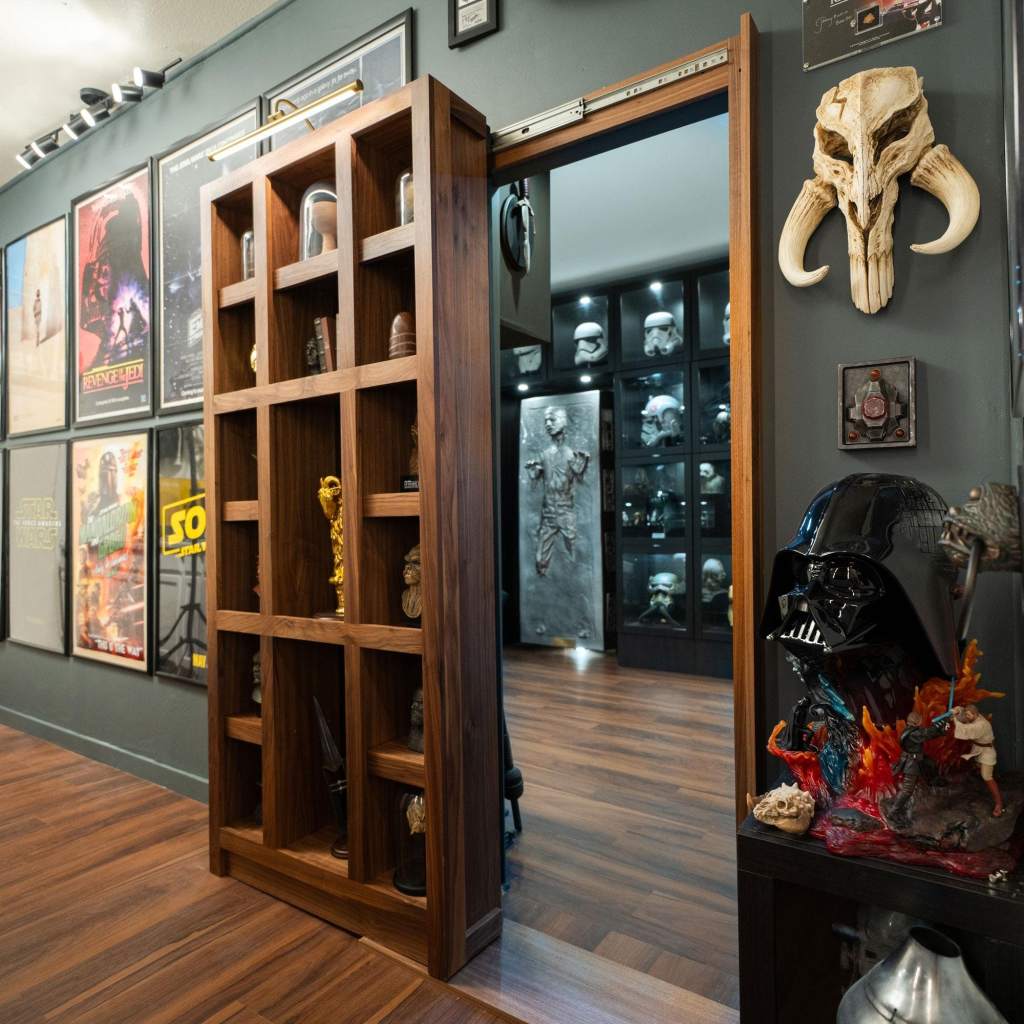
Today, Murphy Door books $60 million in annual sales, about three quarters from custom designed projects, Barker reports. Its doors hide everything from secret panic rooms with bullet-resistant walls, to gun collections, to speakeasies, to a room full of rare Star Wars memorabilia (now featured on Murphy Door’s YouTube channel). In one whimsical installation, a concealed door opens to a firefighter pole, which allows someone to slide down to a tunnel which opens to a golf course near the house.
Among Murphy Door’s celebrity customers: gun-loving musician Post Malone and Adam Carolla, the comedian and podcaster. (For privacy reasons, Barker won’t say what type of installation each bought.) “It’s really like a magic show in itself. It’s kind of the hook and the product at the same time,” Barker says of the hidden doors.
The business now has 140 employees at three manufacturing plants. Last year, Barker says, he turned down an $80 million buyout offer from a private equity firm. He adds that he aims to get sales above $100 million before he seriously considers buyout offers.
Anyway, he’s having too much fun doing projects for customers like investor Daymond John, of Shark Tank fame, who Barker insists he “didn’t know from Adam” when he first met him. “I met him at a trade show and the next thing you know, he’s spending a half a million dollars (with Murphy Door), and it was just fun. The next thing he’s like, ‘Dude, you want to go to a UFC fight with me?’” Barker recalls. “I’m like, ‘Holy crap, this is a fun deal.’”
So why was Barker hanging on to his firefighting jobs when Murphy Door was already doing millions in sales? Two prior construction businesses had landed him in both personal and business bankruptcy. At various low points, he ended up sleeping in his truck and trying to commit suicide. Seeking stability, Barker turned to firefighting, even earning an associate’s degree as a paramedic.
Murphy Door was born in 2012, after Barker built a hideaway home theater room for his kids. “I needed to make something that was kind of exciting for my kids,’’ Barker says. “So I did a ticket booth into our teeny little theater room, so our girls could pass their tickets through the ticket booth.” Unable to find hinges that worked for the novel home theater entrance he’d built, he made his own. He started selling custom hinges for doors and other hardware (largely as a wholesaler to another company) and then expanded his side gig offerings to include more custom furnishings, including hidden doors, which became his best seller.
No surprise, given his past bankruptcies, Barker couldn’t get a loan to expand. But a friend and neighbor became an angel investor, and eventually acquired 10% of his business for $250,000. (Barker still owns 87.5% of Murphy Door, while three other investors hold the remaining 2.5%.)
Then, in 2013, Barker nabbed a spot at the International Builders Show and displayed one of his Murphy Doors, hoping to land a deal with Home Depot or another big box retailer. Instead, a TV executive spotted the door and it ended up featured on an episode of the “I Want That” home improvement show on the DIY Network. The publicity boost came just in time. “I did $9,000 in sales that night, and I owed $8,000 to American Express,” Barker recalls.
More free media followed. “After that, we ended up getting invited to do more shows, like Treehouse Masters, Cabin Fever, Restoration Rescue… It ended up going from one door a week to three, to five, to 10. I’m like, holy crap.” (His products have also been featured on Ask This Old House and Barbie Dreamhouse Challenge.) Plus, he landed a distribution deal with Home Depot.
Originally, Barker called his business The Amazing Bookcase Closet Door System. But an early customer suggested he rename the business Murphy Door, as a play on the original Murphy beds. (Those are the hidden, pull-down beds created more than a century ago by William Lawrence Murphy, who was living in a too-small San Francisco apartment.)
By 2016, when he’d hit $5 million in sales and got that ultimatum from his wife, Barker was still reluctant to quit firefighting. He liked the work and the reliable benefits. “It was super scary. I had to be responsible for my health insurance, my family’s future retirement. And even though I knew I could do it — I knew how to make money, and had proven it to myself multiple times — I felt like I wasn’t good enough to make it last,” Barker says of the transition to full-time entrepreneur. “I’m like, ‘What if I screw this up and I have to go back begging for a job at the fire department?’”
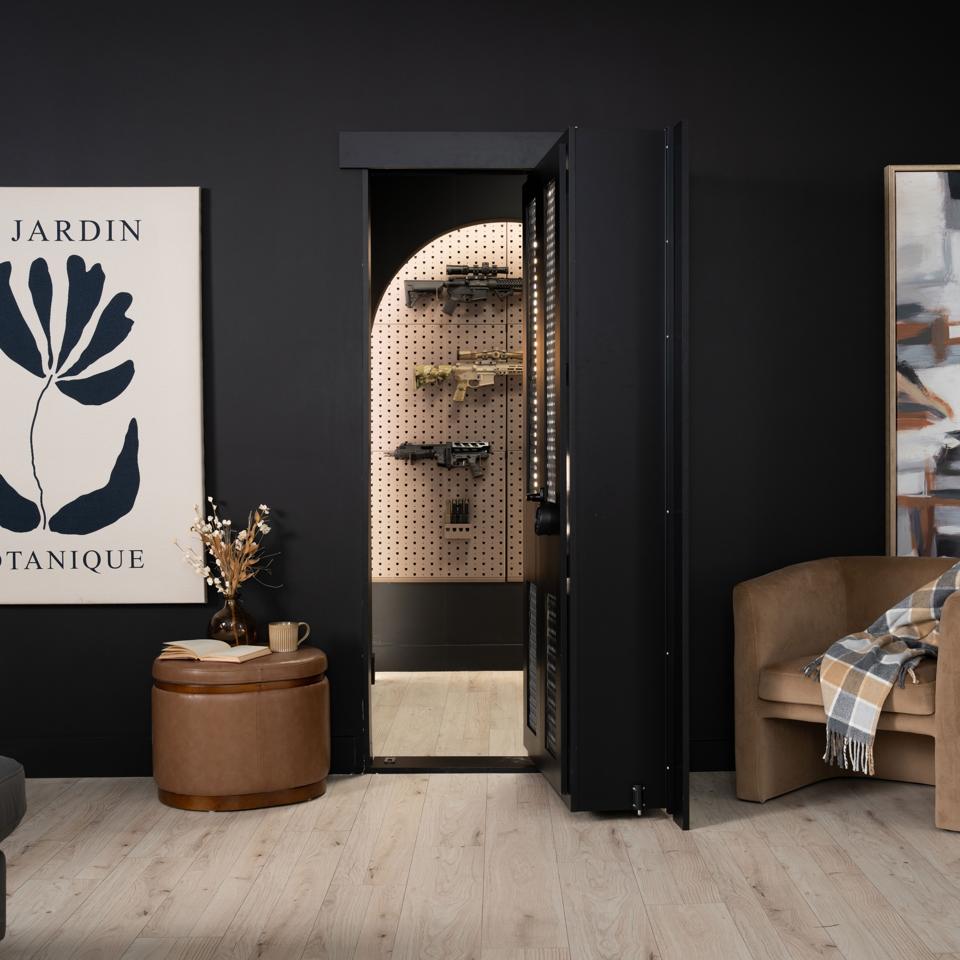
These days, Barker sells not only predesigned doors, hidden beds and other home furnishings, but also works at the architectural design stage with homeowners who want to incorporate his products into construction as their homes are built.
That means Murphy Door has a huge range of prices. Barker says he did one custom construction job that cost more than $1 million. But his cheapest offering, a simple hidden door that customers can assemble themselves in about two hours, costs just under $1,000, and the median sale is just $2,380. One of his biggest struggles, Barker says, has been figuring out how to communicate to potential customers on his website that he can do 300 million variations on Murphy Door’s base offerings, by switching up anything from the design to materials to size.
Barker is still running his original manufacturing plant in the Salt Lake City area, with a second in Lexington, Kentucky and a third in Rigby, Idaho. A fourth is under construction in Dallas, Texas. (He has spread out the geographic footprint of his manufacturing to reduce delivery times.)
The Covid pandemic in 2020 turned into a major boon for Murphy Door, as Americans working from home became interested in giving their home offices more (and often hidden) character. “Covid took us from $7.7 million (in sales) to $15 million in one year,” Barker says. “And then from $15 million to $24 million the next.”
Barker told Forbes he now spends about $5.8 million a year on marketing—mostly for ads on social media platforms, including Facebook, Instagram, and TikTok, but also for trade shows. He earns about $10 million a year before taxes, and $7 million net of taxes, he says. That’s more than enough to fly family members with him when he goes on business trips around the country to places like Miami. Those junkets help hold down family complaints about the hours he works. Truth is, workaholic Barker is still on the roster at the local fire department, even though he hasn’t worked a shift in two years.
Want to see more Forbes articles on your feed? Tap here to make Forbes Australia a preferred source on Google.
Look back on the week that was with hand-picked articles from Australia and around the world. Sign up to the Forbes Australia newsletter here or become a member here.