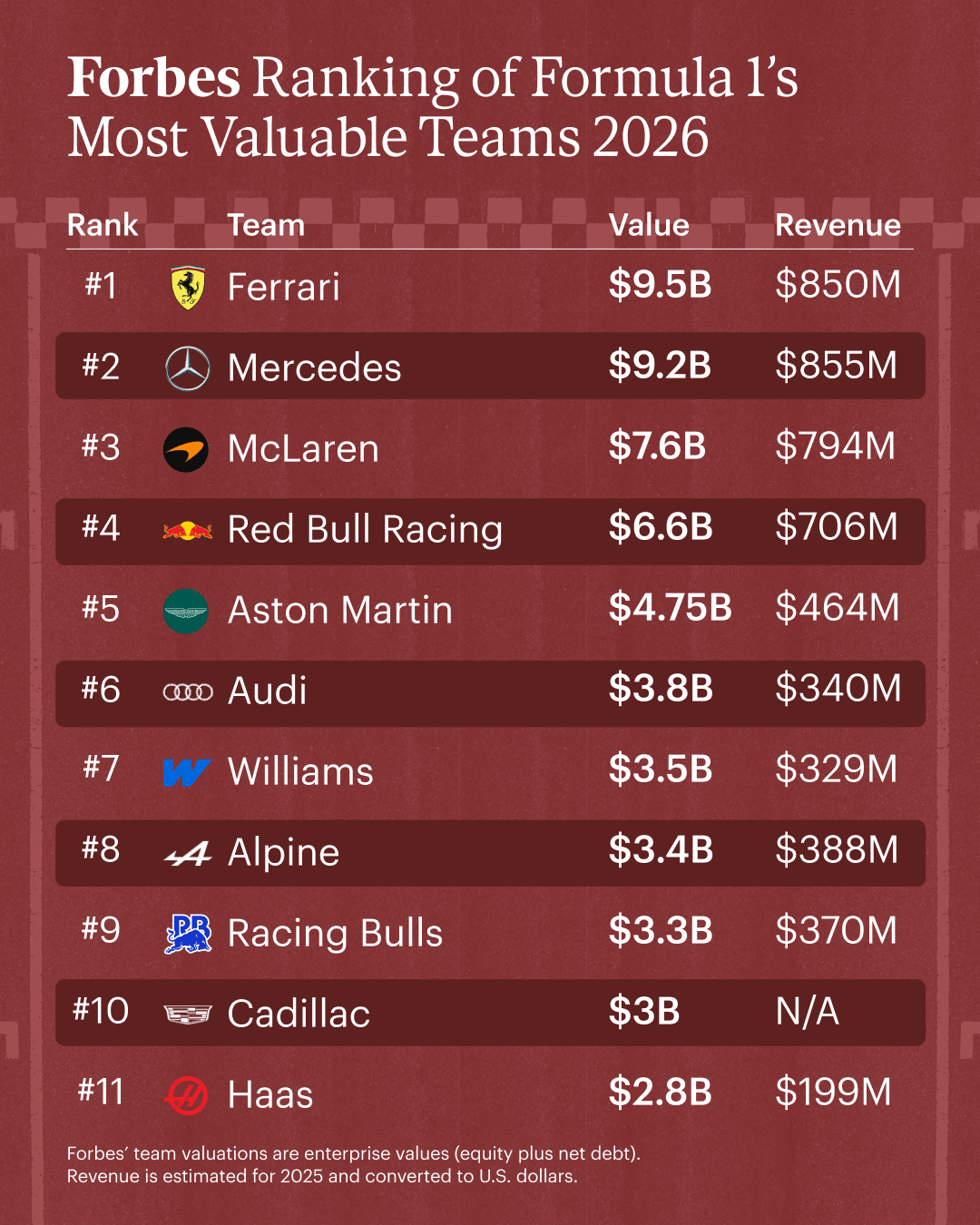
Formula 1 powerhouses Ferrari and Mercedes are worth more than ever, with help from their rival Aston Martin.
Sweeping changes to Formula 1’s technical regulations resulted in dramatically different car designs for 2026. Off the track, the series is undergoing a similarly radical transformation.
Just 12 months ago, Mercedes’ billionaire team principal, Toto Wolff, agreed to sell a minority stake in the team at an approximately A$9 billion valuation – already a sign of major growth for the sport, at roughly six times the team’s estimated price tag from 2019.
Today, the deal looks like a bargain. Forbes now values the Mercedes team at A$13.8 billion – up 53% in a year – putting the Silver Arrows on a tier with the top half of the NFL, the NBA’s three most valuable teams and European soccer’s Real Madrid.
And while that is unquestionably impressive acceleration, Mercedes is neither the most valuable team in F1 – that would be Ferrari, at A$14.3 billion – nor the fastest growing, a title that goes this year to Haas after an astonishing 87% increase in its valuation to A$4.2 billion, from 2025’s A$2.3 billion.
McLaren, which won last year’s constructors’ championship on the track, showed comparable pace, surging 73% to A$11.4 billion, from A$6.6 billion last year.
In all, Formula 1’s 11 teams are worth an average of A$7.8 billion, a 47% jump from 2025’s A$5.4 billion. Factor out Cadillac, which is valued at A$4.5 billion in its inaugural season of competition and was not included in Forbes’ 2025 ranking, and the average is up 53%, to A$8.1 billion.
The gains reflect an upturn in teams’ business: Holding the currency exchange rate steady, estimated revenue among the series’ ten existing teams rose 15% from 2024 to 2025, to an average of A$795.1 million.
Both Mercedes and McLaren expect to surpass A$1.5 billion in revenue in 2026, which would be a first in F1. (In fact, as of its most recent valuation lists, Forbes has identified only three other sports teams that have reached that mark: the NFL’s Dallas Cowboys and European soccer’s Real Madrid and Barcelona.)
Sponsorship rates are rising, and in a sport that has long been a draw for B2B marketers eager to impress potential clients by demonstrating their technological capabilities in the Formula 1 paddock, teams have signed a slew of deals in various niches of the AI ecosystem.
For instance, software company Atlassian serves as Williams’ title partner, but among the team’s 25 other sponsors are an “official thinking partner” (Anthropic’s Claude), an “AI orchestration partner” (Airia) and a “data and AI services partner” (Brillio).
At the same time, F1 has seen new interest from financial services firms, such as recent Mercedes additions Nu and Stripe, as well as consumer brands, with Aston Martin signing up Elemis skincare last year and Gucci set to take over as Alpine’s title partner in 2027, to name two examples.
The rising valuations have more to do with teams’ multiples, however. Seven years ago, on average, Forbes valued F1 teams at 2.3 times the previous season’s estimated revenue. By last year, the average multiple was up to 8.3x.
Now, Forbes values the ten existing teams (excluding Cadillac) at 10.3 times last year’s revenue on average, closing the gap on the NFL (13.4x) and the NBA (12.9x) and easily overtaking the NHL (8.9x), MLB (7x) and European soccer (where 23 clubs valued by Forbes this year had an average multiple of 5.6x).
F1 team stakes rarely change hands, leaving few data points to draw from, but Racing Bulls owner Red Bull reportedly declined an offer of up to A$4.5 billion for the team this year, and billionaire New York Jets owner Woody Johnson purchased a minority stake in Aston Martin in August at an enterprise value of A$7.1 billion, according to two people familiar with the deal.
That translates to a 10.2x multiple on the A$696.1 million in revenue listed in the team’s 2025 annual report.
“It’s just one of those weird markets,” one current F1 investor says. “People are almost paying whatever it takes.”
The upswing appears to be a somewhat belated reaction to Formula 1’s introduction of a cost cap in 2021 – “the most important moment in F1 history from a valuation perspective,” as one series insider puts it.
Historically, Formula 1 was a money pit, with top teams’ annual budgets soaring past A$600.1 million, but in an effort to level the playing field, the new system limits spending in many areas related to the design and manufacturing of cars. Ahead of the 2026 season, the cap was set at A$322.5 million.
With that change, Mercedes ranked fifth on Forbes’ most recent list of the world’s most profitable sports teams, and it recorded a A$337.5 million operating profit in 2025. Five other F1 teams joined Mercedes in the black in 2025, according to Forbes estimates, and while McLaren posted a loss on paper, that was the result of a large long-term incentive plan payout to its executives.
This year, the team is expected to approach A$300 million in profit.
Formula 1 is not yet at the point of structural profitability, as is the case in the NFL, where massive league distributions virtually ensure that franchises cannot run at a loss. However, insiders say the series may reach a point in the next few years where F1’s prize fund – the money distributed to teams from centralised sources like media rights and race hosting fees, divvied up according to where they finish in the season-long standings – covers the cost cap for most or all teams.
Looking ahead, Formula 1 still has room to grow in the United States – already the most fertile territory for corporate partners – where the series switched its broadcast home to Apple TV this year, from ESPN, as it tries to build on an audience pulled in by the Netflix docuseries Drive to Survive.
The series also has a young, international fan base and continues to explore underdeveloped markets around the world, with Malaysia stepping in to host a race in place of Bahrain amid the war in the Middle East this year and a Grand Prix set to be held in Africa for the first time since 1993 with a race in Rwanda in the early 2030s.
“Why should the revenue multiples be any lower than the NBA, really?” one F1 investor says. “It’s global. Almost as many people watch every race as the Super Bowl. You have 300,000 people attend race weekends, centralized media rights.
It’s an awesome sport. It just took people a couple of years to understand.”
Formula 1’s biggest advantage, though, may simply be scarcity. Even with the addition of Cadillac to the grid this year, the series is locked into 11 teams – roughly a third the number of franchises in the major American sports leagues – for the foreseeable future, and stakes do not come up on the trading block often.
In a rare example, Sportico reported this month that Alpine investor Otro Capital had hired an investment bank to explore a sale of its minority stake, and with Cadillac owner Mark Walter facing a federal investigation into loans made between his other businesses, rumours have circulated around the paddock that he has been shopping the team with an asking price of A$5.1 billion.
In a strict financial analysis, it might be hard to justify paying that figure for a startup team that still has a lot of catching up to do both on and off the track. (The same would apply to Haas, which Forbes values at 14.1 times its 2025 revenue.)
But investors’ appetite to break into sports ownership has supercharged valuations in leagues around the world, and no one knows when the next opportunity to take control of an F1 team might roll around.
“[Cadillac] has the least infrastructure, the least track record, the least pedigree, and their big ambitions to build in the U.S. are going to be hard to deliver against,” one F1 insider says. “But it’s the value of being part of the sport and riding the crest of the wave.
“This time next year, we’ll probably be talking about the first $10 billion Formula 1 team.”
Most Valuable F1 Teams 2026
1. Ferrari
A$14.3 billion
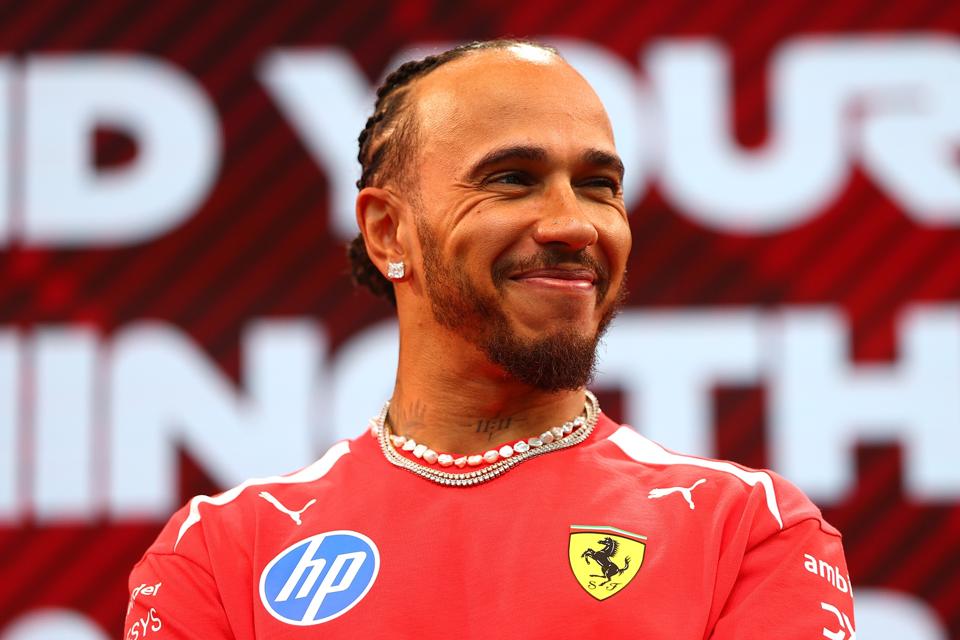
One-Year Change: 46%
Revenue: A$1,275 million
Operating Profit: A$240 million
Team Principal: Frédéric Vasseur
2. Mercedes
A$13.8 billion
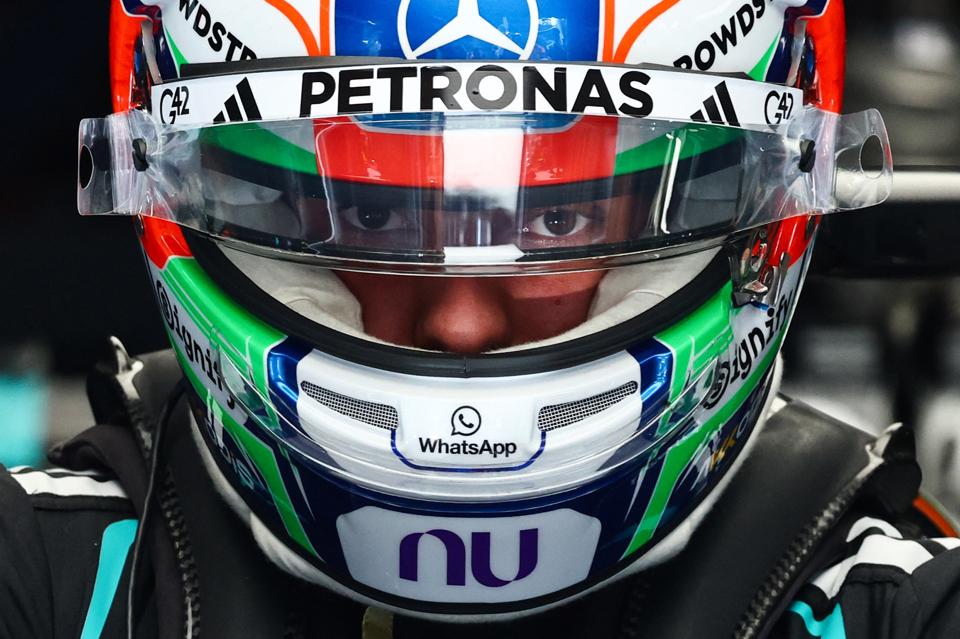
One-Year Change: 53%
Revenue: A$1,283 million
Operating Profit: A$337.5 million
Team Principal: Toto Wolff
3. McLaren
A$11.4 billion

One-Year Change: 73%
Revenue: A$1,191 million
Operating Profit: -A$87 million
Team Principal: Andrea Stella
4. Red Bull Racing
A$9.9 billion

One-Year Change: 52%
Revenue: A$1,059 million
Operating Profit: A$49.5 million
Team Principal: Laurent Mekies
5. Aston Martin
A$7.1 billion

One-Year Change: 48%
Revenue: A$696.1 million
Operating Profit: -A$40.5 million
Team Principal: Adrian Newey
6. Audi
A$5.7 billion

One-Year Change: 58%
Revenue: A$510.1 million
Operating Profit: -A$30 million
Team Principal: Mattia Binotto
7. Williams
A$5.3 billion

One-Year Change: 40%
Revenue: A$493.6 million
Operating Profit: -A$40.5 million
Team Principal: James Vowles
8. Alpine
A$5.1 billion

One-Year Change: 39%
Revenue: A$582.1 million
Operating Profit: A$33 million
Team Principal: Flavio Briatore
9. Racing Bulls
A$5 billion

One-Year Change: 43%
Revenue: A$555.1 million
Operating Profit: A$15 million
Team Principal: Alan Permane
10. Cadillac
A$4.5 billion

One-Year Change: N/A
Revenue: N/A
Operating Profit: N/A
Team Principal: Marcin Budkowski
11. Haas
A$4.2 billion

One-Year Change: 87%
Revenue: A$298.5 million
Operating Profit: A$19.5 million
Team Principal: Ayao Komatsu
Methodology
Forbes’ 2026 Formula 1 valuations were compiled from information obtained from public filings and private documents—such as valuations calculated for teams by banks—and from interviews with industry executives, analysts, bankers and investors. Revenue estimates are from Formula 1 operations in 2025 and exclude ancillary businesses, such as selling engines. Operating profit estimates are 2025 earnings before interest and taxes. Team values are enterprise values (equity plus net debt). No revenue or operating profit estimate is listed for Cadillac, which began racing as Formula 1’s 11th team in 2026; no one-year change is listed for Cadillac, either, because Forbes did not value the team in 2025.
All 2025 revenue and operating profit figures were converted to U.S. dollars based on exchange rates as of December 31, 2025 (£1 = $1.35; €1 = $1.18).
Want to see more Forbes articles on your feed? Tap here to make Forbes Australia a preferred source on Google.
Look back on the week that was with hand-picked articles from Australia and around the world. Sign up to the Forbes Australia newsletter here or become a member here.