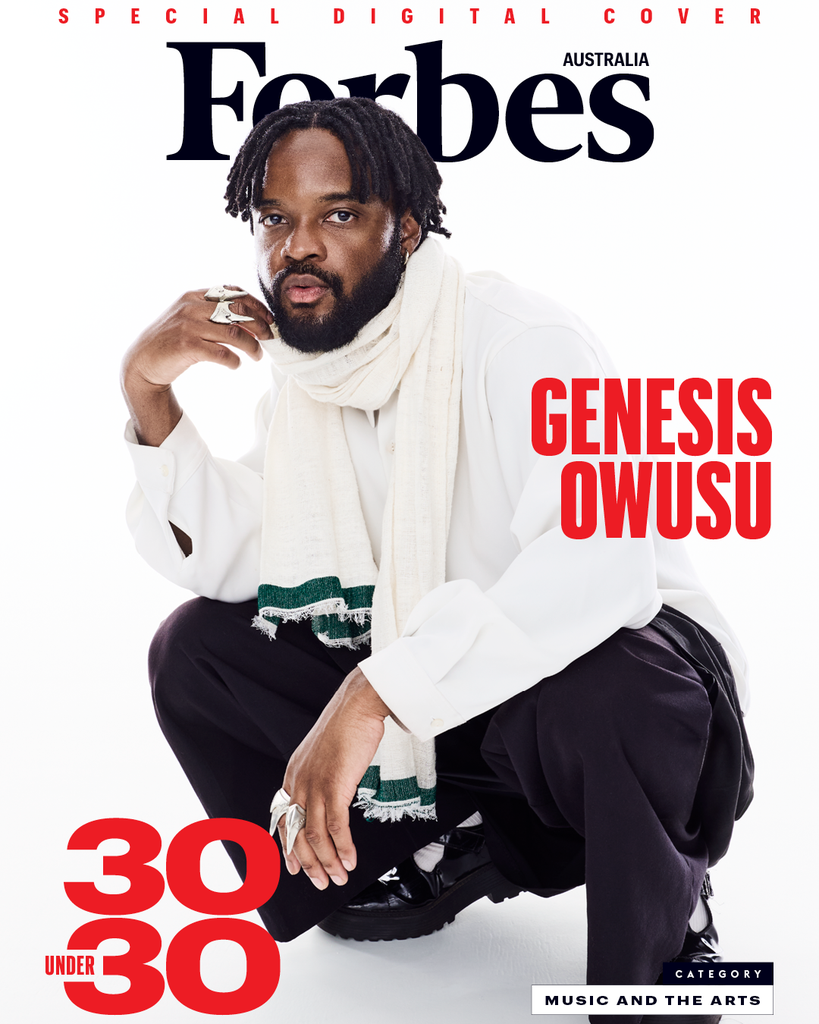
Genesis Owusu has seven ARIA wins and eight more nominations this year. At 28, he says each album is one piece of a bigger world he’s building.
This article featured in Forbes Australia’s 30 Under 30 Issue. The full list is out now.
Genesis Owusu spent weeks in a converted church in Wales with producer Dann Hume, mostly talking.
“You can understand yourself better when your ideas are able to ruminate in a space outside of your own head,” he says. “Being tucked in a space with Dann for weeks where we just shoot the shit about life, art, politics, society. Where we could disagree and figure out how to articulate our thoughts to each other, it’s extremely valuable, especially when the album is essentially the musical form of those same conversations.”
The result, Redstar Wu & the Worldwide Scourge, was released on 15 May 2026. It debuted at No. 3 on the ARIA Albums Chart, the highest entry of Owusu’s career, and at No. 1 on the Australian artist and vinyl charts. It is his third album, and he is just 28.
Born Kofi Owusu-Ansah in Koforidua, Ghana, Owusu moved to Canberra with his family as a toddler. His household was always full of music and poetry, and his older brother, Kojo Owusu-Ansah (artist Citizen Kay), started experimenting with hip-hop at an early age. Owusu followed suit. But he was growing up in the internet era, and things were moving quickly. Australian artists at the time were expected to fit a certain mould – he didn’t.
“The only way through those expectations was to blow them up. But I think that’s kind of the way that it should be. Industries will always be playing catch up because culture will never be built in a boardroom; it’s built on the ground.”
He describes his style as ‘post-genre’ (not quite fitting neatly into any traditional radio or vinyl category), but when, exactly, did he realise music could be a career? “Before I was any good,” he says. “Pretty much running off what sensible people would call ‘pure delusion’. I knew I was going to do some crazy shit.”
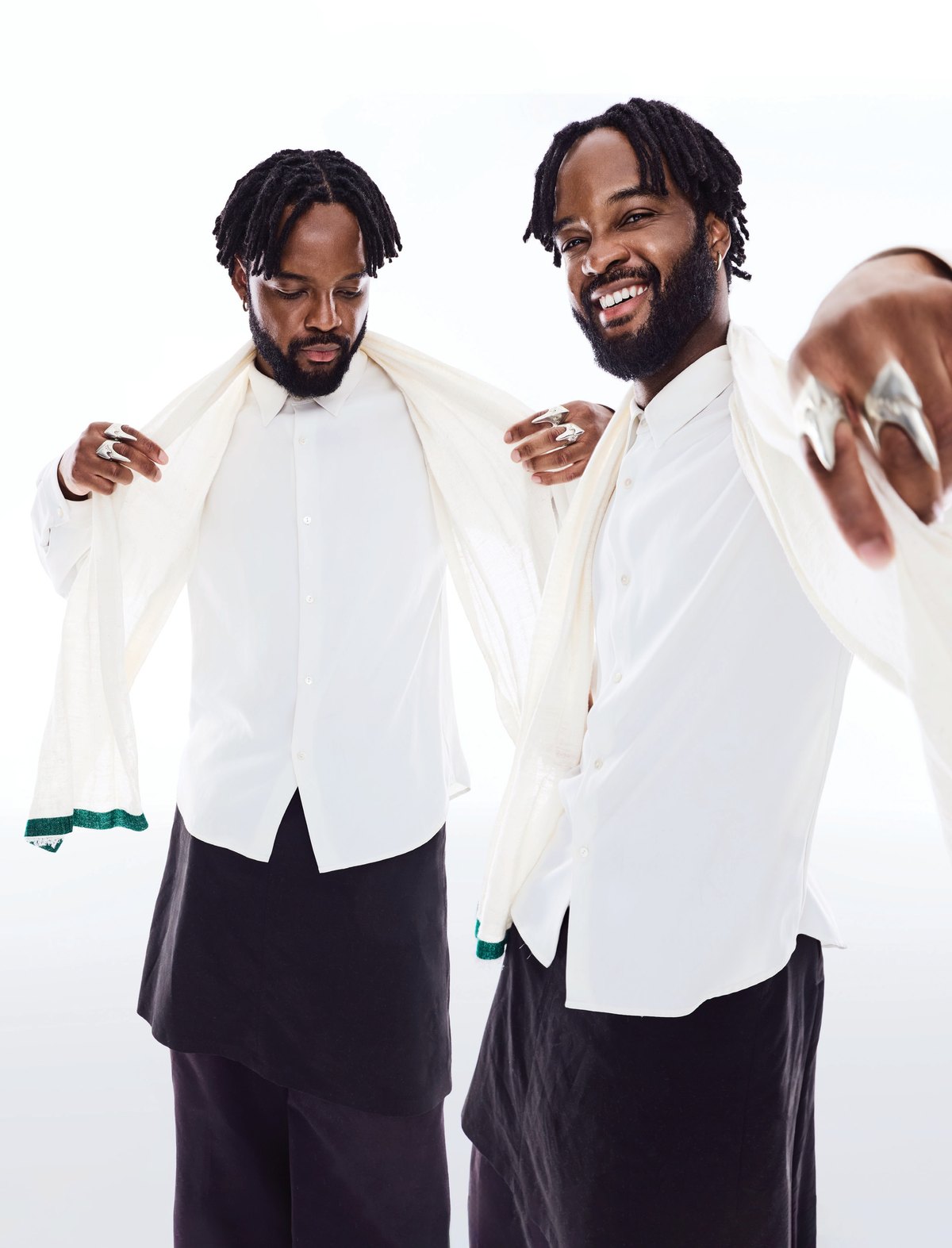
He wasn’t wrong, and recognition came quickly. His 2021 debut, Smiling With No Teeth, tackled themes like racism and depression and won four ARIA Awards, including Album of the Year. It also took the Australian Music Prize and the J Award for Australian Album of the Year. Rolling Stone Australia later ranked it No. 1 on its list of the best Australian albums of the 2020s so far. Struggler followed in 2023 with a surreal world of its own, and won three more ARIAs, including a second Album of the Year. He now has seven ARIA wins.
He describes his job in terms of narrative rather than genre. “From my second album, I learned that my true role is that of the storyteller. I’m not a good instrumentalist or producer, so the words and ideas were my main tools, and the music was a vehicle for the narrative.” Each record takes a different form. “First album, I was writing as a surrealist autobiographer; second album, I was the Kafkaesque fiction author; third album I was the gonzo journalist.”
Owusu also says he likes to work quickly. Songs begin as a sound, a poem or a dream, and he doesn’t like to labour over them. In fact, usually the vocals you hear on his tracks are his first take. “The ideas that come fast are usually the ones that I keep, because they’re not forced,” he says.

The new album moves through hip-hop, punk, funk, soul and pop, and takes on political division and prejudice while arguing for human connection. His reference points for balancing heavy themes with melody are Prince and André 3000. “1999 and Hey Ya respectively do that balance of lyrical tragedy vs infectious groove.”
But Owusu isn’t just behind the song itself; his records are part of a bigger creative world he’s penned in his journals or notes app, usually from his bedroom.
“I write and write and write to try to make sure the vision is as honed in as possible, and then I’m able to work with amazing directors, designers and producers, who are able to make those thoughts into something tangible in the areas that I cannot myself,” he says. “Music was never the end-all-be-all for me. It was one aspect of broader worlds that I wanted to create. The worlds are the point.”
And the world beyond the studio has certainly noticed. His single “Stampede” soundtracked Apple’s iPhone 18 Pro campaign in September, and he made a cameo on the television series Heartbreak High. He is nominated in eight categories at the 2026 ARIA Awards, including Album of the Year.
That success hasn’t altered his instincts, and it’s not the reason he continues to carve out his place in the music industry.
“I have to create. The creation is me, and I can’t let the masses have that kind of power over my self-worth.”
It does give him a lot of credibility, though. “I think validation is a currency, and it’s helped me gather the resources to keep creating. I have to keep a constant check on myself that I’m not getting lost.”
Asked to look ahead, he points beyond music into other forms of art, namely film.
“My second album would’ve been a film if I’d had my way,” he says. “It spawned from a story that I wrote, so there are a lot of mediums that I would like to touch.”
But his longer-term measure is modest. “If you spoke to me in 15 years, what would really give me some life would be to know that the things I’ve done have opened some doors, some way or somehow, for people in the future.”

Look back on the week that was with hand-picked articles from Australia and around the world. Sign up to the Forbes Australia newsletter here or become a member here.