AI needs a foundation: Why smart companies automate first

In the race to incorporate artificial intelligence, organisations today are spending big for minimal returns. The real payoff, Nintex’s Sean Chandler says, happens when business get their processes in order, then automate, before introducing AI.
BRANDVOICE – PARTNER CONTENT

It’s a startling fact. Research shows that 95% of generative AI investments make little or no returns despite businesses spending around US$30-40 billion to upgrade their systems. According to Nintex’s APAC enterprise sales director, Sean Chandler, most organisations simply accelerated their AI transformation across broken systems.
“Layering AI on top only creates faster inefficiency, not transformation,” he says. “With anything new, there’s going to be a learning curve. But when you’re running at a 95% failure rate, I think we do need to pause there and go – where, and why?” he says.
And it’s a growing dilemma worldwide. As organisations experiment with AI or attempt to move past previous failures, they’re relying on fragmented processes, manual approvals, and disconnected workflows. Costly solutions that were acquired as quick fixes are often siloed. The scale of the problem is enormous.
“When we speak to global IT leaders and chief information officers (CIOs), their tech stack can be around 200 to 300 different point solutions, all solving very similar challenges,” Chandler says.
He defines this challenge as “SaaS sprawl” – where organisations layer multiple point solutions without a cohesive, connected strategy. Organisations should be thinking more holistically – investing in broader platforms where data can flow seamlessly across the business, he says.
This enables company-wide processes, consistent document management, and operational efficiency before automation is introduced – and certainly before scaling AI deployment.
Many organisations struggle with fragmentation at the organisational level, where departments or subsidiaries operate in silos, with little visibility into which technologies are being used, where they’re working, and how they could be scaled. This lack of alignment means businesses are missing critical opportunities to optimise investment, drive efficiency, and unlock true enterprise-wide transformation.
So, what are the other 5% of successful enterprises doing right?
Chandler works with enterprises across APAC to drive optimal outcomes, beginning with laying strong operational foundations, then deploying automation, and finally embedding AI to maximise impact. His work spans iconic brands such as Virgin Australia, Flight Centre, Treasury Wine Estates, and National Gallery Singapore, and extends to ASX Top 100 companies and leading public-sector departments, ensuring that technology adoption translates into measurable business results.
“What makes us different from what AI provides is the human element, and that’s creativity and empathy.” – Sean Chandler
Today, more than 7,000 companies in over 100 countries have partnered with Nintex to drive successful transformation, gaining deep insights into their foundations before moving on to automate and orchestrate systems.
Chandler likens this process to running a marathon: “AI is the brain, automation and process are the muscles. If you asked me to run a marathon tomorrow, my mind might say, ‘Yes, I can do it.’ And I could probably finish – but without the muscle strength and training – that is, understanding your processes, optimising them, and embedding automation before AI – the result won’t be great. Problems could linger for six, 12, even 18 months afterwards – just like a torn hamstring after a race you weren’t properly prepared for.”
Automation before intelligence
Before embarking on change, Chandler says the first step is to define what success looks like. Then the foundations of the business need to be examined. Mapping workflows helps to discover why certain processes are carried out and why they’ve been set up. It also uncovers bottlenecks, for example, is knowledge or approval only held by one person in the organisation?
Is governance a potential risk to moving forward?
“If you can’t clearly understand or explain your processes, you don’t truly know what you’re doing. So how can you automate them? How can you deploy AI to drive efficiency? From there, automation can bridge skills gaps and eliminate manual steps – and that’s where AI delivers real impact,” Chandler says.
A recent Nintex survey found that global business leaders see automation as crucial for AI success. It found that automation reduced administrative work per employee by 5-7 hours a week, cut compliance reporting time by 30%, and resulted in a 12% increase in productivity, with a similar improvement in accuracy.
Although 84% of IT and finance leaders agree automation must come before AI for successful implementation, senior executives still measure success from different perspectives. “CIOs are two times more likely to say they have seen success with their AI projects than chief financial officers (CFOs),” Chandler says.
“One reason is that financial indicators will always be lagging. A CFO is paying for this investment right now, but they might only realise the full benefits in two to three years. And secondly, if we don’t have that success criteria set up, and we haven’t had internal stakeholders talking, we have a problem where one side of the business believes it’s been a phenomenal success, the other side is just seeing the bill.”
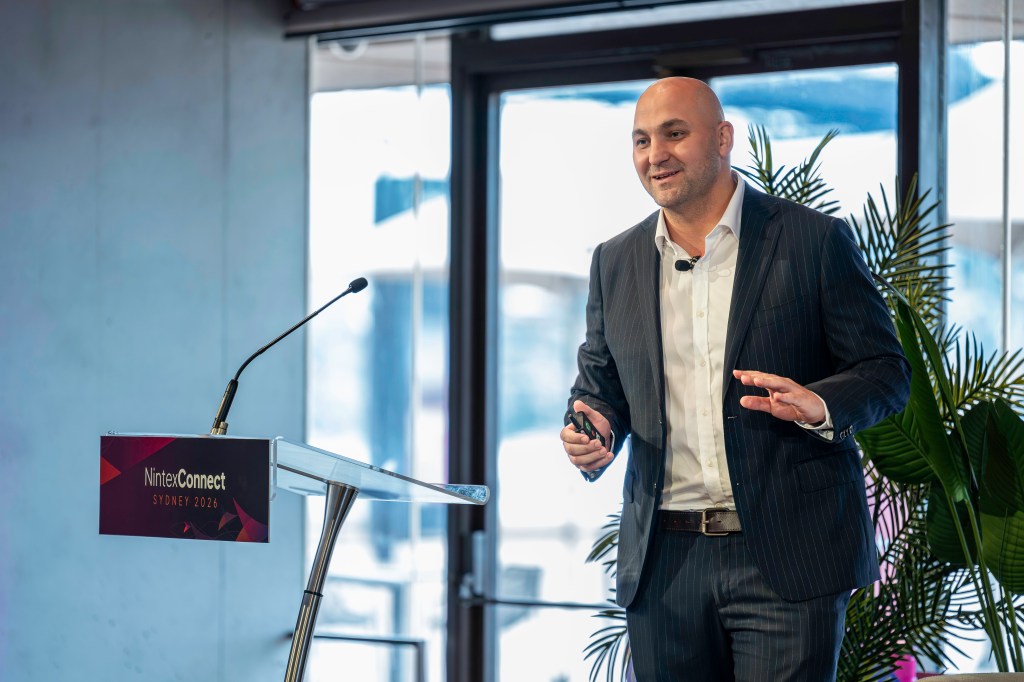
AI and human oversight
Despite AI replacing tasks, jobs and people, Chandler still firmly believes humans need to be in the loop. “If you set up an automation, it’s critical to consider when does a human get involved? That process needs to be well documented, and companies cannot afford to get it wrong. Technology can help with efficiency and the way work is done. Automation can remove administrative friction. But some moments should never be automated or replace people,” he says.
“What makes us different from what AI provides is the human element, and that’s creativity and empathy.”
Maintaining humanity in business transformation also prompts this 32-year-old senior leader in Nintex’s APAC Enterprise team to reflect on what could be lost.
“Much of the success I’ve had has come from honest feedback – from people who’ve been there and done that. I worry that we may be heading towards a future where a young employee, encouraged to do more with AI, asks a model to write their performance review – only for that review to be assessed by another AI. Suddenly, you have AI talking to AI,” he says.
“That kind of scenario might train the model, but it doesn’t build the critical thinking, judgment, or leadership capabilities that people need to grow.”
“Organisations become more efficient when AI, workflow and human innovation unite. By understanding your processes and then using AI and automation, we can flip the script and deliver phenomenal success for businesses,” Chandler says.
Learn more at nintex.com
Want to see more Forbes articles on your feed? Tap here to make Forbes Australia a preferred source on Google.
Look back on the week that was with hand-picked articles from Australia and around the world. Sign up to the Forbes Australia newsletter here or become a member here.