Stripe bets big on AI agents to transform online commerce

In the future of commerce, AI systems won’t just recommend what to buy; they will also be able to execute purchases autonomously on a user’s behalf.
BRANDVOICE – PARTNER CONTENT

Imagine an AI assistant helping find the perfect birthday present for a loved one, comparing prices across retailers and completing the purchase, without you having to open any tabs or shopping carts. Or a small business where software automatically restocks fast-moving items, places the order and pays the supplier, without a human touching a keyboard.
That future is no longer fiction, and could rapidly become the next battleground for the payments industry.
As artificial intelligence evolves from simply advising humans to making decisions on their behalf, payments processing giant Stripe finds itself at the centre of the transformation taking place across the global payments industry.
The company is using AI to protect and optimise its vast payments network. It is also moving beyond into building the infrastructure for so-called ‘agentic commerce’ where AI systems don’t just recommend what to buy, but can execute purchases autonomously on a user’s behalf.
Through its partnership with ChatGPT creator OpenAI and the development of its Agentic Commerce Protocol (ACP), Stripe is testing a future where software agents, rather than humans, increasingly initiate, negotiate and complete online transactions, a shift that could fundamentally change the nature of the digital economy.
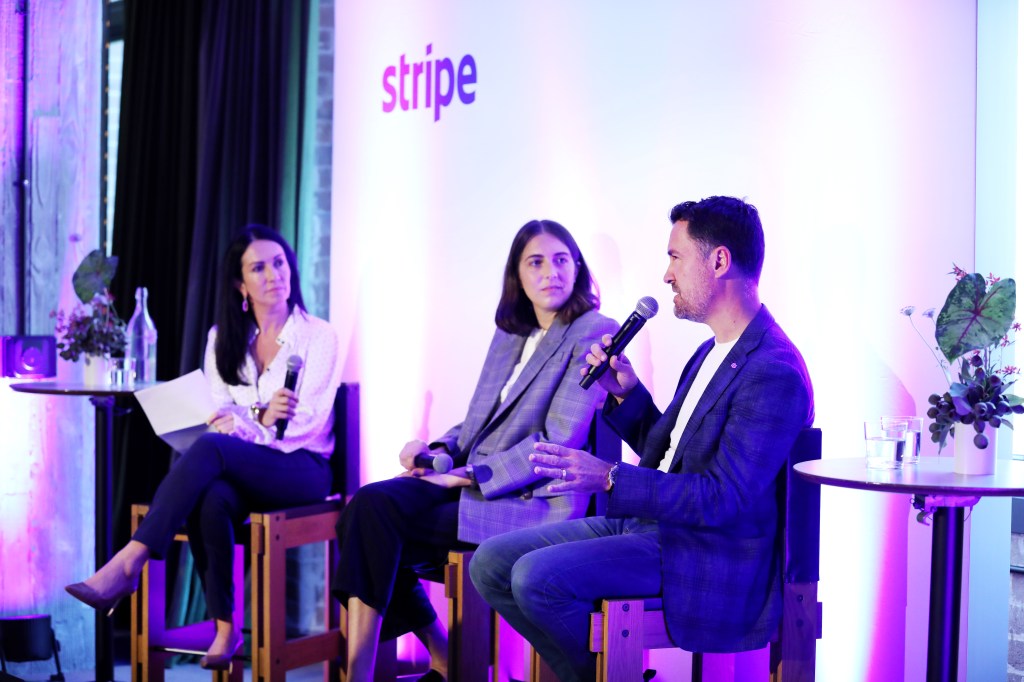
“We’re seeing the rise of agentic commerce, and from our perspective, this is hugely pervasive,” Karl Durrance, Stripe’s managing director for Australia and New Zealand, recently told a packed room of industry executives in Sydney.
“We’re injecting AI into every part of our business, and the impacts are monumental. These technologies are unlocking dramatic gains.”
Building the payments foundation model
Stripe has a long history of using AI models to prevent fraud, increase authorisation rates and personalise checkout experiences for each buyer. Last year, it built the world’s first AI foundation model for payments, trained on tens of billions of transactions. The result: after deploying the Payments Foundation Model, the fraud detection rate jumped from 59% to 97%—overnight.
The company is also using AI for a dynamic checkout experience, prioritising the display of payment methods that individual customers are most likely to use based on their location, device, and purchasing habits.
But it’s really on the consumer side that the payments giant is quietly reshaping the future of commerce and helping unlock new business models. In recent months, Stripe has partnered with OpenAI on two major initiatives.
The first is the ACP, an open-source framework co-developed with OpenAI that is a shared technical language between AI agents and businesses. One integration lets merchants sell through AI channels while retaining control over what’s sold, how their brand appears, and the customer relationship.
Stripe has also unveiled Instant Checkout, which allows ChatGPT users to buy directly in chat, initially from sellers on Etsy and subsequently on Shopify. When a chat user asks a shopping question, ChatGPT shows the most relevant products from across the web. If a product supports Instant Checkout, users can simply tap “Buy,” confirm their order, shipping, and payment details, and complete the purchase without leaving the chat.
While both initiatives are currently live only in the US, they will become available in other markets, which could drive business growth in more countries, including Australia, where nearly 50% of adults use ChatGPT every week.
Durrance sees the development of AI agents as the next major wave in the sector, helping automate workflows and drive productivity, and expanding their use beyond the tech sector into every industry.
That perspective comes from Stripe’s unique visibility into the AI economy, given that 78% of the Forbes AI 50 companies use its payments network. Both established players, like OpenAI, and emerging firms are scaling at rates never seen before, he says, with sector companies taking just 18 months to reach $30 million in average recurring revenue.
“We’ve never seen a business or a sector grow at that speed. It’s unprecedented. That’s the kind of proxy to suggest people are paying for it, they’re getting value from it, and therefore it’s growing fast. It’s a pretty good signal,” says Durrance.
About 10% of Stripe’s new business sign-ups are now referred by large language models, up from almost zero a year ago.
Navigating the complexities ahead
Despite that express growth, expansion of agentic commerce will likely be cautious, given regulatory complexity and the need for infrastructure to support exponential increases in transaction volume.
Since these AI-driven interactions involve the movement of money, payment processors and regulators are grappling with issues around user intent, liability, compensation, and compliance with banking rules.
“Online shopping habits will change. We’ll use agentic commerce for more administrative purchases – weekly groceries, replenishing essentials – and reclaim our time…” – Karl Durrance
Another dilemma for retailers is that each AI agent requires custom integration work, creating an unsustainable technical burden as new agents constantly emerge. This is why Stripe launched its Agentic Commerce Suite (ACS), built on top of the ACP. Together, they create a two-sided infrastructure: AI companies connect their agents to ACP once, retailers connect to ACS once, and Stripe handles everything in between. This provides retailers a single integration that makes their products discoverable and purchasable across all AI agents — current and future — without rebuilding existing commerce systems.
Despite the hurdles, major players are betting big on agentic commerce.
“Agentic commerce is about letting people move from intent to action in a single, trusted conversation, where AI doesn’t just help you find the right thing, it helps you actually buy it,” says Emma Lalley, Head of Global Expansion at OpenAI.
“In ChatGPT, that means going from chat to checkout in just a few seamless taps. That’s why we co-developed the Agentic Commerce Protocol with Stripe as an open standard that lets AI agents, people and businesses work together to complete purchases safely. We’re essentially laying the groundwork for a future where discovery, decision and purchase happen seamlessly in one flow.”
Durrance also says feedback since the US launch of Instant Checkout in September indicates a much wider variety of merchants will be available on the platform in the future, attracting more consumers.
Stripe notched US$40 billion in volume from the latest Black Friday-Cyber Monday sales, but he says agentic commerce isn’t currently a measurable component of that. That’s about to change.
“By Black Friday-Cyber Monday this year, agentic commerce will be measurable, and next year it’ll be a meaningful contribution,” says Durrance. “Online shopping habits will change. We’ll use agentic commerce for more administrative purchases – weekly groceries, replenishing essentials – and reclaim our time for buying experiences that matter, like gifts or luxury items.”
Learn more at stripe.com
Want to see more Forbes articles on your feed? Tap here to make Forbes Australia a preferred source on Google.
Look back on the week that was with hand-picked articles from Australia and around the world. Sign up to the Forbes Australia newsletter here or become a member here.