Smart leaders are using AI and process automation to build better businesses and, more importantly, better lives

Nintex’s Keith Payne says the smartest thing a leader can do right now is to hand off the manual work to machines and reclaim time for critical thinking, health, and ultimately their edge.
BRANDVOICE – PARTNER CONTENT

The most powerful leaders in Australia right now aren’t working harder. They’re working smarter. And increasingly, that means letting intelligent systems do the heavy lifting, so humans can do what they do best.
That’s the conversation that Keith Payne has been having with boardrooms across the globe as they explore the humanistic impact of AI. As Nintex’s APAC regional vice president, he’s spent years watching organisations drown in inefficient processes, manual workflows, and more recently, AI investments that go nowhere.
In fact, a recent study by Nintex and MIT showed that 95% of all AI investments are unsuccessful due to a lack of grunt work up front, especially around continuous improvement and change management. His message is clear: automation and AI aren’t a threat to your people.
Used well, they’re the best thing that’s ever happened to them.
“Organisations deploying AI should be highly intentional,” Payne says.
“Leaders should encourage their teams to use it to create happier employees who are better at what they do – while also delivering better employee and customer experiences.”
AI is not a silver bullet
Here’s the uncomfortable truth. Most organisations are spending big on AI and getting mixed results and ROI.
Why? Because AI accelerates growth, efficiency, and stakeholder value at an unprecedented pace.
The result is innovation being layered over inefficient processes, which can be counterproductive.
What we’re seeing in the market is that leading organisations are most successful when they adopt a holistic, process-first approach – what Nintex calls agentic business orchestration.
It’s as much a philosophy as it is a platform: mapping processes first, using AI to identify where workflows can deliver the greatest impact, automating processes intelligently, and then creating customer and employee experiences that genuinely deliver results.
“We must never get to a point where the human in the loop is redundant for critical decision-making, reasoning and contextual thinking.”
The organisations that are getting it right, from Treasury Wine Estates, Woolworths, Virgin Airlines, Coca-Cola, Australian Super and the University of Sydney, aren’t just embracing efficient process workflows, automation and AI; they’re rethinking workflows across their entire organisation. Process first. Automation second. AI on top.
Why regulated industries are leading the charge
The boldest movers aren’t necessarily the big tech companies. They’re the banks, superannuation funds, government agencies and education providers – organisations where auditability, compliance and risk management aren’t just operational requirements, but business-critical drivers of transformation and efficiency.
When the cost of a broken process is regulatory, the incentive to fix it is enormous. These industries have learned that intelligent orchestration isn’t a nice-to-have. It’s operational survival that helps them deliver exceptional outcomes at scale.
The human in the loop
Payne grew up near Coventry, once the beating heart of British mining and manufacturing, home to Jaguar, Rolls-Royce and thousands of component engineering companies. He witnessed these industries employing hundreds of thousands of people disappear, while new, more service- and technology-centric jobs were created.
“It feels different with AI. It’s moving quickly. The pace is unprecedented. The technology is moving faster than people and organisations can adapt.”
But Payne remains an optimist at heart. He’s seen transformation create entirely new industries, roles and opportunities.
His conviction is that the rise of the agentic enterprise, where AI agents coordinate work seamlessly across organisations, has the potential to become the most human-centred transformation yet, if leaders choose to make it so.
That starts with one non-negotiable.
“We must never get to a point where the human in the loop is redundant for critical decision-making, reasoning and contextual thinking.”
AI makes the recommendations. Humans make the calls. That’s the line in the sand we need to draw.
Energy is the currency of leadership
As a global executive, Payne knows jet lag. He knows what it feels like to walk into a crucial meeting running on empty. And he knows how much it costs – in presence, in thinking, in outcomes.
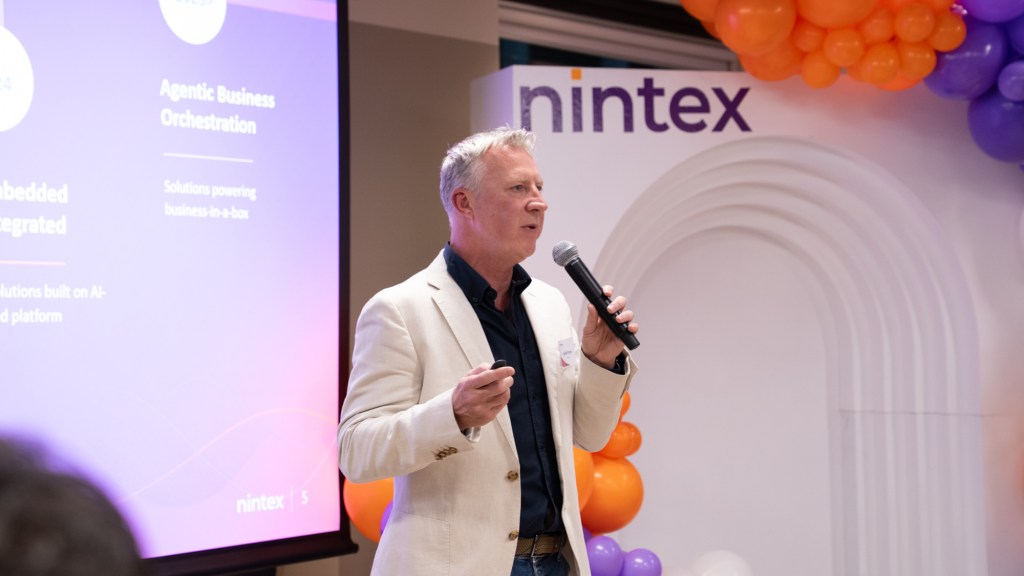
So, he uses AI as a personal concierge. Not to make decisions for him. To give him the information he needs to make better decisions about his schedule, health, nutrition, and recovery.
“Energy is the currency of leadership,” according to Keith’s wife, Camilla Thompson, executive wellbeing coach and author. And Keith agrees.
“AI has the potential to give leaders more of it. They can reinvest that time back into their health, their families, and how they lead.
“It’s not just about productivity gains. It’s about performing at a high level, for your organisation and the people you love.”
This is the argument that lands hardest in the boardroom. Not the efficiency metrics. Not the cost savings. The idea that intelligent orchestration can give a senior leader two more hours a day. Two more hours of clarity, focus, and presence.
That’s not a technology story. That’s a leadership story.
What comes next
The agentic enterprise is not a future state. It’s here now. Intelligent systems that anticipate business needs, coordinate processes automatically, and optimise workflows in real time are already deployed in Australian organisations.
The question isn’t whether this transformation is coming. It’s whether your organisation will lead it, follow it fast, or get left behind.
“AI can be incredibly freeing, if you orchestrate it,” Payne says.
Thinking. Deciding. Leading.
Start with the process. Fix what’s broken. Automate what works. Then put your best people back where they belong.
Learn more at nintex.com.
Want to see more Forbes articles on your feed? Tap here to make Forbes Australia a preferred source on Google.
Look back on the week that was with hand-picked articles from Australia and around the world. Sign up to the Forbes Australia newsletter here or become a member here.