Vertex Mastery: Why Asia-Pacific’s Small and Medium Businesses May Struggle to Scale

BRANDVOICE – PARTNER CONTENT

Small and medium enterprises are an important component of economies across the Asia-Pacific region, and the challenges they face scaling beyond a certain threshold are increasingly relevant to Australian businesses, investors and advisers with exposure to the broader market. In Malaysia alone, SMEs represent more than 97 percent of all registered companies and contribute approximately 38 percent of national GDP, according to government data. In Thailand, the Philippines and Indonesia, the proportions are comparable. In Australia, SMEs account for around 98 percent of all businesses and contribute roughly 42 percent of private sector employment, according to the Australian Small Business and Family Enterprise Ombudsman. Across the region, the economic backbone is not conglomerate-scale enterprise. It is the mid-market: businesses that may include food and beverage operators, manufacturing subcontractors, logistics providers and service firms, many generating between one million and fifty million dollars in annual revenue, though the sector is broad and varied.
Yet a notable number of these businesses appear to reach a ceiling. They grow quickly in the early years, fuelled by the founder’s energy, market timing and a willingness to work hours that would be unsustainable in a salaried role. Then, in many cases somewhere between three and ten million dollars in revenue, growth can flatten and margins may compress. Some advisers who work with this segment suggest the pattern is common across the region, though experiences vary considerably by industry and market. Australian SMEs are not immune, with many facing similar margin pressure, talent constraints and the challenge of competing in markets shaped by businesses far larger than themselves.
The conventional explanation is competitive: Asia-Pacific SMEs face pricing pressure from larger manufacturers, fragmented domestic markets and regulatory environments that vary sharply between jurisdictions. But a less examined factor may be structural rather than environmental, and it concerns the founder themselves.
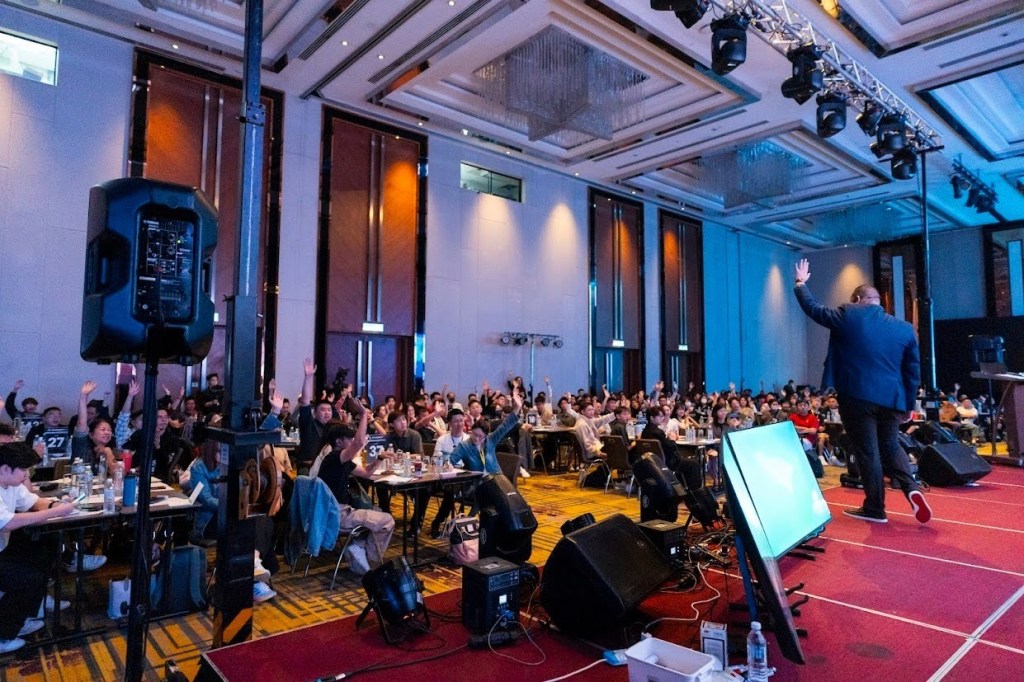
David Ky Chua, known as The Laughing Business Buddha, is a third-generation Malaysian entrepreneur who runs a family tile manufacturing business while simultaneously operating the consulting firm Vertex Mastery. He frames the issue in terms he says most SME owners across the region have never been taught. “There is a fundamental distinction between a founder and a CEO that most business owners in this region do not understand,” he says. “A CEO works in and on the business. A founder works off and out of the business. Most SME owners are wearing both hats, and it is among the most significant reasons many struggle to scale.”
The distinction is not new. It has been a staple of governance thinking for decades, visible in the separation between founders like Mark Zuckerberg or Howard Schultz and the operational CEOs hired to run their companies. But across Asia-Pacific SME culture, whether in Kuala Lumpur, Bangkok, Manila, or regional Australia, the concept has limited penetration. The founder is the business. Stepping out of operations to focus on vision, valuation and strategic direction strikes many as either a luxury or a dereliction of duty.
David Ky Chua, who according to his own reporting, has run more than 20 cohorts of Vertex Mastery’s Category King programme across Malaysia, Japan and Thailand, says the operational trap can produce a damaging psychological shift. “When founders stay in the CEO seat for too long, they become defeatist,” he says. “They start blaming the market. They lose their innovative spirit. The moment they step out and start thinking like a founder again, many find their energy and perspective return.”
The observation resonates with those who work with growth-stage Australian businesses. The transition from working in the business to working on it, a concept long discussed in Australian entrepreneurial circles, remains one of the most commonly cited sticking points for SMEs that plateau in the five to twenty million dollar range.
A related structural issue concerns hiring. Among businesses below five million dollars in revenue, owners tend to recruit for their weaknesses. This is logical at that stage. But scaling beyond five million may require a counterintuitive shift: the founder may need to hire people who are stronger than them in their own areas of expertise, and pay those hires accordingly.
“If you are the best marketer in your business, you need to find someone who is a better marketer than you and pay them accordingly,” David Chua says. “That ego jump is the simplest concept to understand and the hardest thing for a business owner to actually do.”
There is a further dimension that shapes how Asia-Pacific SMEs grow or fail to. Many founders have absorbed an unexamined assumption that growth means expansion: more branches, more warehouses, more headcount. The model can work until margins on each additional unit of growth become thinner. The phenomenon is recognisable in the Australian franchise and hospitality sectors, where rapid expansion has preceded financial difficulty for a number of operators.
What some consultants now advocate is a more deliberate approach: building a business large enough to generate meaningful value and income, but structured so that the founder is not operationally required. For Australian founders eyeing expansion into Southeast Asian markets, this structural discipline may be especially critical given the complexity of operating across multiple jurisdictions and cultures.
Across Asia-Pacific, a large cohort of first-generation entrepreneurs who started businesses in the 2000s and 2010s are now entering their forties and fifties. In Australia, almost half of all small business owners are over the age of 50. Their companies have survived the startup phase. But many have reached the point where the founder’s direct involvement may be the constraint rather than the engine of growth. How this generation navigates the transition from operator to strategist may shape the next decade of SME performance across the region, and the implications extend to Australian businesses and advisers engaged on both sides of that opportunity.
Vertex Mastery’s Category King programme teaches SME owners a hybrid methodology drawing on Chinese-style business model architecture combined with Western positioning and brand strategy. As Australian businesses deepen engagement with Southeast Asian markets through trade, investment and partnership, the question of which growth frameworks actually fit the Asia-Pacific context becomes increasingly practical. The founders who get this right may not just build larger businesses. They may help shape what the next generation of Asia-Pacific enterprise could look like.
This article is intended for informational purposes only and does not constitute financial advice. Readers should seek independent professional advice before making any business or investment decisions.