
Clothes may change every season, but the way they’re coloured hasn’t kept up. One Australian company is attempting to rebuild textile dyeing from scratch.
This story features in Issue 21 of Forbes Australia. Tap here to secure your copy.

For decades, the global textile industry has quietly relied on the same water-soaked, energy-hungry processes to colour and finish fabrics. Now, Australian deep-tech startup Xefco believes it has found a way to do it without water.
In 2024, Xefco raised $10.5 million in a seed funding round led by Main Sequence Ventures.
Before Xefco, co-founders Tom Hussey and Brian Conolly ran Zhik, a marine sport apparel company focused on sailing gear. Roughly half of their time was spent in Asia’s textile hubs, working directly with mills, garment factories, and textile manufacturers.
Two things stood out almost immediately.
First, the lack of innovation. “This is a really traditional industry,” Hussey says, “It manufactures things the same way it has done for decades, if not centuries.” The sector is entrenched by the vast, water-dependent infrastructure traditionally required to operate at scale. Combined with razor-thin margins and a reliance on low-cost labour, change has been slow, and production is concentrated in the developing world’s manufacturing hubs, where cost efficiency has historically outweighed innovation.
Second, the environmental toll. Dyeing and finishing are responsible for around 20% of global water pollution and roughly 3% of global carbon emissions. Producing just one kilogram of fabric can require up to 200 litres of water during dyeing and finishing alone.
That water is usually mixed with dyes, fixing agents, and auxiliary chemicals, heated with steam generated by coal or gas, rinsed repeatedly, then reheated to dry and set the fabric. All to meet the intense market expectation of perfect colour, feel, and finish.
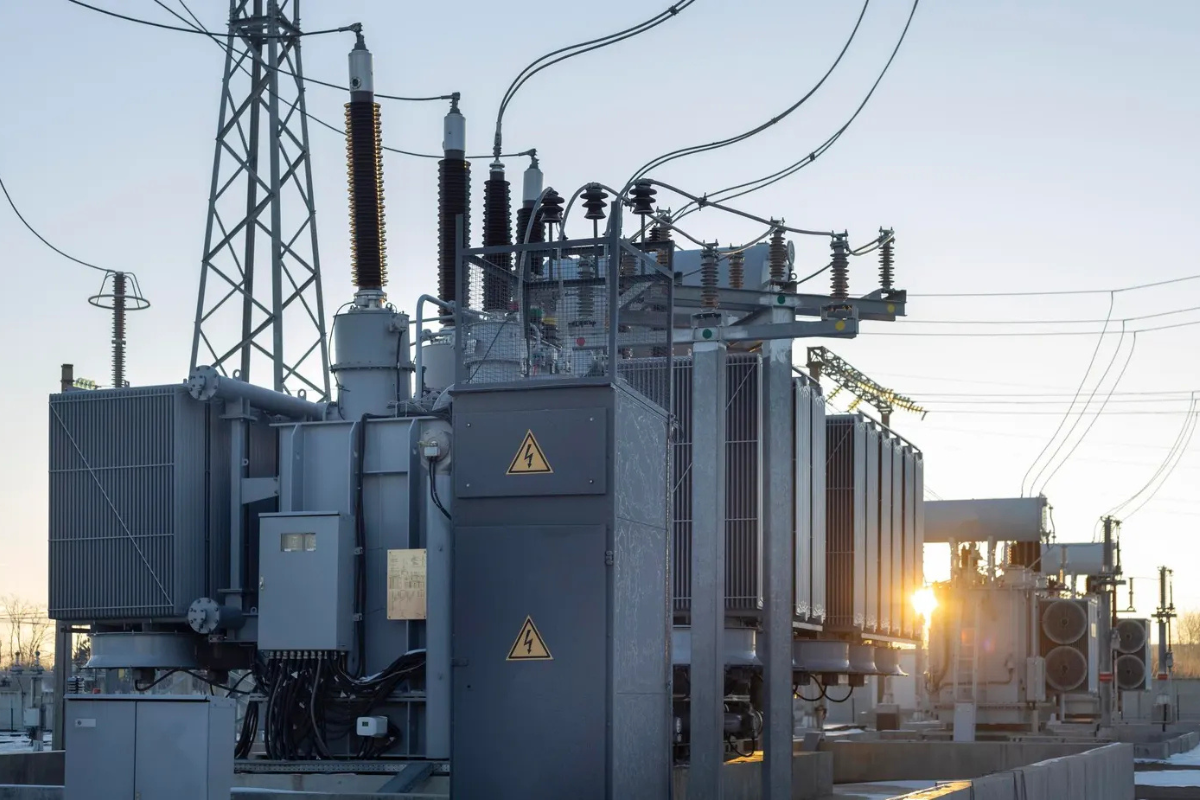
The result is massive energy demands and wastewater streams that are notoriously difficult to treat. In many textile hubs, untreated effluent continues to flow into rivers and streams.
“If you go into major textile regions, you’ll see pipes everywhere,” Hussey says, “and if you speak to people there, you’ll learn that there’s a massive issue in wastewater discharge … you’ll even hear stories about blue dogs walking around”.
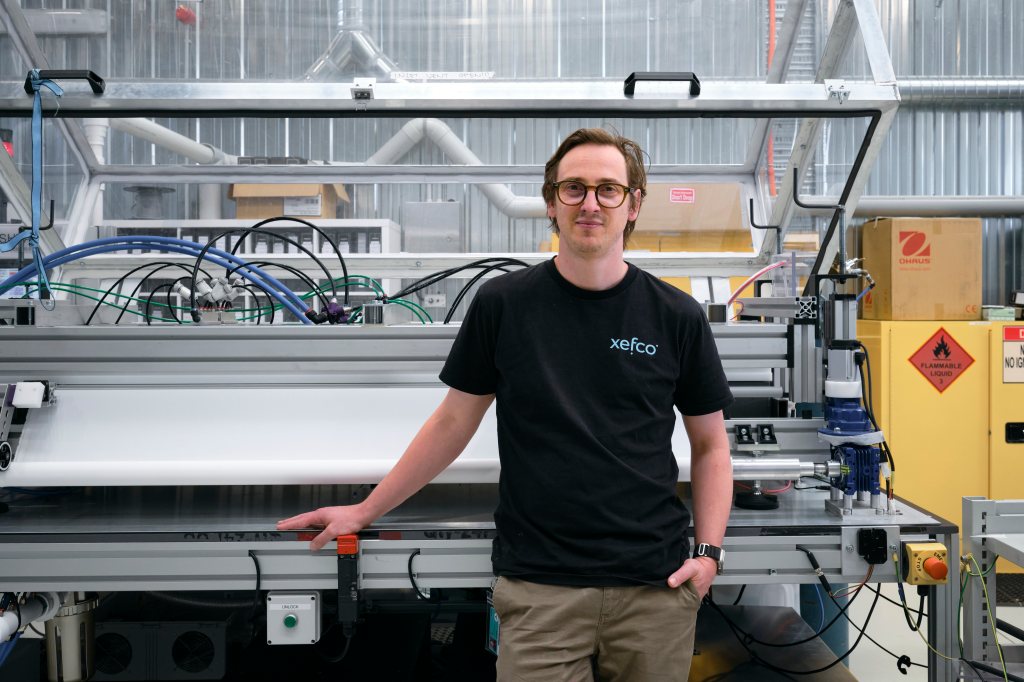
Now, despite mounting pressure from regulators and brands, many of which are now required to disclose Scope 3 emissions, dyeing and finishing have seen little disruption. Yet as companies chase aggressive carbon targets, often 30-50% reductions within a decade, the need for change is ever more clear to Hussey.
Xefco bets that meaningful environmental change won’t come from incremental tweaks to century-old methods but by replacing them entirely. “The real opportunity is to remove the water altogether,” says Hussey.
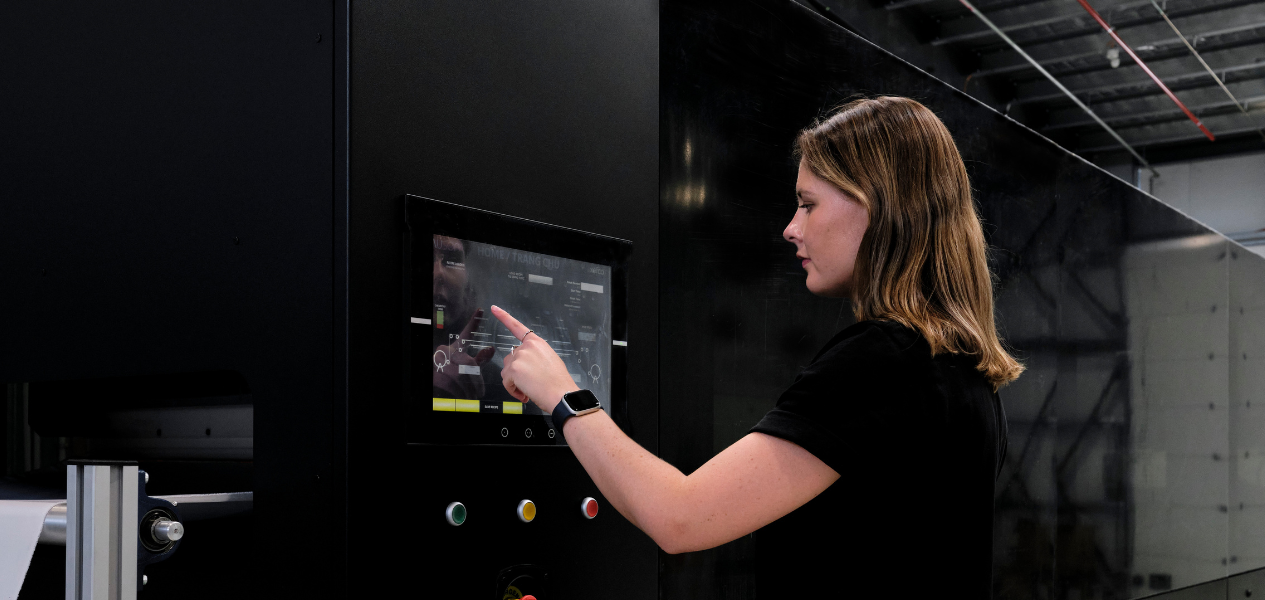
So Ausora was built, a water-free dyeing and finishing system built around atmospheric plasma.
At the heart of the process is a re-engineered version of plasma-enhanced chemical vapour deposition (PECVD), a coating technique used in semiconductor manufacturing. Traditionally, PECVD requires vacuum chambers, making it slow and expensive for low-margin, high-volume materials like textiles.
Ausora’s breakthrough was eliminating the vacuum. Through proprietary hardware and control systems, Xefco says it has made plasma coating work at atmospheric pressure and on an industrial scale.
The system uses inert gases to generate low-temperature plasma that polymerises ultra-thin coatings directly onto the fabric.
The coatings are thin and flexible enough to preserve the fabric’s hand feel, while delivering colour fastness that meets industry standards. The same process can also apply functional finishes such as water repellence, moisture wicking, fire retardancy, and anti-odour without additional wet treatments.
The environmental impact is dramatic: 100% less water, around 97% less chemistry, and up to 90% less energy than conventional dyeing and finishing. Hussey also hints that reduced energy demand will make the process far more compatible with renewable power.
Preparing to scale
Plasma technologies have been explored, although largely limited to niche finishing applications or vacuum-based systems that struggled to scale.
Every Ausora system is modular, designed around repeatable building blocks rather than bespoke factory installations. Hussey explained that for large mills, multiple units can be arranged in parallel or in-line to match throughput requirements.
Crucially, every machine is fundamentally the same, which Xefco believes will allow them to scale manufacturing more effectively.
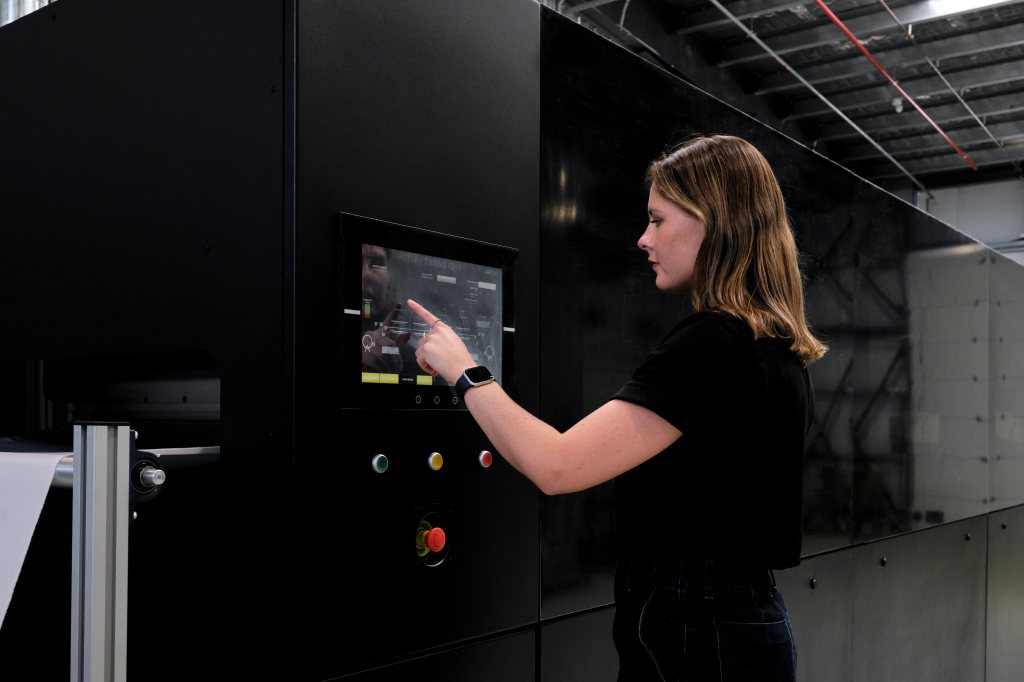
As technology eliminates the need for water infrastructure and treatment, the machines can be placed almost anywhere, opening the possibility of finishing and dyeing in areas with limited water resources.
Hussey describes Ausora as “large-scale printers,” capable of colouring fabrics on demand, opening the door to decentralised production, shorter lead times, and reduced overproduction.
Ausora’s first commercial implementation is underway, with Xefco partnering with Shinta Woo Sung (SWS), a global leader in footwear textile manufacturing. A purpose-built facility is planned for Vietnam soon.
Hussey hopes to produce “hundreds and ultimately thousands of [Ausora] machines over the coming years”, perhaps bringing one of the fashion industry’s dirtiest steps into the clean-tech era.
Want to see more Forbes articles on your feed? Tap here to make Forbes Australia a preferred source on Google.
Look back on the week that was with hand-picked articles from Australia and around the world. Sign up to the Forbes Australia newsletter hereor become a member here.