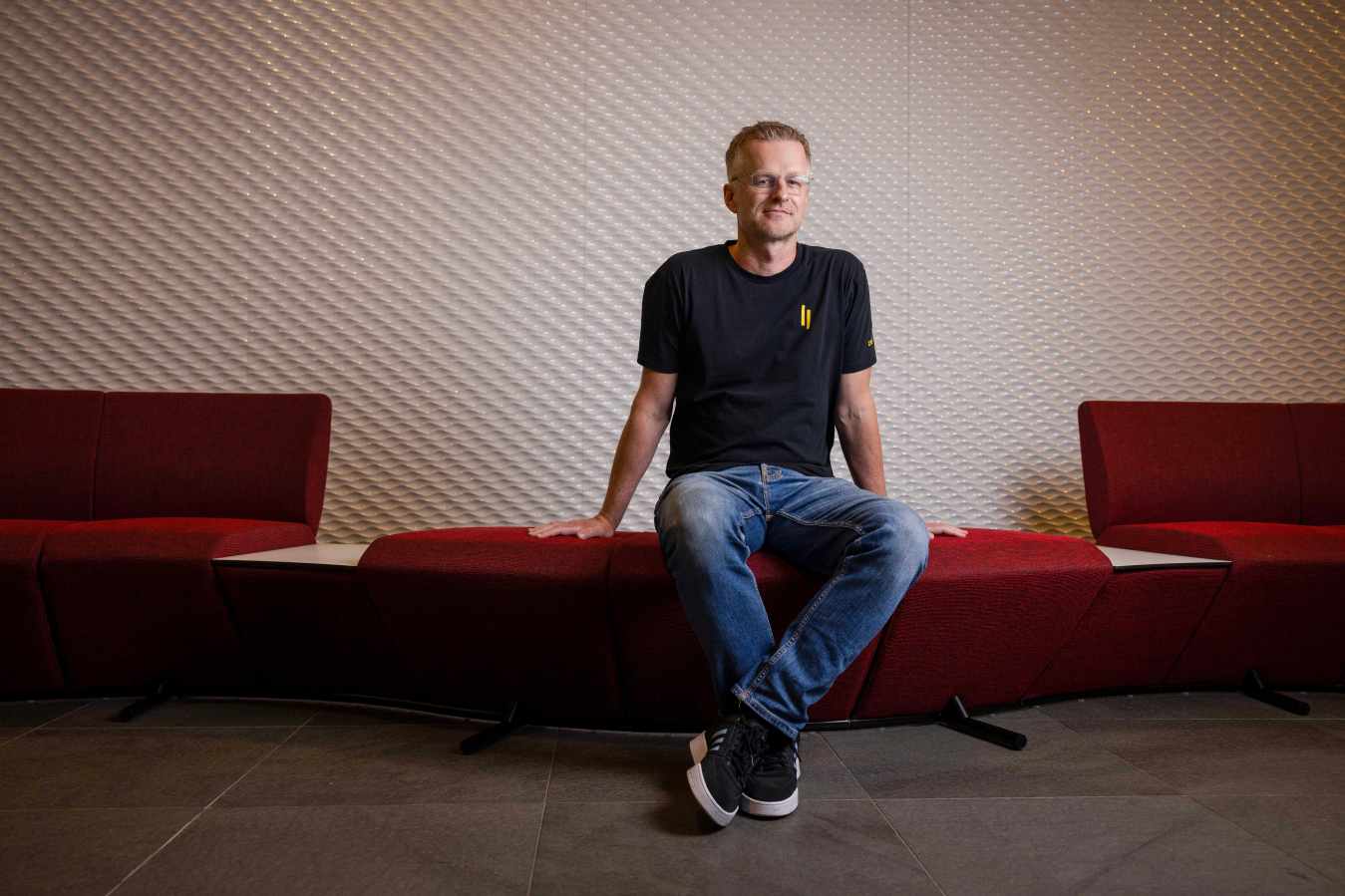

Pred Dragila was a retrenched banker and nightclub DJ when he became obsessed with fixing payments. Thirteen years later, his Fat Zebra processes $95 billion a year.
This story features in Issue 24 – out now. Tap here to secure your copy.

Pred Dragila was spinning discs at nightclubs. But the retrenched banker’s thoughts and conversation were consumed by electronic payments and by why merchants found it so darn hard to do them.
“I was the most boring person in my friendship group,” Dragila says, “because everyone was going on holidays and talking about great things and I was just thinking about technology in finance.”
DJ Pred knew banking wasn’t for him. It was too easy to see problems and too hard to solve them. “But it planted a seed of this idea about the movement of value and how the whole system worked. I couldn’t drop this idea in my head. ‘Why is it difficult for a business to get online and sell? And why is it controlled by the big four banks? How do you do it better?’”
In the post-GFC years, he built a network of engineers and web developers. “Lots of coffees. Lots of beers… It got to a tipping point where I realised, ‘Well, I have to give it a crack to solve this. I’m not a software developer, but I understand where the pain points are and why they haven’t been solved.’”
In 2013, Dragila and engineer Matt Lewis launched Fat Zebra, a platform that now claims to be Australia’s largest domestic payments company, handling 500 million transactions a year worth about $95 billion.
Fat Zebra declines to disclose what its clip is from that, but payments processors typically retain between 0.15% and 0.45% after banks and card schemes take their share, meaning Fat Zebra’s revenue would fall between $140 million and $430 million. All without having spent a cent on advertising or even talking much about itself.
In what he thinks is only his third interview, Dragila tells the unlikely story of how the immigrant kid in a baseball hat took on the suits and remains intent on taking payments from them.
Tragedy
Pred Dragila was born in Prague, Czechoslovakia, the son of Croatian and Serbian parents. His physicist father, Ranko Dragila, got a job in photonics at the Australian National University, Canberra, in the late 80s, bringing the family out when Pred was two.
Ranko died of leukemia when Dragila was eight, and his mother, Ljiliana, stayed in Canberra with the four children. Dragila went to the local Telopea Park High School, then enrolled at Lake Tuggeranong College.
“What drew me there was the engineering. The apple didn’t fall far from the tree with me, my dad and his interests. I was very much interested in this idea of building things and exploring, hyper-curious. Tuggeranong had a solar car project, and that fascinated me.
“We realised we couldn’t just be the software forever because our business will only be as good as a bank’s ability to service its customers. And that’s never a great place to be.”
Pred Dragila
“But I wasn’t the brightest of students. I really struggled with the idea of sitting in a classroom and learning. I don’t feel like it fed the curiosity.”
He dropped out and found himself DJing in Canberra clubs. “What young man wouldn’t run at the chance to do that?” says Dragila. “It was important for me because I was a bit of a nervous kid through school. I was very shy.”
Bored during the day, he got himself a job at the Commonwealth Bank, then St George and AMP. “It didn’t take long for me to realise that it probably wasn’t for me.”
Fat Zebra
A redundancy during the GFC sent him back to spinning discs, but the payments problem kept nagging at him. He knew the banks didn’t care. For them, payments were a loss-leading side hustle to the main game of lending money. They imposed credit checks and would take their sweet time in giving approvals.
“First, we needed to have a platform that was scalable and stable. No latency, no downtime. That was incredibly important,” Dragila says. “Secondly, it had to be easy to connect to. Our end customer shouldn’t have to understand how it works. They just have to know that it works. If they’re thinking about it, it’s because something’s broken.”

In his wilder dreams, he thought that maybe one day they could take the banks out of the equation, but to start, they needed their money to provide the “merchant facility”, the account for the business to pull the money out of.
In early meetings, he could sense them sussing him out. “The banks look at any new participant in the fintech ecosystem as a threat before they see it as an opportunity. So, the first interaction is always just sizing you up and understanding what the threat to the bank is by allowing you into the ecosystem.”
Fat Zebra was offering increased reach. The banks provided the accounts.
“That in itself became the problem,” says Dragila. “Over time, what we learned was that while we were able to do the technology well, our customer base was still relying on two parties to get it right. And while we backed our ability to get it right, we consistently found that the banks couldn’t get it right.
“I’ve always been of the belief that it’s better to build value than it is to grow into a valuation.”
Pred Dragila
“Ultimately, they’re not payments companies. They’re not designed to revolve around payments. This is our day job. This is just another product they sell. We realised very quickly that we couldn’t just be the software forever because our business will only be as good as a bank’s ability to service its customers. And that’s never a great place to be.”
But business was slow; Dragila relied on his wife’s teacher’s wage to survive the first few years. “There were many moments where I asked myself, ‘What do I do if this doesn’t work?’” There would be “sugar hits” of growth, but they always seemed to flatline, and the doubt would return.
Dumb money
“My now wife was super supportive. She kept reminding me why I was doing it and kept on telling me to back myself and just get it done. She always knew what to say to snap me out of it. You have to have that reminder of why you’re doing it. And I genuinely believed that we were the ones to solve the problem.”
Having bootstrapped for six years, in 2018 they raised $8.8 million in an equity deal with US payment processor First Data Merchant Solutions. The idea was that Fat Zebra would be First Data’s front-end portal, giving global scale. But in July 2019, First Data was bought for US$22 billion by Milwaukee-based fintech giant Fiserv. And the whole point of the deal evaporated.
It went from being strategic money to almost dumb money in a matter of months,” says Dragila. The money wasn’t enough to break free of the banks, but Dragila was able to pay himself a wage for the first time and to bring on the extra staff who would build the system that allowed them to hit critical mass.
When huge amounts of money and valuations were being thrown around during COVID-19, Dragila resisted. “I’ve always been of the belief that it’s better to build value than it is to grow into a valuation. If we did it right, if we did it consistently, we would build a business that isn’t here for the next five years, it’s here for the next 15, 20 years and beyond.
In February 2024, Fat Zebra bought customer data-portability fintech Adatree and, then seven months later rolled up payment software provider Pin Payments. Then, four months later, swallowed SecurePay, Australia Post’s online payments company, for an undisclosed sum in April 2025.
“We’re a business now that processes over 500 million transactions a year in Australia,” says Dragila. “And we’re touching almost one in every five online transactions in this market. So that scale is what’s allowing us to now start looking at breaking free of the banks. We will be there by the end of this year.
“We’ve never spent a dollar on marketing. It shows that if you’re consistent and solve a problem, your customer base will talk about it and ultimately become your biggest sales force.”