What began as a solution to ill-fitting suits has grown into a $110 million platform, capturing human body data at scale. Now, Bodd is taking its technology into healthcare to power a new generation of data-driven care.
This story features in Issue 21 of Forbes Australia. Tap here to secure your copy.
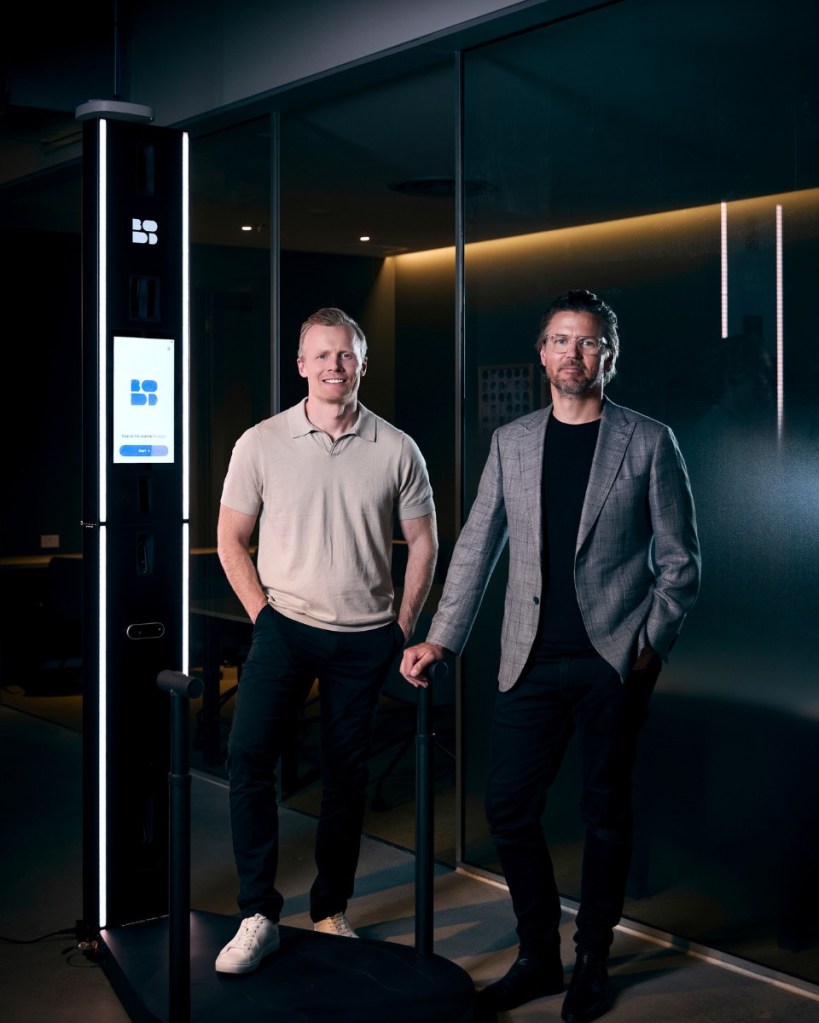
Defence, aviation, apparel, fitness, healthcare. On the surface, these industries appear to share little in common. Yet each now falls within the expanding remit of Bodd, the Melbourne-based start-up unlocking human body data at scale.
Founded by childhood friends Rob Fisher and David McLaughlin, Bodd has built a non-invasive 3D scanning system designed to map the human body. In under 90 seconds, the scanner generates a detailed profile of its user, recording a suite of physical measurements such as body composition and shape, as well as health metrics including blood pressure and heart rate.
“At our core, we’re a data and science company focused on the human body,” says Bodd co-founder and chief technology officer David McLaughlin.
“We’ve built is a platform that brings together our hardware device and cloud system to create a simple and interactive experience that allows us to capture a rich set of data and insights quickly, accurately, and privately.”
Rather than selling its equipment, Bodd leases its Bosch-manufactured scanners on a subscription basis, with customers paying per scan under multi-year agreements.
“What makes the model work is that the platform itself is very modular,” McLaughlin says. “It’s like a marketplace, where customers can choose which features they want to turn on and activate for an additional fee.
“Because of the range of what we can do, we’ve seen our technology deployed across a wide range of industries.”
The result is a roster of customers that spans the New Zealand Defence Force, United Airlines, Stewart & Heaton, Portwest, and Brooks Brothers.
From next year, the company will also begin deploying its technology in the health and wellness space, including in pharmacies supporting patients on GLP-1 weight-loss treatments such as Ozempic, as well as in clinical settings.
“Once a patient is scanned, that data becomes a baseline that can be used to track their progress over time throughout their weight-loss journey.”
It’s not just customers who are paying attention. In December, Bodd raised $15 million in an oversubscribed funding round, valuing the company at $110 million.
However, for Rob Fisher and David McLaughlin, building a health technology company of this size was never the plan.
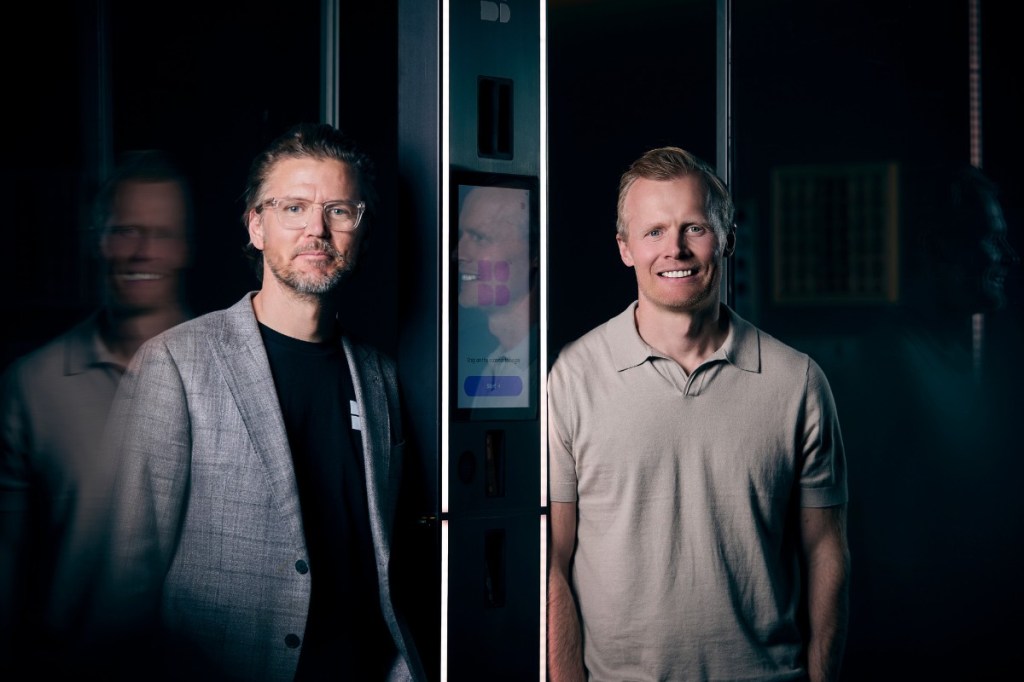
Before Bodd, the pair were running Tailors Mark, a made-to-order menswear business. It was there that they first ran into the problem that would ultimately shape the company’s direction.
“Like every apparel brand, we were dealing with the same fundamental problem: you don’t truly know how a garment will fit until it’s on a customer’s body”, says Bodd co-founder and chief executive officer Fisher. “That created a lot of hidden waste through alterations, remakes, and returns.
They soon realised the issue wasn’t how garments were designed or made, but the lack of reliable data behind the fit.
“We started looking for a way to capture accurate, consistent body measurements and body-shape data at scale, and nothing on the market did that well enough.”
Over the following years, they began developing their own solutions. The business became a testing ground for everything from online sizing calculators designed to statistically predict body dimensions to mobile apps that estimated measurements from photos.
“We used the menswear business almost as an R&D hotbed to build and try these different technologies,” McLaughlin says.
Eventually, they assembled a crude prototype that would form the foundation of Bodd’s technology. Built from little more than timber, cameras and a rotating platform, it was already capable of capturing data in ways they hadn’t seen before.
“That was a real ‘aha’ moment for us. We could see the value in the data we were generating, even from something that was rudimentary at the time,” Fisher says.
“Once we stepped back, it was clear that inaccurate body data wasn’t just limiting Tailors Mark – it was driving inefficiency and waste across the entire apparel industry.”
From that point on, the opportunity became impossible to ignore, and the pair went all-in on the technology.
“I think we’ve learned from our own entrepreneurial journeys that you can only do one thing well at a time,” McLaughlin says. “In those early days, Rob and I had too many plates spinning, and nothing was getting the focus it needed.
“So we realised that if this was going to work, if the business was going to reach its potential, we had to go all in. Those are the moments in a career when you have to step back and ask what the right call is, and where the bigger opportunity really lies.
“We could have kept running the menswear business, but we became increasingly convinced that the technology had greater scope, both in the problems it could solve and the industries it could open up.”
With the onset of the pandemic, the pair used the period to rebuild the technology from the ground up. Early trials quickly pulled them into uniforms and workwear, where the value proposition was clear.
“We quickly realised the technology was fundamentally an efficiency tool,” McLaughlin says.
“The uniform and workwear companies we were working with were managing large workforces that had to be fitted accurately and at scale. In those environments, it’s about function, safety, and ensuring people have the right equipment to do their jobs.”
But it didn’t take long for that logic to extend beyond apparel. As organisations began asking what else could be measured while people were being scanned, the focus shifted from what workers were wearing to what was happening inside their bodies.
One example came through Bodd’s work with Australian Defence Apparel and its customer, the New Zealand Defence Force.
“The human performance team there saw Bodd being used to size troops and started asking whether we could also capture things like BMI, body composition or other physical metrics,” McLaughlin says.
“That was another ‘aha’ moment for us. We realised the data wasn’t limited to clothing or sizing. Once you’re scanning someone for their kit, it’s only natural to ask what else you can measure. That’s when the door really opened on what the technology could become and its potential in health.”
With a team of nearly 30, Bodd is now focused on taking that expanded capability to a global stage. With deployments already spanning defence, aviation, apparel, fitness, and healthcare, the company is accelerating, with North America, Europe and the Middle East firmly in its sights.
At the same time, Fisher says the next phase of growth, particularly in health and wellness, demands a different level of care.
“Health data is incredibly powerful, but it’s also incredibly sensitive,” he says. “The data we collect can genuinely accelerate and improve outcomes, but only if it’s interpreted correctly and integrated thoughtfully into care pathways.
“We’re very conscious of not over-claiming or rushing ahead of evidence. Getting the balance right between innovation, regulation, and trust is critical. The opportunity is huge, but so is the responsibility, and we take that very seriously.”
Fisher says Bodd’s next chapter is defined by scale. “We started by solving a very specific problem around fit, but we’re now building the infrastructure for accurate human body data that can support better decisions across entire organisations.
“As more industries move away from reactive models and toward preventative, data-driven approaches, the timing feels right. Being able to take this globally, and contribute trusted data is what makes the next chapter for Bodd so compelling.”
And just as Tailors Mark revealed a much bigger opportunity over time, McLaughlin believes Bodd’s early identity may one day feel just as narrow.
“If you look three to five years ahead, we’ll probably be seen as a health and wellness data business that just happened to masquerade as an apparel sizing business.”
Want to see more Forbes articles on your feed? Tap here to make Forbes Australia a preferred source on Google.
Look back on the week that was with hand-picked articles from Australia and around the world. Sign up to the Forbes Australia newsletter here or become a member here.