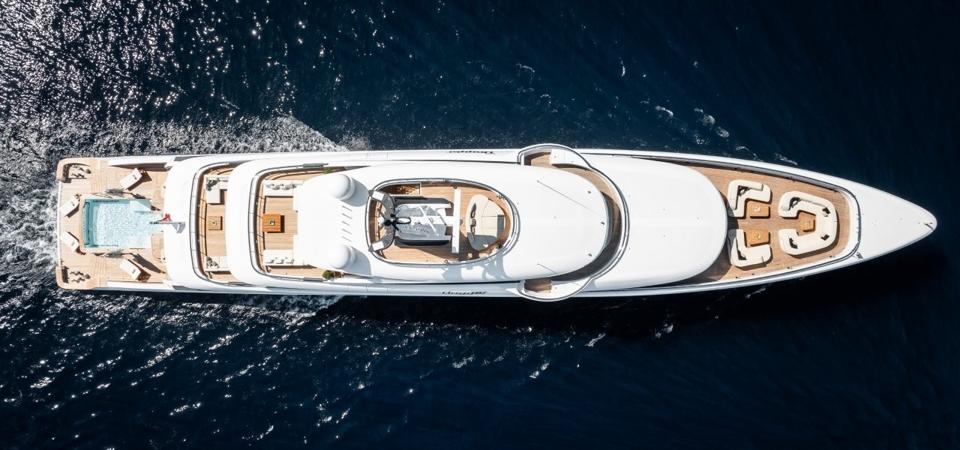
The 219-foot-long Benetti hybrid superyacht Dagger made its global debut at the Monaco Yacht Show. Built by Benetti, the vessel features an exterior designed by RWD and sophisticated interiors created by Sinot Yacht Design and Architecture.
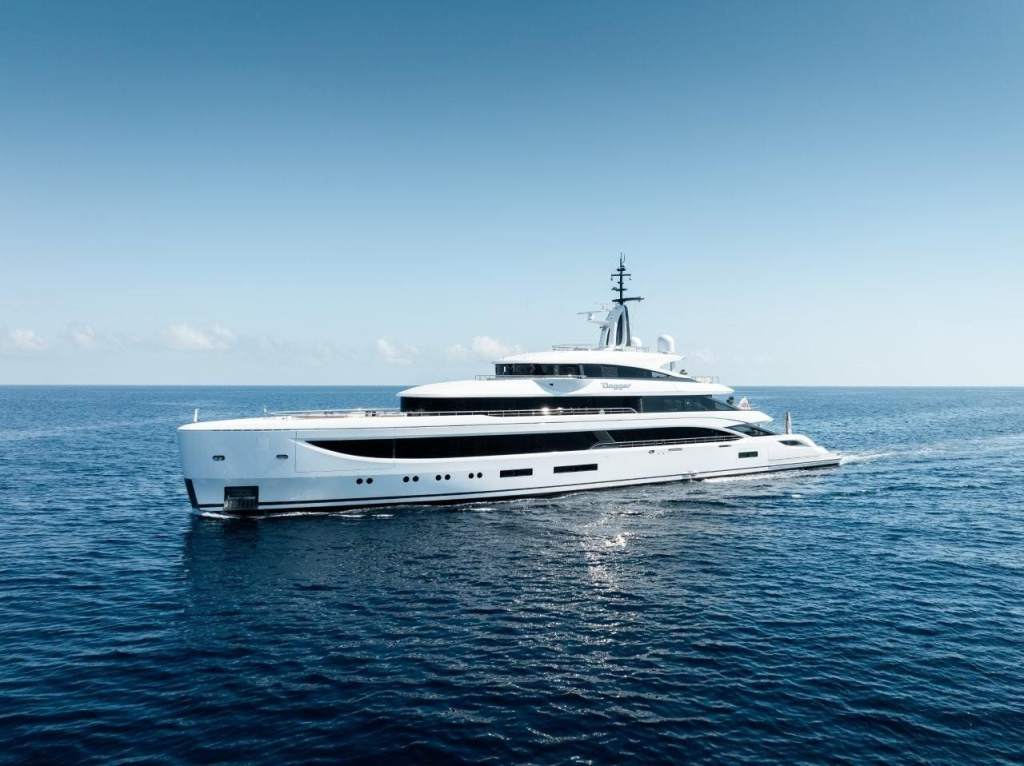
I’ve always believed that any efforts to improve environmental sustainability in yachting will only really be effective if they’re…cool. Now, I know that sounds pretty superficial. But hear me out. Yachting is inherently cool.
And who doesn’t want to help the environment? But…the practical actions required to reduce the environmental impact of anything—yachts, cars, planes, etc.—is usually quite technical and perceived to require some sort of sacrifice. Now that’s not very cool, is it?
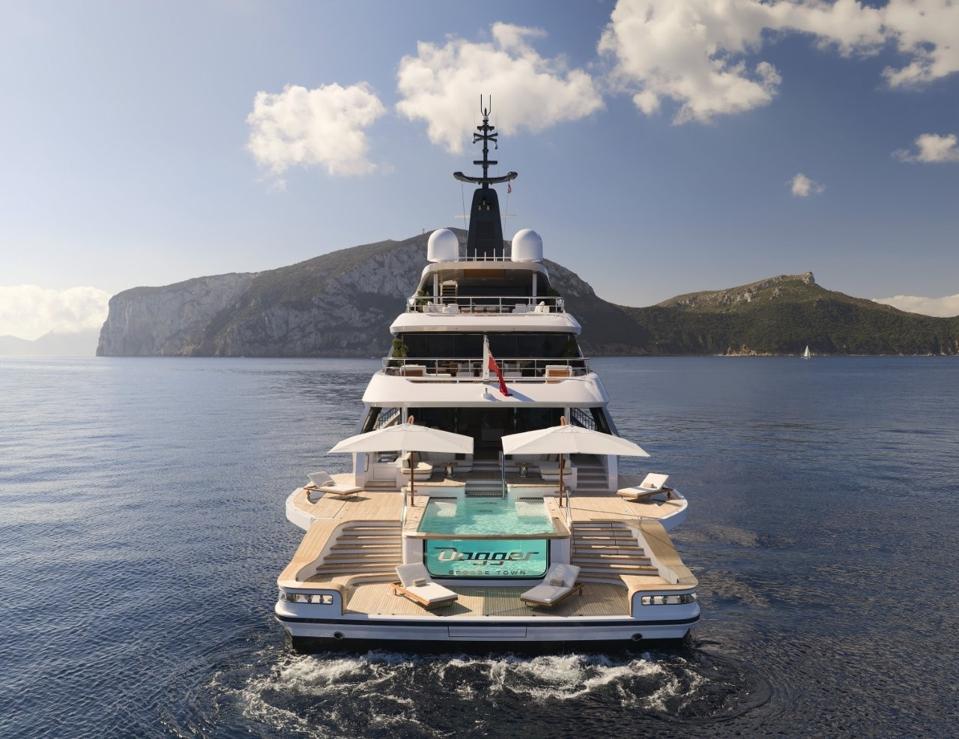
But you know what is cool? The 219-foot-long Benetti B.Now hybrid superyacht named Dagger that made her global debut at the Monaco Yacht Show recently. It features an exterior designed by RWD, interiors by Sinot Yacht Design & Architecture and is built by Benetti that has been leading the charge to improve environmental sustainability in yachting for decades.
In fact, Dagger’s engine and generator configurations, variable pitch propellers, and 360 kWh Sodium-Metal Chloride (salt) battery pack featuring peak shaving capabilities of up to 150 kW provides a state-of-the-art tested technological solution that Benetti’s R&D team engineered to improve life onboard while reducing environmental impact.
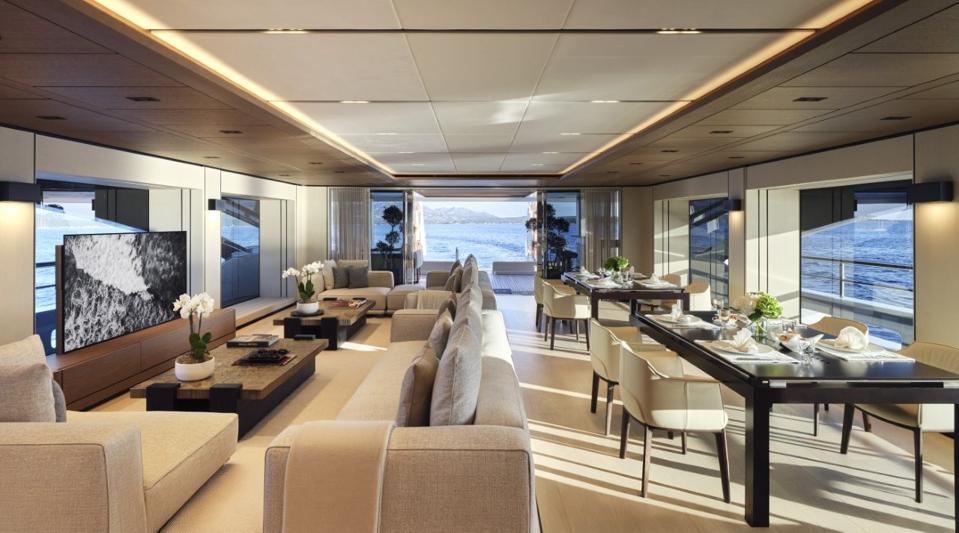
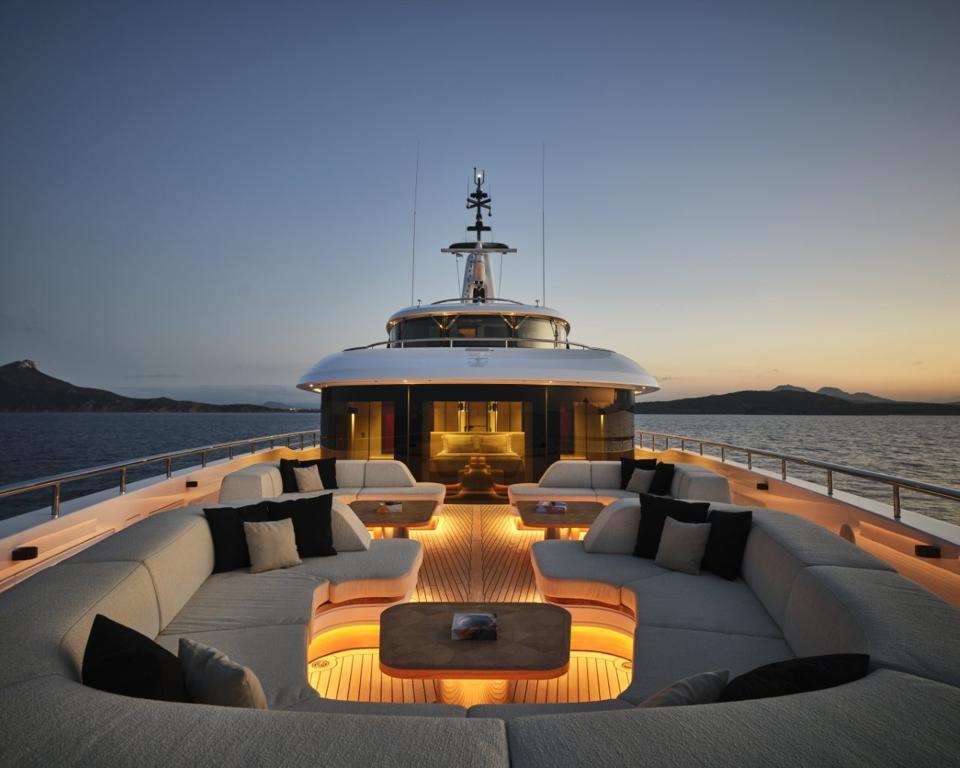
And you know what else? The continuity between super technical naval architecture, sexy exterior lines (including the unequivocal success of the Oasis Deck® that was developed for Benetti by RWD), and the soothingly sophisticated interior design is, um, very very cool.
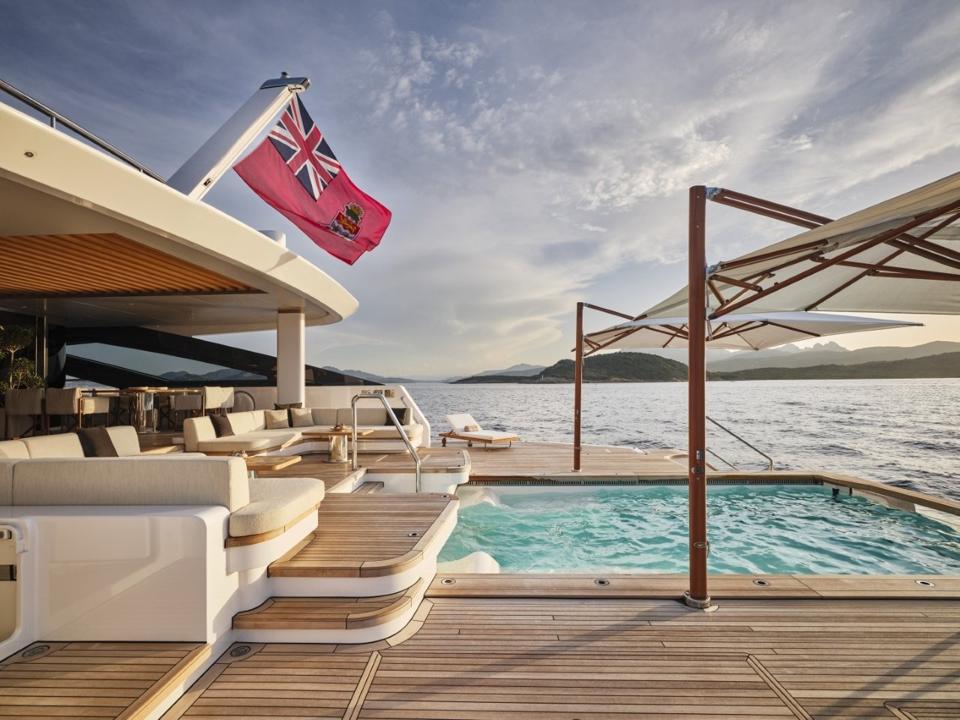
But maybe it’d be better if I let Sinot designers explain their interior inspiration. “At the heart of the concept is a sophisticated yet highly adaptable living environment: an interior that responds naturally to different moments on board, from intimate family life to larger and more formal occasions.
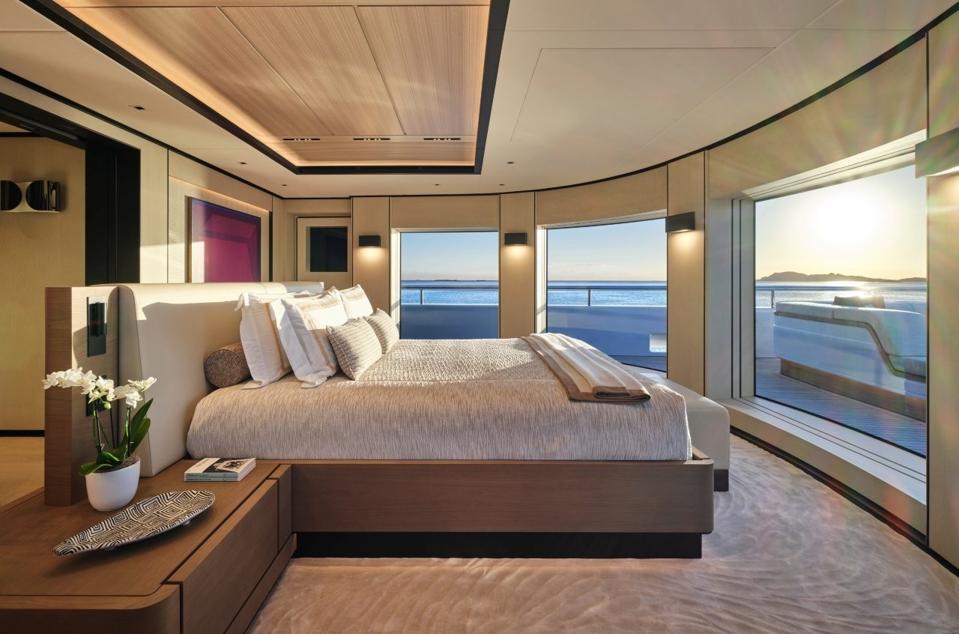
“A strong graphic framework gives M/Y DAGGER its distinctive architectural language. Light woods, natural stones, tactile wall finishes, and soft upholstery are contrasted by darker architectural lines that continue across furniture, doors, floors and ceilings.
Together, they create a recognizable rhythm and continuity throughout the yacht.
“This architectural precision is balanced by softer, more organic forms. Structured lines transition into rounded corners, curved furniture and generous upholstered elements, creating spaces that feel refined without becoming formal.”
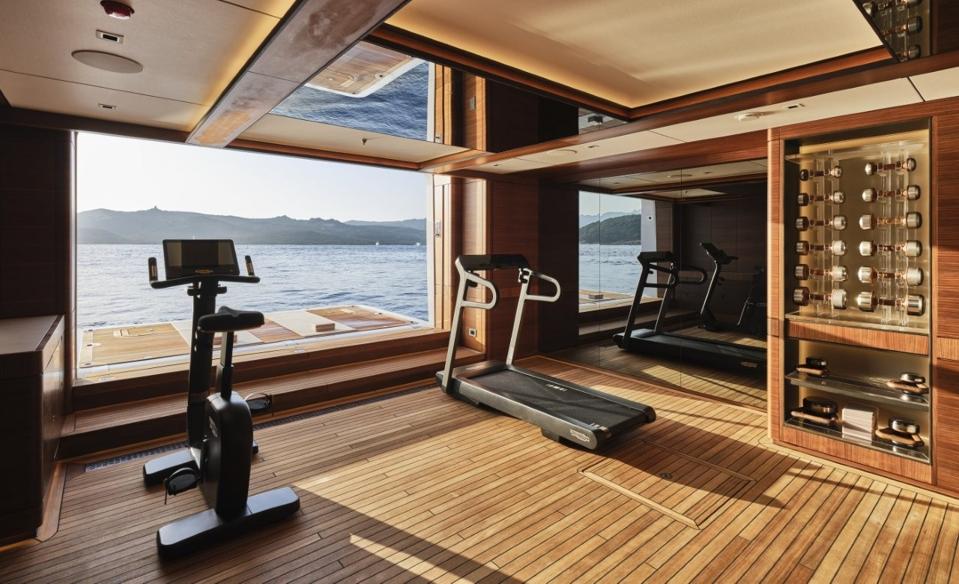
And the wide-open Oasis Deck® is not the only way owners and guests can enjoy chilling in the sun and easy access to the sea. There’s also a Beach Club / Wellness that features a gym and spa, as well as a large tender and toy garage.
Meanwhile, reducing Dagger’s environmental impact all starts with two Caterpillar main engines 2x CAT C32 – rated at 1193 kW @ 2000-2300 rpm and three Caterpillar electric generators (two C7.1 at 118 ekW and one C9.3 at 200 ekW).
Bridging the mechanical and electrical systems are two 200 kW VEM Shaft Generators / Electric Motors (PTO/PTI)—bidirectional electrical units capable of functioning both as generators and as propulsion motors: In PTO (Power Take-Off) Mode: they power the onboard hotel loads and recharge the battery bank by drawing power from the main engines.
In PTI (Power Take-In) Mode: they convert energy from the generators or batteries into direct thrust on the propeller shafts.
Another key technological development is the yacht’s Controllable Pitch Propellers (CPP) that adjust blade pitch in real time, optimizing hydrodynamic efficiency and enabling speed adjustments or course reversals without changing shaft rotation direction or altering the engines’ optimal RPM range.
This architecture enables the captain to set different operating profiles based on the cruising scenario: Enhanced Comfort Mode (7 knots): the vessel operates under 100% electric propulsion with the main engines switched off.
The diesel generators power the electric motors while the battery bank manages load peaks (peak shaving), ensuring maximum acoustic comfort during coastal cruising or night passages.
Extended Range Mode (12 knots): cruising is performed using the thermal main engines only, with the diesel generators remaining off. The shaft generators cover the entire electrical demand of the onboard services, reducing generator running hours and achieving fuel savings of up to 15% compared to a conventional diesel-mechanical system.
Eco Transfer Mode (10 knots): designed for long displacement transfers, this mode runs on a single main engine supported by the battery pack, minimizing both fuel consumption and mechanical wear.
One of Dagger’s most distinguishing engineering choices is the adoption of a 360 kWh Sodium-Metal Chloride (salt) battery pack featuring peak shaving capabilities of up to 150 kW.
The sodium-metal chloride chemistry is safe because the non-flammable electrolyte inherently eliminates the risk of fire and thermal runaway. This safety profile allows the battery modules to be installed in existing technical spaces without requiring an isolated, dedicated Battery Room equipped with complex fire suppression systems, maximizing usable onboard volume.
Furthermore, salt batteries are immune to degradation caused by long periods of inactivity and fully restore performance upon reactivation. During daily operation at anchor, they allow the generators to be shut down completely, keeping the yacht in total silence for up to 2 hours with zero local emissions, while fully maintaining hotel services.
Onboard comfort while anchored is further enhanced by an exhaust system routed high above the superstructure to keep the air and the water around the stern clean. Integrated heat exchangers recover thermal energy from the generators for onboard utilities without increasing energy consumption.
Cool, right?
Want to see more Forbes articles on your feed? Tap here to make Forbes Australia a preferred source on Google.
Look back on the week that was with hand-picked articles from Australia and around the world. Sign up to the Forbes Australia newsletter here or become a member here.