From a late start in Denmark to the legendary red of Maranello, the 17-year-old Ferrari recruit and her Whoop wearable are out to prove that in the modern paddock, biological data is the ultimate competitive advantage.
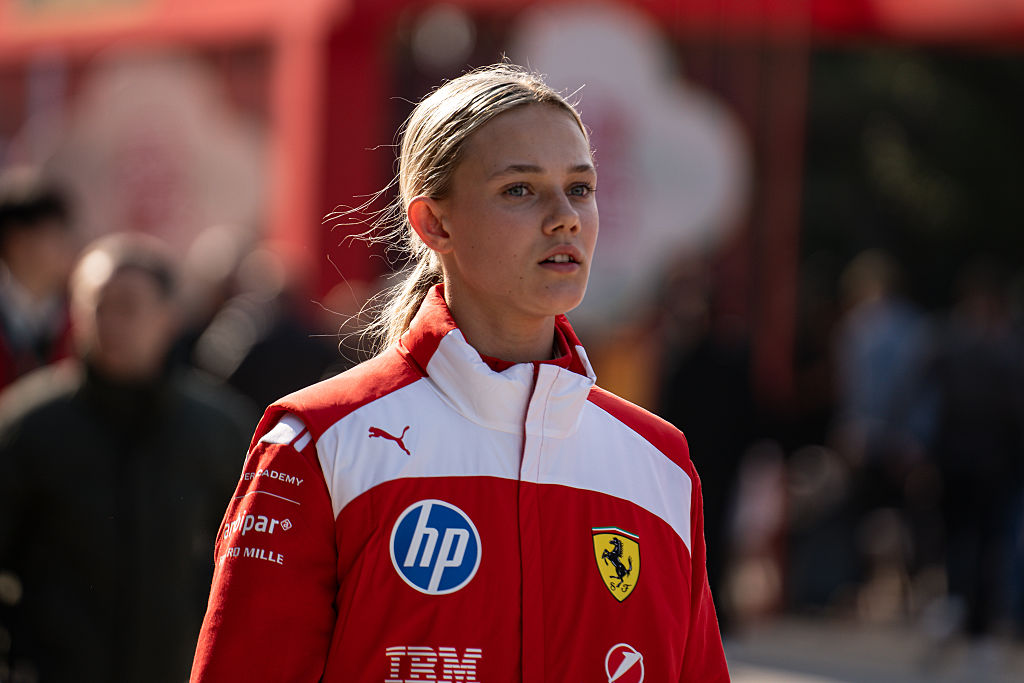
The face on my screen is framed by the headrest of a moving vehicle, as the bustle of a Shanghai morning passes by in the background. It is 9 am on Monday, less than 24 hours since Alba Hurup Larsen finished her first F1 Academy race of 2026, this time driving the iconic Ferrari Rosso Corsa.
Larsen, her parents, and her sister, who is seated in the very back of the van, are already in a logistical sprint: a flight to Denmark for a 24-hour “pit stop” before deploying to the Scuderia Ferrari headquarters in Italy.
At 17, the Dane is the newest recruit to the Ferrari Driver Academy, but she isn’t just another ‘pilot,’ as the Italians say. She is a test case for athletic optimisation – her biological data being uniquely female in this sport, and the results treated with the same analysis as the car she drives.
The language of telemetry
To understand Larsen’s rise, one must understand telemetry. In a professional racing context, telemetry is the high-speed, wireless transmission of data from the car to the pit wall. It is the invisible umbilical cord between the machine and the engineers, turning every gear shift and tyre rotation into a live graph on a monitor.
For Larsen, however, and this newest breed of elite athletes, the definition has expanded. It’s no longer just about the car – or the racquet, or the golf club, or basketball.
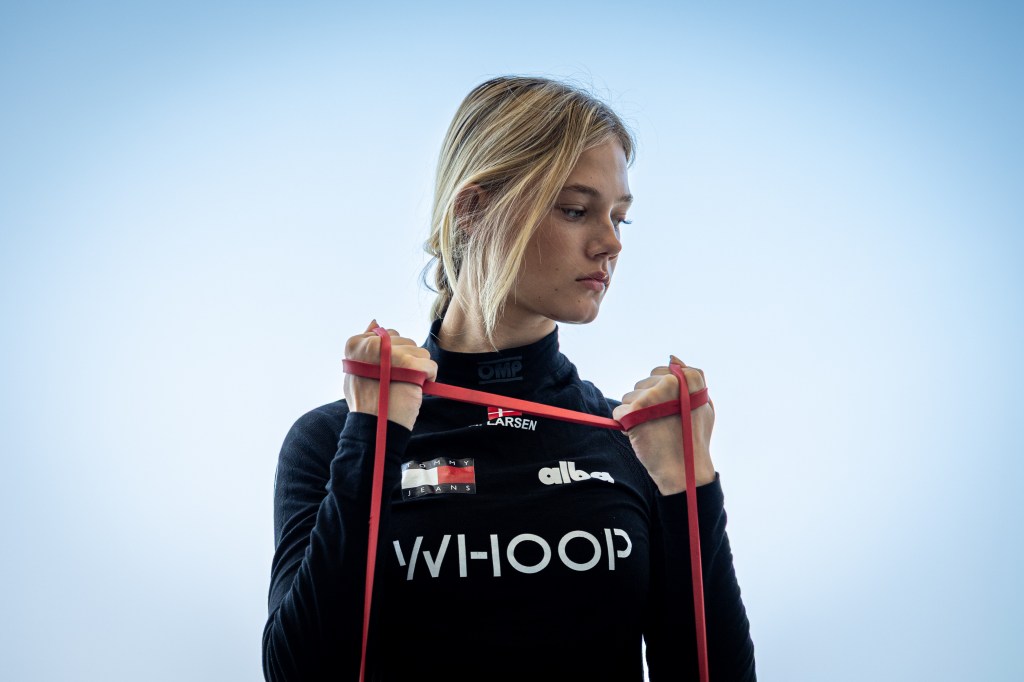
It’s about the human engine that interacts with those devices. By using wearable tech, Larsen tracks “human telemetry” – metrics like heart rate variability and real-time stress levels – treating her own physiology with the same analytical rigour as a vehicle. In short, telemetry is the conversion of raw performance data into objective, actionable math.
“I can see my stress level, my heart rate when I’m in different situations,” Larsen explains. She has identified a phenomenon she calls the “Qualifying Spike” – the physiological tax of high-stakes pressure.
“For example, from practice to qualifying, even though we’re doing the same amount of laps, the heart rate can rise like 10 BPM – just because there’s more pressure in qualifying. It really helps me to stay calm by reducing my heart rate, and that’s something that I learned from wearing my Whoop.”
Competitive karting and a learning mindset
While many successful drivers are doing laps at age four, Larsen didn’t sit in a competitive kart until she was 12. Closing that eight-year gap required learning in months what used to take years.
“It’s about working hard, and there’s so much more than just driving. Simulator, physical training, you optimise on so many different things,” she says. “Data is such an important thing about Formula 1 and the whole world of racing. If you’re being very analytic when looking at the data, that’s how you become a good driver – from keeping learning and wanting to learn.”
This is not Larsen’s first rodeo on the F1 circuit. She was sponsored by Tommy Hilfiger in her debut F1 Academy season last year, finishing in 7th place ahead of 19 other female drivers.
The Scuderia Ferrari Driver Academy announced in December that Alba would race in its livery for the 2026 season, calling her ‘a rapidly rising talent.’ In addition to the six F1 Academy races, Larsen is competing in the 2026 mixed gender, 10-round F4 British Championship.
Racing legends and ‘More Than Equal’
While both sexes can compete in F4, few women do. Across all motorsport categories, just 10 per cent of participants are female, according to research from the David Coulthard-founded organisation More Than Equal, which states its mission is to break barriers and pave the way for the first female F1 champion.
Empowering women and girls to race is a passion Larsen shares with 62-podium winner Coulthard.
“Racing is still a man’s world, but it is changing,” the poised teenager says through her white headphones, while bumping through the traffic of Shanghai. “Introducing girls to racing and getting them to try it for the first time is what I’ve been doing with my G.I.R.L. project. Driving fast and knowing that you belong builds a lot of confidence.”
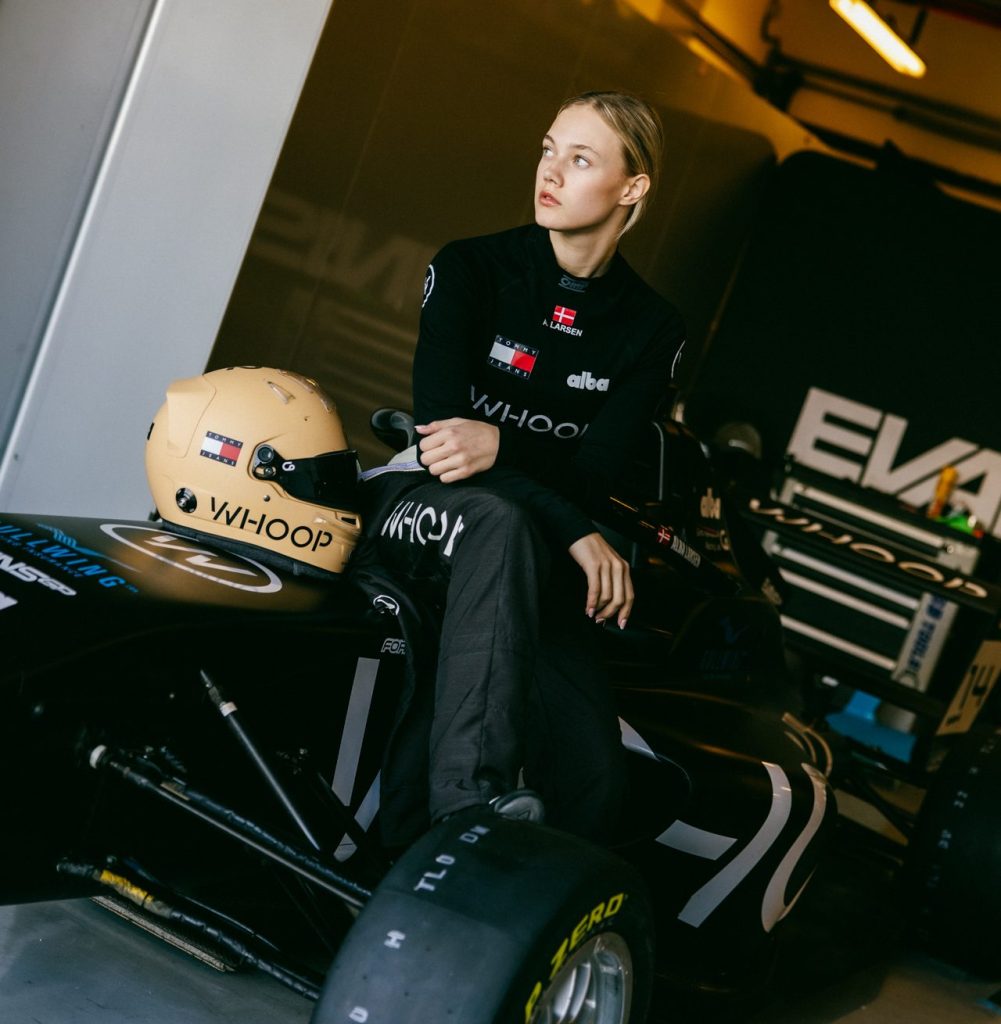
Founded when she was just 15, Girls International Racing Lab (G.I.R.L.) won the FIA’s first Women in Motorsport Award last year. The initiative has reached 400 girls in Larsen’s native Denmark and aims to reach 15,000 around the world in 2026.
As for what skills are needed to be superior on the track, Larsen credits intuition, practice, and relentless determination.
“I’ve always been super competitive. I’ve always really had that, like, fighter instinct.”
Alba Larsen
“I just love overtaking and really fighting on track. The rest is really about driving and driving. You know that 10,000-hour rule … when you do it so many times, you get good at it.”
Her mentorship circle now includes fellow Ferrari drivers Charles LeClerc and Lewis Hamilton, who she consulted in Shanghai on the ins and outs of the track. In Hamilton, Larsen sees the “best of the best” and a fellow boundary-breaker. “He has also met a lot of barriers that he needed to break down,” she says. “And he is interested in getting more girls into racing.”
Also in the Whoop ambassador’s orbit, is Danish motorsport legend Jan Magnussen, who raced F1 and won Le Mans four times.
“There’s a go-kart track just 15 minutes from my house. My parents are good friends with Jan and his family and I went to school with his two youngest kids who introduced me to racing. And that’s really how I fell in love with it,” she says.
Beyond the telemetry and the simulators, Larsen is navigating a landscape that wasn’t originally built for her. Despite the progressive nature of Scandinavian culture, the paddock remains a fortress of tradition. She spoke candidly about the benefits of growing up in Roskilde, a 40-minute drive from Copenhagen, and in a country where girls are encouraged to be competitive.
“In general, girls play a lot of sports. I played handball before I got into racing, and at first karting was just for fun. But when I started doing it internationally, and won the FIA Girls on Track and was named the fastest girl in the world, that’s when people were like, oh, she is serious.”
She remembers the boys from her school who doubted her, unaware that they were fueling the “fighter instinct” that would eventually land her a seat at Maranello.
“Some of the boys from my class, they made fun of it and didn’t think that I could get far. But now that I race for Ferrari, it’s like … well, now you can see, right?”
Want to see more Forbes articles on your feed? Tap here to make Forbes Australia a preferred source on Google.
Look back on the week that was with hand-picked articles from Australia and around the world. Sign up to the Forbes Australia newsletter here or become a member here.