Divorced from Bill Gates and the foundation they created, French Gates discusses connecting with other women to maximise their impact at a critical time.

Additional reporting by Matt Durot and Monica Hunter-Hart
On an NPR podcast in early February, Melinda French Gates was asked about the latest Epstein files released by the Justice Department that revealed some scandalous but unverified claims about her ex-husband and actions he was trying to hide from her. While French Gates suggested she divorced Bill Gates and severed ties with the Gates Foundation at least in part due to earlier Epstein revelations, she took that moment to focus not on herself but the pain inflicted on the victims, saying that no girl should ever be put in that situation. “It’s beyond heartbreaking… I am able to take my own sadness and look at those young girls,” she added.
It’s not lip service for French Gates; she has literally pivoted away from Bill, whom she left in 2021, and from the foundation they set up together a quarter of a century ago, to focus on philanthropy and investments that seek to help girls and women. In fact, she has been building up her own philanthropic initiatives for years. She founded an umbrella organization known as Pivotal in 2015, then launched its private foundation arm in 2022 and three smaller branches—Pivotal Momentum, Opportunities, and Pathways—in 2023. (Those smaller foundations were originally named after birds—Rosefinch, Greenfinch and Snowfinch—before being rebranded in 2024.) It’s not clear how these foundations’ missions differ, though they’re all part of Pivotal, which is “working to accelerate the pace of social progress for women and young people in the U.S. and around the world,” according to its website.
While Forbes still counts Bill and Melinda’s giving together—the couple has given away an estimated $52.6 billion, more than anyone besides Warren Buffett—Melinda now has her own money to influence charitable giving as she envisions, including $12.5 billion her ex-husband donated to Pivotal after she left the Gates Foundation in 2024. She has already donated at least $540 million to other nonprofits focused on social progress for women and girls, calling issues affecting them “unconscionably underfunded.” That includes $14 million last year to the National Partnership for Women & Families, $12 million to National Women’s Law Center Fund and at least $10 million to various nonprofits focused on women’s reproductive rights.
Gates is part of a cadre of women philanthropists who are using their wealth not only to support underfunded groups but to also influence how much is given away and how quickly. Of America’s top 25 givers, six are women and another 12 are husband-and-wife (or ex-husband and wife) teams in which the woman either runs or co-runs the pair’s philanthropy. The fact that women are leading the charge to diversify and speed up giving should come as no surprise. According to Matti Navellou, who runs wealth and investment manager Iconiq’s philanthropic arm, women tend to give faster and more generously. No one has set the tone more than MacKenzie Scott, who has donated $26.4 billion with few strings attached in the less than seven years since her 2019 divorce from Jeff Bezos – faster than anyone else in the world.
That’s partly because people who are not founders or primary creators of their wealth are open to taking “more risks” with their philanthropy because in some ways they feel less ownership of their fortunes, according to Cecilia Conrad, CEO of Lever for Change, a nonprofit that pools funds from wealthy givers, including French Gates, Scott and at least three other billionaires. Pooled funds, or “giving circles,” which cut down the time and money needed to find and vet charities, are gaining traction. “Increasingly we’re focused on collaboration with other donors,” says Cari Tuna, the wife of Facebook cofounder Dustin Moskovitz and chair of Coefficient Giving, through which the couple has donated an estimated $4.3 billion to date. “It’s always been a part of my vision.”
Adds French Gates, “Women know there’s a lot of power in collective action, and giving circles are a chance for everyday givers to make their resources go further.” Aging Americans are expected to pass on more than $120 trillion, the largest intergenerational wealth transfer ever, and women will be the biggest beneficiaries. Says French Gates, “From a philanthropic perspective, I can’t wait to see what they will do with it.”
French Gates agreed to answer seven questions about her approach to philanthropy and how women are leading the way.
What do you think motivates you to be so generous? Both in terms of the money you’ve given and the time you spend on philanthropy?
I never could have predicted that I’d be sitting here today with a level of resources that, honestly, seems absurd. If you’ve benefitted from a system that allows so much wealth to be concentrated in one person’s hands, the responsible thing to do is to give back to society. That’s what I believe, and that’s why I give. Resources are meant to be shared.
How has your approach to giving changed in recent years?
When I stepped away from the Gates Foundation to start a new chapter in my philanthropy centered at Pivotal, I thought a lot about where I want to give but also how I want to give.
The longer I do this, the more deeply I feel that philanthropists are most useful when we’re standing behind movements led by others instead of trying to lead movements of our own. I care a lot about the work I do, but I’m never going to be the expert on any of the issues I work on. That expertise sits with our partners.
And I’ve gotten more and more intentional about making sure that the ways I engage with them—from how I structure grants to encourage collaboration to how we come together to track results—reflects that fundamental understanding.
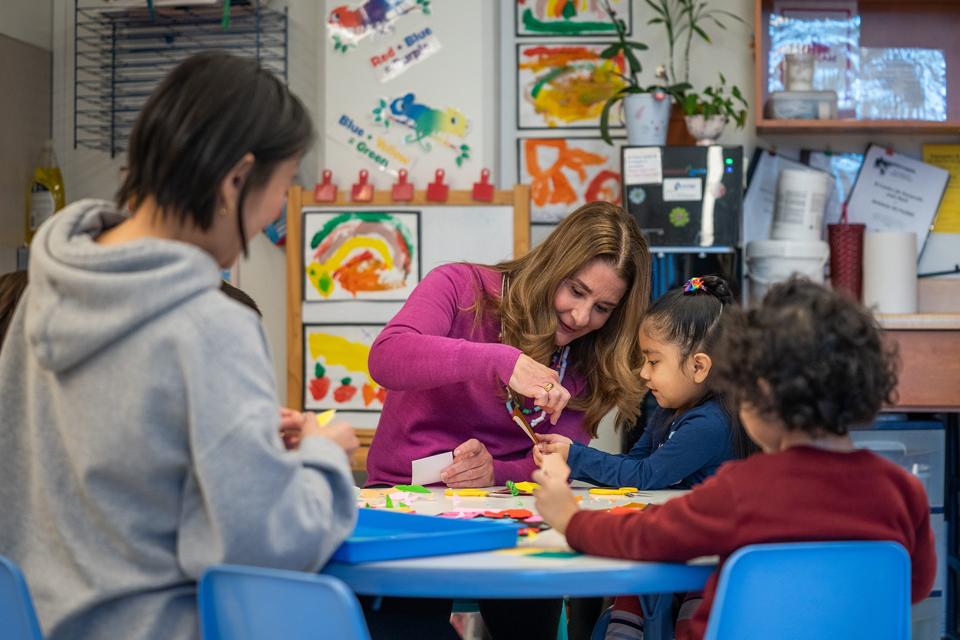
Melinda French Gates frequently visits nonprofits around the country. Here she is making crafts with children at the El Centro de la Raza headquarters in Seattle, Washington.
Photo by Jovelle Tomayo, Courtesy Pivotal Ventures
What are the trends in philanthropy that you think are most notable?
Two come to mind. First, giving circles, which are a way for people who care about the same issues to pool their resources and maximize their impact. The number of giving circles has more than doubled in the last decade,[i] driven in large part by women. Women know that there’s a lot of power in collective action, and giving circles are a chance for everyday givers to make their resources go further.
At the same time, we’re at the cusp of what some have called the Great Wealth Transfer. Women are poised to inherit trillions of dollars by 2030, which means they’ll soon control more wealth than they ever have before. From a philanthropic perspective, I can’t wait to see what they do with it.
Where do you still see major gaps in giving–where aren’t philanthropists focused enough? (And are there areas that are already receiving too much money?)
Issues affecting women and girls are chronically and unconscionably underfunded. Organizations dedicated to women and girls receive only around 2% of U.S. philanthropic dollars. Globally, if you put aside cancer research, women’s health receives just 1% of research funding. The funding levels aren’t meeting the need, which means there are countless opportunities to improve women’s and girls’ lives. Women’s health especially is a big priority for me moving forward.
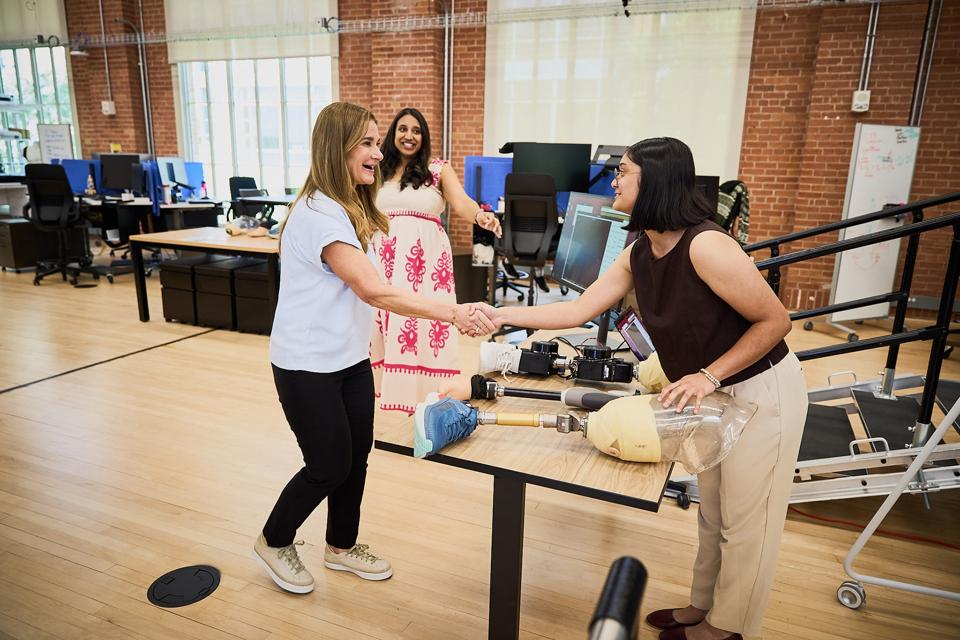
French Gates visits the Texas Robotics lab at the University of Texas in Austin, TX last year.
Photo by Bexx Francois, Courtesy Pivotal Ventures
Do you think there are gender gaps in terms of how money is given away?
When I started traveling to India and parts of Africa for the Gates Foundation, one of the first things I learned is that women tend to invest their resources differently than men. They are more likely to pour money into their child’s education or health, which pays dividends for both their families and their communities down the line. We’re still learning a lot about the different ways that women philanthropists give, but research does show that they are similarly interested in community impact and want to give in ways that align with their values. They’re more likely to focus on issues like poverty, health, education, and increasingly, racial inequality. This, too, is going to pay dividends.
Who or what has been your biggest influence in terms of how you approach your philanthropy?
Early on, my dear friend Warren Buffett shared a wonderful piece of advice: “Find your bullseye.” What he meant was choose an area where you think you can make a difference and maintain focus on it. All these years later, I’m still thinking about that advice. There are so many worthwhile causes in the world and so many ways each one of us can make a difference. But to maximize your impact, it sometimes helps to concentrate your efforts. If you’re focused on everything, you’re focused on nothing.
Do you collaborate and/or are there other women philanthropists who stand out due to their innovative approaches?
One of the best parts of my work is connecting with other women and getting to know the next generation of philanthropic leaders. My daughter, Phoebe, is at the start of her own giving journey, and it’s been a joy to watch her find causes she cares about and support them in meaningful ways. Already, I’m learning a lot from her and the way she sees the world.
This aticle was originally published on forbes.com and all figures are in USD.
Look back on the week that was with hand-picked articles from Australia and around the world. Sign up to the Forbes Australia newsletter here or become a member here.