Inside, how McCartney sang, sued, countersued, toured and toiled his way into the three-comma club.
Welcome to “The Billie,” Forbes’ newest newsletter. Named for our internal shorthand for “billionaire,” each week we’ll bring you an amazing story of excess success from the 3,400-plus members of the three-comma club. We’re using our first edition to give you an exclusive: Paul McCartney is now a billionaire.
Six decades after singing that he “don’t care too much for money” and “may not have a lot to give,” McCartney has sung, sued, countersued, toured and toiled his way to a $1.4 billion fortune. But for years he earned far less from The Beatles than you might imagine—and far more from artists you might not expect. It’s a classic story of how art and commerce can come together.
—Chase Peterson-Withorn
Growing up in war-torn, working class Liverpool, Paul McCartney noticed adults were always stressed about making ends meet. “I’ll solve that,” he decided simply. “I will try to get money.” So he wrote rock-and-roll tunes from his living room, formed a little band and got to work. Yet as Beatlemania swept the world, the Fab Four raked in relatively little. Their record deal is said to have paid them less than a penny per album sold, and their publisher Dick James controlled the copyrights to the lyrics and melodies the band wrote. “It turned out to be basically a slave contract,” McCartney wrote in a 2017 Forbes essay, “no matter how successful we made the company, we didn’t get a raise.”
—
Anytime a high school theater group performs Grease, McCartney gets paid.
—
So McCartney declared independence. In 1969, months before the band broke up, he launched his own publishing company, MPL Communications, to control his solo-career publishing and master recordings, giving him a much larger cut of his future royalties. He began snapping up other artists’ publishing copyrights too, decades before the music catalog boom sent valuations off the charts. He bought the catalog of early rocker Buddy Holly. He bought Broadway musical scores. He bought timeless Christmas standards. Today, McCartney quietly sits atop a mountain of music royalties. Anytime “Blue Suede Shoes” is streamed or a high school theater group performs Grease, McCartney gets paid. MPL—which owns thousands of songs and likely generates tens of millions in annual revenue—is now McCartney’s biggest business, worth at least a quarter of a billion dollars. (He declined to comment on Forbes’ estimates.)
🎄 The Man Who Bought Christmas
Paul McCartney’s toy bin of songs includes the copyrights to dozens of Christmas classics. Here are five of the most iconic holiday jingles owned by Sir Paul:
- It’s Beginning To Look A Lot Like Christmas
- The Christmas Song (Chestnuts Roasting On An Open Fire)
- Wonderful Christmastime
- Blue Christmas
- Baby, It’s Cold Outside
Meanwhile, Sir Paul, 84, has spent decades helping The Beatles get back a bigger share of their own catalog as well. After scores of lawsuits, negotiations and renegotiations with the labels that own the band’s recordings, the group’s Apple Corps holding company now brings in upward of $50 million annually from music streams, vinyl sales and Beatles merch. Paul, Ringo and the estates of John and George each get a 25% cut, an income stream Forbes estimates is worth more than $150 million apiece. Even more valuable for Macca: His share of his Beatles songwriting copyrights—a holy grail of music publishing that, after he fought to regain his U.S. rights over the past two decades, now brings McCartney at least $10 million per year and is worth at least $200 million.
Add up the value of his music catalogs, the royalty checks he’s cashed, the hundreds of millions he has earned from world tours (Paul was “the workaholic of our band,” Ringo once said), real estate across the UK and the Hamptons, plus a collection of art including works by Picasso and Magritte, and McCartney’s net worth is at least $1.4 billion. He’s the world’s third-richest musician (behind only Taylor Swift, $2 billion, and Jay-Z, $2.8 billion). “Is it more noble if we don’t write for money, if we just write for art and love?” he once mused. “I think the two can coexist. I’m happy to enjoy both.”
Additional reporting by Matt Craig
🗃️ From The Forbes Vault
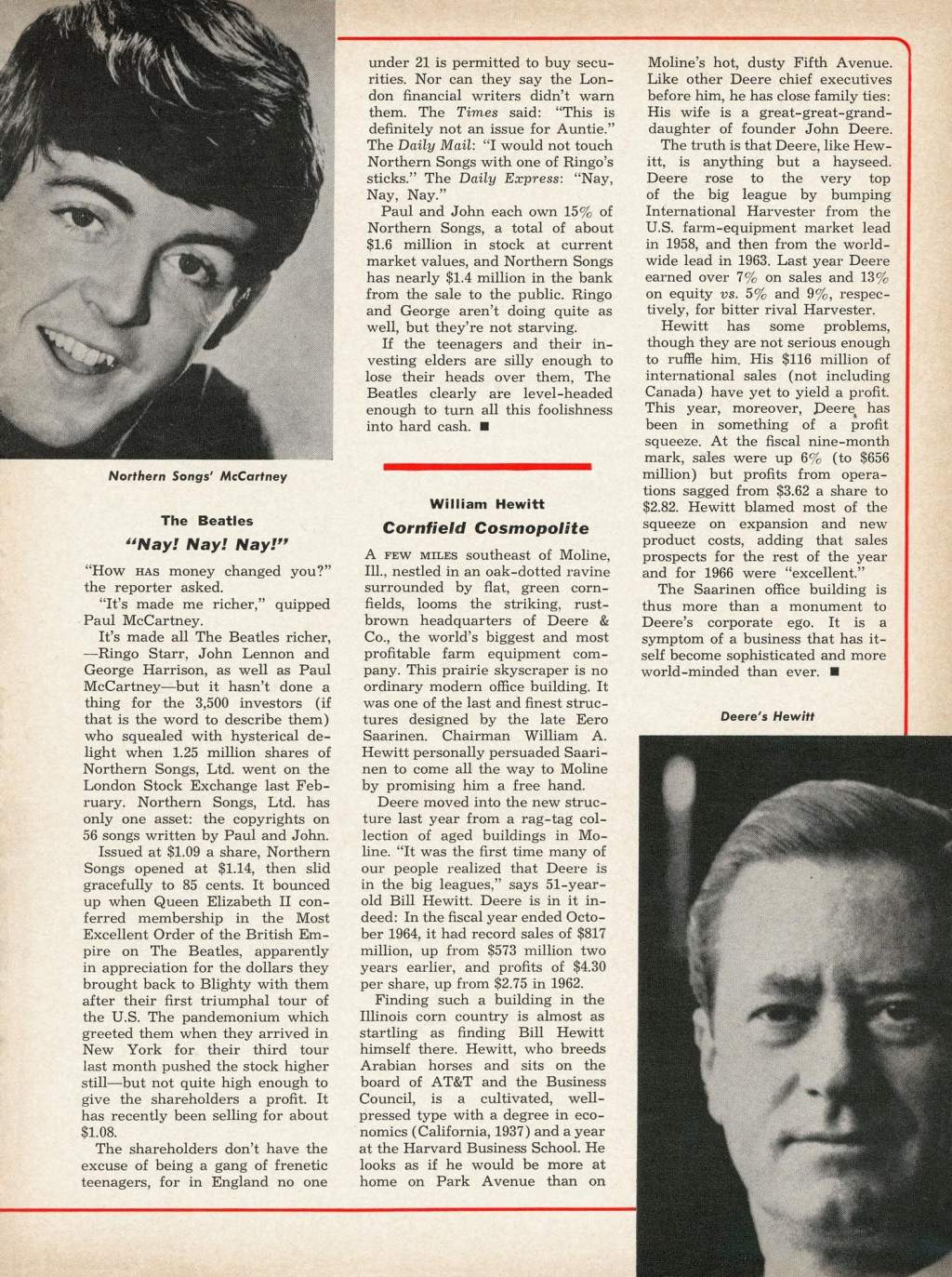
Sir Paul’s copyrights to his Beatles compositions have traveled a long and winding road. Today, McCartney owns all his U.S. publishing. In the 1980s, Michael Jackson held the catalog. In the 1990s, Sony bought in. But back in 1965, the Lennon-McCartney songbook actually traded on the London Stock Exchange, though much of the financial press—including Forbes—dismissed it as an early meme stock trading on little more than Beatlemania.
Forbes, September 1, 1965:
“How has money changed you?” the reporter asked. “It’s made me richer,” quipped Paul McCartney. It’s made all The Beatles richer…but it hasn’t done a thing for the 3,500 investors (if that is the word to describe them) who squealed with hysterical delight when 1.25 million shares of Northern Songs, Ltd. went on the London Stock Exchange last February…The pandemonium which greeted them when they arrived in New York for their third tour last month pushed the stock higher still—but not quite high enough to give the shareholders a profit. The shareholders don’t have the excuse of being a gang of frenetic teenagers, for in England no one under 21 is permitted to buy securities. Nor can they say the London financial writers didn’t warn them. The Times said: “This is definitely not an issue for Auntie.” The Daily Mail: “I would not touch Northern Songs with one of Ringo’s sticks.” The Daily Express: “Nay, Nay, Nay.”
💯 Quiz
Fame can still generate a fortune even after death. Each Halloween, Forbes tallies the celebrities whose estates are banking the most from the grave. This year’s no. 1 earned $150 million. Who is (s)he?
A. Dolly Parton
B. Michael Jackson
C. John Lennon
D. Quincy Jones
Forbes
The Billie
Want to see more Forbes articles on your feed? Tap here to make Forbes Australia a preferred source on Google.
Look back on the week that was with hand-picked articles from Australia and around the world. Sign up to the Forbes Australia newsletter here or become a member here.