Chip Wilson was both celebratory and harshly critical after the company announced last week that its CEO is stepping down. But it’s just one small battle in a very public war between Wilson and the company he created.
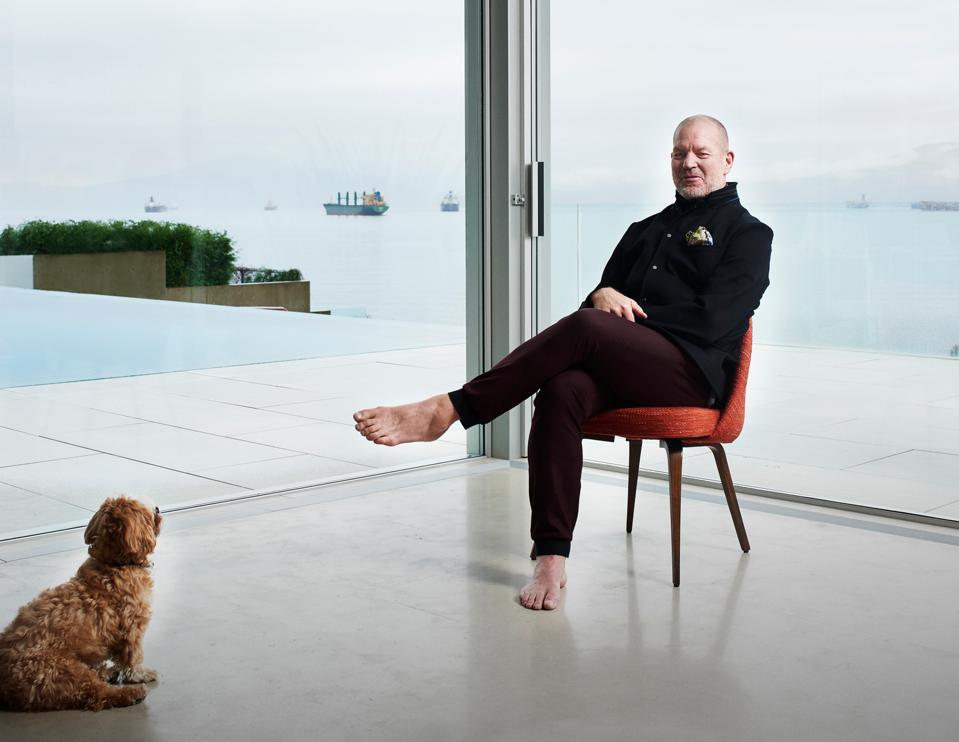
“Put product and brand back at the center,” said Lululemon founder Chip Wilson in a Wall Street Journal advertisement in October. “On paper, Lululemon still looks good, but it’s losing its soul.”
Jens Kristian Balle for Forbes
On weekends during the holidays, there is rarely any breathing room at the Lululemon in Dallas, Texas. It is one of the busiest stores in the high-end mall on Black Friday, filled mostly with teenage girls waving their parents’ credit cards and middle-aged women looking for new pilates outfits. While holiday sales won’t be tallied for a while still, revenue for the retailer is expected to reach a record $11 billion for 2025. In the most recent quarter, North American sales slipped by 2% but overseas revenue surged 33% ensuring an overall increase of 7%.
Lululemon is hardly the crumbling brand that its controversial billionaire founder Chip Wilson continues to deride, years after leaving. But as anyone who has followed Wilson’s ranting knows, things have not been so great lately for the iconic yoga brand and its shareholders. Lululemon’s market cap peaked in December 2023 at $64 billion. Since then, the stock has fallen by 59%, slashing its valuation to $25 billion. That’s why it didn’t come as a complete surprise when Lululemon recently announced its CEO Calvin McDonald will be stepping down in January, or that the announcement—made alongside the company’s strong quarterly earnings—helped send shares up 11%.
Wilson—whose pile of Lululemon shares jumped by $180 million in value, to $2.1 billion, in a day—responded with comments that were both contemptuous and triumphant. “After overseeing years of poor decisions erode the brand and destroy shareholder value,” he wrote in a self-published press release, “it is clear to me that only under my increasing pressure has the lululemon Board of Directors (the “Board”) finally started to listen.”
With McDonald out, Wilson appears to have scored a major victory in his long-running battle with his old company, but he isn’t done. Lululemon’s board has not announced a clear succession plan, he says. The business needs to add “refreshed, experienced” directors to advise on the CEO selection.
In a document filed with the SEC on Monday, Wilson made it clear that—as both an industry veteran with “obvious extensive experience” with Lululemon, and as its largest individual shareholder, with 8.4% of the stock—he would not hesitate to take his own actions to “refresh the board” if his suggestions are ignored. (Lululemon did not respond to Forbes’ request for comment on Wilson.)
“It could just be a threat of some sort,” says David Swartz, a consumer analyst at Morningstar who covers Lululemon. “It could be that he wants to be on the board himself. But there’s a couple issues here. Firstly, I am pretty sure that Lululemon’s board does not like him very much. Second, he potentially has a conflict with his relationship with Amer Sports, which could be considered–to some degree–a competitor to Lululemon. [Wilson] owns more of that company than he owns of Lululemon.”
Wilson has long been a relentless critic of the athleisure brand—despite having not been involved with the company for more than a decade since being ousted in 2013 (and officially leaving entirely in 2015), having come under fire for attributing an issue with see-through leggings to “some women’s bodies.” He has cashed out 75% of his stock since parting ways with Lululemon and has been making billions of dollars on other ventures and investments. Despite this, he cannot seem to let go of his relationship to the brand that acts ambivalent toward him at best, and hostile at worst. He too has been very combative. In 2024, he slammed diversity in Lululemon’s advertising calling models in some ads “unhealthy,” “sickly” and “not inspirational”. In October, he took out a full page ad in The Wall Street Journal titled, “Lululemon: In a Nosedive.”
Part of why Wilson is upset could simply be attributed to his own bottom line. At Lululemon’s peak in December 2023, Wilson’s 10 million shares were worth more than $5.2 billion; they’re now worth $2.1 billion. (Had he held onto all 40 million of the shares he had in 2014 around when he left the company, he would be sitting on Lululemon stock worth more than $8.3 billion.) As the company’s largest individual shareholder, no one has lost more wealth over the past two years thanks to Lululemon stock than Wilson.
Then again, it’s clearly not just about dollars. He’s been complaining the brand has lost its way for nearly a decade, even as sales jumped from about $1.8 billion in 2014 to $11 billion without him at the helm, all while the stock skyrocketed by 220%, even despite the rocky past two years. In 2016, Wilson griped that Lululemon had “lost its way” in an open letter to the company. In 2017, he bought an ad on a bus stop across from Lululemon’s headquarters, urging the company to buy rival Under Armour. By the end of 2020, the stock was five times the price it was in 2015, yet Wilson was still displeased, last October claiming Lululemon’s 2020 decision to acquire at-home fitness brand Mirror “squandered $1 billion” on the $500 million purchase. “He can say whatever he wants, but the numbers say the company doesn’t need him,” Morningstar’s Swartz told Forbes around the company’s peak. Now, with Lululemon suffering from a sales slump amid predictable products and increased competition, things may be changing.
“By most measures, you would say the last seven years have been successful for Lululemon despite the recent problems,” says Swartz. “The reality is that this industry–the activewear space in general and women’s athleisure in particular–has become far more competitive in the last few years.”
Smaller, faster-growing apparel brands like Vuori and Alo Yoga have been eating at Lululemon’s market share. Alo, which leverages celebrity endorsements and pushes for streetwear appeal, has grown to more than 130 stores from 10-15 stores in 2021 and has increased revenue an estimated tenfold since the pandemic, while Vuori has eclipsed $1 billion in revenue across its more than 100 stores thanks to its product offerings that rival Lululemon in quality and by originally marketing itself as an athleisure brand for men.
“If you have several different companies going after the same customers and generating sales in the hundreds of millions or billions, then even the largest companies in the industry are going to feel that to some degree,” says Swartz. “It will add up.”
Meanwhile, persistent inflation has hit consumers, who have looked to lower-priced brands than Lululemon, whose classic Align leggings cost upwards of $100. That has put pressure on Lululemon’s market position, says Brittany Steiger, a retail and ecommerce analyst at Mintel. Brands like American Eagle’s Aerie have taken advantage and branched out their product offerings from underwear to more affordable athleisure alternatives.
Luluemon, for its part, has responded by expanding beyond women’s activewear, and into things like men’s clothing and accessories. In 2022, the brand announced that men’s attire would drive a five-year plan to boost revenue to $12.5 billion by 2026. In 2024, men’s apparel made up around 25% of the company’s yearly revenue.
Wilson thinks it’s precisely the wrong move. A serial entrepreneur, he founded Lululemon in Vancouver, Canada in 1998, with a simple idea in mind. After taking his first yoga class following a back injury, he noticed that his instructor’s clothes were thin and see-through. He wanted to create high-end yoga attire made specifically for women’s bodies (at the time, many athletic-wear companies manufactured clothes for men and just adjusted those products for women). As athleisure picked up in popularity throughout the late ’90s and early-2000s, Lululemon became synonymous with high-end yoga pants and continued to grow, all while fighting off a slew of Wilson’s controversies until he was pushed out, first as chairman in 2013 and then from the board entirely two years later. Now much of his pressure campaign to turn around the brand is centered on getting back to basics. “Put product and brand back at the center,” he demanded in his October WSJ ad. “On paper, Lululemon still looks good, but it’s losing its soul.”
Despite all this, Wilson is nearly as rich as he was at Lululemon’s peak in 2023, thanks to the success of Amer Sports. He spent around $1 billion to buy a roughly 21% stake in Amer in 2019—and it’s paid off. The company, a multinational sporting goods company originally founded in Finland as a tobacco company by four student groups, went public on the New York Stock Exchange in 2024. Revenue hit $5.2 billion that year, up 18% from the previous year, thanks to dominant tennis brand Wilson and premium outdoor apparel brand Arc’teryx. Wilson, who is on Amer’s board, is now sitting on a pile of the company’s stock that’s worth about $3 billion, almost $1 billion more than his Lululemon shares, as Amer’s shares have jumped 194% since the IPO. He has also pumped cash into other fashion businesses such as Sheertex and his real estate investment firm Low Tide, and has pledged $100 million to solve facioscapulohumeral muscular dystrophy (FSHD), a rare form of muscular dystrophy Wilson has suffered from for decades.
But, no matter what, there’s one venture that seems to loom larger than the rest, whether its stock is up or down: “The world doesn’t need another bland, quarterly-driven apparel company,” Wilson wrote in October. “It needs bold vision. It needs lululemon to fly again.”
Look back on the week that was with hand-picked articles from Australia and around the world. Sign up to the Forbes Australia newsletter here or become a member here.