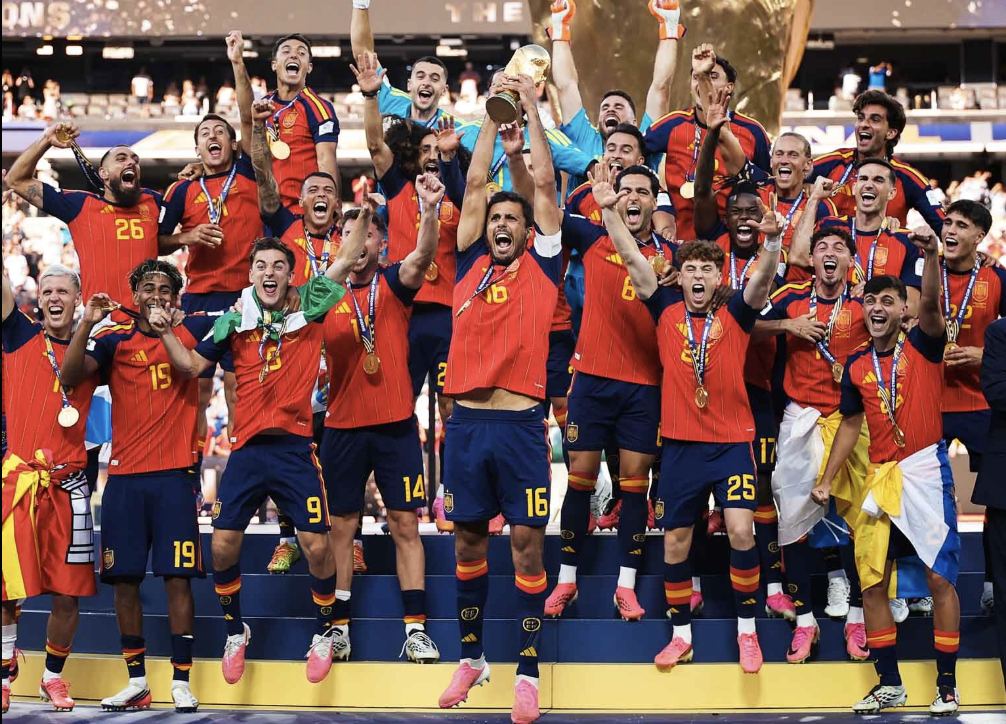
The World Cup is kicking off in less than 100 days against a backdrop of geopolitical uncertainty, giving tourism leaders heartburn and suggesting a more muted lift to the U.S. economy than initially promised by FIFA and the Trump administration.

Key Takeaways
- A growing list of challenges—including the Iran war, a year-long drop in international visitors, withheld security funding for World Cup host cities and lackluster hospitality industry projections—are adding uncertainty that the soccer tournament will deliver the expected economic boost in 2026.
- The timing of the Iran war is “definitely challenging” for tourism, Alan Fyall, professor at the University of Central Florida’s Rosen College of Hospitality Management, told Forbes, stressing that “uncertainty is not good” and tourism thrives on “stability and safety.”
- This week, former Homeland Security Secretary Kristi Noem told lawmakers the government’s “ability to provide for a safe and successful World Cup is being hindered” by the partial government shutdown, even as the agency has yet to distribute $625 million in Congress-approved security funding to the 11 U.S. World Cup host cities.
- Lodging demand in the U.S. during the tournament months of June and July is expected to drive a disappointing 1.7% year-over-year lift in revenue per available room (RevPAR) nationally—roughly a quarter of the overall boost received the last time the U.S. held the World Cup in 1994, according to a recent report from hospitality analytics firm CoStar and Tourism Economics.
- The report projected the 11 U.S. World Cup host markets could see a 13% lift in RevPAR this summer, but the overall impact to the U.S. will be “negligible due to the underlying weakness expected elsewhere,” according to Isaac Collazo, the firm’s senior director of analytics.
- As of early February, airline bookings for the host cities in June were down 5% from Europe compared to last year, down 3.6% from Asia and essentially flat (up 0.2%) from South America, according to Cirium data.
Will The World Cup Significantly Lift The U.s. Economy?
Nobody doubts the U.S. will see some upside to hosting the World Cup. But by how much? A FIFA analysis last year projected the World Cup would drive $30.5 billion in economic output and create 185,000 jobs in the U.S. this year. But that figure was predicated on the assumption that international tourists would flock to the tournament. Tourism officials from three World Cup host cities previously told Forbes that FIFA advised them to expect a 50/50 split between domestic and international visitors. FIFA president Gianni Infantino has said repeatedly that World Cup tickets sold out quickly and demand far exceeded supply, and yet some U.S. fans received emails last week offering a 48-hour window to purchase tickets.
“They’re selling primarily to domestic customers,” Fyall told Forbes, adding, “There is a big question about international visitors, and that’s important because they spend roughly four times as much per person as Americans.” While the State Department has a priority system for fast-tracking visa applications for soccer fans with tickets, that leaves a potentially enormous number of would-be international visitors shut out by the notoriously long and burdensome U.S. visa application process. This is important because, historically, hordes of ticketless fans have flocked to World Cup host nations for fan festivals and the accompanying celebratory atmosphere when their teams won in the early rounds of the tournament. Although fan festivals have been a huge component of the World Cup experience for decades, some U.S. host cities are scaling back or eliminating their fan fests this time around. New York/New Jersey eliminated its fan fest in Jersey City, New Jersey, even after promoting that the event would be open every day of the tournament, PBS reported. “I would be surprised if there’s a big influx of international fans at the last minute this time,” Fyall told Forbes. “It’s not so easy to get here at the last minute, the way everything is now.”
Crucial Quote
“Ultimately, football is a mirror that reflects society, reflects ourselves back to it, and in this moment, the reflection is incredibly ugly,” Roger Bennett, co-founder of Men in Blazers, the largest independent soccer-focused media network in North America, told MS Now’s “Morning Joe” on Tuesday.
Why Are Travel Leaders Worried About International Demand For The World Cup?
There are a range of issues. At the 2026 Americas Lodging Investment Summit in January, U.S. Travel Association CEO Geoff Freeman noted the U.S. was “the only major nation in the world to see a decline in travel” last year and questioned whether the government would continue pursuing tourism-suppressing policies like new visa fees, a $100 surcharge for foreign visitors to national parks and a U.S. Customs and Border Protection proposal requiring international travelers to provide their social media histories.
Marriott CEO Anthony Capuano expressed concern that the U.S. wasn’t making the world feel welcome, telling conference-goers, “When you have visitors asking legitimate questions about what their experience will be coming through customs and immigration … those are big impediments to optimizing what should be a home run opportunity for the lodging industry.” IHG Hotels & Resorts CEO Elie Maalouf chalked up the U.S. market’s underperformance to an “extraneous burden,” citing a range of issues including tariffs, government spending cutbacks and the drop in inbound international travel. At the same conference, Collazo speculated that 2026 would be better than 2025 but still “not a stellar year” for U.S. tourism, adding that much will ride on what happens in World Cup host markets.
Tangent
In June 2025, in the run-up to the FIFA Cup World Cup tournament, U.S. Customs and Border Protection posted on social media that officers would be “suited and booted” and “ready to provide security for the first round of games.” The post was deleted after FIFA officials expressed concerns, the New York Times reported.
Early Summer Booking Data Is Scarce And, At Times, Contradictory
Cirium airline booking data shows inbound international airline bookings are down for this summer and CoStar data suggests only a “modest” lift for hotels during the World Cup. But Mark Rabe, CEO of the travel marketing firm Sojern, told Forbes its data—“verified online flight booking data from over 100 major airline carriers across the world”—shows that while international travel to the U.S. in July and August 2026 is “comparable to what we saw last year,” his firm is seeing “a large spike in international flight bookings to the U.S. in June 2026,” when the World Cup tournament begins.
This story was originally published on forbes.com and all figures are in USD.
Want to see more Forbes articles on your feed? Tap here to make Forbes Australia a preferred source on Google.
Look back on the week that was with hand-picked articles from Australia and around the world. Sign up to the Forbes Australia newsletter hereor become a member here.