Storytelling belongs to everyone. Yet all too often, the opportunity for filmmakers to have their work funded and their stories told is limited to a select few. With rapid leaps in the quality of accessible and affordable generative video models, new pathways are beginning to emerge for how Australian stories can be created, and who gets to tell them, writes Jessie Hughes.
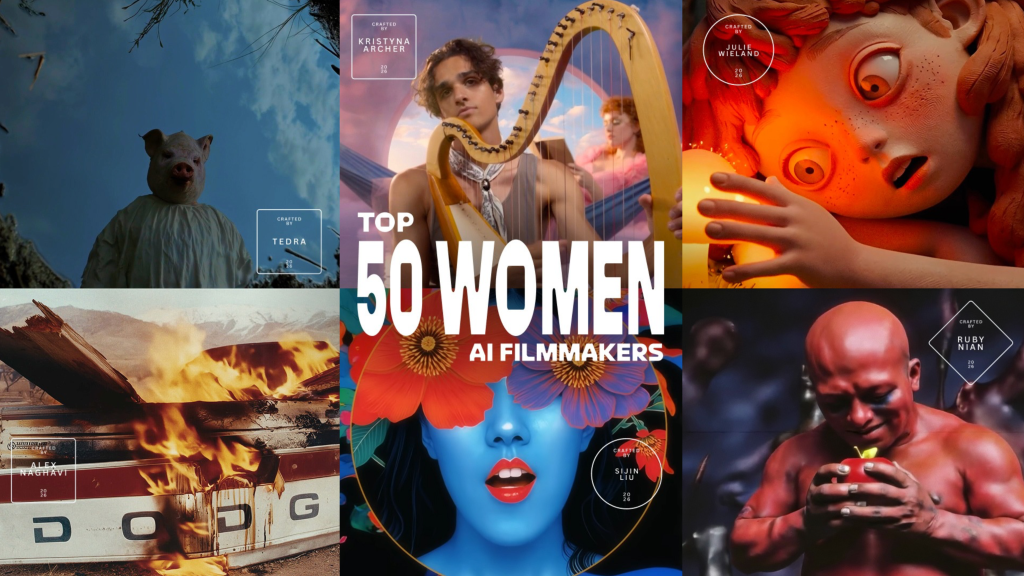
Australian-founded generative AI platform Leonardo.Ai – which was acquired by Canva in 2024 -is highlighting the standout creatives shaping the emerging medium.
Leonardo’s Power List: Top 50 Women AI Filmmakers for 2026 spotlights a new cohort of storytellers exploring a wide spectrum of approaches, from experimental hybrid media and new forms of animation to generative cinema and commercial storytelling.
Driven by strong cinematic principles and creative distinction, these filmmakers are telling stories on their own terms, enabled by rapid technological advances. New AI video tools can now generate multiple shots from a single prompt, maintain character and scene consistency, add synchronised audio and lip-sync, and produce high-resolution footage—making it easier than ever for filmmakers to create complex scenes and animated sequences. What began as a niche space for technologists and digital artists has quickly evolved into a powerful new workflow, enabling creators to build their own cinematic worlds.
Last year, Leonardo’s inaugural 2025 Top 50 Power List highlighted women shaping the emerging field of AI art: however, over the past twelve months, the pace of innovation in generative video has been extraordinary. New models and video pipelines are dramatically expanding what independent creators can achieve in motion, allowing artists to move from still imagery into fully realised cinematic storytelling.
A Global Movement Including Australia
One of the most striking aspects of the AI film movement is its global reach. Unlike traditional film industries, which are often concentrated in major production hubs, generative tools allow creators from anywhere to participate.
Breakaway Australian filmmaker Alex Naghavi is one of those creatives defining the cinematic potential of this unfolding medium. Originally from Sydney, Naghavi spent her early years honing her eye and craft as a Creative Director in Sydney and Brisbane. With a background in product design, branding and technology, AI came to her as a natural extension.
Named in the Top 50 for a second year, Naghavi belongs to the esteemed Eames Institute Curious 100, a Google Flow Artist Resident, and Gen:48 Honouree. Her AI films Railbound, Gentle, and Feast have received numerous industry awards, including Best Film and Best Director. Gentle was recognised by renowned Australian film director, George Miller (Oscar-winning Happy Feet, Furiosa, Mad Max) at the Sydney-based OMNI International AI Film Festival, gifting a silver screen to this new cohort of filmmakers.
Naghavi’s unique approach to AI filmmaking is as an extension to her design practice, seeing generative tools as a way to prototype new visual languages and narrative forms. Known for her curated and distinctive visual taste, Naghavi’s international praise is a nod to the opportunity awaiting Australian creatives to gain global reach and cross-domain recognition.
AI Films Worth The Watch
The 50 women featured in this year’s Power List represent a range of filmmaking approaches, with many particularly influential in shaping the emerging language of AI film.
Together, these artists illustrate the breadth of experimentation. Here’s a sneak glimpse into the future of storytelling with new technologies:
Julie Wieland explores what many describe as post-photography, a dreamlike cinematic style that blends traditional design with generative tools. Her work has appeared in publications including The New York Times and The Washington Post and has been featured in collaborations with platforms such as Netflix.
The collaborative work of Ruby Nian and Sijin Liu highlights another important trend in AI cinema: cross-disciplinary creative partnerships. London-based motion graphics artist Ruby Nian blends animation and generative tools into visually striking motion work, while director Sijin Liu brings over fifteen years of filmmaking experience spanning film, music video and mixed media storytelling.
Kristyna Archer brings a playful sensibility to AI filmmaking. Known for hyperreal, stylised worlds that merge surrealism with fashion aesthetics, her short series, films and photography have been recognised at festivals including the London Fashion Film Festival and the Berlin Commercial Awards.
TEDRA exemplifies the multidisciplinary potential of AI filmmaking. An award-winning filmmaker and designer, she merges music, culture and generative media into bold visual storytelling while centring narratives that elevate BIPOC, LGBTQIA+ and women-led voices.
While generative technologies offer spectacular promise for independent creators, they also hold significant value for the professional screen industry. With Australia’s screen sector often working with smaller budgets and reduced production capacity compared to our international competitors, AI presents a rare opportunity for Australia’s screen sector.
In partnership with Screen Producers Australia, Screenrights, and Screen Queensland, a large cohort of established women and gender-diverse screen professionals will gather on the Gold Coast in late April, ahead of Screen Forever, for the AI for Women in Screen Masterclass.
The 50 filmmakers featured in this year’s Power List represent the early leaders of this movement. Filmmaking no longer belongs to the few, instead to those bold enough to try something new. Watch them now.
Jessie Hughes is the Creative Technologist at Leonardo.Ai.
Want to see more Forbes articles on your feed? Tap here to make Forbes Australia a preferred source on Google.
Look back on the week that was with hand-picked articles from Australia and around the world. Sign up to the Forbes Australia newsletter here or become a member here.