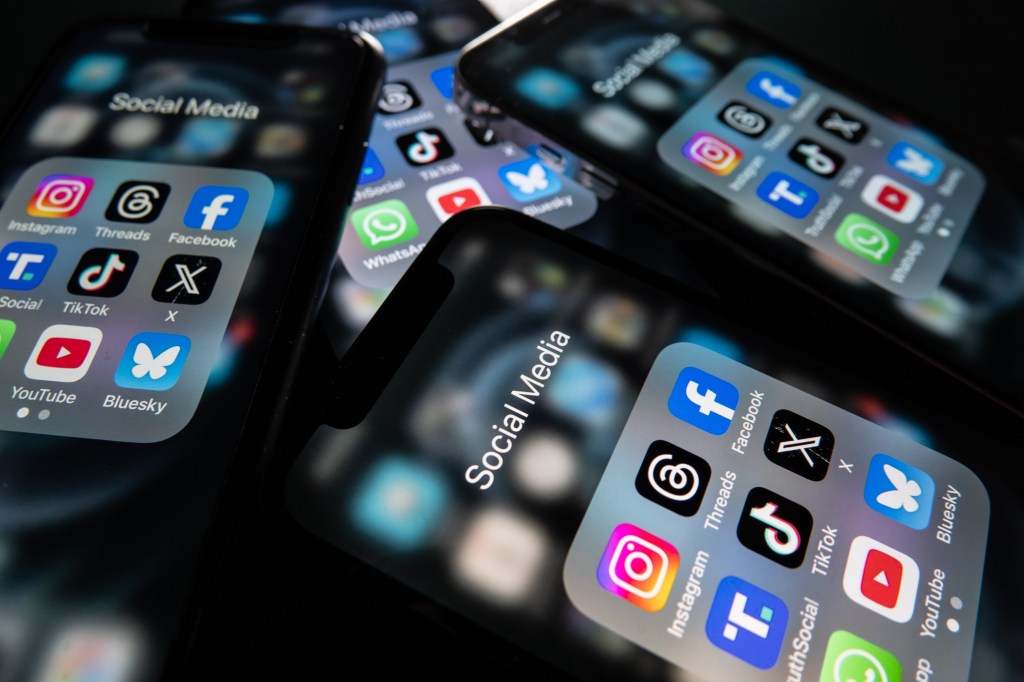
The new law ‘delaying’ social media accounts for minors under 16 is now officially in effect. Ten tech companies are impacted by the first ‘blanket ban’ in the world – and those that don’t take “reasonable steps” to enforce the ban face fines up to $50 million.

Key Takeaways
- Australia’s ban on under-16s holding social media accounts is now in effect.
- Ten major platforms are covered so far, including Facebook, Instagram, TikTok, YouTube, Snapchat, X, Reddit, Twitch, Threads and Kick, with apps like Lemon8 and Yope already being flagged as likely additions.
- Platforms will rely on a mix of tools to estimate a user’s age, such as AI facial analysis and optional ID checks.
- They cannot compel users to hand over ID, and the government concedes the system will not catch everyone.
- Social media giants face fines of up to $50 million if they fail to take reasonable steps to block young users.
Australia’s groundbreaking social media delay has the potential to “change the lives of an entire generation” for the better, according to entrepreneur and thought-leader Oprah Winfrey.
Winfrey, who is currently in Australia, joins fellow Hollywood personality Chris Pratt, and NYU Stern Professor and author Scott Galloway, in praising the move to ban kids under 16 from having social media accounts.
“I think there should be no social media under the age of 16. No phones in schools,” says Galloway.
The US has not instituted a federal ban on social media for minors, like Australia has, though ten US states have passed laws requiring that children’s access to social media be restricted, according to the Age Verification Providers Association.
Galloway and others would like to see other countries replicate Australia’s blanket ban, however, as is being considered in the UK, China, and the EU.
“You are up against the deepest-pocketed, most talented companies in the world, with god-like technology, who are trying to do one thing, and that is to sequester you from your other relationships. They are trying to get you glued to the phone,” warns Galloway.
Australia is the first nation to delay social media to 16
Eight of the ten companies impacted by Australia’s ban are US-headquartered. Facebook, Instagram, Threads (all of which fall under the umbrella of Meta) Reddit, Snapchat, Twitch, and YouTube (owned by Alphabet formerly Google) are all based in California.
X, formerly known as Twitter and now owned by Elon Musk, is headquartered in Texas.
TikTok currently comes under the purview of ByteDance and is domiciled in China. The only Australian company named by eSafety Commissioner Julie Inman Grant as being subject to the new regulations is Ed Craven and Bijan Tehrani’s Kick.
The Melbourne-headquartered livestreaming company has 88 million users around the world, and was not forced to comply with the new social media age restrictions – it assessed itself as a company that would be impacted.

“As an Australian-grown tech company, we support Australia’s ambition to lead in any field. We’ve been working closely with the eSafety Commissioner for some time, and given Australians represent a smaller percentage of KICK’s overall user base, we don’t anticipate significant operational impact as these measures roll out,” a Kick spokesperson tells Forbes Australia.
“We’ll continue engaging on implementation to support fair outcomes: protecting online safety without compromising privacy or limiting the creative freedom that drives Australia’s creator economy.”
YouTube, Snapchat, TikTok and Instagram
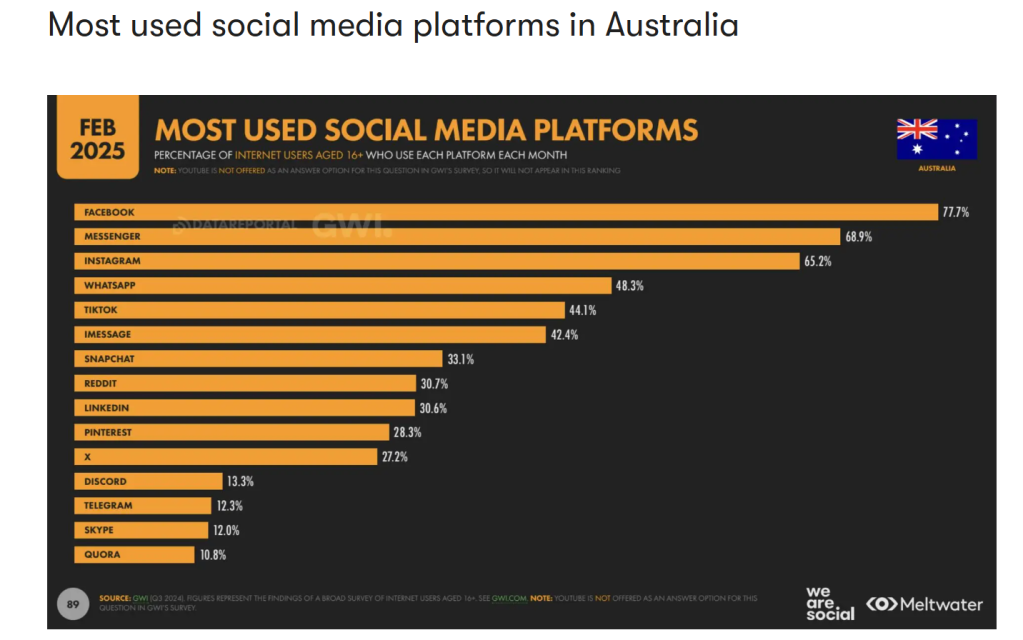
Facebook, Messenger, Instagram, and Whatsapp – which are all owned by Meta – are the top four platforms used in Australia, according to 2025 research from Meltwater.
TikTok, Imessage, Snapchat and Reddit round out the Top 8 most popular platforms used by Aussies of any age. When it comes to the under-16 crowd though, four companies reign supreme.
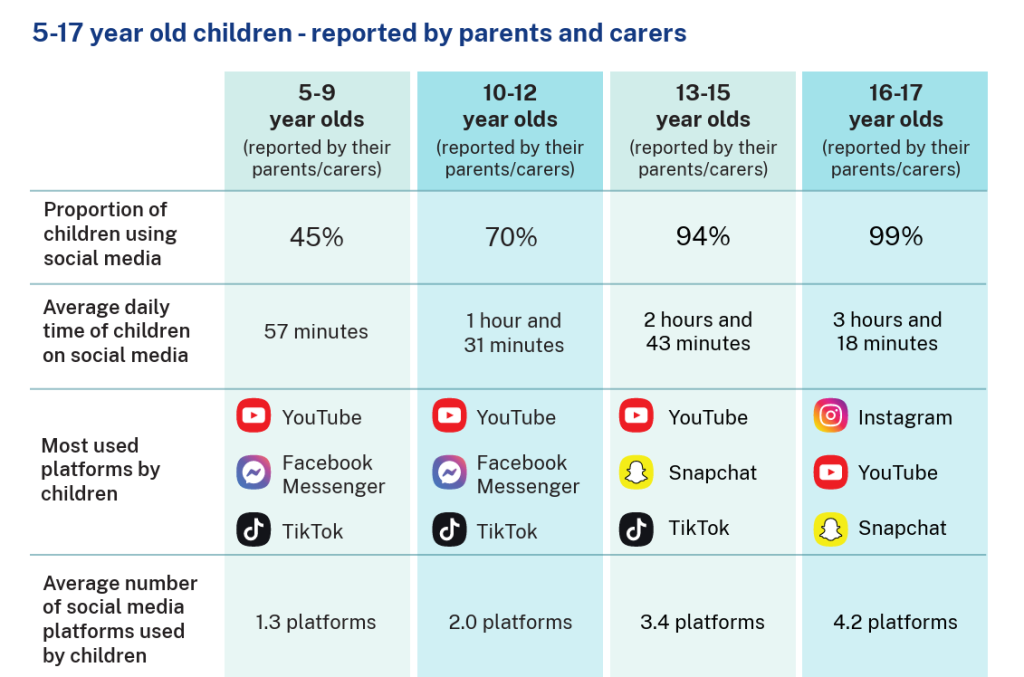
Ninety-four per cent of 13-15-year-olds use social media, as reported by their parents. YouTube, Snapchat, and TikTok are the three most popular platforms for that demographic.
Rachel Lord is the senior manager of Public Policy at Google and YouTube Australia. She notes that the new law “fundamentally misunderstands” the platform, and calls the changes taking place today “disappointing.”
“Anyone under 16 will be automatically signed out starting on December 10 and lose access to features that only work when you are signed into an account, including subscriptions, playlists and likes, and default wellbeing settings like “Take a Break” and Bedtime Reminders,” Lord writes in a Google blogpost.
“Viewers can continue to watch YouTube while signed out. We determine a user’s age based on the age associated with their Google account and other signals and will continue to explore how we implement and apply appropriate age assurance.”
Snap has also indicated that it will comply with the new social media regulations. The Santa Monica-headquartered company founded and led by Evan Spiegel cautions that there is a potential downside to the ban.
“Disconnecting teens from their friends and family doesn’t make them safer — it may push them to less safe, less private messaging apps. We continue to advocate for more privacy-conscious solutions, such as mandating age verification at the device, operating system, or app store level,” Snap writes in a statement.
The company notes that it will ‘preserve’ the accounts of under-16 users for three years, and will age-verify anyone who turns 16 during that time. Presuming they are successfully verified, a user’s account can be restored within that three-year period.
Will under-16-year-olds migrate to less safe digital spaces?
Dr Brittany Ferdinands, who lectures on digital content creation at the University of Sydney, believes there is a risk that youth may migrate to less visible online spaces as a result of the ban.
“Preventing under-16s from having social media accounts won’t necessarily stop them using them. In fact, it may push their activity underground,” says Dr Ferdinand.
The Australian Human Rights Commission also has concerns about the ban, noting that the UN Committee on the Rights of the Child states that ‘content moderation and content controls should only be used to prevent the flow of harmful material to children,’ and ‘should not be used to restrict children’s access to information in the digital environment.’

“Article 17 of the CRC [Convention on the Rights of the Child] notes the important function performed by the mass media (which includes social media) and obliges governments to ensure that children have access to information from a diversity of national and international sources, especially information aimed at promoting the social, spiritual and moral well-being and physical and mental health the child,” a statement from AHRC reads.
In 2024, the Tech Council of Australia (TCA) also raised concerns when it submitted a response to the Australian government regarding the ban.
“It remains unclear what age-assurance technologies will be used to enforce the ban,” TCA’s response reads. “It is uncertain when or how these technologies will be implemented, and whether they will be ultimately effective in preventing under-16 access to social media platforms.”
The rise of age verification tools
TCA also questioned whether current age verification tools are sophisticated enough to verify the age of social media users under 16.
“We note the Government’s finding in its response to the Roadmap for Age Verification that, ‘age assurance technologies are immature, and present privacy, security, implementation and enforcement risks.'”
The social media companies have not been told what age verification tools need to be used.
Dr Zena Assad is a senior research fellow at the Australian National University. She notes that Meta has indicated it will use a UK-founded tech company to comply with the new Australian regulations.
“To enforce the ban, Meta is contracting Yoti, a company developing reusable Digital ID wallets and age assurance technologies. Their website claims they use government issued ID’s (e.g. a drivers license), mobile numbers and selfies to verify age and a combination of proprietary technology, liveness detection, anti-spoofing measures and document authenticity checks for age assurance,” says Dr Assad.
She suggests that those measures may invade the privacy of social media users, and calls the social media delay a ‘band-aid.’
“Banning social media will not address the root cause of the problem – addictive algorithms, misinformation, disinformation, etc. It just delays exposure to that problem,” writes Dr Assad.
Meta facing social media addiction allegations
The controversy comes at the same time that Meta is facing the Massachusetts Supreme Court over allegations that it purposefully designed features on Facebook and Instagram to “make them addictive to young users.”
“Meta’s… own research shows they encourage addiction to the platform in a variety of ways,” the lawyer for the State of Massachusetts, which is suing Facebook and Instagram’s parent company, for causing harm to Massachusetts teenagers, claimed this week.
Meta denies the allegations and says it has a longstanding commitment to supporting young people.
According to reports, some 150,000 Facebook and 350,000 Instagram accounts are expected to be impacted by Australia’s social media delay.
Messenger and Whatsapp, two other platforms owned by Meta, will not be impacted. Neither will Roblox, Steam, Discord, GitHub, Lego Play, Pinterest, YouTube Kids or Google Classroom.
Look back on the week that was with hand-picked articles from Australia and around the world. Sign up to the Forbes Australia newsletter here or become a member here.