Venezuelan President Nicolás Maduro and his wife arrived in New York on Saturday evening after the U.S. captured them overnight in a stunning escalation of the Trump administration’s push for a regime change.
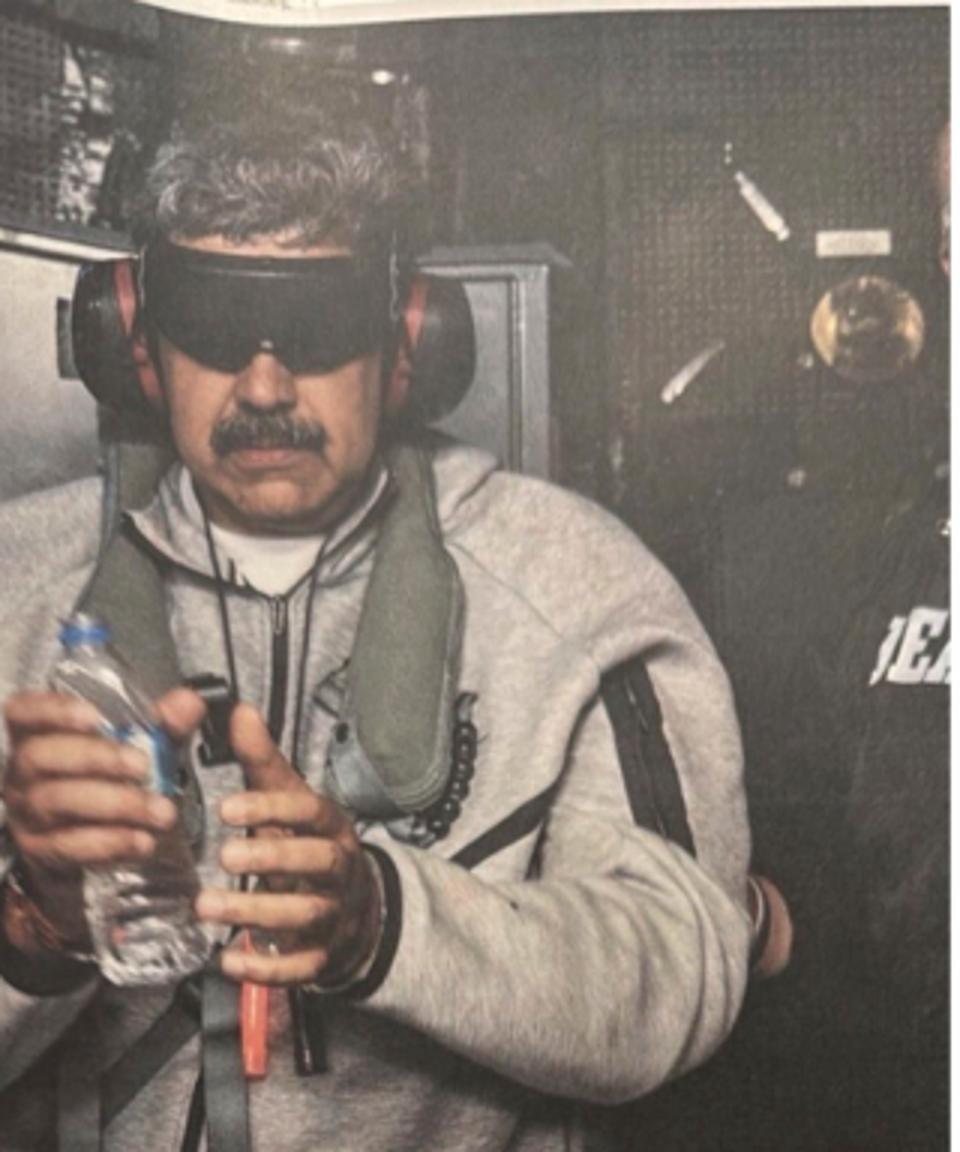
Venezuelan President Nicolás Maduro aboard the USS Iwo Jima after he was captured by the U.S. military overnight Saturday, Jan. 3, 2026.
The White House
Key Takeaways
- Maduro and his wife Cilia Flores landed at Stewart Air National Guard Base in New York state just before 5 p.m. EST, multiple outlets reported.
- Maduro landed in the U.S. after President Donald Trump declared “we’re going to run the country until such time we can do a safe, proper and judicious transition,” in an address to the nation Saturday afternoon.
- He said “we’re going to have our very large United States oil companies, the biggest in the world, go in, spend billions of dollars and fix the badly broken infrastructure” in Venezuela, which holds the world’s largest oil reserves, among several comments Trump made suggesting the takeover is at least somewhat tied to the oil industry.
- Just before delivering the address, Trump posted a photo of Maduro aboard the USS Iwo Jima wearing an eye covering, headphones, a gray tracksuit and holding a water bottle while a Drug Enforcement Administration agent is holding his arm.
- Describing the operation, dubbed “Absolute Resolve,” Trump said “overwhelming American military power—air, land and sea—was used to launch a spectacular assault . . . like people have not seen since World War II” in action he said was designed to bring “outlaw dictator Nicolás Maduro to justice.”
- Maduro was indicted in the Southern District of New York on charges of narco-terrorism conspiracy, cocaine importation conspiracy, possession of machine guns and destructive devices and conspiracy to possess machine guns and destructive devices, according to an unsealed indictment, the same four charges he faced in 2020, though the fresh indictment also names his son Nicolás Maduro Guerra and Flores as co-defendants.
Crucial Quote
“We’re not afraid of boots on the ground,” Trump said Saturday afternoon, in response to a question of whether U.S. troops will have a presence in Venezuela after Maduro’s capture. In a subsequent question about troop presence, Trump said “there would be a presence in Venezuela as it pertains to oil.” He said “we’re going to make sure that country is run properly” and “we’re designating people, we’re talking to people” to run Venezuela. He said Secretary of State Marco Rubio has spoken to Venezuelan Vice President Delcy Rodríguez, who was sworn in to take over for Maduro, and “she’s essentially willing to do what we think is necessary to make Venezuela great again.” Rodríguez contradicted Trump in an address later Saturday, insisting the Venezuelan government stands firmly behind Maduro, repeatedly calling him Venezuela’s “only president” and calling the attacks “an unprecedented military aggression.”
What We Don’t Know
It is unclear how long the U.S. will administer Venezuela, whether troops will end up being deployed to the country and exactly what the benchmark would be for the U.S. ending its direct oversight. Trump said Saturday that “a group” will run Venezuela, and though he did not state who would fully compose it, he motioned toward Rubio, Defense Secretary Pete Hegseth and Gen. Dan Caine and said it would “largely” be them “for a period of time.” It is not known who could lead after U.S. involvement ends, with Trump saying Nobel Peace Prize winner María Corina Machado—a Venezuelan opposition leader who voiced support for Maduro’s capture—lacks “the support or respect within the country” to be a successful leader. Trump also did not explicitly state which American oil companies could be involved in the Venezuela’s oil industry moving forward.
What To Watch For
Trump and Rubio suggested the actions in Venezuela should be considered a warning sign for other Latin American countries that have poor relations with the U.S., specifically Cuba and Colombia. “I think Cuba is going to be something we’ll end up talking about because Cuba is a failing nation right now,” Trump said in response to a question about whether there’s a message for Cuba. “If I lived in Havana and I was in the government, I’d be concerned,” Rubio, who is the son of Cuban immigrants, said. Trump also reiterated his comments that Colombian President Gustavo Petro, whom Trump has accused of sending cocaine into the U.S., “has to watch his ass.” Trump also mentioned Mexico in his Fox News interview Saturday morning, claiming Mexican President Claudia Sheinbaum “is not running Mexico” because “the cartels are running Mexico.” The president said the U.S. is “very friendly” with Sheinbaum, but “something’s going to have to be done with Mexico.”
Chief Critics
Democrats accused the Trump administration of illegally conducting the strikes without proper congressional approval. Sen. Andy Kim, D-N.J., said the strikes prove the Trump administration was lying when it said the months-long military campaign against alleged vessels in the Caribbean is designed to target drug cartels. “Secretaries Rubio and Hegseth looked every Senator in the eye a few weeks ago and said this wasn’t about regime change,” Kim wrote on X. “I didn’t trust them then and we see now that they blatantly lied to Congress. Trump rejected our Constitutionally required approval process for armed conflict because the Administration knows the American people overwhelmingly reject risks pulling our nation into another war.” Sen. Ruben Gallego, D-Ariz., called the strikes an “unjustified war” that is “illegal” and “embarrassing.” Rep. Alexandria Ocasio-Cortez, D-N.Y., tweeted that bringing Maduro to the U.S. for a trial is “to distract” from ongoing scrutiny of the government’s Epstein files release, as well as rising health care premiums for Affordable Care Act enrollees.
Tangent
Trump warned Venezuelan officials in an interview with Fox News “if they stay loyal [to Maduro], the future is really bad, really bad for them,” but said “most of them have converted.” He also dismissed concerns being raised by some lawmakers that he did not seek proper congressional approval for the strikes, telling the network, “they should say ‘great job,’ they shouldn’t say ‘oh, gee, maybe it’s not constitutional.’ You know the same old stuff that we’ve been hearing for years and years and years.”
Key Background
Maduro and his wife were at their home in the Ft. Tiuna military base in Caracas when the U.S. “bombed” and “carried out what we would call a kidnapping of the president and the first lady of the country,” Venezuelan ruling party leader Nahum Fernández told the Associated Press. In addition to Caracas, the U.S. also conducted strikes in the states of Miranda, Aragua and La Guaira overnight, Venezuelan officials said. No U.S. military personnel were killed in the strikes, though Trump suggested several were injured when a helicopter was hit. The strikes follow a months-long U.S. military campaign against Venezuela the Trump administration has said is designed to target drug cartels. The U.S. has conducted dozens of strikes on vessels in the Caribbean it alleges were being used to smuggle narcotics into the U.S., killing more than 100 people. The U.S. military has also built up its presence in the Caribbean, intercepted Venezuelan oil tankers in recent weeks and conducted a drone strike on a dock in Venezuela last month, The New York Times previously reported. The U.S. views Maduro—whom the Trump administration has accused of being a “narco-terrorist”—as a fugitive and offered an award of up to $50 million for information leading to his arrest and/or conviction.
Look back on the week that was with hand-picked articles from Australia and around the world. Sign up to the Forbes Australia newsletter here or become a member here.