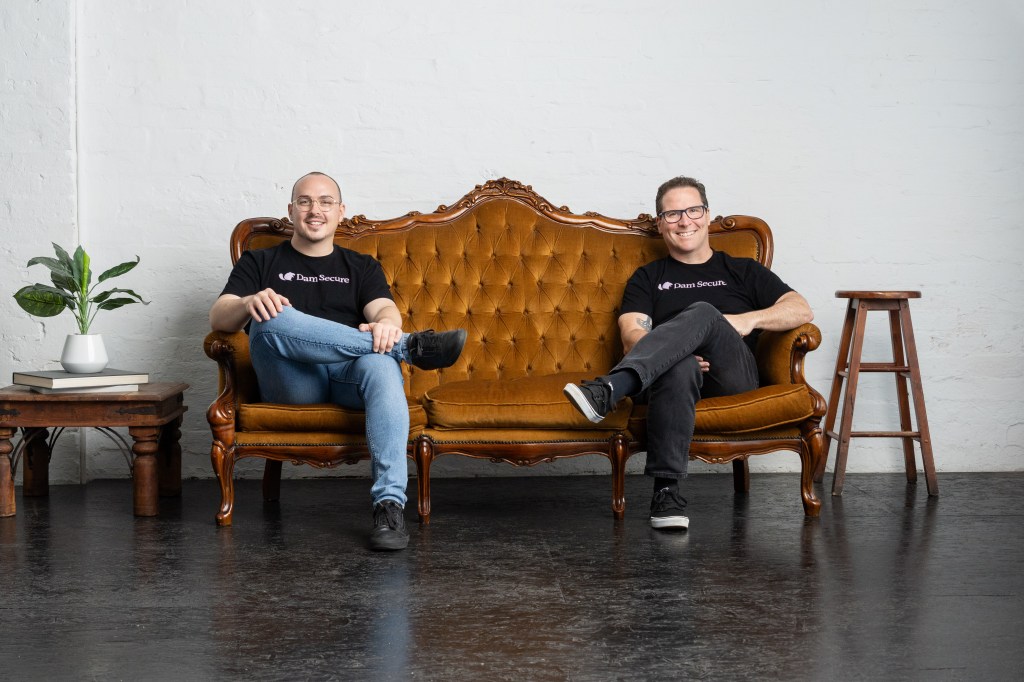
Founded by ex-Zip Payments executives Patrick Collins and Simon Harloff, Dam Secure aims to tackle security risks caused by ‘logic gaps’.
Key Takeaways
- Dam Secure, an Australian AI security start-up has banked US$4 million in a seed funding round led by Washington-based Paladin Capital Group.
- The company is developing an AI platform that helps organisations manage security risks created by the rapid adoption of AI coding tools.
- It says it has significant interest in its product, and plans to use the new capital to accelerate product development and expand its go-to-market efforts in 2026.
Key background
Dam Secure, which launched this year, has raised US$4 million (AU$6.1 million) in its seed funding round, led by Paladin Capital Group. (Paladin, a Washington-based investor, also backed another Australian AI security platform, Circumvent, in a seed round last year).
The company was founded by two ex-Zip Payments colleagues, Patrick Collins, who was the chief product and technology officer at Zip between 2019 and 2021, and Simon Harloff, the senior product manager (product security) between 2020 and 2022. Harloff was also the director of product management, AI, at Secure Code Warrior, a security education platform for coders.
The founders (Collins, the CEO and Harloff, CPTO) say they are developing an AI-native platform which helps organisations proactively manager the growing security risks created by the rapid adoption of AI coding tools. The AI engine will let organisations express security requirements in plain English (for example, they could input a command like, “Customer data must be encrypted at rest”) and it will enforce those rules across large code-bases during the software development process.
The capital they’ve secured will be used to accelerate product development and expand go-to-market efforts throughout 2026 – and they’ve already flagged significant interest from customers across all industry verticals.
Crucial quote
“Industry research shows that, when not explicitly constrained, large language models introduce vulnerabilities in up to half of generated code. This creates dangerous ‘logic gaps’ that organisations are largely blind to. We are already seeing the cost of this in recent billion-dollar heists and widespread ecosystem attacks. These breaches don’t rely on classic bugs, they exploit valid but flawed logic that existing ‘scan-and-patch’ tools simply cannot see,” Collins said.
Tangent
If 2024 was the year of chatbots, one Forbes contributor says 2025 was the year of AI agents. Take a walk down memory lane and find out the key AI moments that defined 2025 – including investments of over $400 billion into AI infrastructure and why November was the month that changed everything.
Look back on the week that was with hand-picked articles from Australia and around the world. Sign up to the Forbes Australia newsletter here or become a member here.