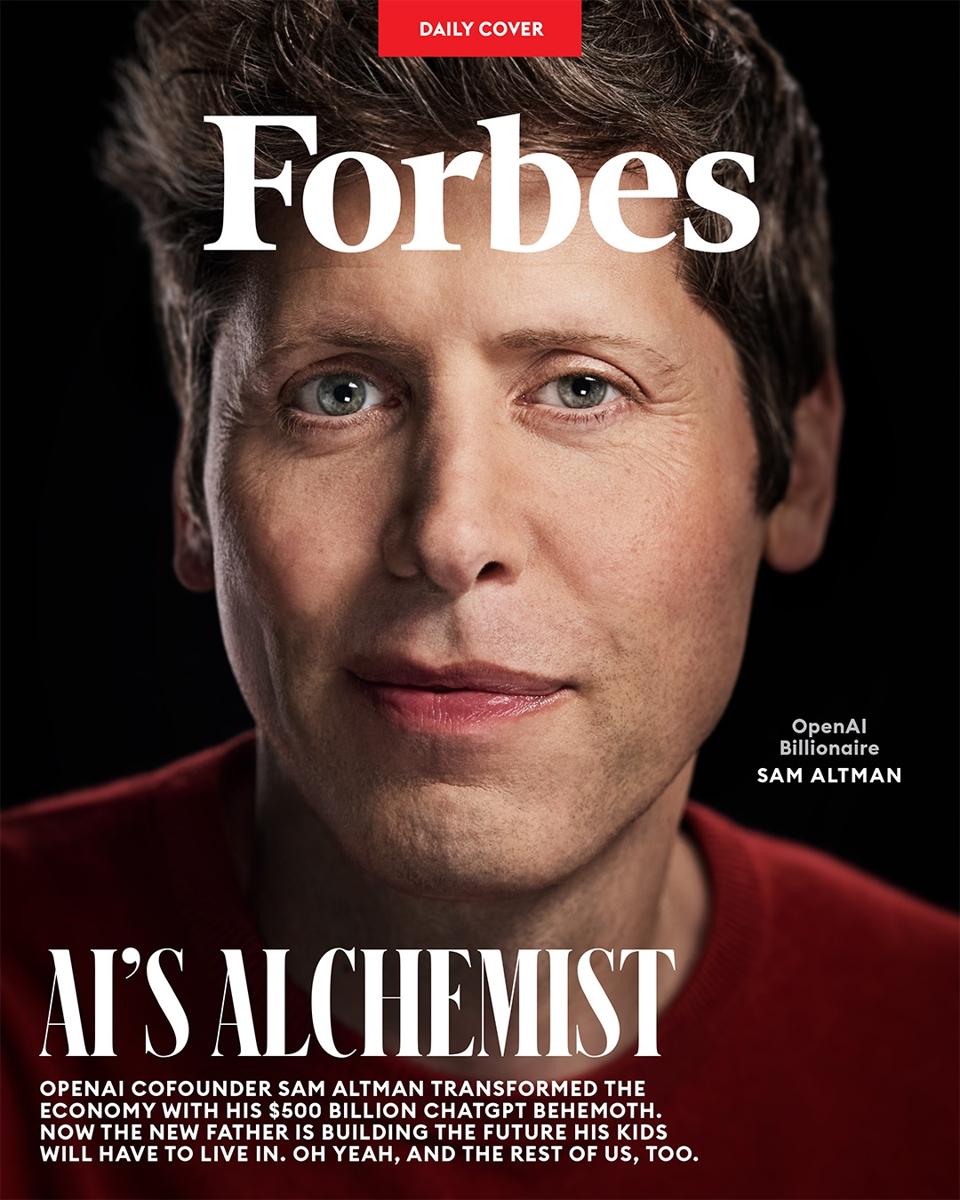
As CEO of OpenAI, the 40-year-old billionaire unleashed ChatGPT, mainstreaming artificial intelligence and creating a $500 billion behemoth. As a new father—with another baby on the way—he’s building the world his kids will live in one day.
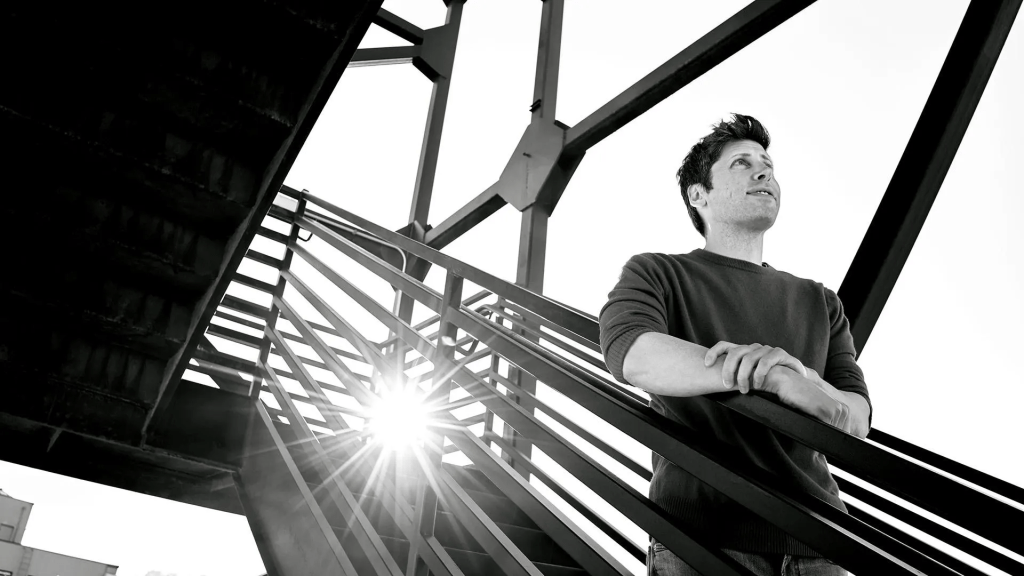
By Richard Nieva, Forbes Staff and Anna Tong, Forbes Staff.
Sam Altman says the stick of uranium in his office is nothing to worry about. Sitting vertically on his desk at OpenAI headquarters in San Francisco like a squat ebony Slim Jim, it is perhaps the most eyebrow-raising among the impressive array of historic innovations he has collected over the years. “That’s depleted,” he says casually of the uranium-238 rod, the same element used to create nuclear energy. “It’s not going to hurt you.” He waves a Geiger counter over it and proves his point.
“You make a big discovery in physics and . . . unlock basically unlimited energy,” he says of the uranium rod. “We didn’t know about this, then theorized that such a thing was possible. A couple decades later, they had made an atomic bomb. Just a crazy, fast thing.”
Altman, wearing Adidas Lego Ultraboost sneakers and a simple gray knit sweater, works methodically and chronologically through the artifacts, most of which typically live in his home office, unseen by anyone but his closest friends. On display today, Altman says: a 40,000-year-old hand ax (“an amazing general purpose Stone Age tool”), a 3,500-year-old bronze sword (“an interesting example of technology having a big geopolitical impact”) and a compressor fan blade from a Concorde jet engine (“the only piece small enough” to carry in). In casual defiance of museum curator protocol, he has lugged all these items to his office in a duffel bag, individually wrapped in bathroom towels.
“I am consistently amazed by how much each generation builds a new layer of scaffolding,” he says of technological progress. “We’re really seeing that now.”
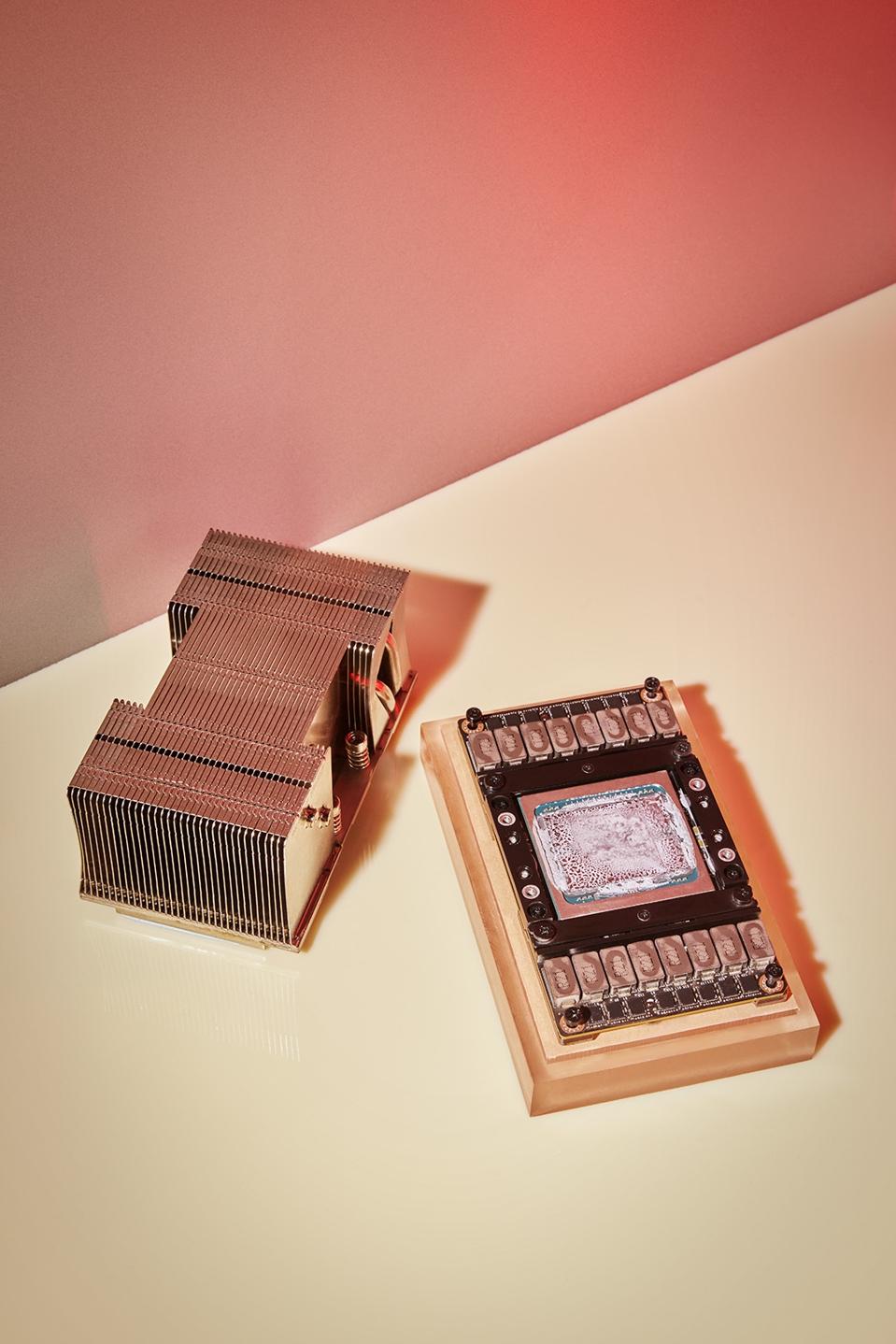
ChatGPU | A GPU chip that trained an early version of ChatGPT. “It looks so old fashioned and kind of crappy and tiny,” Altman says now. After the hardware became too old to use, he gave the chips to all the employees who worked on the project.
Cody Pickens for Forbes
As memorable as the uranium rod is, one of the other striking items in Altman’s collection is an old GPU chip. It trained an early version of the model behind OpenAI’s signature product, ChatGPT, which catapulted AI into the mainstream in November 2022 and set off a chain reaction of innovation that may turn out to be as transformative as the Industrial Revolution.
America has a storied history of innovators who aren’t known for inventing, whose achievement instead was pushing the cutting edge into daily life by sheer force of will and wits. Think Steve Jobs, Bill Gates and Elon Musk. Thomas Edison didn’t invent the light bulb. He—or rather his team—improved it with a longer lasting filament and then aggressively brought it to market.
Altman is of that mold. He’s an investor and an accelerator more than an engineer or a scientist. His vision isn’t about perfecting consumer products—it’s about building the underlying systems that the rest of the economy may soon depend on. ChatGPT now has more than 800 million weekly users. OpenAI, with more than $13 billion in revenue last year, was recently valued at $500 billion (Altman has no direct equity stake in the company, but his other investments make him worth an estimated $3 billion). It’s currently in talks to raise an additional $100 billion in a megaround that could value it at $750 billion or more. Inspired by OpenAI, big tech could pour an estimated $500 billion into AI data centers and chips this year. At this moment, it is perhaps the most important company in the world.
That has made Altman, now 40, the subject of a fast-growing hagiography. Disney CEO Bob Iger says Altman can “look around corners” to see the future. Airbnb cofounder Brian Chesky calls him “one of the two most ambitious people I know” (the other being Musk). Apple design legend Jony Ive says enigmatically that Altman “is comfortable with the unknown, but he is not casual about the responsibility.” Renowned VC Paul Graham (Altman’s former mentor at the startup incubator Y Combinator) offers a balder take: “He’s good at convincing people of things. He’s good at getting people to do what he wants.”
Though soft-spoken with a low-key Midwestern demeanor, Altman is something of an AI carnival barker. His aggressive predictions about the technology’s exponential growth need to come true to justify not just OpenAI’s valuation but the vast economic and social bets forming around it. And it’s not clear he quite knows how to get there. Can he deliver on a future as big and fast and expensive as the one he describes?
“I think I am unusually good at projecting multiple things— years or a couple of decades into the future—and understanding how those are going to interact together.”
Forbes has been tracking Altman, who ranks sixth on our upcoming list of the greatest living American innovators, for more than a decade. In 2015, he was a featured member of our inaugural Forbes 30 Under 30 Venture Capital list as the newly minted 29-year-old leader of Y Combinator. “It’s cool that you can make a list of the problems in the world and then fund companies to solve them,” he told us.
Viewed solely through the lens of those investments, Altman is a wildly ambitious business leader meticulously architecting his vision of the future. As the mobile era solidified in the 2010s, Altman presciently backed an array of companies—investing $15,000 for 2% of payments giant Stripe before it even had a name, and leading a $50 million funding round into Reddit in 2014, for example—that grew into mainstays of the app economy.
With AI he’s doing it again. There’s OpenAI, of course. But there’s also Helion, which is attempting to harness the nearly limitless power of nuclear fusion (the type of energy the sun uses), and Oklo, which is developing more conventional nuclear fission reactors, but ones that are smaller and more modular. Both could serve AI’s energy-guzzling needs. Then there’s World (formerly Worldcoin), which is developing tech to provide “proof of humanness” in an emerging world of AI deepfakes. There’s also the nascent Merge Labs, working on neural computing. And through a nonprofit called OpenResearch, Altman backed one of America’s largest experiments on universal basic income—an effort that would provide all citizens with a small, guaranteed, no-strings-attached wage as a possible remedy for the economic disruption AI may cause.
“I think I am unusually good at projecting multiple things— years or a couple of decades into the future—and understanding how those are going to interact together,” he says. Some people are good at predicting what’s next. Others see how different worlds are about to overlap. “But the combination of them is kind of my thing.”
These days Altman has a new lens through which to view the promise and perils of AI: fatherhood. He and his husband have a baby son and are expecting their second child later this year.
“People say, ‘Oh, I’m glad you have a kid because now you won’t do something to destroy the world,’ ” Altman says. “I was really set on not doing that before. Didn’t need the kid.”
Altman’s back story is well told: Raised in St. Louis, a world away from Silicon Valley, he was a nerd fascinated by science, energy and artificial intelligence. “I’ve been obsessed with the same couple of ideas my whole life,” he says. They haven’t changed “since I was like 18.”
Altman landed at Stanford in 2003 intent on studying AI at a time when the zeitgeist was more Web 2.0. During his sophomore year, he won a business plan competition for what would eventually become his first startup, Loopt, a phone app for sharing your location with friends. That’s when he first heard about Y Combinator. He took the redeye to Boston to interview with founder Paul Graham. “I remember thinking, this is what Bill Gates must’ve been like,” Graham recalls of their first meeting.
Graham was so impressed that when he stepped back in 2014, he tapped Altman, then only 28, to run the place. The reason? “Sam gets what he wants,” Graham says. “So if the only way Sam could succeed in life was by YC succeeding, then YC would succeed.”
Altman played in a variety of sandboxes at YC but became very fond of one side project in particular: an AI research outfit named OpenAI. Founded in 2015 as a nonprofit, OpenAI was striving to create AGI, or artificial general intelligence, basically AI that can “think” like humans. Altman personally recruited Greg Brockman, then-CTO of Stripe, and famed AI researcher Ilya Sutskever, known for his pioneering work in neural networks, to join as cofounders—and helped convince Elon Musk, then one of his personal heroes, to back it with $38 million. Altman’s focus on OpenAI soon became almost monomaniacal, making Y Combinator more of a fading hobby than the calling Graham intended it to be. In 2019, Graham and YC cofounder Jessica Livingston were stunned to read a press release announcing Altman as CEO of a new for-profit branch of OpenAI. Livingston asked him to recommit to YC or step down.
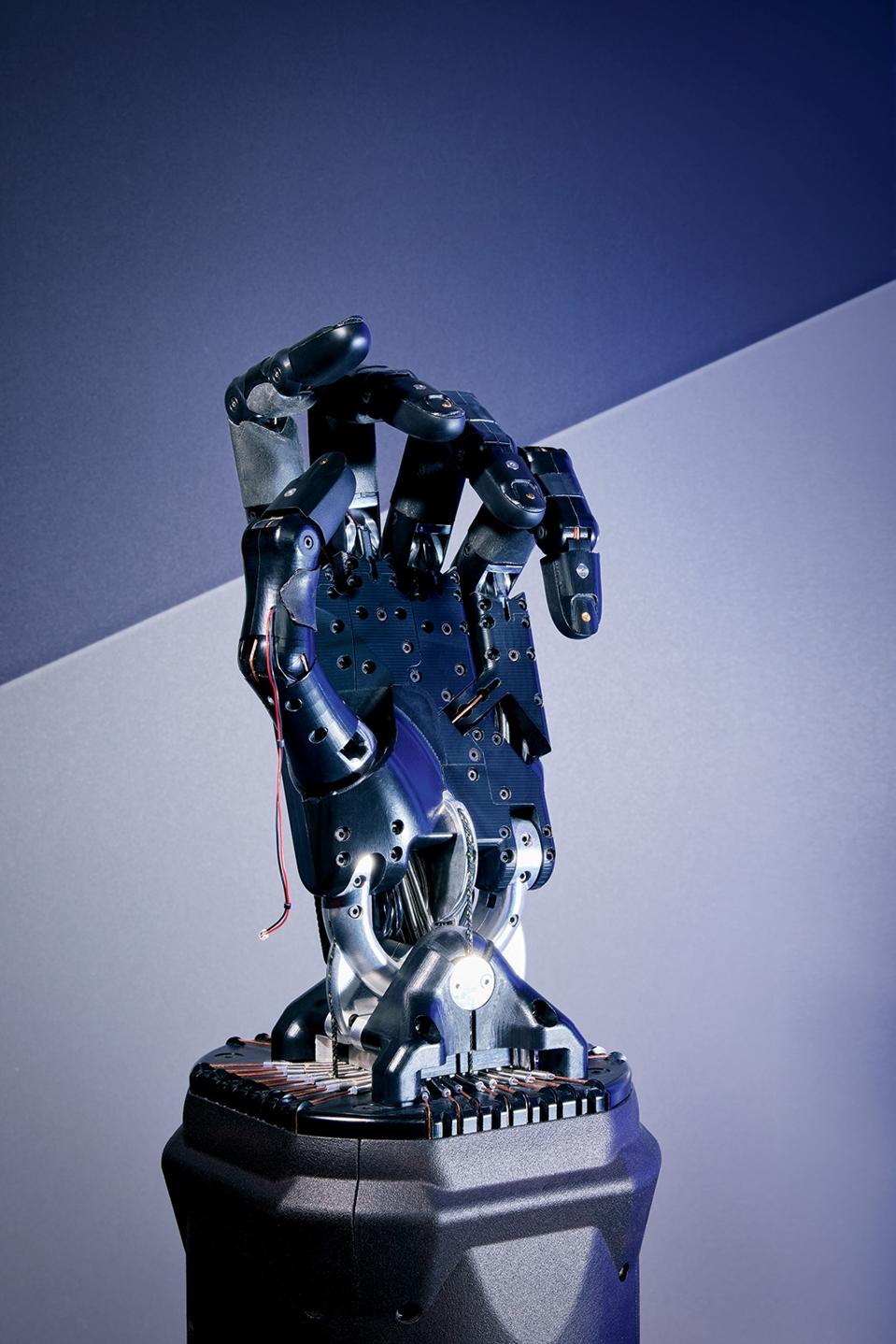
Palm Pilot | Among Altman’s trove of mementos: a robot hand built by OpenAI to enable artificial intelligence to solve a Rubik’s Cube. “It’s an incredibly brittle thing,” Altman says. “The tendons broke all the time.”
Cody Pickens for Forbes
There is “some deserved flak there,” Altman says now. “When it was clear to me that OpenAI was going to work and I was running both things, I was just like, ‘I can pretend that I still care as much about YC, but [OpenAI] is my purpose and I need to go do it.’ ”
This wouldn’t be the first time Altman’s priorities would run afoul of his colleagues. Days before Thanksgiving in 2023, he was fired by OpenAI’s nonprofit board for not being “consistently candid.” Leading the coup was cofounder Sutskever, who’d told the board that “Sam exhibits a consistent pattern of lying” and accused him of “creating chaos, starting lots of new projects and pitting people against each other” in pursuit of his goals. Altman would be reinstated just five days later after what was arguably the most farcical corporate drama in Silicon Valley history—a saga that saw OpenAI employees revolting and threatening to quit en masse if Altman wasn’t reinstalled, Microsoft suddenly stepping in to hire him, and rumors of a new AI model so powerful it frightened those who saw it.
All this occurred amid a dizzying swirl of allegations of duplicity and recklessness. A board investigation would later conclude that Altman was indeed the right leader for OpenAI, but the incident left an indelible mark on his reputation.
It didn’t help that three years prior, an internal power struggle had seen a faction of top OpenAI employees, including siblings Dario and Daniela Amodei, split off from the company to found Anthropic, a rival that touts a particular focus on AI safety. Now valued at around $350 billion, with some $4.5 billion in 2025 revenue, it has become one of OpenAI’s most formidable rivals.
Even more combustible than the Anthropic defection was OpenAI’s decision to restructure the organization to add a for-profit arm. The move allowed OpenAI to function more like a typical company and take funding from investors, including a key $13 billion investment from Microsoft beginning in 2019. Musk was vehemently opposed and left in protest, receiving no equity in the for-profit entity. Palace intrigue abounds, but in a lawsuit, Musk claims he left because OpenAI abandoned its original mission to create AI to benefit humanity in favor of maximizing profits. OpenAI maintains that he instead left because the company wasn’t giving him control of the for-profit. Musk quickly turned around and launched competitor xAI in 2023, which is now valued at $250 billion. The case is expected to go to trial this spring. “It’s not how I would choose to spend however many days it’s going to take. But I feel good about our position,” Altman says.
While Altman felt the creation of a for-profit was necessary for OpenAI to thrive, there’s no question it benefited him as well. It bolstered his influence and his power—though, perplexingly to critics, not his wealth. Altman had no direct stake in OpenAI when it was founded and still doesn’t, even though he could have taken one in the restructuring. Why? “I don’t know. I don’t have a great answer,” he says. “Probably I should [take one], just so I never have to answer that question.” He adds that his lack of equity “is this super-confusing, insane conspiracy theory–producing thing.”
“If [Altman] sees an opportunity not being exploited, it’s very hard for him not to do it. I bet he finds it hard to resist buying commercial real estate in San Francisco.”
The restructuring has made a bitter enemy of former Altman hero Musk, who promptly used xAI to build a ChatGPT competitor called Grok. Billed as a “truth-seeking” AI model, it is mired in an endless swamp of controversy for repeating false narratives about white genocide, calling itself “MechaHitler” and apparently generating sexualized pictures of minors (the company later apologized). “I wish they would do things differently. It’s crazy to me how much time he spends attacking us,” says Altman, complaining about Musk’s accusations that OpenAI doesn’t act safely. “Their own house is on fire on these things consistently.”
While Altman’s tendency to race ahead with ideas that excite him has gotten him into trouble, it’s also a tentpole of his success.
Take the launch of ChatGPT. In 2022, OpenAI’s leadership had wavered on releasing the model to the public, arguing it was better to wait for a more powerful one. It was Altman who convinced them to go when they did. “Sam was like, ‘Let’s just try to get this out,’ ” says Brockman, OpenAI’s cofounder and president. The night before the launch, he recalls the team making predictions on how it would go. “I thought it would be a little bit of a flash in a pan,” he says now. “Sam always had the conviction.”
As OpenAI’s valuation and forecasts for the size of the AI market attest, the timing of that launch couldn’t have been better. He’s “forward thinking in the extreme,” Disney’s Iger says of Altman. “Combining both patience and impatience.”
There’s something else at work here, too: Altman knows his history. His itch to release products quickly is informed by studying Xerox PARC, the legendary Silicon Valley research lab known for inventing the modern graphical user interface, laser printers and computer mouse, yet failing to commercialize any of them. “You have to have an economic engine in the cycle,” Altman says. “I think there’s probably a lot of great innovation that has never gotten out of the lab because someone didn’t do the work to just get it into people’s hands.”
That’s something he’s working on now. ChatGPT’s rudimentary text interface dates back to Eliza, a ’60s-era chatbot that famously, and badly, impersonated a psychotherapist. Altman wants to invent a new paradigm entirely, devices to make AI essential to our daily lives.
To that end, OpenAI bought IO, the hardware firm of Jony Ive (the designer of the iMac, iPhone and Apple Watch), for $6.5 billion in July. “Sam understands that user interface is not decoration,” Ive says. “It defines the human experience.”
Altman is enraptured by the project, but intractable in his refusal to describe it; the team works in a secret office in San Francisco’s Jackson Square district. He talks about it with almost Cheshire abstraction: He sees a family of gadgets that provide “extreme contextual awareness and proactive assistance.” There might be a “little friendly companion” that observes you, helpfully expediting tasks and generally improving your daily experience. At one point he describes a device that would have chosen the perfect selection of artifacts he showed off earlier. It would say, “ ‘I know what Sam has been thinking about recently, what he’s likely excited about,’ ” he says. “ ‘I’ve also watched where his eyes go in the room.’ ”
This could all be misdirection. Altman has a reputation for shiny object syndrome. And the challenge of conceiving the devices that could help define human experience is not without risk. Silicon Valley is littered with “world changing” failures—the Segway scooter, Magic Leap’s ferociously overpromised augmented reality and, more recently, Humane’s silly wearable AI assistant pin (an Altman-backed company). “It may flop,” Altman concedes. “Not many times in history have people figured out a fundamentally new computing interface.”
It also could be harmful. OpenAI has been criticized for releasing products without proper safety testing and for shipping features that prioritize engagement over psychological well-being. It has been named in several wrongful death suits that allege ChatGPT directly encouraged and/or facilitated self-harm and suicide. Many argue the behemoth data centers that undergird ChatGPT are power-gorging, water-sucking environmental nightmares. OpenAI has always been quick with apologies and pledges to do better, but it’s hard not to see a pattern emerging.
In December, Altman and Iger spun heads in Silicon Valley and Hollywood when they announced a deal to let OpenAI license characters from the Disney universe, including Mickey Mouse, Darth Vader and Cinderella, to be used in OpenAI’s Sora app, which uses AI to generate realistic videos from the simplest prompts. It was a stunning alliance, as Disney is notoriously protective of its intellectual property, and Hollywood has generally viewed AI as an existential threat. Discussed for more than a year, the agreement allowed Disney, among other things, to include Sora-generated videos on its Disney+ streaming service. It also saw Altman convince the entertainment giant to make a $1 billion equity investment in OpenAI, giving the AI behemoth the most magical of Hollywood blessings. “Sam wanted that as a sign of both confidence and, essentially, to bolster the partnership,” Iger says. “And to create a situation where Disney had a little bit more skin in the game.”
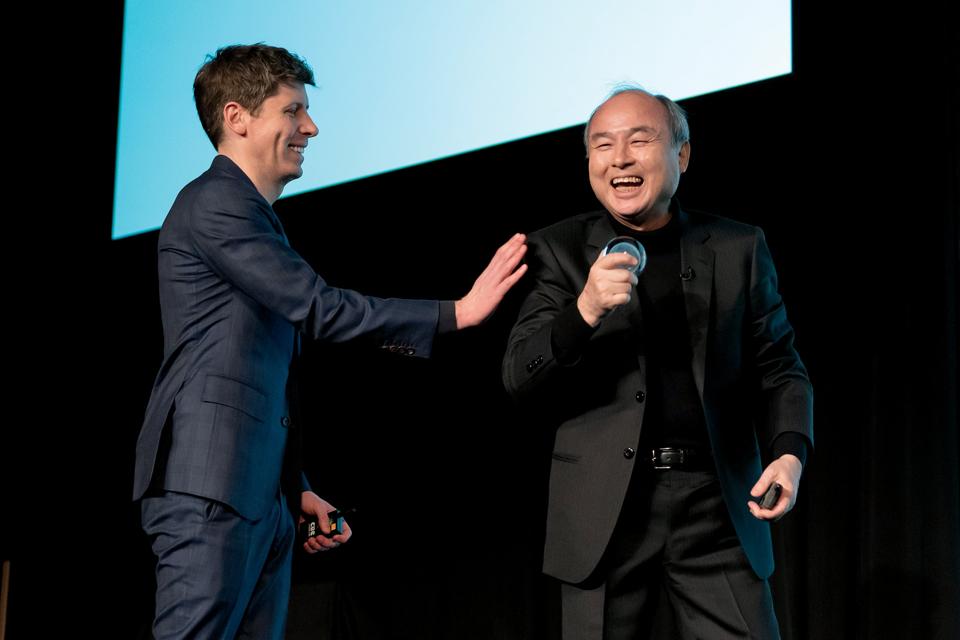
Force Multiplier | Altman’s Rolodex is a who’s-who of Silicon Valley power players. Japanese tech conglomerate Softbank has poured billions into OpenAI and announced a joint venture to bring AI to industries across Japan. Softbank founder Masayoshi Son (above right) says Altman thinks in decades.
Getty Images
It also speaks to Altman’s influence, which has ballooned alongside that of OpenAI. On the first full day of President Trump’s second term, Altman appeared at the White House alongside Trump, Oracle cofounder Larry Ellison and SoftBank’s billionaire tech investor Masayoshi Son to announce Project Stargate, an audacious $500 billion commitment to AI infrastructure in the U.S. It was an extravagant move, befitting a maximalist president and risk-loving investor like Son. But it was Altman who wanted to go even bigger. “We discussed, and he said ‘More is better,’ ” Son tells Forbes. “More is better.”
Altman says Trump has been easy to work with when it comes to AI, though the administration’s nationalist policies don’t quite align with his own or OpenAI’s. “His job is to make sure America wins. And I view our mission as for all of humanity,” Altman says. “There’s some opposition there.”
That said, as OpenAI makes a sprawling land grab for the future, there are also some synergies in their expansionist tendencies. Beyond ChatGPT, Sora and whatever Jony Ive is really working on, the company is building a custom AI chip, a social media application to compete with X and is even considering humanoid factory robots. In January, OpenAI announced a suite of software tools for health care organizations and a freemium ad-supported business model for ChatGPT. OpenAI chief research officer Mark Chen tells Forbes that in the year ahead it hopes to develop an AI researcher “intern” that can help his team accelerate its ideas.
“We are heading toward a system that will be capable of doing innovation on its own,” Altman says. “I don’t think most of the world has internalized what that’s going to mean.”
Critics look at all this and say Altman is just trying to make OpenAI too big to fail, an argument allies dismiss. “I don’t think there’s some secret plan,” says OpenAI chairman Bret Taylor. “People are just very excited about the impact of AI on humanity.”
Graham thinks it’s just Altman’s nature. “If he sees an opportunity not being exploited, it’s very hard for him not to do it,” he says, noting his former mentee has a particular weakness for things that are undervalued. “I bet he finds it hard to resist buying commercial real estate in San Francisco.”
“That term ‘frenemies,’ I think, is a fine way to characterize [the relationship].”
Altman has stakes in more than 400 companies, which might suggest a certain lack of focus. Multiple OpenAI employees tell Forbes they fear the company is trying to do too much too quickly. They worry about its ability to stay ahead in the model race, particularly after GPT-5, which was widely viewed as disappointing. And they were shaken when Apple chose Google’s AI models to power the next generation of Siri, a deal that was OpenAI’s to lose since it had already been powering the iPhone maker’s Apple Intelligence offering. “Yeah, that was not great,” says one engineer. “A lot of us thought that was a done deal.”
Altman, for his part, says he is “110%” focused on OpenAI and its core mission of AGI, which is conveniently hard to define and could be anywhere from three to 30 to forever years away. At one point, he simply declares victory: “We basically have built AGI, or very close to it.”
Told of this assertion, Microsoft CEO Satya Nadella serves up a reality check. “I don’t think we are anywhere close to [AGI],” he says with a chuckle. “We have a good process in place. It’s not about Sam or me declaring it.” Even as one of OpenAI’s most important partners, Nadella acknowledges natural “friction” as the companies compete in AI. “There will be gray zones,” he says. “So that term ‘frenemies,’ I think, is a fine way to characterize [the relationship].”
A few days later, Altman dials things back. “I meant that as a spiritual statement, not a literal one,” he says. Achieving AGI, he concedes, will require “a lot of medium-sized breakthroughs. I don’t think we need a big one.”
Altman is aware that his motivations can be perplexing to some. It’s “hard to know what’s going on inside his head,” says Graham, his longtime mentor, someone you’d think would have at least a general idea. The OpenAI CEO’s insistence on scaling immediately and aggressively often draws criticism. Take his headline-grabbing commitment to spend $1.4 trillion, mostly on AI chips and data centers, over the next eight years. In his mind, it’s “obvious” it will take that amount of money and computing power to keep up with the exponential growth of AI use. “Then the rest of the world is like, ‘financial reality.’ And I don’t think I’m the strongest at keeping those dueling perspectives in mind,” he says.
Altman has a pretty simple succession plan for OpenAI: Hand off the company to an AI model. If the goal is for artificial intelligence to become so advanced that it can run companies, he asks, then why not his own? “I would never stand in the way of that,” he says. “I should be the most willing to do that.”
And then what?
He says he has no professional ambitions beyond OpenAI, with one caveat: In a post-AGI world, he might find passion in a new type of work not yet created. “The things I really wanted to accomplish, I’ve mostly accomplished,” he says. “I feel like I’m playing for bonus points at this point.”
Look back on the week that was with hand-picked articles from Australia and around the world. Sign up to the Forbes Australia newsletter here or become a member here.
This story was originally published on forbes.com and all figures are in USD.