Tesla beat Wall Street expectations in its first earnings report this year, following a recent decline in its core auto business as the company shifts its focus to self-driving taxis, humanoid robots and AI infrastructure.
Key Facts
- Tesla reported first-quarter revenue of $22.39 billion and $0.41 earnings per share, beating FactSet estimates of $22.19 billion and $0.35 per share.
- Although the automaker reported its second-worst quarter for car sales since 2022, it said Wednesday that demand for its vehicles rebounded in North America and European regions, driven by countries like France and Germany while growth continued in the Asia-Pacific region, particularly in South Korea and Japan.
- Tesla delivered just over 358,000 vehicles in the first quarter, up 6% year-over-year, but missing the company’s compiled consensus of 365,645 and FactSet projections of 381,000.
- Capital expenditures increased 67% from the first quarter in 2025 to $2.49 billion as part of the company’s plan to spend $20 billion this year, more than double last year’s $8.5 billion, to fund its business pivot.
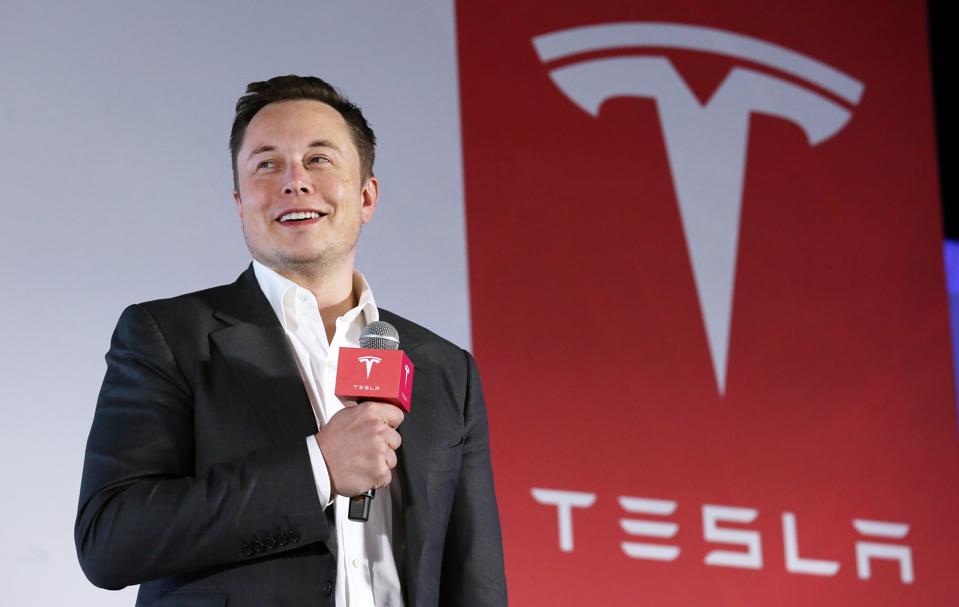
- On Wednesday’s earnings calls, founder and CEO Elon Musk said the aggressive capex was “well justified,” especially as the company intends to invest heavily in training AI models, as well as designing and manufacturing AI chips in-house, as it races against the largest tech companies.
- Shares rose 4% in after-hours trading but are down 11% this year, underperforming the rest of the “Magnificent 7” tech stocks including Apple, Microsoft, Alphabet, Amazon, Meta and Nvidia.
Key Background
The quarter caps a difficult stretch for Tesla’s core auto business. Full-year 2025 revenue fell 3% to $94.83 billion—the company’s first-ever annual revenue decline—while earnings per share collapsed 47% to $1.08 as the company experienced its second annual decline in vehicle deliveries. Tesla’s founder and CEO Elon Musk has pivoted the company away from its core electric car business this year amid declining sales, redirecting toward robotaxis, humanoid robots and AI infrastructure. The brand has struggled with increasing competition, especially from Chinese EV makers, aggressively taking market share and customer backlash from Musk’s involvement with the Trump administration. This year, the company announced it planned to end the production of its Model S and Model X vehicles, instead using the manufacturing facility in California that made those cars to produce its line of humanoid robots. It also said it would make a $2 billion investment in Musk’s AI venture xAI. On April 18, Tesla announced plans to expand its robotaxi business, which currently falls behind Alphabet’s Waymo, beyond California to Houston and Dallas (Tesla’s current robotaxi service in California is operated by human drivers or with human safety supervisors). In the first quarter, Musk also merged SpaceX and xAI in a deal valued at $1.25 trillion as he gears up the combined companies for a potential record-breaking IPO.
Forbes Valuation
Forbes estimates Musk is the richest man on Earth with a $786 billion fortune, eclipsing second-richest Larry Page’s fortune by more than $500 billion. Musk may soon be the first person to have a net worth exceeding $1 trillion, as SpaceX’s public debut expected in June would value the company at $1.75 trillion. Musk owns an estimated 43% of SpaceX and 12% of Tesla—where he also sits on a $1 trillion pay package approved by Tesla shareholders in November, though it requires the automaker to achieve several goals over the next decade. Musk also raised a combined $2 billion in private capital for his two other startups, tunneling company The Boring Company and brain implant outfit Neuralink.
Tangent
“I think Optimus will be not just Tesla’s biggest product ever, but probably the biggest product ever,” Musk said during his opening remarks on Tesla’s first quarter earnings. Tesla’s first humanoid robot project was unveiled in 2021 and has unveiled two versions so far. In late 2024, Optimus robots performed simple tasks at Tesla’s October “We, Robot” event, though it was revealed that several were remotely operated. Last year, Tesla deployed hundreds of units inside its own factories for task execution and AI training data, though Musk acknowledged on last quarter’s earnings call that they were for learning purposes and not performing any material tasks. On Wednesday’s earnings call, Musk said that the company will unveil the latest version of Optimus sometime around late July and August, as Optimus’ third iteration is expected to head into production this summer.
This article was originally published on forbes.com and all figures are in USD.
Want to see more Forbes articles on your feed? Tap here to make Forbes Australia a preferred source on Google.
Look back on the week that was with hand-picked articles from Australia and around the world. Sign up to the Forbes Australia newsletter here or become a member here.