Sam Altman was interviewed by Commonwealth Bank CEO Matt Comyn on Tuesday, where he admitted to being surprised that AI hasn’t stimulated more economic growth.
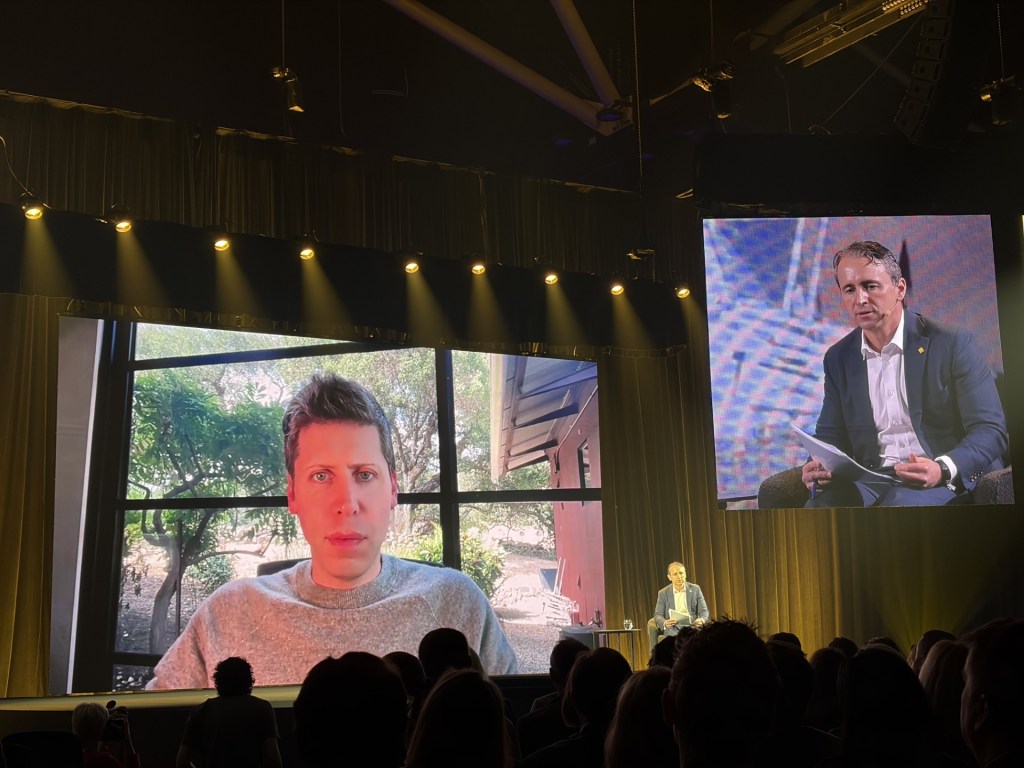
OpenAI CEO Sam Altman says Australia could and should be a data centre capital of the world – even as he concedes being stumped over the limited economic gains AI has thus far yielded.
Altman called into Commonwealth Bank’s Accelerate AI event on Tuesday, where he gave a surprisingly candid answer to a question from CBA CEO Matt Comyn about what business leaders ask of him.
“There’s a lot of great things I hear from companies, the negative one I hear is ‘our spending is going up and up, people feel like they’re being very productive… but where is the revenue, where are the actual productivity gains?'”
Altman’s answer? “It’s all still very new, and it’s just gonna take a little bit longer to figure out how a company actually does run more efficiently as we make these great new products. But if a year from now, we’re still talking about that same question, I’d be more concerned.”
AI investments have fuelled the ongoing US stock market boom as money pours into semiconductors, data centres and foundation model makers like OpenAI and Anthropic. Altman’s “startup” was last valued at US$852 billion.
As OpenAI reportedly prepares for an IPO for later this year, the productivity question will give ammo to the technology’s sceptics. A National Bureau of Economic Research survey of 6,000 executives in US, UK, Australian and German companies found 90 per cent reported no impact on productivity from AI use. A Goldman Sachs research note from February stated “We still do not find a meaningful relationship between productivity and AI adoption at the economy-wide level.”
Altman touted AI’s ability for one-person startups to go farther than ever before, and for the technology to speed up advances in scientific research. But he admitted that he expected AI to be a bigger economic boon at this point than it’s so far been.
“Given the fact that we have these incredibly smart models… frankly, it’s been a little bit harder, or maybe a lot harder, to get the positive economic impact that we all thought we’d have at this level of technology.”
Uncapped potential
Altman gave a little local flavour to his interview by promoting the opportunity in front of Australia. Just like Atlassian co-founder Scott Farquhar has advocated for Australia being a data centre hub for Asia, Altman says the country could be a top supplier of “low-cost intelligence.”
“Australia has among the best natural resources and abundant clean energy stories in the world, and if Australia wanted to become a data centre capital of the world it would certainly be able to,” Altman said. “In fact I think it would be one of the very top few places in the world in terms of what’s possible.”
OpenAI will be the central tenant of NextDC’s $7 billion Sydney data centre, which once built will be the biggest in the southern hemisphere.
Last July, ahead of OpenAI establishing an office in Sydney, the company released a Blueprint for Australia containing recommendations for how the country could ride the AI tidal wave. Policy recommendations included tax incentives for businesses adopting AI and to modernise copyright law to accelerate AI development.
“It does seem to me like demand for sufficiently high quality and sufficiently low cost intelligence is effectively uncapped, so you can imagine the ability to deliver this AI infrastructure to be one of the most important markets in the world.”
Want to see more Forbes articles on your feed? Tap here to make Forbes Australia a preferred source on Google.
Look back on the week that was with hand-picked articles from Australia and around the world. Sign up to the Forbes Australia newsletter here or become a member here.