Desperate to rebuild his fortune, Donald Trump asked his political supporters to become his business partners. Those who trusted him most got hurt the worst.
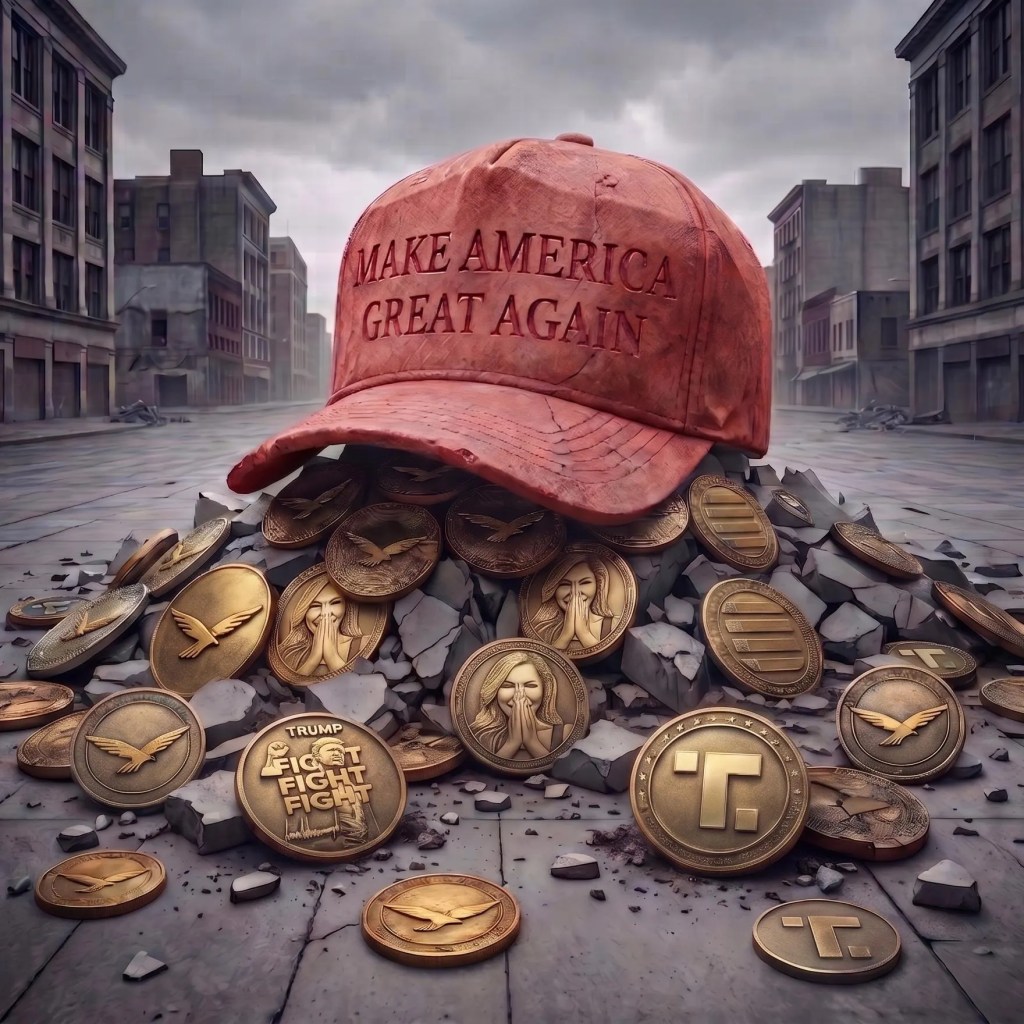
Charles Brucaliere for Forbes via Gemini
Vadim Fistikan started working at 17 and built the kind of savings that usually takes years of overtime, delayed purchases and adult restraint: more than $100,000 by the time he hit his late twenties. In 2021, the Washington State truck driver eyed a house near family in Florida, with a pool and a waterway that led to a river, and then the ocean. “We were thinking about pulling the trigger,” he says. “Then I saw this whole Trump thing going on.”
This Trump thing was the Trump Media and Technology Group, the company behind Truth Social. In October 2021, the president unveiled the business, promising a censorship-free platform and giving supporters a chance to invest via a special purpose acquisition company. Shares of the SPAC jumped 1,650% in two days, then fell about 30% by the start of the third. To Fistikan, that looked less like a warning than a discount. “I’m like, ‘I’m getting in,’” says the three-time Trump voter, who added to his bet until it hit $205,000.
That investment is now worth $30,000.
Fistikan logged onto Truth Social last fall to voice his frustrations. “I’m like, ‘Hey, this is a scam,’” he says. “And a lot of people were like, ‘No, you’re just a Trump hater.’ I’m like, ‘No. I was on board since day one. … I’m now broke.”
He’s not alone. Katherine Chiles, the SPAC’s former chief financial officer, now uses her Truth Social account to promote a song accusing the president of selling out his supporters—“Donald Trump is a b—-.” Chad Nedohin, a worship leader who once moonlighted as the unofficial captain of Trump Media’s retail shareholders, now describes the company as a vehicle for enriching the president and his inner circle. “We’re just poor cattle to them,” Nedohin says. “He doesn’t care about anyone.”
Throughout the president’s life, his most remarkable creations—whether casinos in Atlantic City, public offerings on the New York Stock Exchange or political movements across America—all relied on one thing: believers. In 2021, Trump left the White House with an abundance of them—and quickly got to work monetizing. To do so, he followed a process with three distinct stages. First, the invention: come up with a business concept, invest almost nothing, take a big chunk of equity. Second, the sale: stir up a frenzy among the faithful, cash out what you can. Third, the mess: watch the assets collapse, salvage the scraps. From 2021 to 2025, five Trump-family ventures reached public investors: Trump Media, World Liberty Financial, Trump’s memecoin, Melania Trump’s memecoin and American Bitcoin.
“We’re just poor cattle to them. He doesn’t care about anyone.”
Now, they are all hitting the messy stage. Trump Media shares are down 89% from their peak. World Liberty tokens have fallen 82%. The president’s memecoin is off 98%. Melania’s version has dropped 99%. Shares of American Bitcoin are down 95%. The Trumps, after cashing out $1.9 billion, are still up $3.1 billion overall, according to Forbes calculations. Their supporters are down an estimated $7 billion.
Representatives of the Trump Organization did not respond to requests for comment. Nor did spokespeople for Trump Media, which sued Forbes and other publications over allegedly inaccurate reporting about losses during the company’s first year of operation. The White House ignored questions about the president’s moneymaking ventures, issuing a statement on his policies instead. “President Trump cares deeply about the patriotic Americans who elected him to office and fights for them daily,” said deputy press secretary Anna Kelly.
The human cost of all this lies in accounts like Fistikan’s. He didn’t just buy a stock. He bought a story, that Trump views his supporters as partners rather than tools. “Pretty much my whole life savings [was] in this one stock,” says Fistikan. “This is the greatest theft, con job he has ever done.”
Nick Pinto was sitting inside Champions, the wood-heavy, leather-laden restaurant at Trump’s Miami golf resort, in January 2025 when a Robinhood notification lit up his phone: Trump had launched a memecoin.
Pinto, 26, makes most of his money creating videos for social-media platforms. His due diligence consisted of Googling around and hopping on X. “I was like, ‘Oh, let me buy some of this—never know what’s going to happen.” He initially invested $7,000.
Pinto was part of a frenzy that delivered the first family an extraordinary windfall as Trump returned to the White House. The roots of it lay in World Liberty Financial, the crypto project the president had launched the previous September. Billionaire Justin Sun, facing allegations from the Securities and Exchanges Commission, invested $45 million in its token after Trump won the election, then put another $100 million into the president’s memecoin. Melania Trump added a coin of her own. The three tokens traded furiously as Trump ascended to the throne, throwing off hundreds of millions in cash.
Then the president added a perk: dinner at his Virginia club for the top 220 memecoin investors.
“I went crazy,” says Pinto, who upped his bet to $480,000, allocating about 60% of his entire investment portfolio to the memecoin. That was enough to get him into the dinner, a scene both surreal and shoddy. Pinto says it felt like a wedding, with mediocre food and poor service. “They didn’t even give me soda—all I had was water.”
Another attendee remembers offering a cigarette to former NBA player Lamar Odom, who took a FaceTime call while they were standing outside. “I’m with these crypto kids!” Odom told his caller, Khloe Kardashian.
The memecoin slid downward after the event and never really recovered, losing two-thirds of its value by the end of the year. It was around that time that one of Pinto’s friends, who had also attended the dinner, convinced him to turn on the coin.
“This is something that the Trump family kind of came up with out of the blue,” Pinto says his friend told him, “and there’s not really a way for us to predict the future of the coin or what their plans for it are.”
Convinced, Pinto ditched 75% of his position, locking in roughly $250,000 in losses. He held onto the rest in case something wild happened.
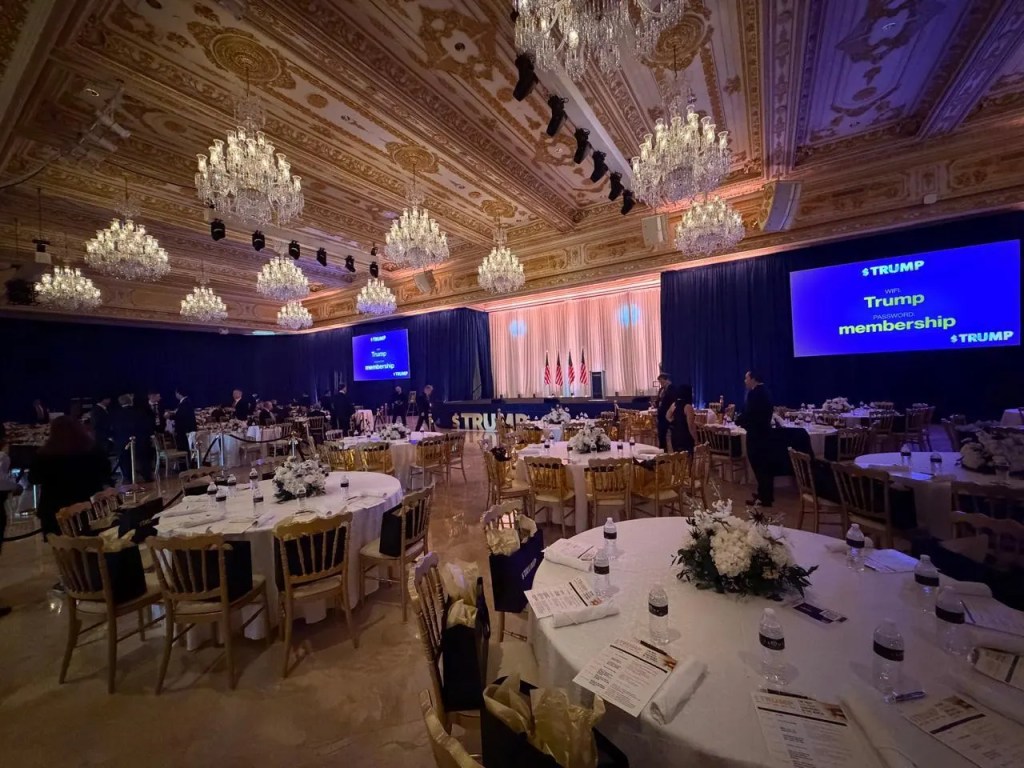
Something did. In April, Trump hosted another event, this one at Mar-a-Lago. Attendees received goodie bags with Trump trading cards, statuettes of the president filled with cologne and Trump watches. “I almost didn’t get one because people kept stealing mine,” says Pinto, who recalls one attendee slipping out with six bags. “Mine got swiped, and then I saw a chair that was empty, so I swiped one, too.”
Memecoin Merch
The president hosted two events for his memecoin holders, one at his golf course in Virginia and another at Mar-a-Lago in Palm Beach. Attendees walked away with bags full of Trump-branded tchotchkes.
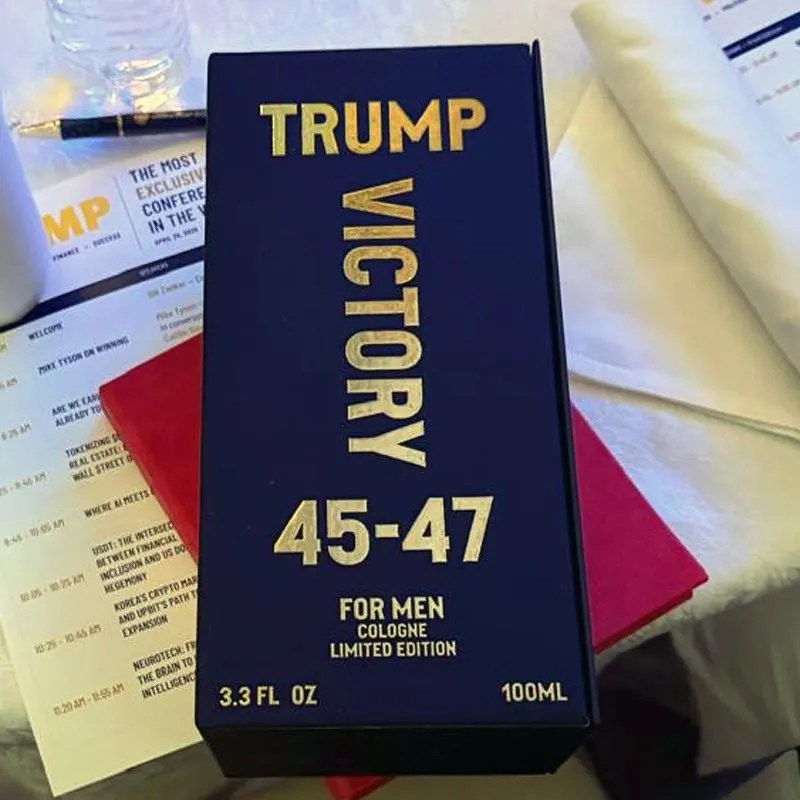
Smells Like Victory
Among the goodies: bottles of cologne, packaged in golden statuettes of Donald Trump that retail for $249 online. “I haven’t used it yet,” says two-time memecoin event attendee Nick Pinto. “I have it for decoration.”
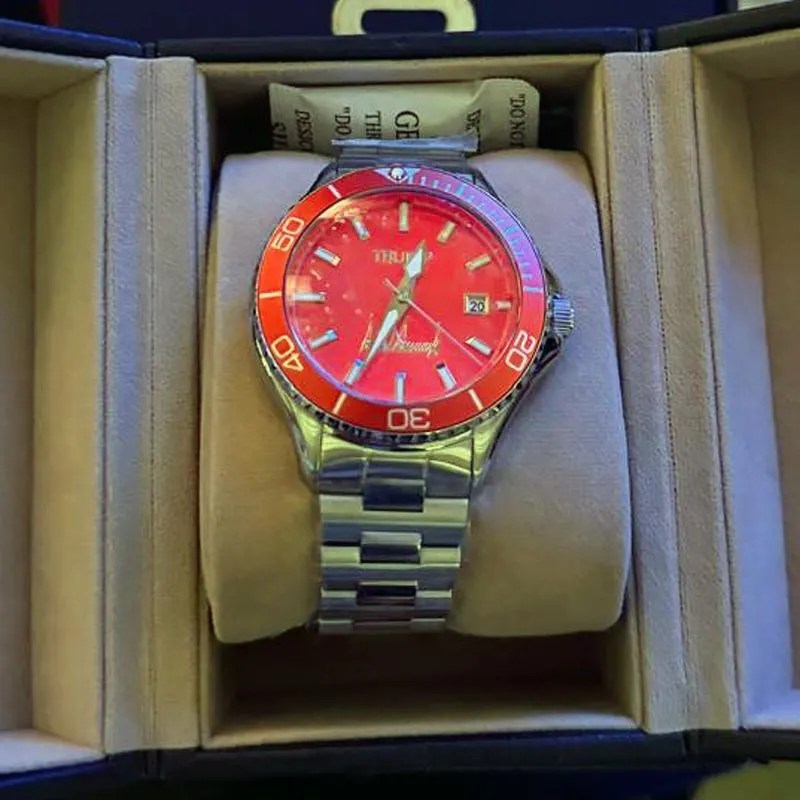
Watch Your Back
Red-faced watches became hot items at the Mar-a-Lago event. Online, the president sold other varieties, including one with pieces of the tie and suit he wore in his mugshot photo at the Fulton County Jail after he was indicted on racketeering and other charges in 2023.
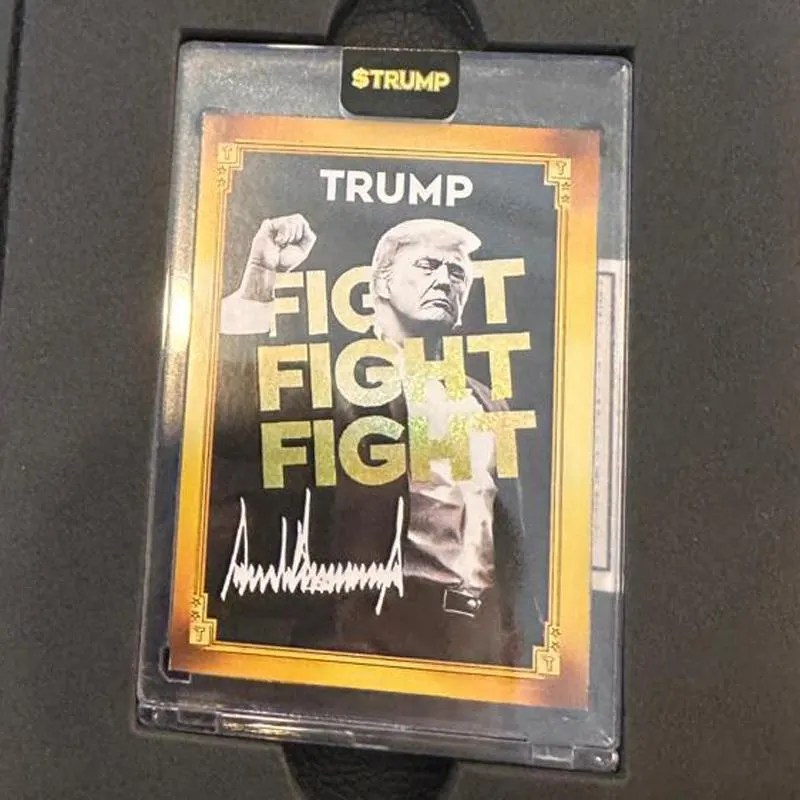
Face Value
Trump trading cards featured words the president shouted after a bullet grazed his ear in Butler, Pennsylvania: “Fight, Fight, Fight.”
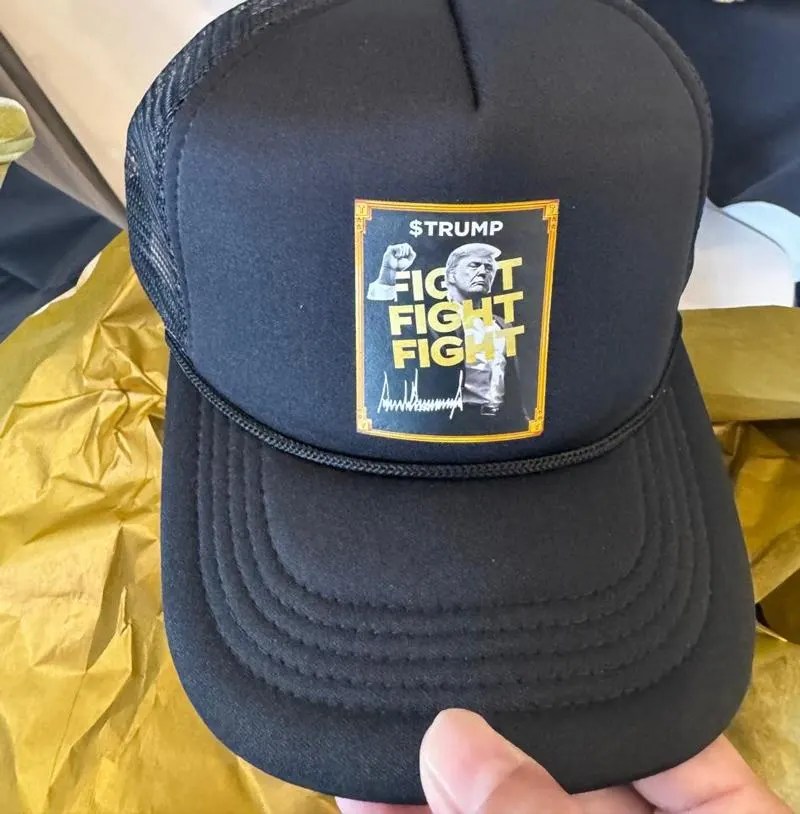
Blackout
Red MAGA hats are old news. Memecoin diners received black caps featuring the president, his signature and the name of his token, $TRUMP.
“I was like, ‘Oh, let me buy some of this—never know what’s going to happen.”
Some attendees wanted more than trumpery. Before the initial dinner, Huma Finance cofounder Erbil Karaman upped his investment, knowing the White House was considering legislation related to stablecoins, dollar-tracking cryptocurrencies that his company uses to help people move money overseas. Karaman says he did not do any lobbying at the event. Two months later, he accepted an invitation to the White House for a bill signing.
The people who did best with Trump’s memecoin tended to be the ones who cared least about it. Morten Christensen, founder of the crypto site airdropalert.com, bought the coin right after it launched, then ditched it when the hype started to fade a few days later. He says he made about 30 times his money on the trade. To attend Trump’s dinner, he bought and shorted the coin simultaneously, securing a seat for the first event for about $1,200 in fees and a spot at the second for $500.
“The MAGA people, they really believe,” Christensen says. “I’m just here for the profit. I’m in some group chats with believers, and they are really good at ignoring facts or data. … I kind of feel sorry for them.”
Even Justin Sun no longer pretends Trump’s crypto offerings are good investments. In a lawsuit filed in April, he alleged World Liberty pushed him to increase his investment, then froze his assets after he balked. Sun accused World Liberty of defrauding and extorting him. World Liberty said it had the right to freeze Sun’s tokens and countersued for defamation. Sun also alleges that, after World Liberty sent so much money to Trump and other insiders, the venture began taking on risky loans. The man who, more than anyone not named Trump, sold the project to the masses now describes it as “on the verge of collapse.”
How A Capitol Uprising Led To Capital Raising
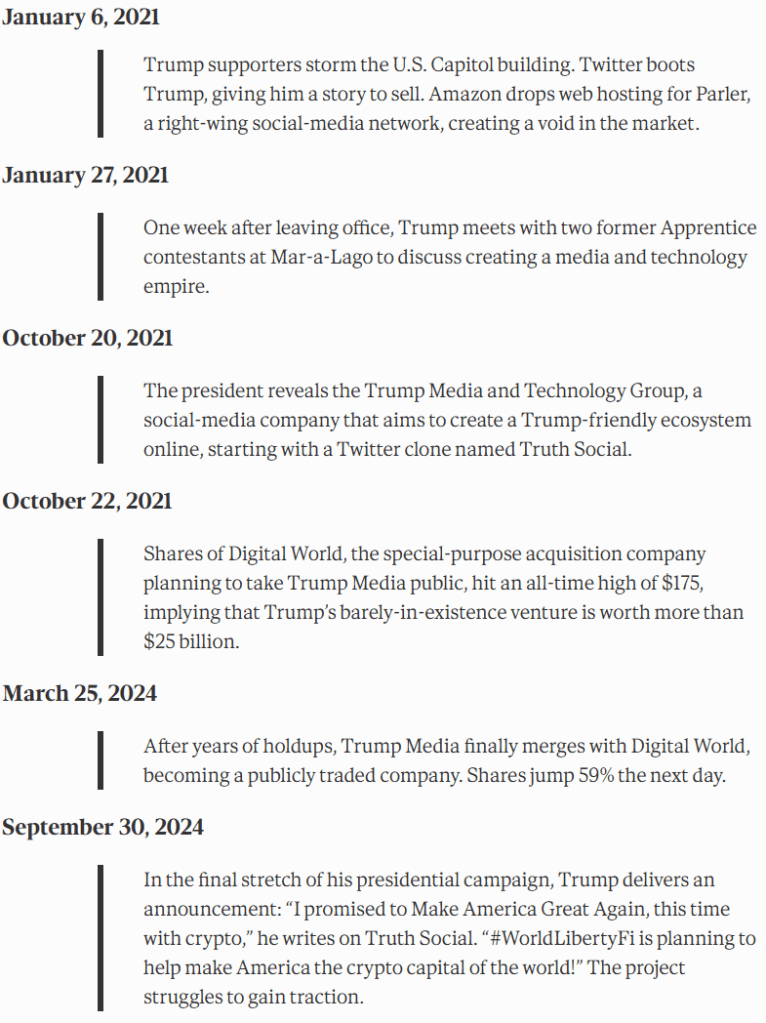
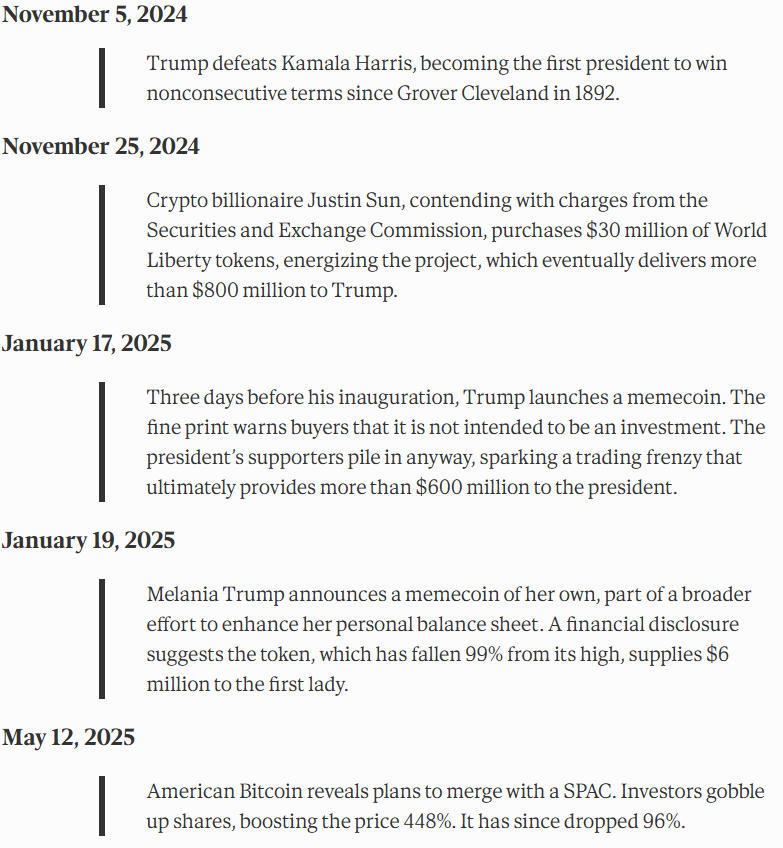
As believers become skeptics, the Trumps are shifting assets in telling ways.
World Liberty, which pitched itself as a vehicle to upend traditional finance, delivered about $850 million to Trump, who has since loaded up on the least exotic asset in finance, municipal bonds. Trump Media, meanwhile, has become less a social-media company than a hoard of bitcoin. It raised $2.4 billion through equity and debt when shares were riding high, then put the proceeds into the cryptocurrency near its peak.
That erased about $1 billion of shareholder capital. It also gave the company an asset that appears to be more enduring than Truth Social, the “free-speech” platform that recently suspended a Forbes reporter who used it to contact shareholders. For a company that promises to give people a voice, Trump Media seems to have a rather narrow view of who should use one.
First sons Eric Trump and Donald Trump Jr., who manage their fathers’ holdings on a day-to-day basis while he serves as president, have adopted the old man’s playbook for themselves. In March 2025, they struck a deal with a data-center company for 20% of its bitcoin-mining machines, then rebranded the business as American Bitcoin.
What did the data-center company receive in return? A crowd of investors wrapped up in a Trump-tied hype cycle, into which it could dump enough shares to more than make up for the 20% of forfeited equity. The companies announced a deal to go public via SPAC on May 12, 2025, and shares of the SPAC jumped 448%.
Ryan Kenney, a 41-year-old military spouse who studied architecture but now spends much of his time raising two kids, thought he was getting into American Bitcoin early and cheap when he invested $60,000 after prices pulled back the next week. The stock’s value was in its buzz, not the fundamentals. That made the standard meme-stock rallying cries—“Buy the dip!” “Average down!”—especially dangerous. Kenney kept buying, ultimately upping his investment to $98,000. It’s now worth $9,000.
Lately, he has been thinking about others in a similar predicament. And the scale of their losses. “Maybe people didn’t lose as much as I did,” he says, “but that might be hundreds of thousands of Americans all losing five grand.”
Then there is Fistikan, still dreaming of that Florida house. With his savings wiped out, he settled for an overgrown, $18,000 lot, figuring he could build on it. Someday. The Iran war drove diesel prices above $6 in the Pacific Northwest, where he hauls loads, cutting into his earnings.
“I would make the same amount of money if I was flipping burgers,” he says.
Recently, short on cash, Fistikan had to sell something. He could have liquidated his Trump Media shares, which still appear overheated as the company bleeds hundreds of millions of dollars a year while maintaining a market cap more than triple the value of its underlying bitcoin holdings. But Trump-tied investments are not moved chiefly by discounted cash flow. It’s more loyalty and the hope that another rally is just one frenzy away.
So Fistikan sold his F-150 pickup.
That’s the Trump trade in miniature. The dream was a house in Florida near the water. The outcome, for now, is an overgrown lot, a clobbered investment account and just enough cash to stay afloat.
This story was originally published on forbes.com and all figures are in USD.
Want to see more Forbes articles on your feed? Tap here to make Forbes Australia a preferred source on Google.
Look back on the week that was with hand-picked articles from Australia and around the world. Sign up to the Forbes Australia newsletter here or become a member here.