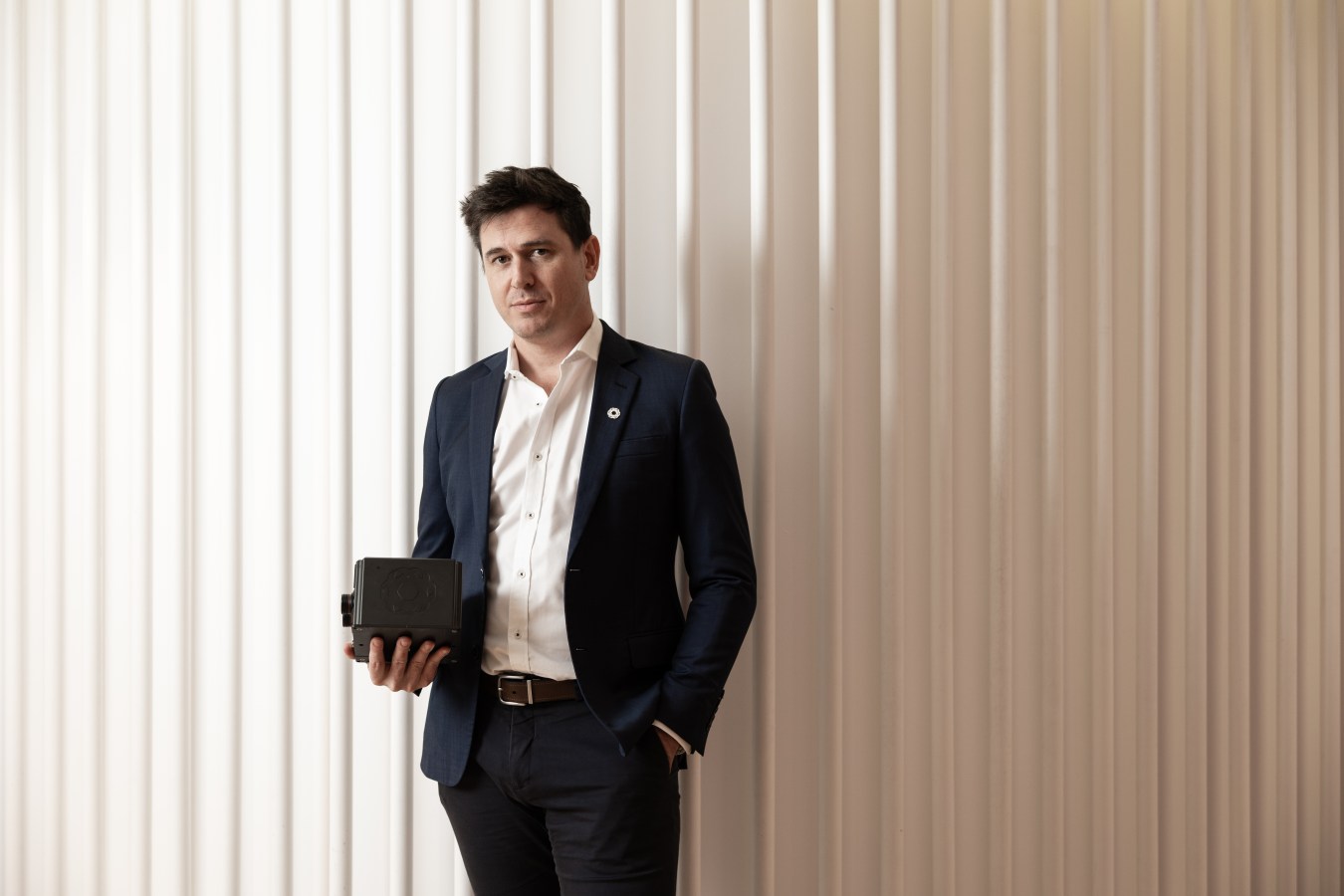
Cibby Pulikkaseril has raised a $3.5 million seed round for Zabidou, a deep tech second act after his first startup collapsed amid an attempt at revolutionising self-driving cars.
Cibby Pulikkaseril remembers standing by the test track where the team at his first startup Baraja would trial the LiDAR tech it was developing to help self-driving cars “see” their surroundings. One day, after months of work, the team got their “aha” moment when the LiDAR system they were developing could map crisp details of its environment.
“The engineer working on that turned to me and he said, ‘Oh my God, we’re going to make billions of dollars,'” Pulikkaseril recalls.
Baraja did not make billions of dollars. The startup hit a valuation of $300 million in 2021 thanks to envelope-pushing LiDAR, but long commercialisation timelines and a crowding market resulted in it cutting 75 per cent of employees two years later. By 2024 some investors had reportedly written its value down to zero.
“I invented a new type of LiDAR [at Baraja] and that sounds awesome” Pulikkaseril told Forbes Australia. “But now looking back, that meant that we had to solve every problem for our technology ourselves. I was inventing things always.”
“Now instead of a market that is yet to materialise, I was like, ‘what can I sell today?'”
Zabidou is his answer to that question, and has just capped a $3.5 million seed funding round led by Black Nova, Main Sequence and Antler. Founded last July, it previously raised $1.3 million in pre-seed funding.
Zabidou is also built around lasers, but this time it’s for the factories of today rather than autonomous cars of the future. Zabidou makes kit for the manufacturing sector that can assess factory outputs like steel and concrete using cameras and lasers. It’s robotic quality assurance.
“The camera that we use is the vision, and the lasers give us the touch,” Pulikkaseril said. “So it’s as if we’re replacing a person that’s there to look and feel at the end of the line.”
Zabidou’s first customers are in the construction industry following an “accidental” meeting where Pulikkaseril discovered a prospective customer was having difficulty finding staff to assess the railway support beams they were manufacturing. Zabidou’s system is placed at the end of a conveyor belt in the customer’s factory, where it scans each beam to confirm it is constructed to the designed specifications.
Pulikkaseril says the product fixes a fundamental cost problem of quality assurance in the manufacturing sector. Manufacturers can’t afford to test every output, he says, and many construction delays are caused by faults only discovered on the job site.
Manufacturing companies across the world factor in the “cost of poor quality,” where imperfect outputs have to be replaced with fresh inputs and labor, often equal to 15-20 per cent of sales. Meanwhile a 2025 survey found nearly half of US manufacturers ranked time-consuming inspection processes as a top challenge. Zabidou is hoping to solve both problems.
“It’s very hard to find people to do those jobs, especially in regional parts of Australia, and the second is just the cost of labor makes that impractical.”
Zabidou’s products are deployed in 15 sites across six customers. Pulikkaseril said Zabidou’s systems cost around half as much as a human operator. Pulikkaseril says the cost of developing bespoke software is dramatically falling thanks to AI coding tools, which allow the company to customise software for each customer. It is product agnostic: The second customer Zabidou signed is a petfood maker.
Black Nova founding partner Darcy Naunton said the early-stage investor had been looking for a manufacturing startup to back for “some time.” Too many companies seek either to solve simple, “low value” problems or have products that needed to integrate into every part of a factory to be effective.
“Zabidou is the opposite of that in every way that matters,” said Naunton. “It is one box on one line, installed in days, sitting at the point where quality gets signed off.”
Pulikkaseril’s abiding lesson from Baraja was that it is easy for deep tech companies to look impractically far into the future.
“At Baraja, we had to spend money to win a contract for production in the future,” he said. “We only work [at Zabidou] for customers that are ready to pay today.”
Want to see more Forbes articles on your feed? Tap here to make Forbes Australia a preferred source on Google.
Look back on the week that was with hand-picked articles from Australia and around the world. Sign up to the Forbes Australia newsletter here or become a member here.