
Wikipedia and Fandom founder Jimmy Wales has distilled decades of building into seven rules. But the most important lesson came from getting it wrong.

Before Wikipedia became a global phenomenon, there was Nupedia – an attempt to build a rigorously vetted online encyclopedia that, in a seven-step scrutiny process, required contributors to fax in their CVs for checking before they could write a word.
It was, as Wales now says, “the seven rules of mistrust”.
Nupedia never got off the ground, but when the little crew of people dreaming of a free encyclopaedia for everyone on the planet decided to let any random stranger contribute, Wikipedia, the website that now gets 10,000 page views a second, was born.

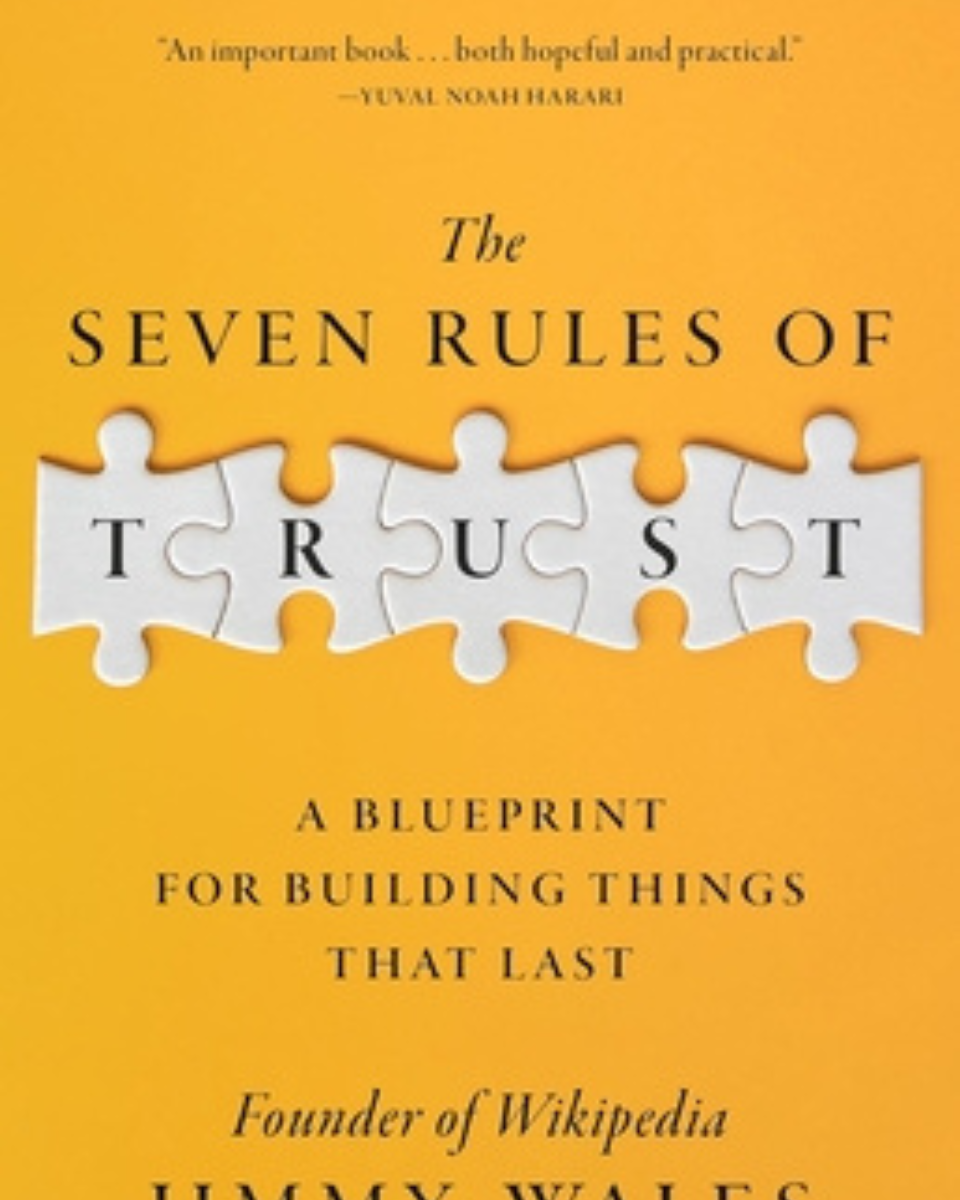
Twenty-five years later, Wales has written a book on that notion, The Seven Rules of Trust, and is coming to Australia in May to talk about it at the Wheeler Centre in Melbourne and the Sydney Writers Festival.
“Wikipedia went from being something that was considered kind of a joke,” Wales tells Forbes Australia, “to one of the few things that people really do trust online, even though it’s obviously flawed.”
Wikipedia has gone on to become everything he’d dreamed when it was founded on January 15, 2001, he says. “Keep in mind I’m a pathological optimist, so I always think everything’s great. It turns out everything is great.
“The idea has always been very simple. It’s to have a free encyclopedia for every single person on the planet in their own language. We’re in over 300 languages, but a lot of those languages are still quite small. There’s still a huge amount of work to do … but broadly, Wikipedia is pretty much as I envisioned it. And it’s been amazing to see how popular it is … That’s kind of awesome.”
With 10,000 page views a second, according to Wikipedia, does he wonder, “What if I’d monetized back at the beginning?”
“What I always say is, ‘Look, I live in London and the number of bankers in this town who have far more money than I ever will, there must be thousands of them, and their lives must be unbelievably boring compared to mine. I get to go anywhere in the world, I meet with world leaders, I meet with Wikipedians, I mean I meet all kinds of people, I do whatever I like. It’s a fantastic life, so no, I don’t have any regrets.”
Wales was a Chicago futures trader and amateur geek who made enough money on speculations to co-found a startup, Bomis, in 1996. He identifies as an Ayn Rand-inspired libertarian at odds with the current US administration.
Wales signed an open letter telling Americans not to vote for Donald Trump in the 2016 US presidential election, but says he has not been on any retribution lists of the president.
“I’m not sure he knows how to use a computer, so, you know, he hasn’t really ever talked about us, and that’s fine. We’re not worried about him.”
Does he find himself feeling awkward about being lumped in with others who similarly identify as libertarian in these interesting times?
“I think it’s a very odd time, to see the very curious sort of people I would have thought wouldn’t like Trump and the authoritarianism embracing it, and that’s a real disappointment. I think they’ve forgotten some of the principles that they believed, in terms of not coercing other people and letting people get on with their lives.”
And so what are Jimmy Wales’ seven rules?
Rule 1: Make it personal
“People don’t usually think about Wikipedia in personal terms, because it’s written in a very encyclopaedia tone and it’s sort of a voice from nowhere. But the trust in Wikipedia is really about individual people. We say, ‘Please come and edit. Come and help us improve Wikipedia.’ And that really does involve one-to-one trusting someone.
“Trust is always won or lost on that one-to-one level. So the first rule of trust is to say, ‘Look, don’t think in statistics, don’t think in numbers. Think about that one person, that one partner, that one customer, whoever it might be, and what are the things that you need to do to get their trust.’”
Rule 2: Be positive about people
“If you spend too much time on toxic social media, too much time looking at the ridiculous political discourse that we have today, where politicians aren’t really seeing the best in people, you can get a very toxic view of humanity that is really not true.
“The truth is people are basically decent, and we know this in our day-to-day lives. What I always say is, when you get into an elevator with eight complete strangers, you don’t think, which one of these people is gonna stab me? You just think, ‘Here’s some random people. I’m sure they’re perfectly nice.’”
Rule 3: Create a clear purpose
“One of the things that has made Wikipedia successful is that it’s a very simple idea: Imagine a free encyclopedia for every single person on the planet. I can say it in one line, and it’s the core of everything we do.
“By having that very clear, good purpose, it simplifies decision making internally. We know what it is we’re here to do, but it also makes us more trustworthy. People can predict our behaviour. If you think: What is Wikipedia likely to do? Are we likely to put ads on the site? No, that doesn’t further the encyclopaedic purpose. Are we likely to turn into short-form video content? No. That’s not an encyclopaedia.
People can rely on you if they understand your purpose and what you’re trying to do.
Rule 4: Be trusting
He recognises that it’s never been harder to trust what people are seeing online.
“You need to adhere to your critical faculties, and look at information that’s coming in and scrutinize it and think about it, and say, ‘Look, I’m a trusting person. I do trust people. But that trust has to be based in rationality, and it turns out a lot of very old-fashioned things are what makes up the reasons you should trust something.
“So, traditional journalism with an editor and fact checking and all of that, that all is there to contribute to getting to the truth and getting facts and therefore being trustworthy, as opposed to random stuff that’s just floating around on social media.”
Rule 5: Be civil
“The thing I remind people is, ‘Don’t imagine that the pre-social media, pre-algorithm internet, was some kind of paradise.’ I come from an older internet in a world where there was a thing called Usenet, which was a giant unmoderated message board. Oh man! It was super toxic, everybody at each other’s throats and lots of spam and a lot of nonsense.
“I always joke, we don’t need algorithms to be mean to each other, like people can do that anyway … But we need to build environments that support civility, and we need to find ways of being in places where people are kind to each other, people stop and listen. And that’s a part of the software design, obviously. That’s a part of the incentive structures that you put into place.
“If we want to get anywhere in society, we do need to have civility … You need to say, ‘Okay, I don’t agree with you, but tell me more about that.’
“One of the core rules of Wikipedia is no personal attacks. So if people start attacking each other, that’s it. We just block them, ban them, like, that’s just not okay. But if there’s a raging debate where people are keeping it civil, it turns out that actually you can find compromises.
“There’s almost always a way to write something that more people will agree with. One of the simplest techniques is what we call going meta. It’s like, step back a step. Wikipedia shouldn’t take sides in the dispute. It should just describe it. It should say, here are the two competing views, here’s the arguments put by one side, here’s the arguments from the other side. People are actually quite good at that, and it does help to resolve those conflicts in a way that’s productive rather than just being people flaming each other online.
Rule 6: Be independent
“I talk about the decision of Jeff Bezos’ Washington Post, to not endorse a presidential candidate in the last election. I agree with that policy. I think this is the right thing. There is good research showing that when news outlets endorse political candidates, it reduces trust not only of people who disagree with that endorsement, but even people who agree with the endorsement.
“They’re concerned that all the rest of the allegedly straight news is actually just shilling for a candidate. [The Post’s endorsement] was very badly timed. Two weeks before the election made it seem like it was a very weak endorsement of Trump. But broadly that idea of saying, ‘We shouldn’t take sides’ is crucially important.
Rule 7: Be transparent.
“One of the cute things we say in the book is, be transparent, especially when you have something to hide. There’s always gonna be a mistake that you’ve made. There’s always gonna be something that’s not going right. And there’s a real temptation to listen too much to PR people or legal people who will tell you, ‘Don’t admit anything. Don’t acknowledge that anything’s wrong. Spin it in a positive way.’
“That can be so toxic and erosive to trust rather than saying, ‘You know what, we screwed up. We’re gonna do some refunds. Here are the procedures we put in place to make sure this doesn’t happen again.’ People will forgive. People will understand.
“People accuse Wikipedia of being ‘Wokepedia’, that it’s been taken over by the radical left. Well, it hasn’t been taken over by the radical left. But I am willing to say, ‘Actually, I don’t think we are completely neutral in all the cases. We strive to be. Do we always get it right? No.’
“The thing for us to do is say, ‘Help us fix it. Let’s take a look at that.’ And sometimes we’ll dig in and go, actually, it isn’t biased. In other cases, we’ll go, ‘You know what, we’ve only taken one side of the story. We need to look at some other sources and rewrite this.’ That gives us trust in the long run if people see us being intellectually serious about trying to get it right, rather than bluffing our way through.”
Jimmy Wales appears at The Capitol in Melbourne (20 May), presented by The Wheeler Centre, and at Sydney Writers’ Festival (17-24 May).
Want to see more Forbes articles on your feed? Tap here to make Forbes Australia a preferred source on Google.
Look back on the week that was with hand-picked articles from Australia and around the world. Sign up to the Forbes Australia newsletter here or become a member here.