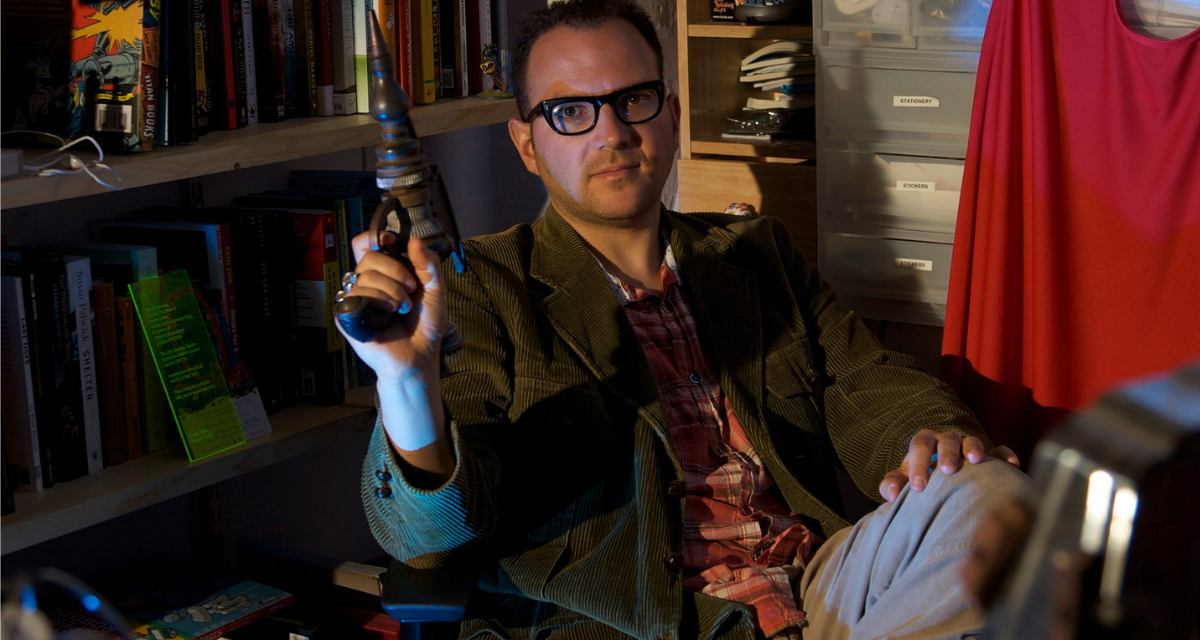

Cory Doctorow – the writer who coined the word ‘enshittification’ to describe how tech platforms put profits before users – believes Australia could lead the world in turning things around.

Cory Doctorow is sympathetic to the aims of the Australian government – and that of his native Canada – in attempting to take on social media giants by clawing back revenue for news publishers and in slapping age bans on social media. But, he argues, their solutions have been wildly problematic.
In this edited interview with Forbes Australia ahead of his visit to Australia in August for the Festival of Dangerous Ideas, Doctorow, the author of 19 books, speaks to Mark Whittaker about a world where the US loses control of the internet.
How is Australia doing in its battle with Big Tech?
Not super great. Australian regulators and lawmakers have got a valid diagnosis that there are serious problems with the way that Australians are exposed to the predatory conduct of American big tech firms and the defective products that they export. But I think their remedies are poor.
Historically, everyone in the advertising sector who wasn’t an advertiser or a publisher took about 15 per cent out of the sector. That was kind of the administrative cost of advertising as an industry. Today, Facebook and Google, who have 80 per cent of the market, take 51 per cent. So basically, every advertising dollar that the news media gets is having 51 cents taken out of it by this American duopoly.
And these two American firms, Google and Facebook … they each run their own buy-side platform, sell-side platform and marketplace. They also advertise and they’re publishers. This is like you going to court to get a divorce and discovering when you get there that you and your partner have the same lawyer and that that lawyer promptly puts on a wig and announces that they’re the judge. And then you look over at the bench and they’re trying to match with both of you on Tinder. And then at the end of the trial, the judge bangs the gavel and says, ‘I’ve decided who gets the house. It’s not you. It’s not you. It’s me.’ They’re running a crooked operation.
Then there’s payments. If you’ve got a publication and you take payments over an app, there’s another duopoly controlled by Google and Apple that control all the apps. And they’ve made it their ironclad policy that anyone has an app has to use their payment processor.
In Australia, you have free payment processing for person-to-person transactions. We go to the pub and you buy me a pint. I can just send you money from my bank account to your bank account for nothing. The merchant probably pays more if they’re using Visa … about 3 per cent. Google and Apple charge 30 per cent. They take 30 cents out of every dollar that any Australian gives to any other Australian enterprise or individual using an app and they trouser it.
It is the most profitable thing Apple does. They make $100 billion a year on payment processing. [Apple reports that it makes $109 billion across its entire services division which includes the App Store, iCloud, Apple Music, Apple TV, and Apple Pay]. It’s more profitable than their hardware business. It’s more profitable than the $20 billion that they get in a bribe from Google every year not to enter the search market. It’s worth about four times all the advertising in all the newspapers in the world.
But if you try to do that to Facebook today, to Meta, they will nuke you until you glow.
Cory Doctorow
If you could just collect your subscriber dollars without paying the app tax, it’d be as though you had 25 per cent more subscribers tomorrow.
And then there’s social media, which is, again, run by a duopoly, more or less, of Mark Zuckerberg and Elon Musk. And those companies are the conduit by which you reach your customers. And what those companies have done is they’ve said to their users, ‘Build a list of the people you want to hear from, and then we’ll show you when they post something new.’
But they don’t show them that. Once a business has a critical mass of subscribers, they start suppressing the stuff that you publish, and then they charge you to boost your content so it’s seen by the people who’ve asked to see it. It’s a fraud.
So you have these three ways in which American tech companies – each of them dominated by a different duopoly but with overlapping players – are just stealing money from media.
So what does the news bargaining code do? It says keep stealing money but give some of it back.
What should the Australian government have done?
They could have said we’re going to stop you from stealing from us. We’re going to block this nakedly anti-competitive practice of having a vertical monopoly in ad tech. We’re going to force you to accept third-party payment processors. We’re going to force you to end the fraudulent practice of telling users that you’ll show them what the people they follow post and then charging the people that they follow money to reach them.

I’m a Canadian. We’re basically cold Australians. We make all the same dumb mistakes as you guys. And we did the same goddamn thing. And we’re doing it again. Because now Australia has said it’s a real problem that social media networks and advertising networks target children, which is totally true. They should not be allowed to target children.
Australia said the answer to this is we are going to force the same companies that have this rampant surveillance problem to gather sensitive information about every internet user and retain it indefinitely, including all the activities that those users do, in order to stop them from targeting children.
You want to be more efficient to stop them from targeting children, make them stop spying on everyone. If they can’t spy on anyone, they can’t target children because they don’t know who the children are.
Won’t they just skirt around privacy laws?
You’re right. But there are other ways to create privacy rather than regulating the conduct of these firms – by making it legal for Australian firms to compete with them. Not by offering a social media, but by offering alternative apps that access social media and block surveillance. These have a very long history.
No one goes into a mobile phone shop and says, ‘I’m looking for the phone that spies on me the most?’
Cory Doctorow
In fact, they’re in the origin story of Facebook. When Facebook started, the problem that they had was that everybody who wanted to use social media already had an account on a service run by an evil, senescent Australian vampire billionaire named Rupert Murdoch.
As much as they hated being on Rupert Murdoch’s torment site called MySpace, they loved their friends. And it’s a pain in the ass to get your friend to leave MySpace when it’s time to go to Facebook. And Facebook’s initial pitch was: ‘It’s like MySpace, except it’s not owned by an evil billionaire and we’ll never spy on you.’ So getting people to leave the heavy surveillance, weird-billionaire-owned platform for the nice one, the fair-trade-hippie one that was Facebook in 2006, was the challenge.
They solved it by hacking MySpace. They gave MySpace users who wanted to come to Facebook a bot. And when you logged into Facebook, that bot would scurry off to MySpace, pretend to be you, scrape everything that MySpace was waiting to show you, and put it on your Facebook wall.
And then you could reply to it and it would push it back out to MySpace.
But if you try to do that to Facebook today, to Meta, they will nuke you until you glow. They will invoke a law that was passed as part of the Australia-US Free Trade Agreement [2004] called an anti-circumvention law that makes it illegal to reverse engineer and modify Facebook products without Facebook’s permission.

So if Australia wants to know what it has under its control, it may not be the conduct of Facebook. But it is the access to the courts that Australia affords to Facebook to destroy Australian firms that make complementary goods like ad blockers and privacy blockers for apps that would protect Australians from having their money and their data stolen by Facebook.
You don’t have to get Facebook to do a single solitary thing to change that law.
And here’s the kicker. The reason Australia has an anti-circumvention law as part of the Australia-US Free Trade Agreement is that the US free-trade negotiator told the Australian negotiator, ‘You will have tariffs on your exports to America unless you pass this law.’
But now you have tariffs anyway. Happy Liberation Day.
Someone threatens to burn your house down unless you do as you’re told, and you do it, and they burn your house down anyway, you do not have to keep doing what they told you to do.
Although they could still put a 50 per cent tariffs on us.
Take it from a cold Australian, they will do that anyway. Trump literally just did that to Canada because we didn’t immediately capitulate to all of the things he demanded that we do after we capitulated to his last set of demands … You should always assume that any bargain struck with Trump will last until he gets up out of bed on the wrong side.
What’s the easiest and fastest thing Australia could do to tackle the enshittification of the internet?
It’s that anti-circumvention law. It is a no-brainer. It’s not only a way that you can enact these policies. It’s also where you can make – excuse my Australian English – a “f*ckton” of money. Because everyone in the world wants the thing that blocks ads and privacy violations on Facebook and gives you a better experience and shows you the stuff and the people you follow. You could export that tool to everyone in the world, because everyone else in the world has also signed up to a law like the one Australia signed up for. None of them have a domestic sector making this.
You guys can have the relationship to disenshittification that Finland had to mobile phones for 15 years when Nokia ruled the world. You could turn America’s trillions into your billions. And you could export all kinds of things, not just Facebook ad blockers.
Your farmers can’t fix their John Deere tractors. I mean, they are expected to fix them. They put the part in. But it won’t start working until they pay $200 and wait a couple of days while their crops rot in the field to have a John Deere representative come out and type an unlock code into the console.
The only reason you can’t just get rid of that entirely superfluous form of rent-seeking is that the US-Australia free trade agreement makes making that product illegal. Every Canadian and European farmer would buy that product from you. You could export these tools everywhere.
But then the US would make our beef and wine exports suffer.
This would be a giant opportunity for you. When Trump gets angry at foreign officials, he takes away their access to American tech platforms. So the judge who sentenced Benjamin Netanyahu and the judge who sentenced Jair Bolsonaro [judge Alexander de Moraes was investigating the former Brazilian president] both lost all their Microsoft accounts, which means that they lost all of the documents related to the court, all of their calendars, all of their address books, all of their email archives, and every account that they used with their Outlook address.
So if Trump wants to take revenge on Australia, he doesn’t have to hit you with tariffs. He can shut down every important ministry and firm in Australia with the click of a mouse. So you need to get your data off of Trump’s platforms as quick as you can. And the quickest way to do that is to jailbreak those apps and suck the data out of them and put them into made-in-Australia apps running on servers in Australia. And, again, those tools are tools that everyone in the world needs and would buy from you.
You’d also have the entire market of American consumers who are the first people who get f*cked by American tech companies. Every bad idea an American tech company inflicts on an Australian, they’ve already inflicted on an American.
When Trump comes after you for making him angry, you’d have a whole army of Americans who’d love you for saving them from American tech companies.
This is a utopian vision
It is the most hopeful I have been in 25 years of doing tech policy work, which isn’t to say that I’m happy or optimistic. But hope is like the belief that there are moves you can make that will take you closer to what you want than any other moves that you’ve had to your ready-to-hand previously. And there are so many moves that right now can be made, and not just by Australia, by anyone. This is kind of a race. Countries don’t really know they’re in it. But if Canada gets there first … you won’t be selling those products to the world. You’ll be buying them.
Is AI about to become the ultimate enshittification machine?
AI is different from social media or search engines, because AI doesn’t actually make any money. AI is the money-losing-est thing the human race has ever done. There is literally no venture we’ve tried that comes close, and it has no path to profitability through the production of foundation models.
Every user who signs up to an AI company costs the AI company money. Every time you use AI, it costs money. Every generation of AI loses more money than the previous generation. It’s like the opposite of the web. If you remember 2000, sure, there were web companies that lost money, but when they got new customers, they became more profitable.
Imagine if every new customer made you less profitable. How do you ever pull out of that tailspin? AI is going to enshittify hard because they have even more imperative to make money and squeeze both their suppliers and their customers than profitable businesses.

And they are monumentally unprofitable … this year, the sector has spent at least a trillion dollars, and it looks set to gross $50 billion.
So $50 billion sounds like a lot of money … but if you want me to turn a trillion dollars into $50 billion for you, I’ll do it … like a chicken could outperform Sam Altman on return on investment.
So they’re going to squeeze everyone really hard, and AI gives them lots of opportunities.
How will AI be enshittified?
So just take the fact that the number of tokens consumed by a given query is totally opaque … you have to trust the AI companies when they tell you, ‘Oh, that query cost $100 worth of tokens’, as opposed to the $1 worth of tokens you expected. They’re saying, ‘just trust me’.
There’s also this whole AI-enabled shopping thing that they’re doing … The one thing AI is really good at is multivariant analysis. So you can ask AI to take all the surveillance data that you can acquire from data brokers and the big surveillance advertising companies and put all our users in categories based on your estimation of how attentive they are, how much we can rip them off, when they’re distracted and when they’re not. Does it look like there’s a group of people who buy the first product that’s recommended to them if it’s before 8 am, and those products are usually household goods? And so we can assume those are parents getting the kids ready for school and noticing that they’re running out of loo roll, and so they do a quick search and they buy whatever the first result is. ‘Let’s raise the prices on those users.’ AI is super good at it.
And it’s good at running experiments. It’s like, well, let’s raise the price on those users by 5 per cent. Let’s make it 7 per cent. Let’s figure out where those users ‘nope out’ and just keep titrating the level up and down.
This also hits wages. Uber drivers have been at the front lines on this for a long time. Uber infers how economically desperate a driver is before offering them a job. And that inference is based on how many previous jobs the driver has accepted at low rates. And the lower the rate you accept, the lower the rate that you’re offered. So you’re pushed into lower and lower rates. It means that you become more and more desperate and accept more and more jobs. That’s called algorithmic wage discrimination. And again, it’s the same form of multivariate analysis that AI is very good at.

So is there any role for Australia in disenshittifying that?
In an ideal world, America would have a democratically accountable government that cared about the rule of law. And you could go to the American government and say, ‘Hey, your tech companies are doing these horrible things to us. We want them to stop spying on us.’ And they’d go, ‘You’re goddamn right. We’re going to help you.’ But that’s not going to happen. So you need to take the second-best measure, which is just something that your devices should do anyways. Like, it’s weird that devices don’t do that already. You’d think anyone designing an ideal device would design it to not exfiltrate and leak your data. There is no market for it. No one goes into a mobile phone shop and says, ‘I’m looking for the phone that spies on me the most?’
“Enshittification” was the Macquarie Dictionary’s word of the year in 2024. Here’s to “Disenshittification” becoming 2027’s word.
I love that. I’ve got another book coming out next year called The Post-American Internet. So this is very much on my mind these days. It’s my white whale.
Cory Doctorow is in Australia this August for appearances at Sydney’s Festival of Dangerous Ideas, and in Melbourne at The Capitol, presented by The Wheeler Centre and Now or Never. His new book, The Reverse Centaur’s Guide to Life After AI, is out via Verso on 4 August. Festival of Dangerous Ideas 2026 runs from August 20-30.
Want to see more Forbes articles on your feed? Tap here to make Forbes Australia a preferred source on Google.
Look back on the week that was with hand-picked articles from Australia and around the world. Sign up to the Forbes Australia newsletter here or become a member here.