
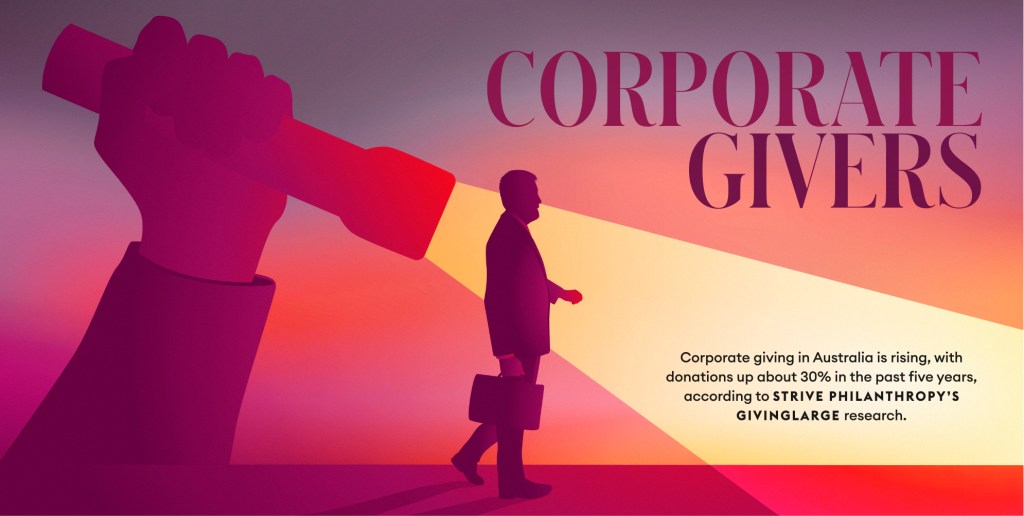
Corporate giving in Australia is rising, with donations up about 30% in the past five years, according to Strive Philanthropy’s GivingLarge research. Anastasia Santoreneos finds that the under-30s are driving organisations to stand for more than just profits.
This story featured in Issue 12 of Forbes Australia. Tap here to secure your copy.
The top 50 corporate givers in Australia contributed close to $1.5 billion to the nation’s community in 2023, thanks to large donations from companies like BHP, Coles, Rio Tinto and Woolworths. But philanthropy – whilst beneficial for the community – is quickly becoming a strategic choice.
Strive Philanthropy’s 2023 GivingLarge report, updated this year to reflect the latest earnings, shows corporate giving amongst the most prolific givers has increased about 30% in five years (from $1.1 billion). The data shows that across 2023, BHP donated the most at $222,156,222 to causes like decarbonisation, thriving communities, responsible supply chains and Indigenous communities. Coles came just under with $151,858,928. In terms of industries, contributions to the community are increasing from mining and resource companies, retailers, banks, and tech companies.
But chunky individual donations tell half the story, Strive Philanthropy director and co-founder Jarrod Miles says, with contributions as a percentage of profit filling in the rest. Across 2023, it was the eco-friendly toilet paper brand, Who Gives A Crap that took the cake, donating 50% of profits to water sanitation, in line with its ethos. Coles came in second at 9.03%.
“Converting dollar values into relative percentages of company profits is a useful way to enable robust comparisons and arguably provides a more meaningful review of company generosity,” Miles says.
But what’s driving the upward trend in giving? In a recent survey of BHP’s workforce, 91% of respondents said working for a company offering a workplace-giving program was important.
“When it comes to attracting and retaining a talented and skilled workforce, we know we need to ensure BHP is a rewarding place to work,” BHP President Geraldine Slattery says. “Part of this is giving our people a say in where social investment is directed and facilitating employees to support causes important to them.”
Miles says it’s the perfect storm of corporations and consumers becoming more ESG-conscious, shareholders becoming more impact-driven, and employees looking for purpose.
“The planets have certainly aligned with these social trends, which is leading to a firming in the value they may bring to the business,” Miles says. “Enlightened companies are taking the opportunity to develop strategies for these emerging stakeholder needs and are quickly realising that their increased community investment can coincide or even boost their firm’s success.”
That’s echoed by Philanthropy Australia CEO Maree Sidey, who says the under-30 demographic drives the organisations they work for to stand for more than profit.
“It comes from that purpose agenda,” Sidey says. “If you are looking at that under-30 generation, they are looking for their purpose to be beyond work – they want their work-life to align with their passions and interests. They want their workplace to engage with social and environmental issues. It needs to be much more integrated, while the over-60s are generally happy to have their charitable interests separate from their work-life.”
“Lots of investors understand the super-power that comes from having purpose at the core of a business – when done right, it’s incredibly motivating for both customers and the team, which can lead to great business outcomes.”
Simon Griffiths, co-founder, Who Gives A Crap
Atlassian is weaving giving into its DNA via its Atlassian Foundation. Mark Reading, head of the foundation, says co-founders Scott Farquhar and Mike Cannon-Brookes decided early on to pledge 1% of equity, profits, employee time and Atlassian products to philanthropic endeavours.
“I’ve previously worked for companies where the commitment to corporate social responsibility was not so deeply rooted,” Reading says. “When I walked into Atlassian, its view on philanthropy felt completely different. It wasn’t just lip service – giving back felt ingrained in what Atlassian does. This authentic commitment to impact and focusing on the underlying issues rather than the symptoms gives me a real sense of meaning and purpose.”
The company donated $17,077,517 to education in 2023, spread across 16 education changemakers globally, and each employee gets five days of paid leave each year to volunteer. The company also offers a donation-matching program. In 2023, one in four Atlassian employees volunteered as part of a team.
“Atlassians love the Atlassian Foundation,” he says. “We’re regularly told it’s one of the main reasons many people join the company. One of Atlassian’s core values is ‘Be the change you seek’, so the Foundation is a great way for employees to live this value. We empower our people to use their time, talent and tools to make a difference for causes they care about.”

The data also tells another story: that companies in the private sector, like Canva or Who Gives A Crap, are building philanthropy into their brand’s value proposition.
“In true entrepreneurial style, this innovative model has reinvented the relationship between business and philanthropy by placing the firm’s desire to do good in the world right next to their need for financial success,” Miles says.
Who Gives A Crap’s co-founder Simon Griffiths says philanthropy has always been tightly woven into the company’s ethos, and all employees are passionate about their cause (to provide everyone in the world with access to clean water and sanitation).
“It’s the reason we exist,” Griffiths says. “It drives our employees and informs our decisions. It helps that we’re having a lot of fun while doing it, cutting through the doom and gloom with delightful consumer experiences.”
Griffiths points to Dan Pink’s philosophy of motivation, which says that motivation is derived from autonomy, mastery, and purpose.
“We don’t get all three of these things right 100% of the time, but we’re very lucky to have a purpose in spades in our business, so we invest quite a bit of thinking time into how best to connect our team to our purpose,” he says.
And while the business model might seem a little left-field for investors, Who Gives A Crap managed to raise $41.5 million in 2021 to fund its expansion and provide sustainable sanitation solutions to 2 billion people.
“Businesses today have a huge opportunity to go beyond profit and actively contribute to making the world a better place.”
Robyn King, head of social impact, Canva
“It’s no secret that there has been a huge shift in public markets towards ESG-focused businesses, and that’s not going away,” Griffiths says.
“Lots of investors understand the super-power that comes from having purpose at the core of a business – when done right, it’s incredibly motivating for both customers and the team, which can lead to great business outcomes.
“Not every investor understands this yet, and that’s okay, but the ones that do tend to be all in. They’re less interested in investing in businesses without purpose – they see purpose as a powerful tailwind, or unfair advantage, that will ultimately help them to achieve a stronger return whilst also making the world a better place.”
Canva’s another: with a $31.4 million donation across the 2023 calendar year (more than double its last reported figure), the design juggernaut says its two-step plan drives it. Step One is to build one of the world’s most valuable companies, and Step Two is to do the most good they can.
“Our philanthropic journey has been a lot like building a company,” Canva’s head of social impact, Robyn King, says. “We’ve been on a huge learning journey over the last few years and see this as a lifelong journey to do the most good we can alongside our entire team and user community.”
The company is part of Pledge 1%, and its founders, Cliff Obrecht and Melanie Perkins, are part of Warren Buffett and Bill Gates’ Giving Pledge. The founders have also committed most of their equity (30% of Canva) towards doing good.
“Businesses today have a huge opportunity to go beyond profit and actively contribute to making the world a better place,” King says.
“We want to use our value to drive positive change, and we see this as an integral part of our identity as a company. By doing so, we hope to join other companies paving the way to change the narrative that good for the world and good for business aren’t mutually exclusive.”
And like Atlassian or Who Gives A Crap, Canva believes its philanthropic endeavours align with its employees’ values.
“Our Two-Step plan is one of the key reasons people come to work at Canva and stay,” she says. “It’s a huge driver in attracting incredible talent who resonate with our values and believe in our goals.”
Top 50 corporate givers: Australia
Roughly $1.5 billion was donated last year by Australian companies.
Rank/Company | Year End (2023) | Community Investment | Causes |
|---|---|---|---|
1. BHP | June | $222,156,222 | Decarbonisation, indigenous partnerships, responsible supply chains, safe equitable workforce. |
2. Coles | June | $161,869,928 | Food rescue, disaster relief, education, health. |
3. Rio Tinto | December | $126,429,862 | Community infrastructure, culture and heritage, health & wellbeing. |
4. Woolworths | June | $122,076,725 | Food rescue, disaster relief, education, health. |
5. Westpac | September | $65,091,056 | Social enterprise, financial inclusion, education, children & young, emergency & crisis relief. |
6. Newcrest | June | $64,413,424 | Sustainable cities and community, health and well being. |
7. CSL | June | $63,261,063 | Patient communities, innovation and science and local communities. |
8. Santos | December | $59,014,148 | Local community, health, education. |
9. National Australia Bank | September | $56,000,000 | Emergency relief, environment, social welfare. |
10. Commonwealth Bank | June | $53,500,000 | Social and financial wellbeing, disaster relief, indigenous support, education. |
11. South32 | June | $41,314,541 | Education and leadership, social wellbeing, economic participation, natural resource resilience. |
12. Telstra | June | $40,600,000 | Digital inclusion, environmental action, disadvantaged communities, disaster relief. |
13. Macquarie | March | $37,536,000 | Breaking barriers to employment, diversity and equity, inclusion, community sport. |
14. Bendigo & Adelaide | June | $32,920,000 | Thriving & healthy communities, disaster relief. |
15. Woodside | December | $32,512,030 | Environment, education, employment, and liveability outcomes. |
16. ANZ | September | $32,500,000 | Financial wellbeing, housing and environmental sustainability. |
17. Canva | June | $31,400,000 | Education, extreme poverty, emergency relief. |
18. Wesfarmers | June | $23,700,000 | Medical research and wellbeing, education, arts, disaster relief. |
19. Optus | June | $23,529,205 | Educational outcomes, employment opportunities for disadvantaged. |
20. Deloitte Australia | June | $18,000,000 | Climate, first nations, food poverty, education, elderly, animal welfare. |
21. Ernst & Young Australia | June | $17,500,000 | Youth education, environment, impact entrepreneurs, indigenous, mental health. |
22. Atlassian | June | $17,077,517 | Education, capacity building. |
23. Mirvac | June | $13,941,632 | Community infrastructure, social enterprise, social connection. |
24. OceanaGold | December | $13,719,858 | Local business support, community infrastructure, education, health. |
25. KPMG Australia | June | $12,878,834 | Reducing inequalities, climate action, resilient & sustainable communities. |
26. QBE Insurance | June | $12,436,280 | Reduced inequality, sustainable cities and communities. |
27. PwC Australia | June | $12,400,000 | Disaster and crisis relief, homelessness, NFP capacity. |
28. CottonOn | June | $12,337,256 | Education in health, social & public welfare & human rights, mental health and environment. |
29. Brambles | June | $11,431,554 | Food security, food waste, environmental restoration, education. |
30. Fortescue Metals | June | $10,890,000 | Health and wellness education and development, environmental responsibility, arts and culture. |
31. Goodman Group | June | $10,800,000 | Children & youth, community, health, food rescue, environment. |
32. Future Generation | June | $10,600,000 | Youth mental health. |
33. Hearts and Minds Invest | June | $10,237,269 | Medical research. |
34. IAG | June | $10,000,000 | Disaster & community resilience. |
35. Colonial Foundation | June | $9,225,000 | Medical research, education to improve inequity, rural & regional vitality. |
36. Suncorp | June | $9,043,714 | Financial, social and natural hazard resilience, emergency relief, road safety education. |
37. Sargents Pies Foundation | June | $8,000,000 | Children’s hospital care. |
38. Sonic | June | $7,800,000 | Reconciliation, employment, emergency relief, medical research. |
39. Mineral Resources | June | $7,780,000 | Health & well-being, strengthening local communities, economic empowerment. |
40. Stockland | June | $7,718,840 | Accessibility, inclusion, health, education, employment and other bespoke community needs. |
41. The Lottery Corporation | June | $7,719,747 | Education, health, social welfare. |
42. Nib | June | $6,600,769 | Health, mental health and health equity. |
43. Northern Star | June | $6,400,000 | Community, health, environment, indigenous advancement, education & development. |
44. GPT Group | June | $6,359,962 | Child wellbeing, youth homelessness and mental health. |
45. AGL Energy | June | $4,759,570 | Resilience in communities where we operate, support climate action, energy affordability. |
46. Origin Energy | June | $4,500,000 | Family violence, natural disasters, and homelessness. |
47. Orica | June | $4,100,000 | Health, education, social & public welfare, environment. |
48. Humanitix | December | $4,000,000 | Disadvantaged children, education, healthcare. |
49. Transurban | September | $3,800,000 | Empowering customers, championing road safety, strengthening communities. |
50. Qantas | June | $3,600,000 | Reconciliation, connecting communities. |
Scale of Generosity
The top ten Australian corporate givers listed by percentage of profits.
Company / Percentage of Profits | Community Investment | Year End (2023) | Causes |
|---|---|---|---|
Who Gives A Crap – 50.0% | $1,405,617 | June | Water sanitation. |
Coles – 9.03% | $151,858,928 | June | Food rescue, disaster relief, education, health. |
OceanaGold – 6.98% | $13,719,588 | December | Local business support, community infrastructure, education, health. |
Bendigo & Adelaide – 3.38% | $32,900,000 | June | Thriving & healthy communities, disaster relief. |
Woolworths – 3.03% | $122,076,725 | June | Food rescue, disaster relief, education, health. |
Newcrest – 3.00% | $64,413,424 | June | Sustainable cities and community, health and well being. |
Tabcorp – 2.49% | $1,400,000 | June | Emergency relief, health. |
South32 – 2.08% | $41,134,541 | June | Education and leadership, good health and social wellbeing, economic participation, and natural resource resilience. |
IAG – 2.04% | $10,000,000 | June | Disaster & community resilience. |
Orica – 2.02% | $4,100,000 | September | Health, education, social & public welfare, environment. |
Are Australian corporates doing enough?
While $1.5 billion is a sizeable figure, GivingLarge notes that the global benchmark for corporate giving is 1%, meaning Australian businesses could be donating a lot more to communities.
“In terms of total corporate community investment, extrapolating the pre-tax profit of Australian businesses each year and applying a 1% calculation, we estimate a potential of up to $5 billion that could make its way from corporate to community each year,” Miles says.
Philanthropy Australia says some may argue that 1% of pre-tax profits isn’t enough either. However, the organisation says it’s focused on helping corporates put more structure behind their giving via their Blueprint to Grow Structured Giving initiative, launched in 2021. That blueprint outlines how philanthropic, for-purpose, business and government sectors can work together to double structured giving by 2030.
A part of that is to raise awareness about corporate giving and help educate corporate founders on best practices.
“It’s got to be done with true intent,” Philanthropy Australia chief Maree Sidey says.
“Compliance and regulatory issues need to be considered at the start of a foundation. It needs the right input, expertise and background. So, I think there’s a real piece of education for corporates that is not just a side hustle; you need to employ the right person, support them, and integrate it fully into the business.”
Billionaires pledging their fortunes

Look back on the week that was with hand-picked articles from Australia and around the world. Sign up to the Forbes Australia newsletter here or become a member here.