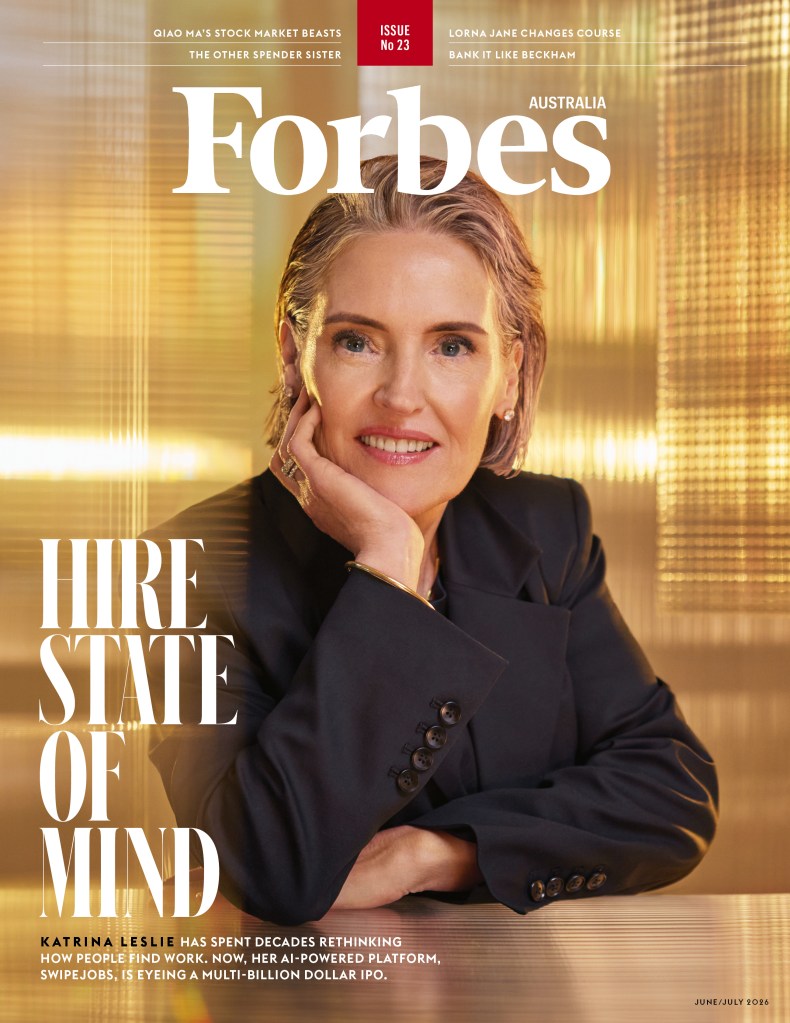
The Queensland cattle farmer’s daughter behind Swipejobs spent 30 years studying how people get hired. Now Katrina Leslie is reinventing the system.
This story features on the cover of Forbes Australia: Issue 23 . Tap here to secure your copy.

Jane Hussey remembers meeting Katrina Leslie in 1994 – two women in their 20s, solid Aussie accents, on the way up. They just clicked, and at that very first meeting, Hussey asked Leslie, then Westpac’s 27-year-old head of human resources, what her big-picture goals were.
“I’m going to have five children,” said Leslie.
Hussey, 29, Westpac’s head of training, almost fell off her chair laughing. “And I said, ‘You’re going to have your first, and then you’re going to reconsider that,'” Hussey recalls.
Leslie also said she’d maybe start her own business.
Sure enough, Leslie had those five children, and they’ve turned out all right; four pursuing medicine while the youngest is studying AI.
And she had four businesses, which also turned out okay. The youngest, Swipejobs, did $1.4 billion in revenue in 2025 off 3.1 million users per day, and earnings of $70 million before interest, taxes and depreciation. It also got a valuation heading up towards $2 billion, and Leslie still owns almost 70% of it.
All this she did on the quiet, shunning publicity, but with the company planning an ASX listing, she’s been urged to tell her remarkable story to Forbes Australia. Reluctantly.

The outsider
“I guess it’d be inappropriate and rude for me to say I’d rather eat broken glass than do this interview,” Katrina Leslie begins. She asks the PR person sitting in on the interview to protect her from saying too much, saying the wrong thing. “I’m a very direct individual, and I’m an over-discloser, and I don’t want any profile.” But she says all this in a completely pleasant way. Like the no-nonsense rural woman she is at heart.
Katrina Leslie grew up on a cattle property in central Queensland, but has asked that we don’t say where in order to protect the privacy of her parents.
“My parents were incredibly hard workers. [On a cattle property] there is no start to the workday, or end … You just do what it takes. If that’s your whole childhood, it frames how hard you work.”
They were a 25-minute drive from a small town. Leslie always felt like an outsider and had no idea until years later that other people saw this as a negative. “I had the ability to run my own race, to look at a problem, not feel tied to the herd and not be tied to how other people think.”
But she liked school and schoolwork. She studied science at university, but found herself drawn to “workplace science”, measuring performance, culture, statistics. “In the 1980s that was pretty uncool.” She had to go to Perth to do her post-grad in it.
She came out of that and went into mining giant BHP, whose graduate development program took her for a year in each of Australia’s steelworks – Whyalla, Wollongong and Newcastle – while completing a master’s in commerce.
She met her husband, Russell Leslie, a director at Macquarie Bank, and so moved to Sydney, picking up a job with Microsoft, first in HR then in recruitment, before moving to Westpac.
When she fell pregnant with her first child, she figured that was the time to go out on her own – developing software to help employers assess who they were hiring or promoting – her first shot at the problem that would define her career. Job applications were becoming easier, but the ability to sort through them was not keeping up.
She’d been working on this first company, IPS, for a few months when she called her friend Jane Hussey, who was pregnant with twins, asking her to come on board. “We can take our babies out for coffee,” Hussey recalls her saying. “I’m not joking, three weeks later and we were running a business with 20 employees. So, there was no coffee for us.”

Babies on board
After Hussey had the twins, IPS was “growing like a weed”. “I needed to come back to work to help. Katrina had the idea of building an on-site creche. Twenty-five per cent of our office space was behind a glass wall with toys and slippery slides behind it. We’d all bring our kids to work. We were able to attract all of this talent, guys and women, because we had this little creche.”
Leslie had previously suspected she would like to be an entrepreneur. “But I didn’t realise just how much I would love business,” she says.
She has asked herself many times why she loves business so much. “I think it’s that I like to imagine how to create something, a business proposition, how to solve a problem. And what I really love is working with other people on those problems. I get a lot of my energy from other people … and you can get that energy all day, every day.”
I met a lot of crazy people with terrible ideas. When you’re at that level, you’ve got to find somebody you can work with for a long time.
Leslie had her second child the following year, 1998 – breastfed in the creche – and even though Russell was still the major breadwinner at the “Millionaires Factory”, she made it clear she wasn’t giving up her career.
The Dotcom boom was taking off, and Leslie was restless. “I wanted to buy data businesses across America, get developers, and work out a legally defensible method where you could rank every job applicant in real time.”
She put it to Russell that they move to the US to start a new business. He said that if she made enough from the sale of IPS, he’d be happy to retire and look after the kids and the money.
The sale went well, and in 1999 they landed in Minneapolis with two kids, a healthy bank account and a house rented online. She built the job-ranking business, ePredix, buying three companies that owned 50 years of research and data. She had two more kids.
She wanted to go for that fifth, but Russell put his foot down. He was the primary carer, and if they were going to have more, he needed a support network back in Australia.
“I loved doing business in America,” says Leslie, “It’s a large, fast, unforgiving market. It’s challenging, but it was more important to me to have more children. And that business was way too early.” ePredix had 140 staff when she sold it in 2005 for an undisclosed sum.
Early bird flies home
Whatever she got for ePredix, it is notable that this is when the family starts to appear in the real estate gossip pages, buying and selling several properties over the coming years and founding Saltire Estate winery in the Hunter Valley.
The stories always style it as “retired Macquarie banker Russell Leslie” behind the sale. His wife stayed out of the limelight as she gave birth to their fifth child, Angus, and her third business, HRX, a recruitment outsourcing and HR technology company that helped large employers manage hiring.
“I had five children under 10 and needed to work school hours and have school holidays off. I would drop them at school, work school hours, help with the after-school activities, cook dinner at night and then go back online at night.”
The business did well, but she couldn’t help thinking she was just tinkering at the edges of the problem. “I knew how broken the job model was. I was astounded that with technology innovation, the way you get a job hadn’t been transformed.”
Swipe left for destiny
Jane Hussey had come back to join Leslie at HRX. She remembers the conversations about what a shame it was that you put so many names at the top of the funnel, and only one person walked away with the job at the bottom.
“Katrina was looking at all of the emerging technology models, like Uber and Tinder and all of these marketplaces that were starting to emerge,” says Hussey.
But applicants were applying for 400 jobs, and employers were drowning in that sea of applications, missing the best candidates.
Really accomplished professionals are saying they’ve never had such difficulty finding a job. They’re becoming disillusioned and thinking it’s about them.
She wanted to be the one to find a job for everybody, like getting a lift or a date. “I’d seen the job model from every angle. I’d spent my whole career in it. And I just thought: ‘The whole model’s broken. I needed to take what we did in ePredix, data-driven AI, real-time technology, and to put it into the hands of the consumer.'”
She approached it – her “last business” – with a sense of destiny. “I knew it was an audacious goal, but everything had led me to this. ‘I’m going to solve this.'”
She sold HRX in 2013 and started Swipejobs. She had the money; she didn’t need to sell herself to investors. She was too early to interest them anyway, she thought.
After the workout period, Hussey, who’s had a little equity in most of Leslie’s plays, came over to join her again. There was no need to haggle over the terms. “A really defining point about Katrina is she’s incredibly generous,” says Hussey. “It’s not like you even have to negotiate those things.”
It was always going to be targeted at the US. Leslie sat herself down in a US employment agency and watched as job seekers interacted with the system.
She took on some coders in Prague who built a prototype. It didn’t work, she scrapped it and started again, focusing this time on short-term jobs.
By 2015, she had a prototype. “I did a pilot in Dallas with a well-known US organisation. I got a feed of all the jobs in the economy, and I realised I couldn’t close the data loop. The technology didn’t scale.”
So, she scrapped it again. “We just kept pushing and pushing,” says Hussey. “Obviously, that meant more and more investment from Katrina. But she never lost sight of the fact that she could do it. And neither did we as a result of that.”
“The turning point,” says Leslie, “was Andy Barker.”
What is Swipejobs?
Swipejobs works as a personalised job-matching engine that constantly scans the labour market.
Job seekers build a “matching profile” based on what they want in a role – like pay, location, flexibility, skills or workplace culture. They can upload resumes or connect LinkedIn profiles.
The user then gets their own personalised “job agent”, which scans the entire economy for jobs, continuously ranking them according to those preferences. Users can give feedback on the matches, training the AI to better understand what they are looking for.
On the employer side, the system works in reverse.
Employers can see rankings of active applicants and “passive” candidates. Leslie describes it as a two-sided, live marketplace where both job seekers and employers can instantly see the strongest matches.
It is active in the US and UK but has not yet launched in Australia.
Farm boy
Andy Barker had been looking to join a start-up since arriving in Australia from the UK in 2013. He kissed many frogs. “I talked to a lot of, air quotes, ‘entrepreneurs’, over three and a half years. I met a lot of crazy people with terrible ideas. When you’re at that level, you’ve got to find somebody you can work with for a long time.”
A recruitment consultant suggested he meet with Leslie and Hussey. “It was the first time in Australia I’d met someone who I thought, yes, I could work with you.”
He liked the idea and loved Leslie’s intensity in solving the problem. Not to mention the size of the opportunity. He went home that night and told his wife he’d found the start-up that was going to be a thing.
Leslie liked that Barker had grown up on a dairy farm in the English Midlands. They had that shared experience of work surrounding you, and don’t buy a new thing if it can be cleaned and repaired.
Leslie told him about serving people at an employment market in Indianapolis to see how people used her platform. She’d seen them living pay cheque to pay cheque and how she could make their lives better. He loved that.
“When I walked in on day one, she was like, ‘We need a hundred developers by the end of the first year’,” says Barker. But he had run a team like that in the UK. He said, “I don’t want to do that. I want to build a really good small tech team. We want to drive the right processes rather than just throw people at the problem.”
“It was Katrina’s money,” says Barker, “and she would have gone to a hundred developers in the first year if that had been necessary. But we [thought], how can we do this in the best way?”
Leslie had rented a yellow weatherboard cottage in Mosman because she wanted to create a place where they could hunker down. As soon as she saw Barker working with her French “DevOps” guy, Val Fearon, and Sri Lanka-born tech lead, Pira Kanagaratnam, moving fast, releasing, she knew they’d arrived.
“I now realise the most fortunate bit was getting those three guys working with Jane and I to make it. They’d come from other countries with the right skill sets and the right experience, all coming together. I see them as magical.”
They’d cook lunch each day, across their national cuisines. “We’ve kept the table because it’s so iconic in the company’s history; we call it the glass table.”
They ended up with a team of 20 by the end of that year, when they went from 1,000 users a day to 80,000, not so much building the engine while the plane was flying, as replacing the engine midair.

Goldilocks and the black box
All the while, Leslie kept talking endlessly about AI for good, but people weren’t that interested. While trying to raise capital in 2020, they got sick of explaining that this was not Software as a Service or Blockchain. This was predictive AI. “We ended up hiding that slide because people wanted us to be software. We thought, let’s not fight it.”
But Leslie did manage to raise $80 million from a small group of high-net-worth investors, including David Paradice of Paradice Investment Management, Sydney-based Ironbridge Capital, Audant Investments’ Robert Whyte and Caledonia’s billionaire fund manager Will Vicars.
Vicars describes Leslie as a “unique breath of fresh air” with enormous energy. “But what stands out even more is how well-executed she is as a founder – thoughtful, deeply across every part of the business, and remarkably disciplined in how she communicates and leads.”
Vicars tells Forbes Australia her warmth and sense of humour “make people want to back her not just as a founder, but as a person”.
And with the arrival of generative AI in late 2022, their bet started to look a whole lot better.
Leslie felt she’d always been early with her previous businesses. But suddenly she was in the Goldilocks zone. “Generative AI was our opportunity to have anyone who’s interested in looking at what their job matches are, to have a personalised job agent where they use chat, voice, whatever, to guide them, then all the jobs just change as they interact.
“But the thing that has shocked me is just how much worse AI has made the process of finding a job. For employers, the volume of applicants is up more than 400% since 2022. They’re using AI tools to screen people out. Most employers know they’re screening out qualified people, but they just can’t deal with the volume.
“And from an applicant’s perspective, they’re not hearing back, so they’re applying for 400 to 700 jobs. One in three jobs is fake.
“But the thing that I’ve found confronting in user groups, particularly in the last 12 months, is that really accomplished professionals are saying they’ve never had such difficulty finding a job. They’re becoming disillusioned and thinking it’s about them.”
Leslie argues Swipejobs will not worsen the flood of job applications because applicants will focus on their best matches and not just hit “auto apply” to submit applications en masse.
And she says Swipejobs, by using “transparent matching”, allows both employers and job seekers to see exactly which factors make a candidate suitable for a role, rather than relying on “black box” algorithms that nobody understands.
The best decision I ever made
So, what does Katrina Leslie do to unwind?
“I get a lot of energy working with other people,” she says, scoffing at those who tell her she needs a hobby. Yoga, harumph! “I do this because it gives me energy. Why wouldn’t I want to do something that is energising and exciting?
“And I cannot believe my luck. I want to pinch myself that after being too early several times, that generative AI was released in 2022. Jobs is the top vertical that needs to be changed. AI is the biggest disruption that will occur in my lifetime, and I’m probably going to work into my 80s.”
The PR person interjects to point out that Leslie likes spending time with her children. Reminded, Leslie continues: “My hobbies are my children and solving a problem.”
She’s going to Melbourne this weekend to help her daughter move house because she’s on nephrology shifts at Royal Melbourne and can’t pack.
She did the same for Alasdair in Adelaide a month ago because he had to move out of his rental while doing a cardiology stint at Tennant Creek.
Hussey had said how Leslie always breaks off a meeting to take calls from her children, and her husband. Her children, Alasdair, Clare, Oliver, Zara and Angus remain an absolute priority for her.
At 29, Alasdair is already juggling more careers than most people attempt in a lifetime. By day, he is a cardiology advanced trainee in Adelaide. After hours, he helps run the family’s sprawling Queensland Brahman operation remotely using drones and Starlink plus a team in big hats on the ground.
Somewhere in between, Alasdair co-founded a medical AI non-profit, completed a Johns Hopkins master’s degree while working as a hospital intern, and is now undertaking a PhD focused on using artificial intelligence to bridge rural healthcare gaps.
Leslie is quick to credit Russell’s central role in all this success. While their children refer to his work as “accounting”, Leslie says his responsibilities extend far beyond that, overseeing the family’s broader financial affairs, investments, running the vineyards and the books for the cattle. “We’re a pretty good team,” Leslie says. “Russell’s the best decision I ever made.”
They’ve taken the kids to Africa to visit orphanages, trying to ground them in the need to give back. And she also wanted to ground them in rural Australia, citing that as the reason for buying the vineyards and the cattle station.
“A rural environment, is such a huge positive.”
She loves horse riding, and if she ever does slow down on the work front, she’ll be spending her days on the cattle property abutting the tropical Pacific, and she wants any grandchildren to experience that too.
This story features in Issue 23 – out now. Tap here to secure your copy.
Want to see more Forbes articles on your feed? Tap here to make Forbes Australia a preferred source on Google.
Look back on the week that was with hand-picked articles from Australia and around the world. Sign up to the Forbes Australia newsletter here or become a member here.