Do you need a mechanical watch to track a soccer match? Richard Mille would argue yes.
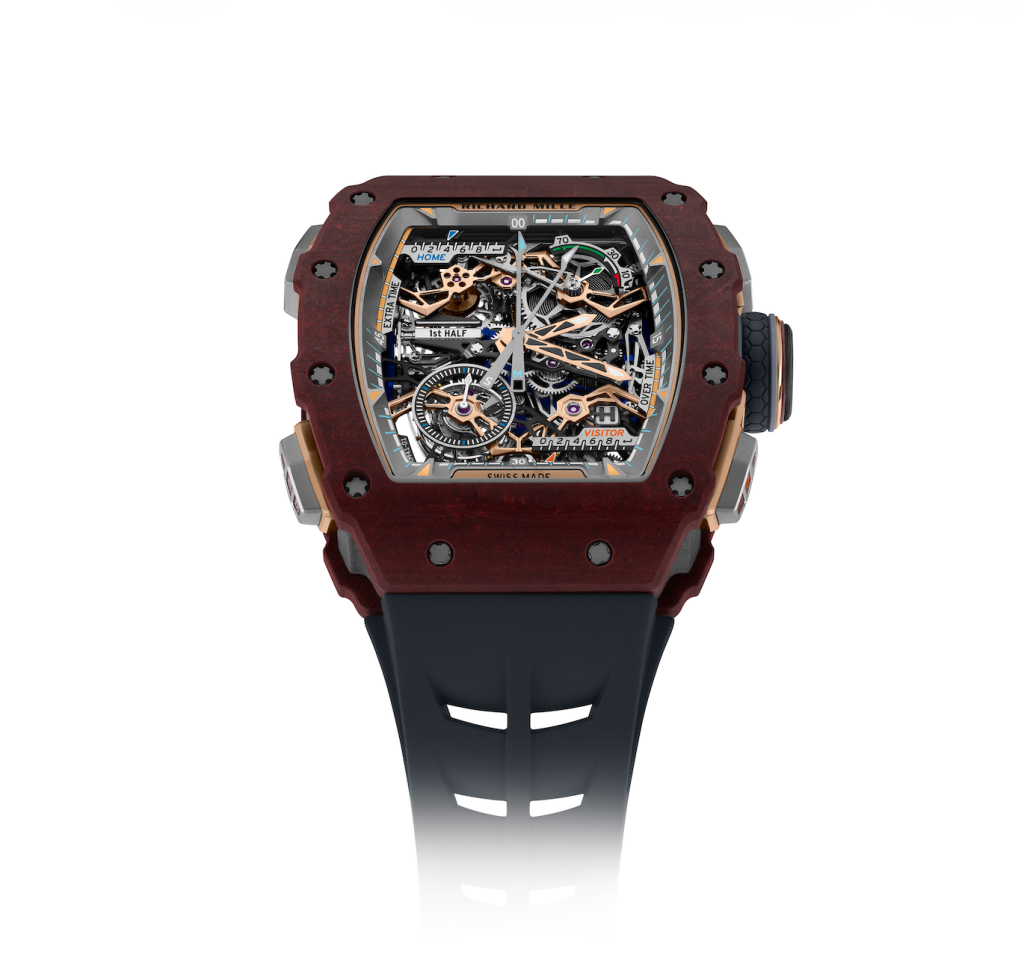
The specialist Swiss watchmaker unveiled the RM 41-01 Tourbillon Soccer, a highly technical timepiece designed to track a football match from kick-off to the final whistle — even recording every goal scored. The watch is offered in two limited editions of 30 pieces each, featuring distinct high-performance case materials.
Richard Mille’s watchmakers and technology specialists spent five years developing a novel, patented tourbillon flyback chronograph caliber incorporating two new complications: a match-phase indication and a mechanical goal counter.
Richard Mille’s Soccer-Specific Complications
The RM 41-01 Tourbillon Soccer introduces a new titanium caliber developed in collaboration with Audemars Piguet Le Locle. The RM41-01 integrates a tourbillon escapement, a 70-hour power reserve, and a function indicator, alongside a flyback chronograph with overlapping central minute and second counters.
The first original complication is the match-time indicator at 9 o’clock. Each reset of the flyback chronograph advances the display sequentially from first half to second half, followed by first and second overtime.

At 4 o’clock, a function indicator composed of three titanium plates set against a lacquered background shows whether the watch is in winding, neutral or hand-setting mode.
Crafted from microblasted grade 5 titanium, the movement’s baseplate and bridges are highly skeletonized to accommodate its 650 components. On the chronograph side, two column wheels control the levers and hammers. According to the brand, the chronograph architecture “ensures a coherent and rational distribution of components without unnecessary layering, favoring technical solutions that optimize performance.”
Framing the movement are microblasted and satin-finished titanium flanges housing the RM 41-01’s second exclusive complication: mechanical goal counters. Activated by pushers at 2 and 4 o’clock, these counters track the scores of the home and visiting teams. Each press advances the hands along metallic rails via a dedicated gear train, displaying up to nine goals before automatically returning to zero.
The complete construction — nearly 800 components including the case and strap — underwent extensive validation to meet all 120 of Richard Mille’s internal shock-resistance tests, including the ultimate 5,000 g trial.
The bridges, gears, and levers have been optimized to eliminate unnecessary material, reducing weight while showcasing its advanced finishing techniques.
Microblasted bridges feature complex, hand-finished geometries enhanced with PVD coatings to improve legibility of the movement’s architecture. The baseplate, finished in the same manner, receives hand-applied white lacquer to highlight its engraving.
The minute-counter bridge is microblasted with hand-polished chamfers before PVD treatment, and features graduated angles with straight-grained upper surfaces. A similar finish appears on the 5N PVD-treated titanium bridge securing the fast-rotating barrel, inspired by the hexagonal pattern of a soccer ball. Contrasting colors and finishes emphasize the movement’s depth and skeletonization.
New Material for the Richard Mille Tonneau Case
A defining feature of Richard Mille watches is the brand’s signature tonneau-shaped case, which in the RM 41-01 Tourbillon Soccer comprises 105 components and is offered in two versions.
The first, a red case, introduces Basalt TPT, a composite developed with North Thin Ply Technology (NTPT) and derived from volcanic rock. Like the dark blue Quartz TPT used in the second version and the Carbon TPT featured on both casebands, Basalt TPT offers exceptional mechanical performance along with resistance to chemicals, corrosion, temperature fluctuations, and UV exposure, according to the brand.
Basalt TPT is composed of 40-micron-thick basalt fibers — compared to 30- and 45-micron fibers used in Carbon TPT and Quartz TPT — stacked with a 45-degree rotation between layers. The resulting composite reveals a naturally wood-like grain pattern that can be rendered in deep, rich tones.
This article was originally published on forbes.com and all figures are in USD.
Want to see more Forbes articles on your feed? Tap here to make Forbes Australia a preferred source on Google.
Look back on the week that was with hand-picked articles from Australia and around the world. Sign up to the Forbes Australia newsletter here or become a member here.