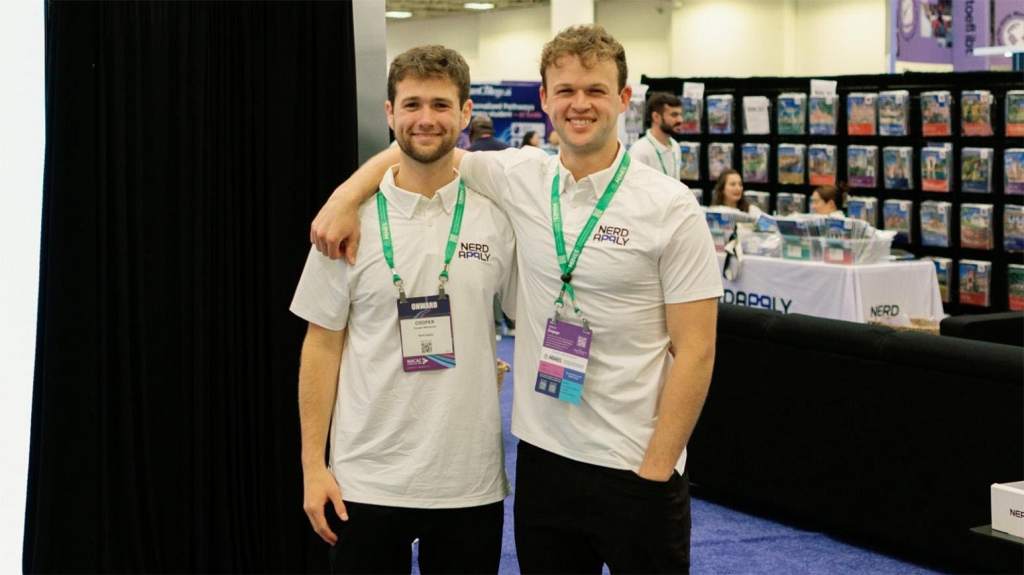
Braden and Cooper Weissman, 23 and 21, turned a $20,000 (A$29,600) credit card gamble into a venture-backed AI startup to help students discover possibilities for their futures.
In the spring of 2025, Braden Weissman was on track to realise his dream of becoming a surgeon. He’d been accepted into the University of Miami’s four-year MD/MBA program and was about to graduate from the University of Michigan.
But at the same time, the artificial intelligence-based service he and his younger brother, Cooper, a computer science student at Dartmouth, had built for college counsellors was growing from nine users to thousands.
Braden deferred med school admission – and never made the move.
Today, Braden, 23, and Cooper, 21, run their education-technology company, Nerd Apply, from the top floor of a building just off Times Square, with 10 employees and $3.2 million (A$4.7 million) in seed funding. On a lower floor sits a surprising and crucial component of their strategy: a $200,000 (A$296,000) printer.
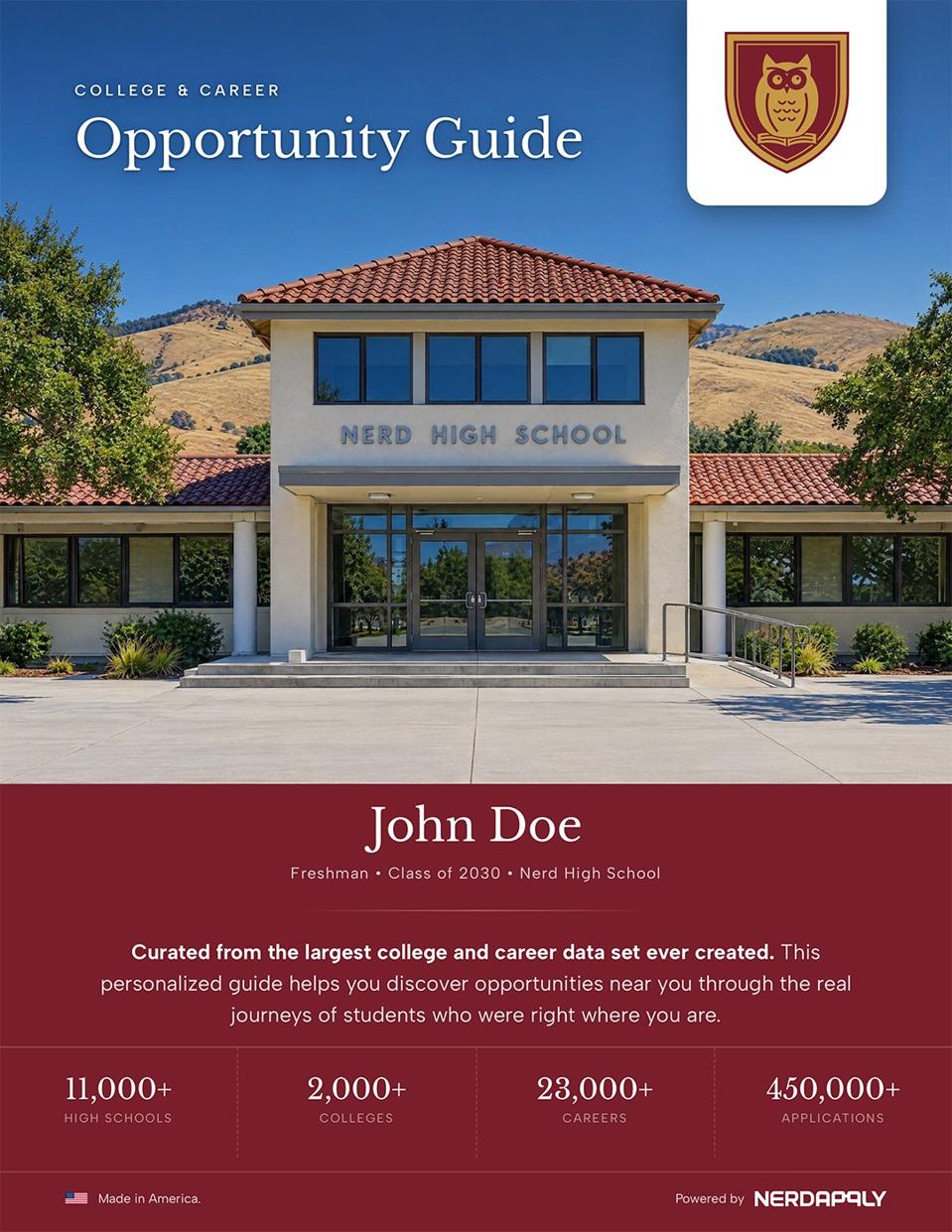
The Weissmans are betting that AI-generated personalised guides, printed on paper and handed to students, can bring personalised college and career guidance to kids whose families can’t pay for expensive human counsellors.
Now they have to prove that a 20-page booklet can turn a profit while helping students understand possible options for their future.
The guides show students the programs, activities and careers that match their interests and what those careers pay. School districts and colleges pay $10 (A$15) per guide. After launching the product at the National Association for College Admission Counseling (NACAC) conference in October, 154 colleges booked meetings with them within two weeks, according to the brothers.
The colleges are exploring offering the guides to both prospective and current students, which the brothers say will help colleges with recruitment and retention.
Growing Up Entrepreneurs
The brothers grew up in Arizona, where they attended Paradise Valley High School, a Phoenix public school with “a lot of free and reduced lunch,” Cooper says. Their parents divorced when the boys were young. “We were a team since he was 4 and I was 6 years old,” Braden says.
On a recent afternoon in Nerd Apply’s small conference room, Braden does most of the talking. Cooper, the computer science major, builds the product. “This is the genius and the innovator of our team,” Braden says of his brother.
When Braden was student body president in his senior year of high school and Cooper was a sophomore in the student government, the brothers learned their school couldn’t buy prom supplies from Amazon because it wasn’t an approved vendor.
So they started a company that got on the approved list and resold Amazon purchases at a 20% markup. The venture grew to 42 schools, but payment delays drained their working capital.
Next came crypto. Braden, then an 18-year-old volunteer EMT, was in the back of an ambulance when their father called. “Hey, Bray,” Braden recalls him saying. “I just want to let you know, Cooper’s made $350,000.”
Cooper had put $2,000 (A$2,960) into a meme coin three days earlier. He didn’t sell, and within weeks it was worth almost nothing. They started a blockchain development firm, bringing in about $75,000 (A$111,000), but “it didn’t feel that good,” Braden says.
“It wasn’t until I got to Dartmouth and Braden got to Michigan where we saw that it’s not just possible to make an impact in your community,” Cooper says. “You could do something that actually changes the entire education system.”
Going All In
Nerd Apply started in 2023 when the brothers realised counsellors lacked real examples of successful and unsuccessful college applications. The first version let counsellors store past students’ applications, use AI to summarise and de-identify them, and show them to future students.
It launched in 2024 while Cooper was a freshman at Dartmouth and two days after Braden had taken the MCAT. Nine counsellors paid $500 (A$740) each. When they learned counsellors were sharing spreadsheets of examples with each other to show to students, Cooper arranged $20,000 (A$29,600) in credit card debt – $10,000 (A$14,800) per brother – through Chase, to be repaid within a year.
They hired overseas developers to build a sharing feature, released in January 2025. Nerd Apply took off.
In July 2025, the brothers raised $250,000 (A$370,000) pre-seed on a simple agreement for future equity with a $5 million (A$7.4 million) post-money valuation cap. By that fall, their database held more than 100,000 applications, and the brothers – both Pell Grant recipients in college – faced a choice: use the data to help the wealthiest students get an edge, charging a premium, or build something public schools could afford.
“We chose the route that would have served a student like us,” Braden says.
In December 2025, they closed a $3.2 million (A$4.7 million) seed round (to date, according to the brothers, they have raised $3.45 million (A$5.1 million)) with a $20 million (A$29.6 million) post-money valuation cap. The round was led by RiverPark Ventures, with participation from Alumni Ventures, OneSixOne Ventures and angel investors, including Gokul Rajaram and David Krane, CEO of GV (Google Ventures).
The funding helped make the counsellor platform free. More than 2,000 counsellors – ranging from public school employees to independent advisors – now use it, and the database holds 500,000 applications.
The Aha Moment
“We don’t work with students,” Braden says. Instead, Nerd Apply works with administrators and connects to the systems school districts and colleges already use. For colleges, that includes what students submit through the Common Application: activities, athletics, transcripts and essays.
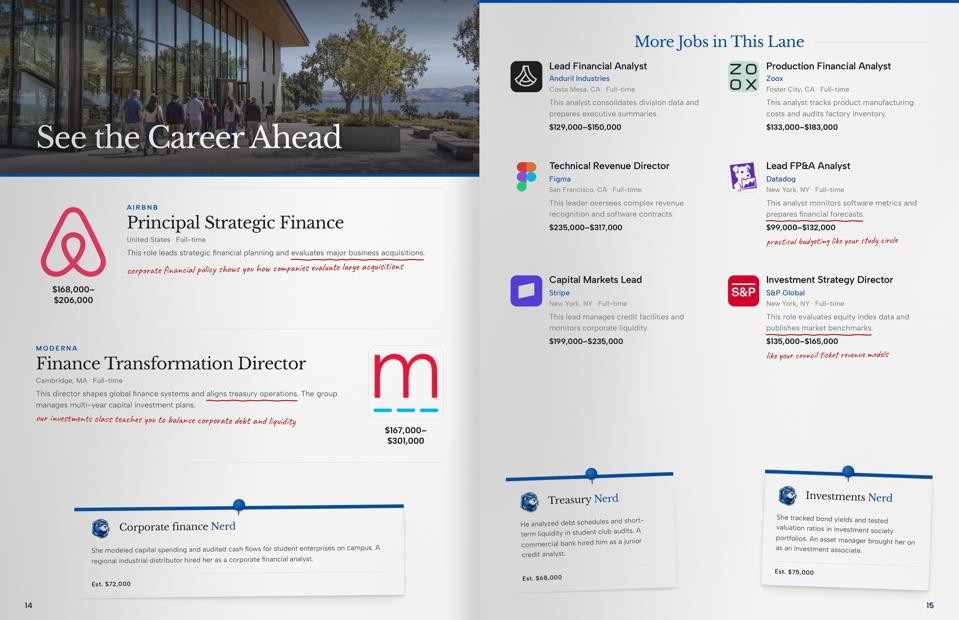
Nerd Apply’s AI scrubs out identifying details and summarises essays by subject. The AI then matches students’ interests to a school’s courses, clubs and programs, and pulls career examples from de-identified alumni profiles on LinkedIn.
The guides also include salary ranges for possible jobs on the career paths, pulled from actual job listings on sites such as LinkedIn, Handshake, USAJobs and Indeed. “Confronting the realities of a salary range” is an important aspect of the guides, says Braden.
The guides started out as PDFs. Then the brothers printed one. “We all held it. And we were like, ‘Oh my God, this feels different,’” Braden says.
Paper now costs about 30 cents per guide, and total printing costs are under $3 (A$4), says Braden. “We spend more on the AI credits to generate each guide than we do on the paper itself,” Braden says.
Nerd Apply isn’t profitable yet. But they expect to print 100,000 to 500,000 guides in 2027. At $10 (A$15) apiece, that could bring in as much as $5 million (A$7.4 million) in sales.
A New Market
Laurie Barron, superintendent of Montana’s Evergreen School District, wasn’t shopping for vendors when a colleague asked her to mentor two young founders, but the timing was serendipitous. Her K-8 district had just created Future Forward, a required one-semester career exploration class for seventh- and eighth-graders funded by a state grant.
“We’re not saying in seventh grade you need to commit to being an engineer or a pipefitter, but we don’t want to send kids to high school with no idea of exploration,” she says. “This isn’t commitment; it’s exposure.”
As the brothers described their guides, Barron saw how they could fit. “States are starting to expect college and career planning at the middle level and not waiting until high school,” she says. So she told them, “You’re missing a market here.”
Braden and Cooper visited Barron’s classes in October with a guide for each student. For parents who worry the guides could make already anxious students even more worried about their futures, Barron says she saw the opposite.
“I did not see one example of anxiety, nervousness or stress the whole day,” she says. “It was mesmerizing. The kids were just, ‘Yes, I want to do this! Oh my gosh, there’s this summer camp this summer!’”
And the salary ranges were a hit. “They were all reading the salary ranges out loud,” Braden says. Whether the guides change what students actually do is harder to measure.
Expanding To Colleges
Nerd Apply also makes guides for admitted college students. Clark University in Worcester, Massachusetts, signed on after Lukman Arsalan, vice president of enrolment, met the brothers at NACAC. Arsalan says Clark enrolled 36% more first-year students this fall, which he credits to the school’s more personalised recruitment.
“Everybody wears an invisible sign that says ‘make me feel special,’” he says.
Starting with the class entering in 2027, every US-based admitted student will receive a personalised guide a few weeks after their acceptance letter arrives. The guides will connect the students’ interests to Clark classes and professors, clubs and alumni outcomes, along with a map of the campus.
Arsalan anticipates ordering roughly 5,000 guides for the next academic year.
As the US population of 18-year-olds is declining and colleges are ramping up their efforts to attract students, Arsalan isn’t eager to share. “I told Braden and Cooper, ‘I don’t want anyone to find out about you guys because I don’t want the secret to be out,’” he says.
The Long Game
The brothers say they want to run Nerd Apply for 20 to 30 years. “Going public is the goal,” Cooper says.
What drives them, though, goes back to where they started. “It wasn’t that we struggled necessarily,” Braden says, but seeing how much access to opportunity other students had, “may have left a little bit of a chip on our shoulder to say the next generation of kids will have access to these things.”
He still remembers being a high school student set on becoming a doctor, with no idea how to get the patient-contact hours he needed. He ended up walking across the street from his school to a hospital and asking whether it took volunteers.
It did. “And our product is literally that—it’s like, hey, there’s volunteering right at this hospital right next to you,” he says.
These days, the would-be surgeon describes the company’s mission simply: “To put opportunity in the hands of every kid in America.”
Want to be more successful? Subscribe to the weekly Forbes Careers newsletter to get insider tips and insights.
Want to see more Forbes articles on your feed? Tap here to make Forbes Australia a preferred source on Google.
Look back on the week that was with hand-picked articles from Australia and around the world. Sign up to the Forbes Australia newsletter here or become a member here.