A spate of AI fundraising deals has made way for a new wave of young European billionaires. Meet the sweet 16 whose fortunes got big boosts of late.
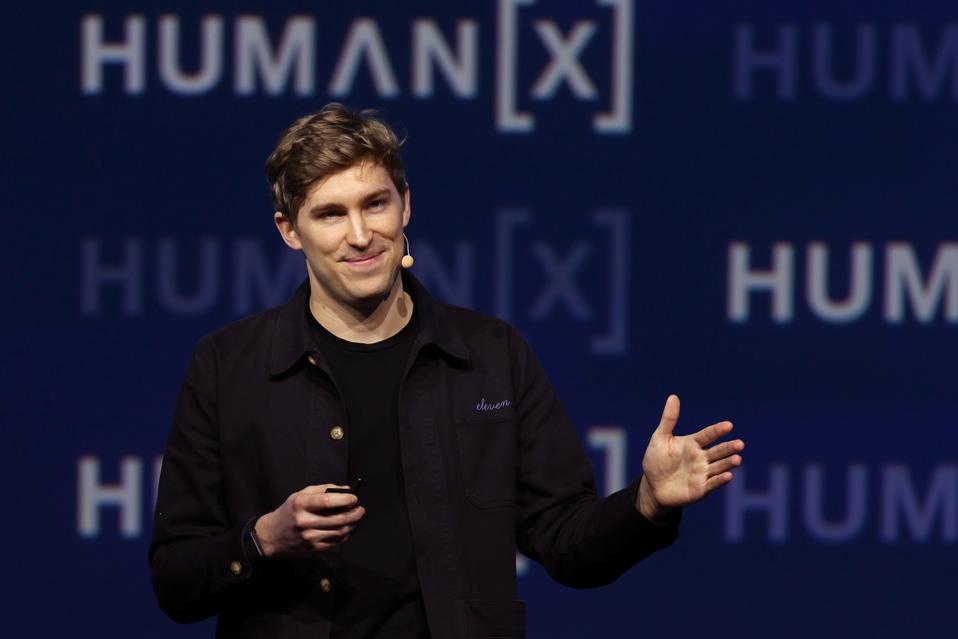
ElevenLabs CEO and cofounder Mati Staniszewski
Getty Images for HumanX Conference
On Wednesday, AI voice startup ElevenLabs announced it had completed a $300 million employee share sale that doubled its valuation to $22 billion. Its Polish cofounders Mati Staniszewski and Piotr Dabkowski, each of whom hold an estimated 15% stake each, are now worth $3.3 billion apiece, up from $1.6 billion earlier this year.
High school friends Staniszewski and Dabkowski grew up watching poorly dubbed films. Those films were in part what led them in 2022 to quit their jobs at Palantir and Google, respectively, and to pool their savings to start ElevenLabs, which uses AI as a better alternative than drab voiceovers. Today, the New York and London-based startup says enterprises like Klarna and Revolut account for 55% of its revenue.
In December, the company had nearly $200 million in trailing 12-month revenue, Forbes reported. It’s likely on track to double its revenue this year, and its AI agents now handle 15 million conversations each week.
They are just the latest European founders whose fortunes have soared in recent months, thanks to a flurry of megadeals and big fundraising rounds that have helped put Europe’s back in the AI race. In the past five months, eight new billionaires have emerged and another six have seen their fortunes swell.
Kicking off a busy summer of AI deals was Berlin-based software startup n8n, which helps businesses automate their workflows using more than 12,000 templates. In May, the startup snagged a strategic investment from SAP, doubling its valuation to $5.2 billion. It was enough to make its CEO and founder Jan Oberhauser a new billionaire with an estimated 45% stake worth $2.3 billion, according to German corporate filings. Oberhauser did not respond to Forbes’ request for comment.
In early August, 25-year-old British entrepreneur James Dacombe became Europe’s youngest self-made billionaire after raising $312 million at a $3.3 billion valuation for his fledgling chip company Olix. Dacombe, who dropped out of high school to start his first company, owns an estimated 30% of Olix, Forbes reported at the time.
In mid-August, Sweden’s Lovable closed a bumper new fundraise of $400 million that valued the AI-powered website app builder at over $13.3 billion. That lifted the shareholding of its cofounders Anton Osika and Fabin Hedin to $3.1 billion each.
A few days later, fellow Swedish founder Arvid Lunnemark’s net worth also doubled after Elon Musk acquired Cursor, the AI coding startup he cofounded with three friends at MIT in 2022. The takeover valued Cursor at more than $60 billion, with Lunnemark’s stake alone worth over $2.7 billion. Lunnemark, a former math olympiad champion, left Cursor in 2025 to launch a new startup called Integrous Research, which is focused on developing systems for safer AI.
Next came news of data center startup Fluidstack, which Forbes reported in September had quietly closed a $1.5 billion round over the summer that valued it at over $18 billion. The company, which projects revenue growing to $660 million this year, was founded in the United Kingdom and was based in London until it relocated to New York in December. The deal made cofounders Gary Wu, 31, Jamie Cox, 29, and César Maklary, 29, billionaires each worth $1 billion. Wu and Cox met while studying at Oxford before starting Fluidstack in 2017. Maklary, who previously worked in aerodynamics for a Formula One team, joined the company in 2020. The startup originated as a marketplace that allowed gamers to rent out GPUs to AI researchers. It is now building data centers across the country and counts Anthropic as one of its largest customers. All three European cofounders are now based in New York.
Then came the largest round ever raised by a European startup. French AI champion Mistral closed a staggering new round in September, raising nearly $3.5 billion at a $24.3 billion valuation. The Paris-based founders, Google Deepmind researcher Arthur Mensch and Facebook veterans Timothee Lacroix and Guillaume Lample, founded Mistral in 2023 to build large language models to compete with American AI labs and Chinese open source models. The round boosted the value of Mistral’s three cofounders’ stakes to $2.7 billion apiece, Forbes estimates, up from $1.8 billion in April.
Acquisitions have also played a role in boosting these fortunes. Chip juggernaut Nvidia agreed to acquire open source platform Hugging Face for $12.9 billion last month. The deal made the startup’s three French cofounders Clément Delangue, Julien Chaumond and Thomas Wolf freshly-minted billionaires, each worth $1.7 billion, according to Forbes estimates.
Hugging Face was founded in 2016 in New York as a playful chatbot for teens, but the cofounders quickly realized the models powering the consumer app were more valuable than the app itself. Today about 18 million developers and 200,000 companies use Hugging Face’s library of models and datasets. While the startup is headquartered in New York, the company considers itself “Franco-American” with most of its employees based in France. Delangue grew up in La Bassée, a small town in Northern France with three siblings. Wolf is based in London.