More than $1 billion went toward AI-native startups. Fintech, biotech / medtech and climate tech startups were also winners in 2025, according to the latest report from Cut Through Venture and Folklore Ventures.

Key Takeaways
- Australian startups raised $5.1 billion across 390 deals in 2025, up 24% year-on-year, making it the third-biggest funding year on record.
- Funding surged late in the year, with $2 billion raised in Q4 alone, the strongest quarter since 2021.
- AI was the main driver, with more than $1 billion going to AI-native startups and 61% of total funding landing with companies using AI.
- The biggest rounds dominated the year, with the 20 largest deals accounting for 58% of total funding.
- Fintech pulled in $868 million, while hardware, robotics and IoT attracted $297 million.
- Early-stage deal sizes stayed strong, with pre-seed medians surpassing $1 million and seed rounds approaching $3 million.
Big Number
$2 billion – The amount Australian startups raised in the final quarter of 2025 alone, marking the strongest quarterly funding result since 2021.
Crucial Quote
“What excites me heading into 2026 is that the market seems to be in a unique state of fast moving without being irrational. Investments are happening at a rapid rate, but the bar is staying high, and that combination should produce healthier companies,” says Chris Gillings, Founder of Cut Through Venture and Managing Director at Five V Capital.
“Liquidity at scale remains the missing ingredient. Deployment has returned with pace and conviction, now the ecosystem needs exits and the delivery of liquidity to limited partners.”
Key Background
Some 390 deals took place in the Australian startup ecosystem in 2025, a 24 per cent increase on the year prior. More than $5 billion was committed to change hands from investors to founders of AI-native fintech, biotech and climate tech companies, making it the third largest funding year on record.
“2025 finished with a bang, delivering one of the strongest quarters of funding announcements since 2021 and signalling that confidence has returned to Australian venture capital,” says Chris Gillings, the founder of Cut Through Venture and Managing Director at Five V Capital.
Sixty-one per cent of total funding went to companies with AI in their stack.
“The AI wave has acted as the accelerant, not because “AI” sells, but because it compresses time. Teams can ship, iterate, and prove value faster, which has pulled more companies into a fundable position earlier.”
The last quarter of 2025 made up 40 per cent of the year’s funding, according to the State of Startup Funding report. Hardware, robotics and IOT attracted $297 million in funding, and fintech drew in $868 million. Media, Crypto and EdTech startups had a more challenging time landing funding, the report states.
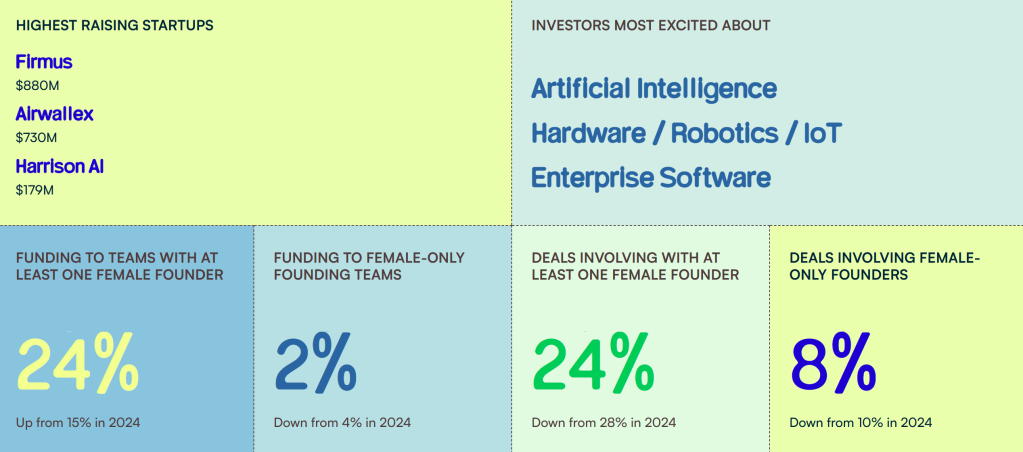
Deal share of funding for female founders did not advance last year, with just 24 per cent of deals going to companies with a female founder, compared to 28 per cent in 2024. All female teams drew in just 2 per cent, down from 4 per cent the year prior.
Four per cent decline in funding for female founders
“Capital gains flowed through a small number of large rounds rather than an increase in the
number of funded teams,” the report reads.
“A limited group of female and mixed-gender teams accounted for most capital raised by women-led startups. As a result, many founders experienced little change on the ground despite stronger aggregate outcomes. The data points to concentration, not systemic shift,” the report reads.
Rachel Yang is a partner with venture capital firm Giant Leap. She drew a line between the DEI pushback in the US and the state-of-funding for female founded startups in Australia.
“A disappointing result ahead of International Women’s Day, but not an unexpected one. When the conversation quietens which has happened over the last 12+ months, progress slips,” Yang told Forbes Australia.
“I believe that the DEI backlash coming out of the US also matters here. Pulling back has flow on effects, including missed returns from women-led businesses.”
Yang also raised concerns about women’s voices being sidelined throughout the AI transformation.
“This matters even more as AI reshapes industries at speed. If women’s voices are missing from who builds and backs this technology, we lock in the same blind spots at scale,” says Yang.

The opportunities exist and the founders are ready. What is missing is sustained belief from the market. That is why we need to keep talking about this more, not less.
Startups with at least one female founder took 24 per cent of total funding in 2025, up from 15 per cent in 2024 – even as the share of deals involving a female founder fell to 24 per cent, down from 28 per cent.
International investment also saw an uptick, with 66 per cent of 2025 deals including at least one funder from overseas. Fifty seven per cent of deals in 2024 had an international investor.
“Whilst weight of capital typically distributes to larger, later rounds, investment activity in 2025 was broadly distributed across staging and sectors receiving capital,” says Alister Coleman, Folklore Ventures’ founder and managing partner.
“As a nation we need to ensure that founders’ bold visions are not squashed, watered down
or taken for granted. Australia has an incredible talent pool of ambitious founders with big ideas, and quality operators that can deliver on these visions.
“We must continue to match this opportunity with a funding environment that supports the growth of technology companies and the gains to come from their success.”
Look back on the week that was with hand-picked articles from Australia and around the world. Sign up to the Forbes Australia newsletter here or become a member here.