The powerhouse influencer was once considered Italy’s Kim Kardashian. Now a fraud trial could turn her into Martha Stewart.

No Cakewalk: After paying millions in penalties, Chiara Ferragni is now awaiting a verdict in her ‘Pandorogate’ trial. “I’m not here to tell you a fairytale,” she wrote earlier this year on Instagram, “fairytales don’t exist.”
Daniel Perez/Getty Images
Fashion influencer Chiara Ferragni wore a conservative double-breasted suit over a crisp, white dress shirt as she walked down the fluorescent hallway of the Palace of Justice in Milan for the start of her fraud trial this November. There was no trademark wink as she pushed through the gauntlet of paparazzi who have followed her career for more than a decade, only a few awkward smiles as she made her way into the courtroom. “It’s a difficult time in my life,” she politely told them, “Thank you for being here. I’m moving forward.”
It’s a far cry from the way Ferragni’s 28 million Instagram followers are used to seeing the glamorous 38-year-old Italian creator, who was a member of the Forbes 30 Under 30 class of 2015 and was named Forbes’ top global influencer in 2017. This was no Met Gala red carpet or Paris Fashion Week show. The pap walk was now a perp walk.
Next month, Ferragni will return to that same courthouse to hear the verdict in her criminal trial for allegedly defrauding consumers in 2022 over a charitable collaboration to sell branded pandoro Christmas cakes with confectionary company Balocco (the charges also mention a less-publicized analogous case involving an Easter Egg she promoted in 2021 and 2022). Italian prosecutors claim that Ferragni made use of her social media following to spread deceptive communications by implying that a portion of sales from the “Pink Christmas” pandoro would go to support a children’s hospital in Turin specialized in rare pediatric cancers.

Let Them Eat Christmas Cake: In 2022, Ferragni announced a collaboration with the Italian bakery Balocco to sell a pandoro that would benefit a children’s hospital—but the hospital had not received a donation from her.
Instagram/Chiara Ferragni
Instead, Balocco had made a donation of about $54,000 to the hospital before the promotion began and there was no relation between sales and the donation amount. Ferragni’s two companies were paid at least $1.1 million for the collaboration, making an “illicit profit,” according to prosecutors. In addition to the $2.7 million Ferragni has already had to pay, including fines and settlements, prosecutors are seeking a 20-month prison sentence. Ferragni has maintained her innocence and opted for a speedy trial, with her attorneys stating that the case has no criminal relevance.
But most of the damage from “Pandorogate,” as it is known, has already been done. Both Chiara Ferragni Brand (legally Fenice, Italian for phoenix), which licenses Ferragni’s name to fashion manufacturers, and the company she set up to manage her career as an influencer, TBS Crew, are bleeding millions after more than a decade of meteoric growth.
The daughter of a dentist and a fashion executive, Chiara Ferragni was studying to become a lawyer at Bocconi University in Milan when she launched her fashion blog The Blonde Salad in 2009 at 22 years old.
“After years spent on Flickr…I felt like I had to move on and create a space for my own,” she wrote in her first blog post. “The name is ‘The Blonde Salad’ because this blog is gonna be a salad of myself.”
Her career took off with remarkable speed from there. By 2011, The Blonde Salad was attracting 800,000 unique visitors per month, and Ferragni had released her first product line, a shoe collection that sold out almost instantly.
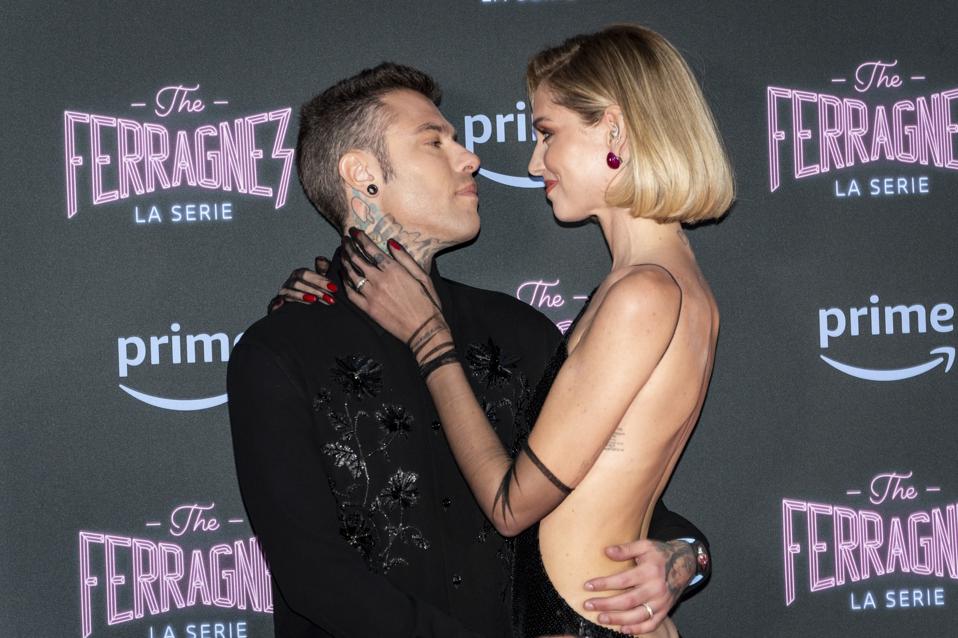
That’s Amore: Ferragni with her ex-husband, the Italian rapper Fedez, in 2023. In his new memoir, he called her “a collective hallucination,” adding, “she doesn’t know a lot about business.”
Elena Di Vincenzo/Archivio Elena Di Vincenzo/Mondadori Portfolio via Getty Images
Ferragni’s ascent was accelerated by the launch of her Instagram account in January 2012, when the app was still in its infancy. By June of the following year, she hit one million followers.
That’s when she went all-in as an entrepreneur, expanding from shoes into a full clothing line through the launch of Chiara Ferragni Brand, a playful mix of bright colors, glitter, and, most crucially, her signature cartoon-style blue eye logo. The brand quickly expanded globally, entering luxury department stores, including Le Bon Marché in Paris and La Rinascente in Milan.
By 2017, Ferragni tightened control over her companies, taking over as CEO from her co-founder (and ex-boyfriend) Riccardo Pozzoli, and opened flagship stores in Milan and Shanghai. At that point, her brand was being sold in over 350 stores across many countries.
Over the next few years, through a series of licensing deals, Ferragni’s collection expanded into a lifestyle brand with accessories, stationery, and eventually makeup. By 2022, revenue hit $15.3 million, almost doubling the $8 million from the prior year, and the company turned its biggest profit to date (about $3.7 million).
Most of Ferragni’s wealth came from collaborating with luxury brands, including Dior, Saint Laurent and Lancôme. According to a Forbes analysis of all of TBS Crew’s income statements from 2017 onwards (which are public in Italy), Ferragni, who owns 100% of the company, generated at least $70 million as an influencer throughout her career—including some work done by her two younger sisters, Francesca and Valentina, leading many to make comparisons to the Kardashians.
Ferragni’s fame reached a new height in 2018 when she married Italian rapper Fedez in a three-day extravaganza in Sicily that was featured in Vogue. In 2021, her reality show The Ferragnez, which documents her life with Fedez, their young children, and her sisters premiered on Prime Video, cementing the Kardashian comparison.

Trial And Errors: “I don’t see her as a criminal,” says Selvaggia Lucarelli, the journalist who uncovered Pandorogate. “I see her as a person who handled her influence very poorly…who didn’t understand how big she was getting.”
AFP
Her career was at its peak when she signed a deal with Italian bakery giant Balocco in late 2022 to promote the pandoro Christmas cake for charity. “Balocco and I have come up with a charitable project to support Regina Margherita hospital,” Ferragni wrote on Instagram announcing the partnership. To sweeten the collaboration, each unit, which cost $11 each (double the cost of a regular pandoro), had a tag that read: Chiara Ferragni and Balocco are supporting Regina Margherita hospital.
That December, an investigation by Italian journalist Selvaggia Lucarelli rocked Ferragni’s career: “Chiara Ferragni’s Pandoro Is Marketing, Not Charity,” read the headline. Lucarelli reported that Regina Margherita hadn’t received any portion of sales after the initial $54,000 donation from Balocco, and Ferragni hadn’t personally donated a cent. “I always had the feeling that [Ferragni] was mixing charitable and commercial activities in a suspicious way,” Lucarelli tells Forbes.
Lucarelli says she was unable to contact Ferragni before her article was published, and that she believes the news came as a surprise. “I don’t see her as a criminal,” says Lucarelli, “I see her as a person who handled her influence very poorly…who didn’t understand how big she was getting.”
Ferragni survived the initial scandal and, in June 2023, Fenice was valued at $82 million in a deal that saw Alchimia Investments sell a portion of its shares to private equity fund AVM Gestioni. “Many believed that I wasn’t good enough or intelligent enough to put together anything of long-term value,” Ferragni wrote on Instagram in celebration, “I will continue to fight for my ideas.”
But that December the Italian antitrust authority AGCM fined Ferragni’s TBS Crew and Fenice $1.2 million for “unfair business practices” tied to false advertising. In an internal email cited in the ruling, a Balocco employee joked: “I’d like to tell [Ferragni’s team] that the sales are actually needed to cover her exorbitant fee.”
In an apology video posted a few days after the ruling, Ferragni called the situation “a miscommunication,” adding, “We teach our children that people make mistakes and that, when it happens, you need to admit it.” She announced a personal donation of $1.1 million to Regina Margherita Hospital but described AGCM’s ruling as “disproportionate and unfair.” She also committed to donating the imposed fine to the children’s hospital should the ruling be overturned on appeal, which did not happen.
After that, Ferragni’s brand deals on Instagram began drying up. Coca-Cola killed plans to release a television ad starring her and she also stopped serving on the board of Italian fashion brand Tod’s, owned by billionaire Diego Della Valle, though a representative for the luxury group tells Forbes that Ferragni’s term expired as planned. (Coca-Cola did not respond to a request for comment).
Soon after, in February 2024, her marriage to Fedez, by then a central component of her lucrative content machine, publicly exploded. “I found out that what I have lived [with Fedez] was complete fiction,” she wrote in a lengthy statement on Instagram, describing how he had been cheating on her since 2017, that she discovered the affair while caring for him during his cancer treatment, and how he phoned his lover right before heading to the altar on their wedding day. Fedez has admitted to the affair but denies having made that phone call.
That fall, Ferragni stepped down as CEO of Fenice and was replaced by Claudio Roberto Calabi. Her longtime business associate Fabio Maria Damato, who was also charged in Pandorogate but has not commented on the case, walked away from his roles in both Fenice and TBS Crew. But it wasn’t enough to stop the bleeding. Ferragni’s Milan flagship store shut down and Fenice’s revenue plummeted 94% to $1.1 million for 2024, taking a loss of about $3.5 million, according to the company’s income statement. TBS Crew was hit just as hard. Revenue dropped from $19.3 million in 2023 to $1 million, a 95% decline that generated a loss of $2.4 million. Both companies laid off employees.
The Fedez drama didn’t die down, either. In his memoir published this October, the 36-year-old rapper claims to have been unaware of Ferragni’s role in Pandorograte. “I found out what happened with the rest of the world,” he wrote in L’acqua è più profonda di come sembra da sopra (which translates to “Water is deeper than it looks from above”), describing Ferragni’s sobbing on the day of the ruling, “I would have told her clear as day: ‘You really fucked up.’” Fedez went on to describe Ferragni as “A collective hallucination,” adding “She doesn’t know a lot about business.”
Even if convicted of the fraud charges early next year, Ferragni is unlikely to serve any time in prison, according to Rome-based criminal defense attorney Gianluca Tognozzi. “In Italy, if you are a first-time offender and are convicted, the sentence is suspended if the term of imprisonment is two years or less,” he explains.
A member of Ferragni’s immediate staff tells Forbes that, if found guilty, Ferragni plans to appeal the verdict and continue her business operations the same way she has done throughout the entire saga. For now, that means sponsorship money coming in from brands in relatively untapped markets around the world. Most recently, she partnered with a small Mexican accessory firm and a Spanish hair care company. Ferragni’s staff member also says that Fenice is in recovery and that its 2025 income statement, which has not yet been filed, is showing positive signs.
If there’s a silver lining to this situation for Ferragni it’s that she was able to buy back control of her business at a substantial discount. In April, she invested $7.3 million into Fenice, increasing her stake from 32.5% to 99% in a rescue operation that saved the company from being forced to file for bankruptcy under Italian law.
“It’s not just about shares or percentages,” Ferragni wrote in April on Instagram announcing her new majority stake: “It’s the choice to take back control of my story: no more delegating, no more pretending everything is fine when it’s not.”
“I’m not here to tell you a fairytale, fairytales don’t exist,” she continued, “but I know I’m trying to build something new.”
Look back on the week that was with hand-picked articles from Australia and around the world. Sign up to the Forbes Australia newsletter here or become a member here.