MCi Carbon’s technology captures carbon and uses it to create building materials, a double whammy in CO2 reduction. After the grand opening of its first carbon refinery on Wednesday, it’s hoping to cap its next raise by the end of the year.
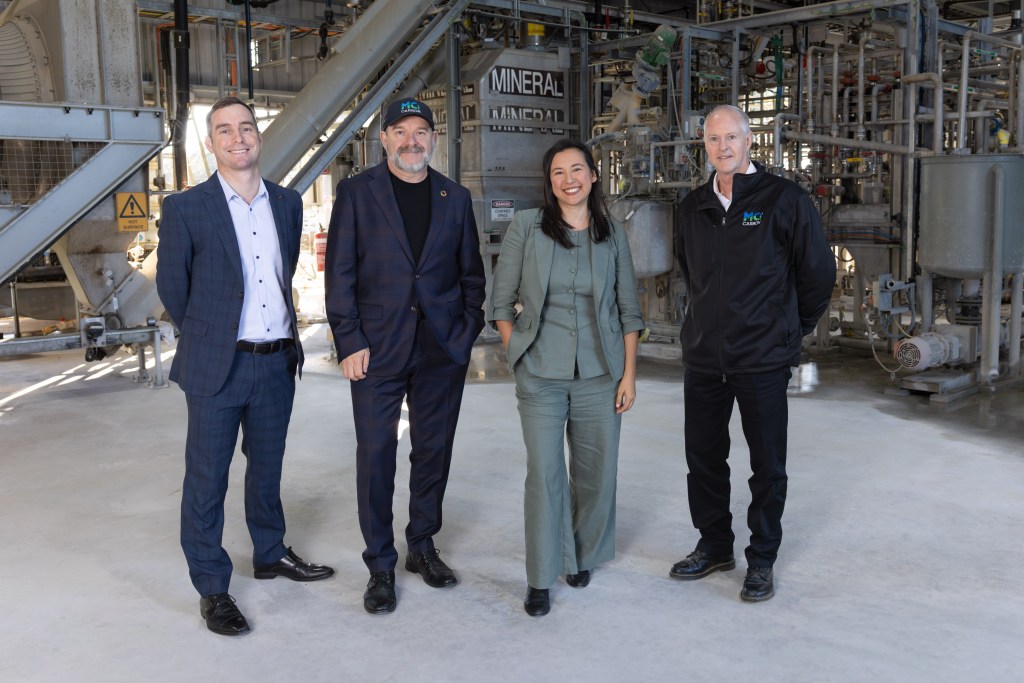
Cleantech startup MCi Carbon is planning a US$50 million ($70 million) capital raise this year, according to its co-founder Marcus Dawe, the next big step in its long-term goal of capturing a billion tonnes of carbon by 2040.
Those funds, likely to come from investors in Japan and Europe, will be used to build MCi Carbon’s next plant – though it is but a fraction of the capital Dawe estimates will be needed for the company to achieve its ambitious mission.
“We’ve got international funders ready to come in on our next capital raise, the reality is we want to have a good, strong base of funders because the pathway ahead for us is US$10 billion of capital” by 2035, Dawe told Forbes Australia. “That would have us roll out our plans around the world.”
MCi Carbon’s technology, developed since the company was founded in 2013, captures carbon and imbues it into quarry rock or other base inputs. These carbon-containing materials then become usable by industry to create brick, glass, asphalt, cement and more. The idea is to reduce industrial CO2 emissions by both capturing carbon outputs and reducing the inputs required to build construction materials.
Dawe, both founder and the CEO, spoke to Forbes Australia ahead of the grand opening of MCi Carbon’s Myrtle plant in Newcastle on Wednesday. The hub is a demonstration facility that allows prospective customers to trial how the CO2 they emit can be recycled into new building materials.
The plan is to build plants near their customers operations, so that the CO2 can be captured directly and building materials delivered quickly. The Myrtle plant allows MCi Carbon to test the best way to configure its plants according to a new customer’s needs.
MCi Carbon was founded in 2013 has thus far raised $40 million, mostly from Japan. Investors include cement maker Mitsubishi UBE Cement Corporation and the Sumitomo Mitsui Trust and Mizuho banks.
Dawe says he has purposefully eschewed the traditional VC route most startups follow because those investors would seek returns in a time frame not appropriate for a deep tech company like MCi Carbon. He has, however, been in discussions with the $15 billion National Reconstruction Fund, which seeks to stimulate advanced manufacturing in Australia.
“We’re looking for strategic investors,” Dawe said, referencing companies that would invest in MCi Carbon’s technology to integrate it into their operations rather than just profit of equity appreciation.
“Strategic investors give you more than money, and you need more than money to do this stuff. You need access to markets, you need deep insight into cost structures around supply chains and… [you need] big collaborations, which we’ve been doing with global manufacturers for several years.”
An illustrative example is $10 billion, ASX-listed Orica, which makes explosives for the mining, oil and gas industries. It is both a backer and a customer of MCi Carbon; the Myrtle plant opening on Wednesday services Orica’s Kooragang ammonia plant. Austrian company RHI Magnesita, which makes heat-resistant bricks that line steel furnaces and cement kilns, has invested US$10 million and plans to have a tailor-made plant by 2030.
In addition to the capital it has thus far raised, MCi Carbon has also received $40 million from Federal Government grants. It is generating revenue in the “lower millions” per annum, Dawe said.
Though carbon capture is a nascent technology, Dawe says it’s a relatively efficient one. The company’s core IP is chemical engineering, he said, which uses a fraction of the energy used by the industrial companies MCi Carbon hopes to court. The potential returns are large, however, with natural resources data cruncher Wood Mackenzie forecasting the carbon capture and carbon offset industries to reach US$1 trillion by 2050.
There are several companies around the world competing with MCi Carbon for that bounty, however. That includes Canadian outfits CarbonCure and Carbon Upcycling, both of which are seeking to reduce the cement industry’s CO2 output.
Want to see more Forbes articles on your feed? Tap here to make Forbes Australia a preferred source on Google.
Look back on the week that was with hand-picked articles from Australia and around the world. Sign up to the Forbes Australia newsletter here or become a member here.