Inside the Team Principal & CEO’s playbook for futureproofing Mercedes-AMG $6 billion Formula 1 empire for the next era.
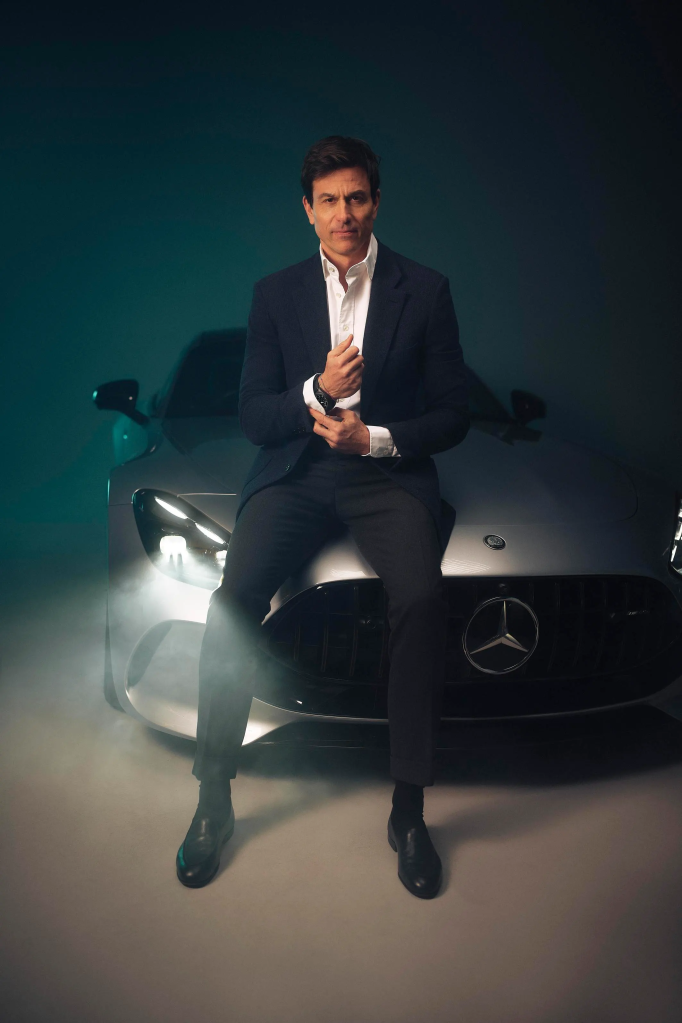
Toto Wolff has a confession that would make most executives uncomfortable. We’re 30,000 feet above the ground on his private jet, flying from the Montreal Grand Prix to New York in mid-June for the F1 movie premiere starring Brad Pitt. It had been a whirlwind race weekend resulting in lead drivers George Russell and 18-year-old Italian newcomer Kimi Antonelli placing 1st and 3rd, respectively. Still, the man who built Mercedes-AMG Petronas as Team Principal and CEO into one of Formula 1’s most dominant franchises—a record eight consecutive titles for the best overall team and car (the Constructor’s World Championship), as well as 131 Grand Prix victories, a feat unmatched in any major sport—reveals the word “leadership” makes him recoil.
With a net worth of $2.5 billion according to Forbes, the 6’5”, 53-year-old Austrian has every reason to rely on the tried and true CEO playbook. Rather, he rejects it entirely. If there’s one thing he knows for sure, it’s that racing is a team sport.
“I feel embarrassed talking about leadership,” Wolff says, staring out the window above the clouds at sunset, dressed in a relaxed denim button-down, white t-shirt and chinos. He had spent the race weekend behind the Engineering desk inside the team garage with over 58 engineers and technicians amid the rev of twenty Formula 1 engines and the squeal of pneumatic wheel guns, all working towards one goal—making it to the podium and edging closer to a World Championship and Constructors’ Championship (Mercedes-AMG ended the season in second place in this year’s Constructors’ rankings).
“This notion of one leader is something that I really struggle with. I couldn’t be the best CFO, the best CMO, the best CEO, all in one,” he says. “I see myself among that team. If there’s a final decision to make, then I will do that. But I rely on the collective.”
Coming from someone who turned a struggling F1 team reportedly valued at roughly $165 million in 2013 into a $6 billion juggernaut, it’s a statement that demands scrutiny. But Wolff’s unease with traditional hierarchies isn’t philosophical posturing—it’s operational strategy.
When it comes to hiring for the 2,000-person organization, which includes the headquarters in Brackley (1,250 staff for the chassis team) and the engine facility in Brixworth, England. Within thirty seconds of meeting someone, he’s made his initial assessment. “It all starts with the personality and character,” he says. Overconfidence is “a no-go.” Arrogance or lack of humility? “An absolute showstopper.” Only after clearing those character hurdles does technical competence even enter the equation.
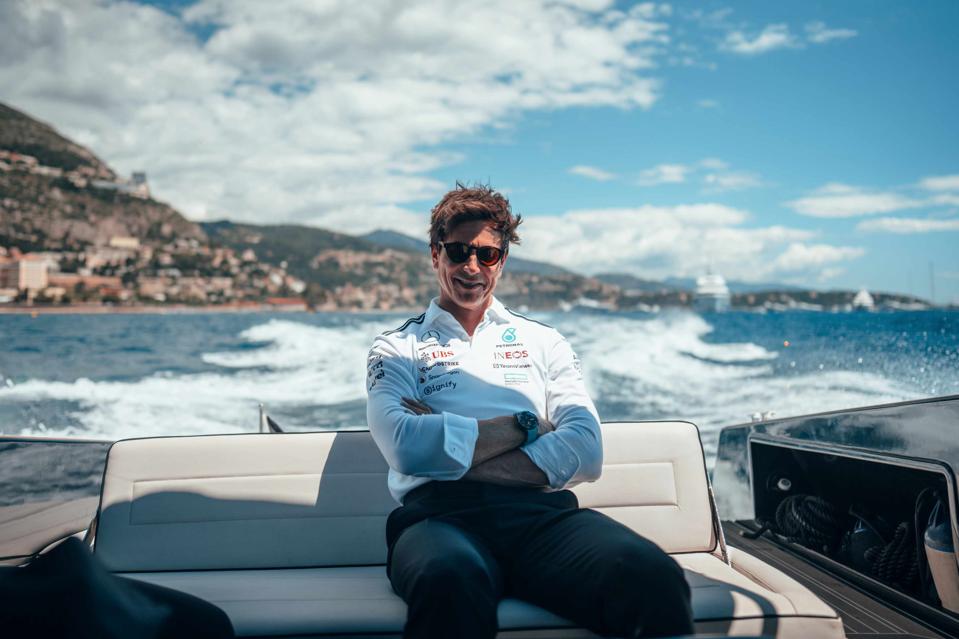
Valtteri Bottas, who drove for Wolff for five seasons before Russell joined, puts it this way: “One of his strengths is reading people and learning how to deal with different people because everyone is different. Some might need more pressure. Some might need less. And he tries to figure out for each individual what works.”
Wolff sees his role as creating an environment where people feel simultaneously protected and pressured—a paradox that defines many high-performance cultures. “I see it a little bit as my tribe, I ought to protect them,” he says. “But I also need to give clarity of the mission.”
That mission tolerates nothing short of greatness. “You gotta be great. If you go from great to good because you’re not motivated enough, or you haven’t been keeping up with the development of technology—then this is an ejection seat.”
The calculus extends beyond any individual. “I’m responsible for the two thousand people that work in this team, their families, their life standards, their mortgages, their dreams, their hopes.”
Russell sees this philosophy embedded across the organization. “Toto has always believed in youth and believed in promoting the next generation,” he explains. “You need a balanced organization. You cannot promote a junior into a senior role if there isn’t already somebody in an experienced position to be his co-partner.”
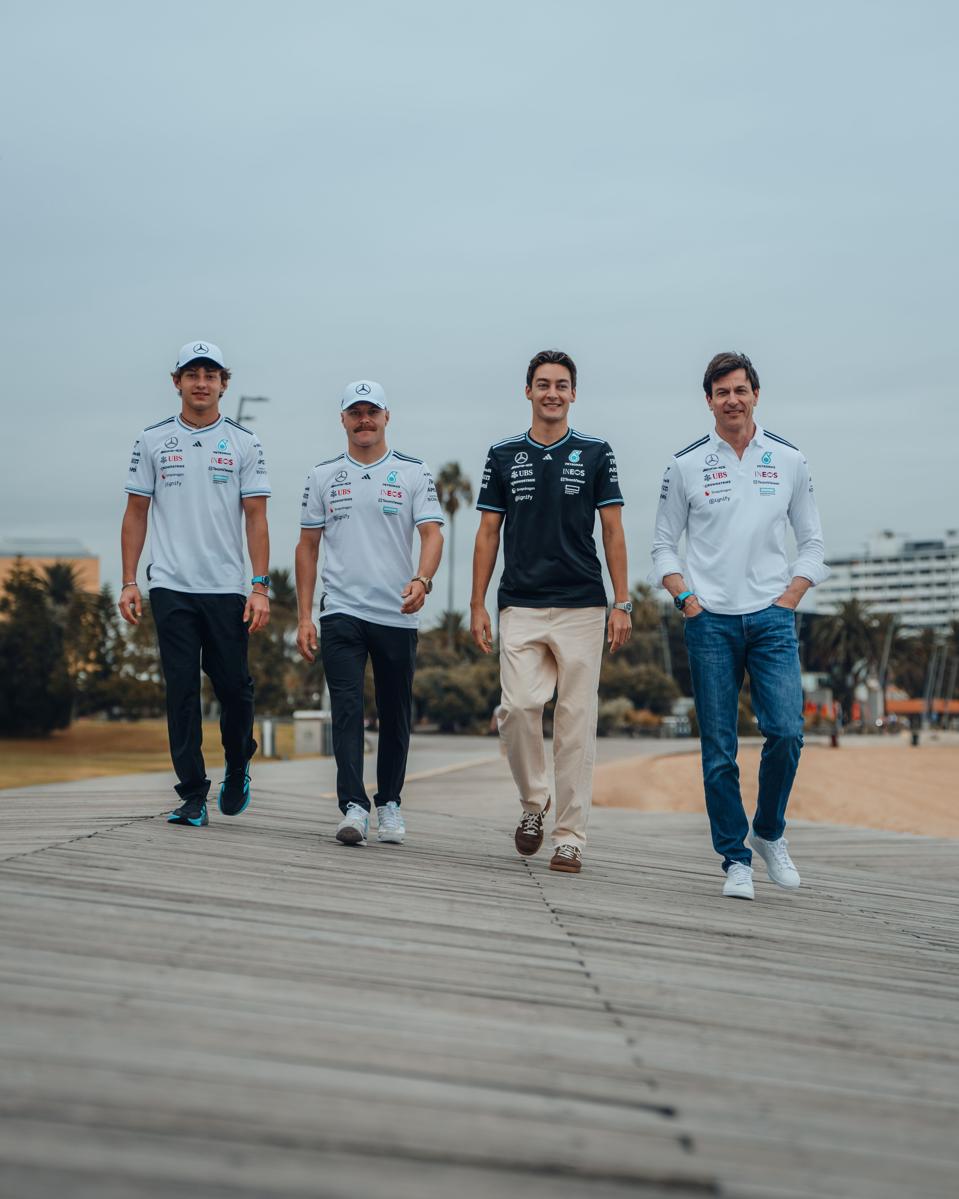
Russell points to Wolff’s decision to promote young Antonelli alongside himself as evidence of this calculated approach. “Toto had the confidence to promote Kimi because he had the confidence in me. I’m seven years in F1 now, [I’ve] won races. So he had a solid base.” But Russell spotlights the core tension: “If you’ve got a winning formula, how do you have the courage to change that formula to preempt the next cycle, right?”
“I only do calculated risks. And calculated risks means even the worst outcome is something that I can cope with.”
Toto Wolff, Team Principal & CEO, Mercedes-AMG Petronas Formula 1 Team
That question applies far beyond driver lineups. Wolff’s investment philosophy is equally rigid. “I only do calculated risks. And calculated risks means even the worst outcome is something that I can cope with.”
The reason traces to childhood trauma. His father developed brain cancer, lost his business, and died heavily in debt. “As a child, losing your father in that way was traumatizing,” Wolff says. His mother, a doctor, spent years paying down that debt. “That’s part of the reason why I don’t take risks that could negatively impact my life or my family’s life.”
He admits leaving “a lot of profit on the table” and says he has zero regrets about it.
That discipline with limited downside risk shaped the unlikely series of decisions that ultimately pulled him into Formula 1’s power center.
Following an early racing career, Wolff founded an investment firm in 1998 focused on Internet and technology companies during the boom era. Other investments included the IPO of HWA AG—the company responsible for developing and racing Mercedes-Benz cars for the DTM as well as Mercedes-Benz’s Formula 3 engine programme. In 2002, Wolff founded a racing driver management company with two-time Formula 1 World Champion Mika Häkkinen while also returning to compete.
Wolff’s path to Mercedes began as pure financial arbitrage. In 2009, he bought a 16% stake of Williams F1 and three years later he became a non-executive director of the team. They won Williams’ last race in 2012.
That same year, Mercedes, struggling with its own performance, asked Wolff to diagnose their problems. His assessment was blunt: their championship expectations didn’t match their top-six results. Two months later, they offered him the top job. Wolff declined—he was an entrepreneur, not an employee. Mercedes restructured its ownership: it bought back 40% of the team from Abu Dhabi’s sovereign fund so Wolff could purchase an equity stake.
That bet paid off 40x. Until recently, Wolff owned 33% of Mercedes-AMG Petronas F1 Team, the cornerstone of his fortune. Today, Mercedes is one of the most profitable sports teams, with an operating profit of $202 million in 2024. Under Wolff’s ownership, Mercedes F1 started its unprecedented run of seven consecutive Constructors’ Championships and Drivers’ Championships in 2014. In those seven seasons, they won 74% of all Grand Prix races.
Wolff’s next big bet is one he hopes will help navigate the Mercedes-AMG team as they zero in on record-breaking territory: winning their eighth World Drivers’ and ninth Constructors’ Championships.
To aid in this quest, Wolff announced he sold a 15% minority interest within his ownership entity to George Kurtz, CEO and founder of CrowdStrike just ahead of the November Las Vegas Grand Prix—bringing an S&P 500 tech leader into the ownership group.
“George’s background is unusual in its breadth: he’s a racer, a loyal sporting ambassador for Mercedes-AMG, and an exceptional entrepreneur,” Wolff explains from the Yas Marina Circuit in Abu Dhabi in early December as the team gears up for the final race weekend of the 2025 season, where it is a balmy eighty-four degrees. “He understands both the demands of racing and the realities of building and scaling technology businesses.”
Wolff adds that “finding someone who understands racing and the tech world is unique and we hope that he’s going to leverage our network in the United States.”
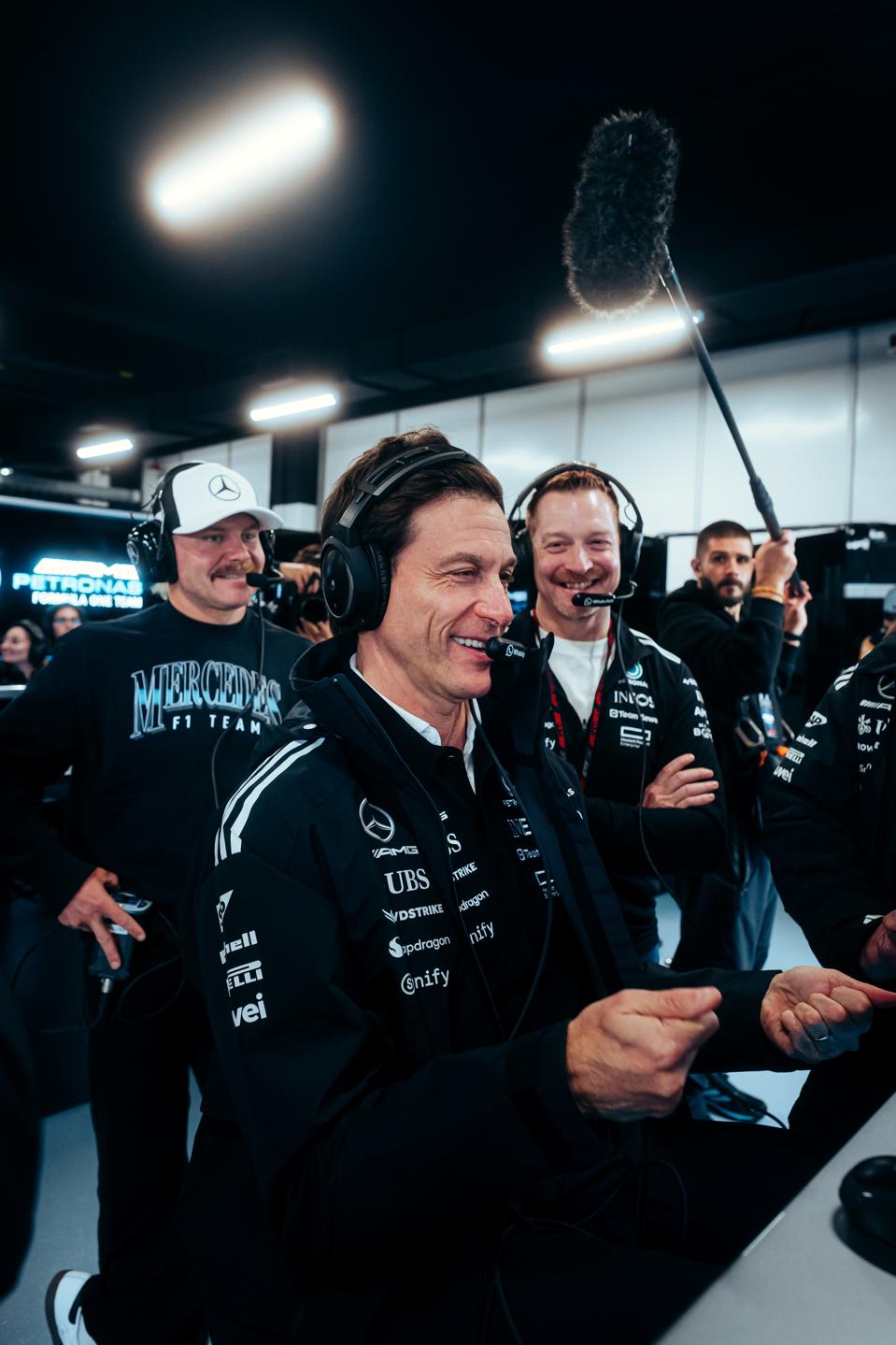
Kurtz, who built CrowdStrike into one of the world’s leading AI-powered cybersecurity companies, is also an accomplished endurance racer who has partnered with Mercedes-AMG since CrowdStrike became a Global Partner in 2018. As Technology Advisor, Kurtz joined the team’s strategic steering committee alongside Mercedes-Benz Chairman Ola Källenius, INEOS founder Sir Jim Ratcliffe, and Wolff.
“If you look at the sport and where it is today, it’s growing,” says Kurtz. “It’s a massive opportunity not only in the U.S. but worldwide and it has reach and interest from fans of all walks of life.”
Kurtz believes owning a stake in the team was the next sensible move after being a partner for seven years. “We’ve got to know the team and I think it’s serendipity when you have a great relationship lining up with a great business opportunity.”
Kurtz will support the team’s innovation and technology strategy—competitive motorsport, data analytics, and performance—while expanding the team’s ecosystem across the U.S. and global tech sectors. “Winning in racing and cybersecurity requires speed, precision, and innovation,” Kurtz says. “Milliseconds matter. Execution counts. Data wins.”
The timing of their deal reflects F1’s extraordinary business transformation. While some investors are skeptical about whether the sports’ rapid growth will continue, team valuations have surged to an average $3.6 billion today, up 89% since 2023. F1 has exploded globally, particularly in the U.S. where Netflix’s Drive to Survive series created millions of new fans. Liberty Media’s $8 billion acquisition of F1 in 2017 has proven prescient—the sport now reaches 1.5 billion TV viewers, with races generating Super Bowl-level engagement.
The financial stakes keep rising. Cadillac’s entry as the 11th team in 2026, backed by General Motors, signals mainstream American corporate appetite for team ownership. The current ten teams—operating under a cost cap of $135 million per season—have become increasingly valuable assets (the cost cap is set to rise next year to $215 million). Mercedes’ $6 billion valuation makes it one of the sport’s most valuable franchises alongside Ferrari.
But even as the numbers swell, Wolff’s attention is turning in a very different direction. His other investments span from a 1% stake in Aston Martin to ventures in sports tech and emerging mobility companies. But now, after more than a decade at the helm, he is shutting down Mercedes’ diversification experiments. The team’s expansions into America’s Cup sailing and technology consulting are being axed.
“We don’t want to do this anymore,” he says flatly. “We’re a Formula One racing team. We don’t want to go sailing. We don’t want to do any other sports. Complete focus [must be] on only Formula One.”
Wolff’s decision is deliberate. After a decade of dominance, Mercedes has struggled since 2021’s rule changes, which introduced new aerodynamic standards. That year, the team won their eighth consecutive Constructors’ Championship, but lost the Drivers’ Championship. “This was the first time that we didn’t get it right,” Wolff admits. Looking ahead to 2026—when F1 introduces 100% sustainable fuel and true hybrid engines—Wolff sees a reset. “That is what Formula One stands for: innovation, high tech, and being the fastest laboratory in the world.”
The 2026 regulations represent more than a technical challenge—they’re a commercial inflection point. With Cadillac entering and Audi joining through existing franchises, the grid is becoming a battleground for automotive manufacturers betting on F1 as their premier technology showcase. Mercedes views the hybrid era as vindication, which is why Wolff is now pulling the organization tighter and sharpening the edges for the era to come.
Wolff’s play is clear: consolidate around core competencies, inject Silicon Valley expertise through partners like Kurtz, and position Mercedes for the next decade of F1 expansion. The sport’s U.S. footprint continues to grow—three American races on the calendar, a Vegas Grand Prix that generated over $1 billion in economic impact, and now an American manufacturer joining the grid.
For a man who turned his 33% equity stake in the team into a $2.5 billion fortune, the next cycle matters more than the last. Russell sums it up best: “We knew realistically we were not going to fight for a championship this year because the foundations were not there. We’re climbing, but you can’t take three steps in one,” he adds matter-of-factly. “Success doesn’t happen overnight”.
Look back on the week that was with hand-picked articles from Australia and around the world. Sign up to the Forbes Australia newsletter here or become a member here.
This story was originally published on forbes.com and all figures are in USD.