Doone Roisin’s presence in Davos reflects a mission that began years earlier — on a bedroom floor, when she launched her podcast — and has since grown into a global platform championing women who are building wealth through business.
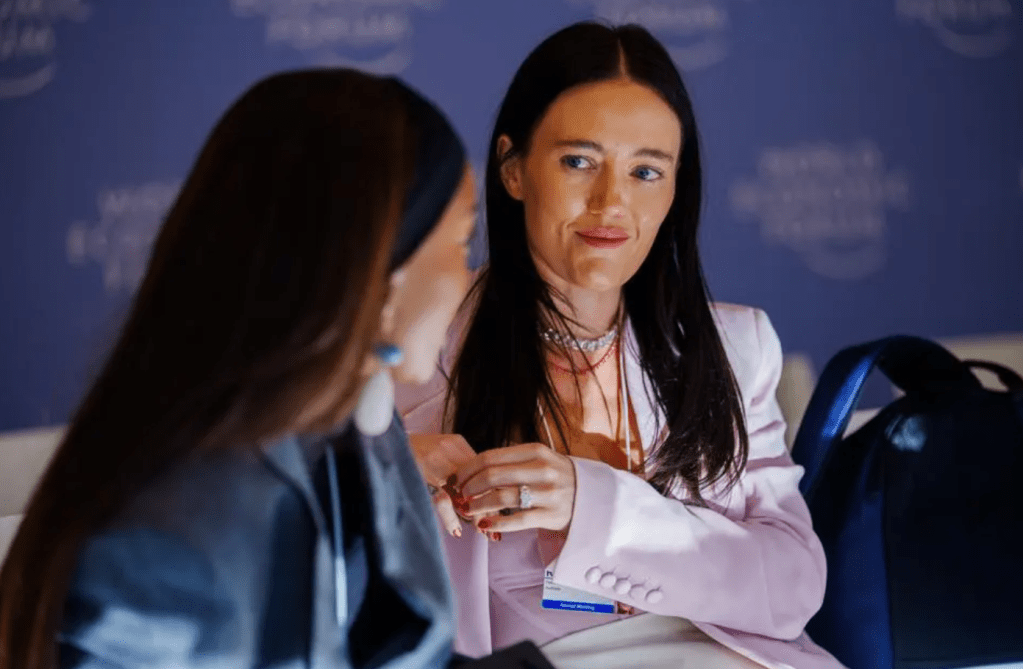
While conversations about women’s economic participation are unfolding inside the halls of the World Economic Forum in Davos, Doone Roisin is focused on what comes next: helping women build and keep real wealth.
This year, Roisin is attending the World Economic Forum’s Annual Meeting in Davos as part of the YGL Mastercard Fellowship.
Her presence in Davos reflects a mission that began years earlier — on a bedroom floor, when she launched her podcast — and has since grown into a global platform championing women who are building wealth through business.
Roisin is the founder of Female Startup Club, a modern media brand built to help women build wealth and business power. What began as a podcast has evolved into a multi-channel media business reaching more than 160,000 ambitious professional women across newsletters, social platforms, and a globally ranked podcast now in the top 0.5% worldwide, with more than 700 episodes.
But the ideas she’s bringing to Davos didn’t emerge overnight.
Roisin grew up in regional Australia, raised by a single mother, far from traditional centers of wealth or influence. She often refers to herself as a “bush fairy,” describing a childhood shaped by nature, independence, and a sense of being on the outside looking in.
At age 10, she moved to a small town — a shift that made her acutely aware of difference and belonging. A later opportunity to attend boarding school would change the trajectory of her life, exposing her to a level of wealth and access she hadn’t seen before. It was there that she began to understand what money could enable, and started imagining a different future.
She began vision-boarding a life in fashion and media, eventually moving to the UK, where she worked in a corporate role in 2016 — a job that clarified what she didn’t want.
She would later launch an e-commerce jewelry brand, but quickly realized she wasn’t connected to it. The business didn’t align with her values, her purpose, or her long-term vision.
“I couldn’t see myself doing it for the next ten years,” she shares with me over Zoom, about that period.
Instead of forcing a misaligned venture, she pivoted.
Around that time, Roisin was reading Tools of Titans by Tim Ferriss and couldn’t help noticing something missing.
“I remember reading all these books about founders and billionaires,” she says. “And I kept thinking: where are the women?”
She began having conversations with women in her own network about work, ambition, and money, and decided to publish them. Those conversations became the foundation of Female Startup Club, which launched as a podcast in 2019.
The goal was never motivation for motivation’s sake. It was education — about money, power, and systems — delivered in a way that didn’t overwhelm or alienate people.

“I want to talk about these things in a way that doesn’t make people shut down,” she explains.
That approach reflects her broader philosophy.
“I really believe in changing women’s economic power over the long term, like over 20 years,” she tells me. “What can we achieve? And for me, I believe it starts with media.”
Growing up without financial security shaped that belief.
“If you don’t have that base level of feeling secure and independent, you’re not making the decisions that are necessarily the best for you,” she says. “You’re making them out of a scarcity mindset, not an abundant mindset.”
Her childhood, she says, is the fuel behind her work.
“When you have a strong North Star and the thing that you care about and you’re working in alignment with your purpose, it makes it easier to go through the low seasons because you’re still connected to what you’re doing in a powerful way.”
Doone Roisin
Female Startup Club has since expanded beyond media into community. Alongside the podcast and newsletter, the company is building a private network for women founders, executives, investors, and creators. Interested members can join a waitlist — sharing details about their role and revenue — to access capital, deal flow, expert connections, and curated growth opportunities.
Roisin has also put her own money to work as an angel investor, backing female-founded companies directly. For her, addressing the funding gap isn’t theoretical, it’s personal.
Not every tactic followed a traditional playbook. When doors closed, Roisin found other ways in. (She tells me that the book The Third Door, by Alex Banayan, inspired her to always seek another way through.)
“I’ve always just done things to make it work,” she says.
That sometimes meant unconventional strategies: posting flyers on buildings in the middle of the night, pitching sponsors before permission, and creating momentum without institutional validation. She even set her sights on meeting Oprah while the media mogul was in Australia in December 2025 — and made it happen.
Scrappiness wasn’t a phase, it remains her M.O.
As Female Startup Club grew, Roisin began thinking more seriously about scale and structure. That evolution led her to Techstars, one of the world’s most selective startup accelerators, where she received $120,000 in funding to help grow the business beyond a founder-led platform.
“The goal within Techstars was to figure out how it evolves and becomes something outside of just me,” she says.
Her longer-term vision is a modern media network for professional women — spanning business, personal finance, policy, and life-stage decision-making — all interconnected by money.
“Everything’s designed by men, for men,” she says. “And we’re fitting into these systems that weren’t designed with us in mind.”
Last summer, Roisin brought those conversations to the main stage at the Create & Cultivate Festival, interviewing investor and entrepreneur Codie Sánchez about women, money, and ownership in front of more than 2,000 attendees.
It’s the same instinct guiding her presence at Davos — not just to be seen, but to influence how economic power is discussed.
Along the way, there have been pinch-me moments. Roisin was invited to Buckingham Palace, where she met King Charles and Queen Camilla in recognition of her work supporting women and girls across the Commonwealth. She has also been named Young Australian of the Year in the UK by the High Commissioner to Australia.
Roisin’s work is about the long game: media as leverage, education as infrastructure, and economic independence as the foundation for choice and freedom.
“If we have an audience, and a valuable place for women, and we’ve spent years on that base level of literacy and planting the seeds, we’ll then be able to go out and create our own,” she says.
As global leaders debate women’s participation in the economy at Davos, Roisin is focused on something more enduring — making sure women are equipped not just to participate, but to shape what comes next.
Look back on the week that was with hand-picked articles from Australia and around the world. Sign up to the Forbes Australia newsletter here or become a member here.