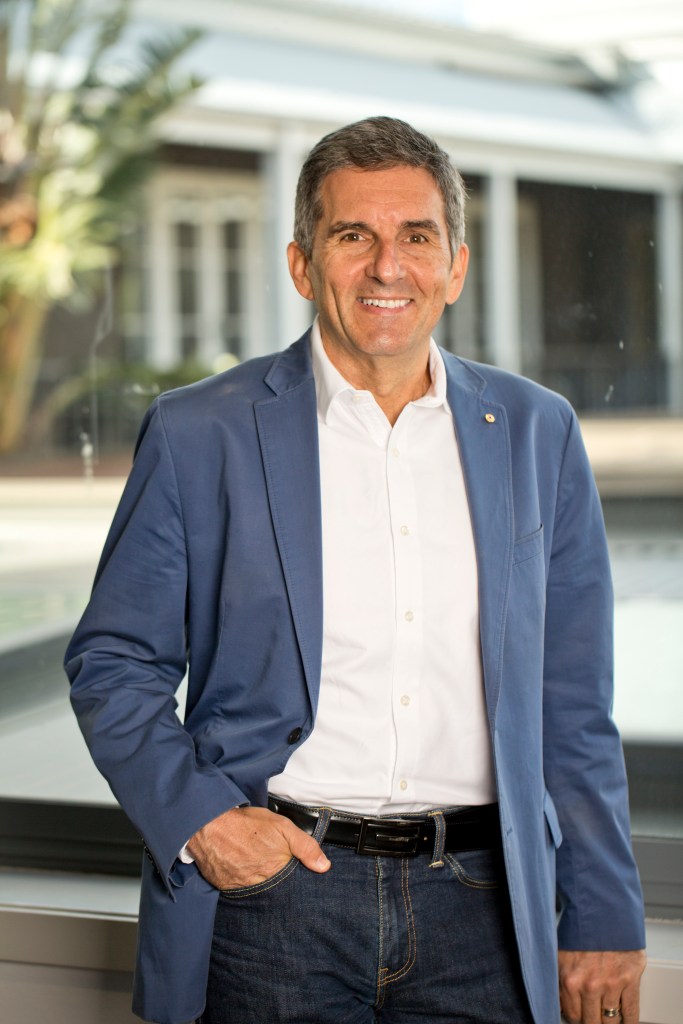
Daniel Petre has problems with the Labor Government’s proposed changes to capital gains taxation, but says the incessant uproar on social media won’t resolve anything.

Airtree co-founder Daniel Petre has written several submissions to Treasury outlining ways to improve its proposed changes to capital gains taxation. He wishes more of his industry colleagues would follow his lead by engaging with the Government over its Budget 2026 policies instead of counterproductive “ranting” on LinkedIn.
“Shut up and put a submission into Treasury, because they’re looking for submissions on how to fix this,” Petre told Forbes Australia. “It’s not helpful that you’re ranting away on LinkedIn on the basis of something that they’ve already said they’re going to consult with people in the startup community about.”
Treasurer Jim Chalmers’ budget handed down earlier this month proposes ending the 50% capital gains tax discount, replacing it with an inflation-indexed model where only gains above CPI are taxed. Capital gains taxation will have a floor of 30 per cent under the new system, above the existing bottom of 23.5 per cent, and a ceiling of 47 per cent.
The prospect of doubled capital gains tax has alarmed startup founders, who rely on equity as a recruitment tool to compete with more established companies. Because startup equity is issued at a cost base of almost zero, a higher capital gains tax would hit particularly hard.
In the wake of the budget, founders were quick to embrace a new meme format: announcing Anthony Albanese as their company’s newest co-founder, 47 per cent equity in hand. Petre calls it an overreaction.
“I’ve had arguments with a lot of my colleagues who say ’47 per cent is locked in,'” Petre said. “No it’s f***ing not, you’re extrapolating. They’ve said they’re going to consult, so no one has ever said that the full 47 per cent will hit startup founders, quite the opposite, and yet the industry has rushed off to vent.”
Chalmers told ABC Insiders last week that he has “already begun” working through potential amendments with the tech sector.
Petre stepped down as an Airtree partner in 2021 and is now Founder Emeritus. The firm, alongside Blackbird and Square Peg, is one of the foundational pillars of Australia’s venture capital ecosystem. His comments are at odds with his Airtree co-founder Craig Blair, who said doubling the capital gains tax would remove over $8.6 billion in productive money from the “engine room” of Australia’s economy and “slow or stop” the startup flywheel.
“We see a place for contributing data, nuance and reasoned argument to this discussion,” an Airtree spokesperson said to Forbes Australia. “Public discourse and formal submissions aren’t competing channels and we’re actively leaning into both.”
Petre, who became an investor after spending years in the early ’90s as a director at Microsoft and who is now a board member of the National Reconstruction Fund, says founders and early-stage employees should retain the 50% capital gains discount. Once a startup hits a certain size, however, that concession should no longer apply for incoming staff.
His rationale is that founders endure low pay and high risk for years before making any profit, and so earn the existing capital gains discount. It’s similar for early-stage employees, who are often remunerated under the market rate in perilous employment conditions. What a carve-out should not cover, Petre says, are employees who join startups like Airwallex and Canva who are big enough that “the risk is gone.”
You’ve joined late into a scaled startup, valued at over a billion dollars, and you expect a break on your shares? Why? You’re not taking risk… You’re not being paid under market salary, you’ve got great benefits… what’s the actual rationale argument?
Daniel Petre
Co-founder of AirTree
Petre’s suggestion that startups should get a carve-out only up until a certain size is contrary to what many in the sector have argued. Q-CTRL founder Michael Biercuk told Forbes Australia his recommendation to Independent MP Allegra Spender, who had a roundtable with founders on Monday, was to not provide a concession cap based on revenue or valuation.
“We want to make sure that businesses that start small grow to things that are big,” he said. “We don’t want the incentives to stop when a company succeeds.”
The budget preserves and expands the Early Stage Venture Capital Limited Partnership (ESVCLP) tax, which gives VCs tax-free returns on early-stage bets. Petre argues the ESVCLP should be protected. When asked if it was self-serving to call for tax concessions for investors, Petre argued the data backed him up.
“There’s very clear data to show that the investors came into the sector because of those tax breaks, and that’s very clear. This is not hyperbole.”
Want to see more Forbes articles on your feed? Tap here to make Forbes Australia a preferred source on Google.
Look back on the week that was with hand-picked articles from Australia and around the world. Sign up to the Forbes Australia newsletter here or become a member here.