Since his 2009 death, the King of Pop’s estate has accumulated hundreds of millions of dollars in cash. His daughter Paris Jackson is trying to access $600 million.

Back in 2021, federal tax court judge Mark Holmes was tasked with deciding how much Michael Jackson’s major assets were worth at the time of his death in 2009. The Internal Revenue Service estimated his name, image and likeness, and his ownership of significant music assets were worth just under $500 million, while Jackson’s estate argued that a mountain of debt and reputational damage from the accusations of child molestation had reduced their taxable value to around $5 million.
In his ruling, Holmes settled on a value of around $110 million, and predicted that Jackson’s earning power would fade in the years to come. “Popular culture always moves on,” Holmes wrote. “And just as the grave will swallow Jackson’s fame, time will erode the estate’s income…The value of what it has left, no matter how well managed, will now dwindle as Jackson’s copyrights expire and his image and likeness shuffle first into irrelevance and then into the public domain.”
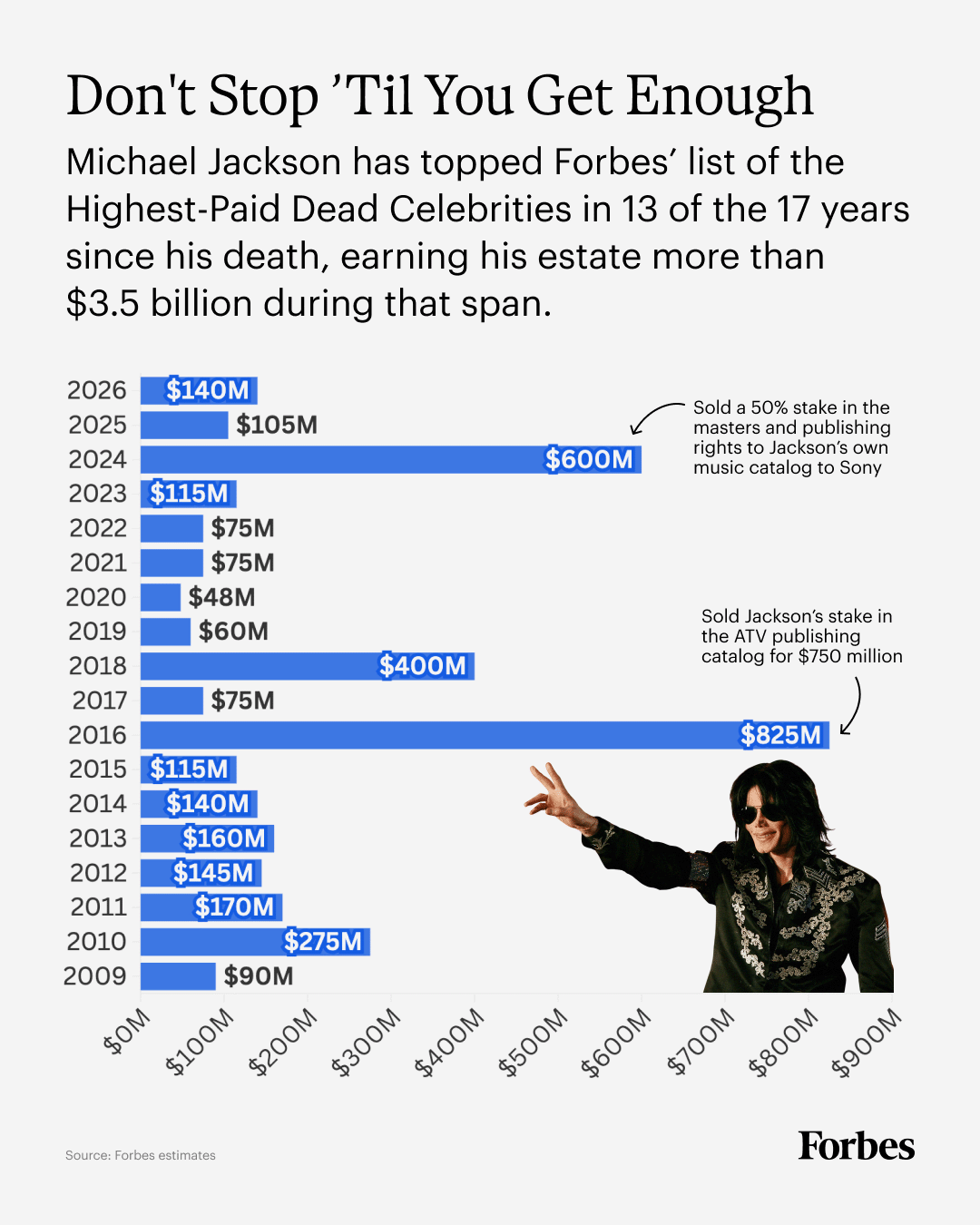
The judge has been proven wrong on both counts. More than 17 years after The King of Pop’s death, he remains one of the most popular music artists on the planet, and his business is worth more than ever. Forbes estimates the estate, presiding over a flywheel of enterprises that generated $140 million over the past 12 months including his music, multiple live shows and a Hollywood biopic, is now worth more than $2 billion. If he were still alive today, he’d be the second richest musician in the world behind Jay-Z but ahead of Taylor Swift and Paul McCartney. Of course, it was his premature death that prompted a rebound in his public perception, and ended his extravagant spending, kickstarting the transformation from financial ruin to entertainment empire.
Despite that success, Paris Jackson—one of Jackson’s three children who are set to inherit that fortune (along with his mother Katherine, and 20% reserved for charity)—says the estate has not distributed almost any of the assets into the family’s trust. She filed a petition in early November asking a Los Angeles judge to force a $600 million partial distribution of the assets to her and her brothers, claiming that estate executor John Branca is slowplaying the probate process in order to maximize his own control. According to Paris’ petition, estate records now show $850 million in cash reserves, enough to pay a portion to the trust and cover outstanding balances.
“Vast estates that have complex assets or that are involved in litigation may stretch well beyond the standard one to two years [of probate],” says Roee Kaufman, a partner at Keystone Law Group specializing in probate—the legal process by which estates validate a will, settle debts and distribute assets. When Prince died in 2016 with no will and a large tax bill, for instance, his estate took six years to move through the system. “But even by that measure,” Kaufman says, “17 years is still an extraordinarily long time.”
Branca, an entertainment lawyer at Ziffren Brittenham who has represented everyone from Bob Dylan to the Beatles, is the only remaining estate executor named in Jackson’s will, after co-executor John McClain passed away in May. (McClain went to high school with Jermain Jackson and helped establish Janet Jackson as a star). Branca has managed the assets in a more active way than the typical executor, and insists he must keep the assets in probate as long as there is outstanding debt and litigation. Jackson died with nearly $500 million in debt obligations in 2009, and still has an outstanding tax bill with the IRS, which is entitled to 20% of the estate at the time of his death, or $22 million based on Holmes’ ruling five years ago (the projected tax bill was once as much as $700 million). It has yet to be settled.
“Ms. Jackson’s counsel is well aware that the estate is prevented from fully funding the philanthropic giving and individual trusts for the beneficiaries until several legal hurdles have been removed, including in particular the ongoing IRS litigation,” a spokesperson for the estate tells Forbes in a statement. “The claim that the executor has withheld or ‘cut” payments is a complete fabrication.”
This petition is one of several Paris and her legal team have filed over the past two years demanding more transparency in the accounting and challenging Branca’s leadership, with mixed results. She won a ruling last June to claw back $625,000 in bonuses paid to third-party law firms that were deemed excessive, but was not successful in a proposal to add a new executor to the estate, seen by the estate’s side as a shameless attempt at a power grab.
Statements have been issued and refuted in both directions since, including $200 million the estate claims it has already distributed to the beneficiaries, $70 million of which has gone to Paris directly (which her team denies), and $109 million in compensation Paris says the executors and their firms filed for 2023 and 2024 combined (which they say is overstated).
“No rhetoric can hide the fact that Mr. Branca has used estate funds to create a lavish lifestyle complete with charging personal trips on private jets to the estate. This wasteful spending and financial mismanagement flies in the face of his fiduciary duty to the beneficiaries and has gone unchecked for too long,” a spokesperson for Paris told Forbes. “Paris called for the trust to be partially funded, something Mr. Branca had the ability and obligation to do long ago. After years of delay, Paris had no choice but to step in herself.”
In legal filings, Branca has rebuffed her claims of his “persistent incompetence” by pointing to his track record. Since taking the reins in 2009, he and McClain have overseen the sale of some of Jackson’s most valuable assets, including the ATV song catalog to Sony in 2016 for $750 million and half of Jackson’s own masters and publishing rights for $600 million in 2024, and also built up new business lines, generating more than $3.5 billion in total, according to Forbes estimates. Jackson has topped Forbes’ list of the highest-paid dead celebrities in the world 13 of the last 17 years.
Some of that money has been used to settle debts, interest on that debt, taxes and near-constant legal challenges relating to Jackson’s child molestation accusers, including recently by the siblings of Jackson assistant Frank Cascio, whose case was ordered to private arbitration in August.
The Michael biopic, on which Branca and McClain were producers, exemplifies the entire dispute in microcosm. The $1 billion the movie earned at the global box office—the most ever by a musician biopic—could prove either Branca’s brilliance or Jackson’s enduring bankability in spite of him, depending on which side you’re on.
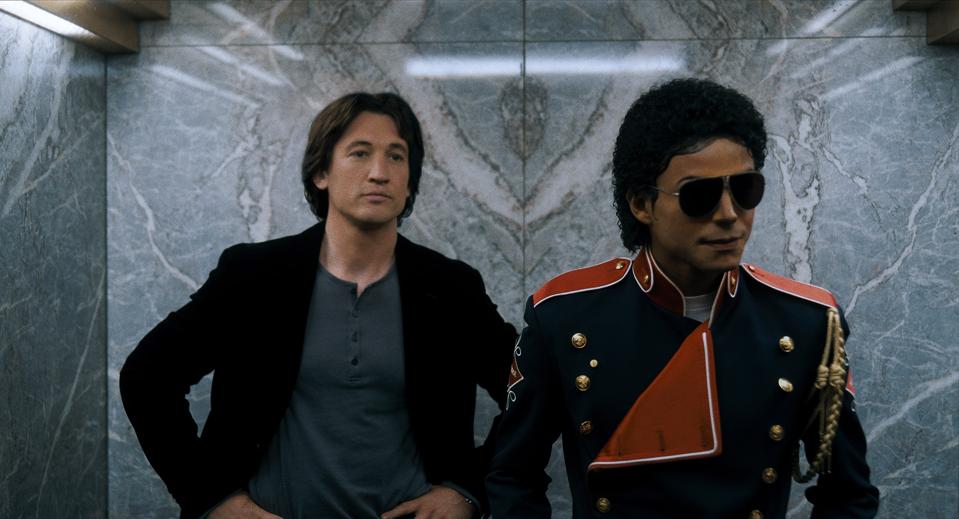
Critics of the estate can point to the almost catastrophic mistake the producers made, discovering after principal photography had concluded that a 1994 settlement with one of Jackson’s accusers agreed to never dramatize their story on screen, which rendered major portions of the footage completely unusable and delayed its release by more than a year. But the estate’s risky plan to salvage the movie by funding an estimated $25 million in additional production (or more) and splitting it into two parts, could end up producing not one but two global blockbusters. The sequel will go into production in late 2026 or early 2027, targeting a late 2027 release.
Paris’ legal team has framed Branca’s involvement in the movie as a desire to fulfill some Hollywood aspirations (he is portrayed in Michael by movie star Miles Teller), saying his compensation tied to entertainment-specific income incentivizes risky bets on projects like the movie. But the estate points out that a global blockbuster is the ultimate marketing tool for Jackson’s business portfolio.
According to data provider Luminate, streaming and physical sales of Jackson’s music added up to 4.6 million album equivalent units in the past year, more than all but three artists Forbes tracked in 2025 (Taylor Swift, Drake and Kendrick Lamar). Ticket sales increased for both the Jackson-themed Cirque Du Soleil show in Las Vegas and MJ The Musical on Broadway, which has spawned several productions around the world. The productions generate millions in cash each year and increase the value of Jackson’s underlying IP.
Putting valuations on those ventures can be tricky, because there’s no way to know how many years the stage shows might run, or how long a popularity bump could last on the portion of Jackson’s masters and publishing rights the estate still owns (it sold half to Sony in 2024 for $600 million). For the foreseeable future, there’s little reason to expect Jackson’s estate won’t continue earning more than $100 million per year across the portfolio.
For now, the estate continues to control an enormous and ever-growing cash pile, which generates an estimated $40 million per year in investment income. After the tax dispute settles and the probate case closes, Jackson’s will dictates that wealth will be distributed to the family trust, and accessed by the children in three chunks, at ages 30, 35 and 40. The children are currently 29 (Prince), 28 (Paris) and 24 (Bigi).
The will installed Branca as not only the executor of the estate, but also its trustee, meaning he will continue to manage the ongoing businesses and oversee distributions even after probate is over. He and his law firm will continue collecting management fees and, if anything, operate with far less transparency or judicial oversight. For any disgruntled family members, proving a failure of his fiduciary duties at that point could prove even more difficult, given how much the estate has grown.
“If he’s going to be controlling the assets whether they’re in the probate estate or the trust, I don’t see much motivation to hoard the assets,” says Kaufman. “He’s going to get paid for his time and his services one way or the other. And the kids are going to receive generational wealth.”
Want to see more Forbes articles on your feed? Tap here to make Forbes Australia a preferred source on Google.
Look back on the week that was with hand-picked articles from Australia and around the world. Sign up to the Forbes Australia newsletter here or become a member here.