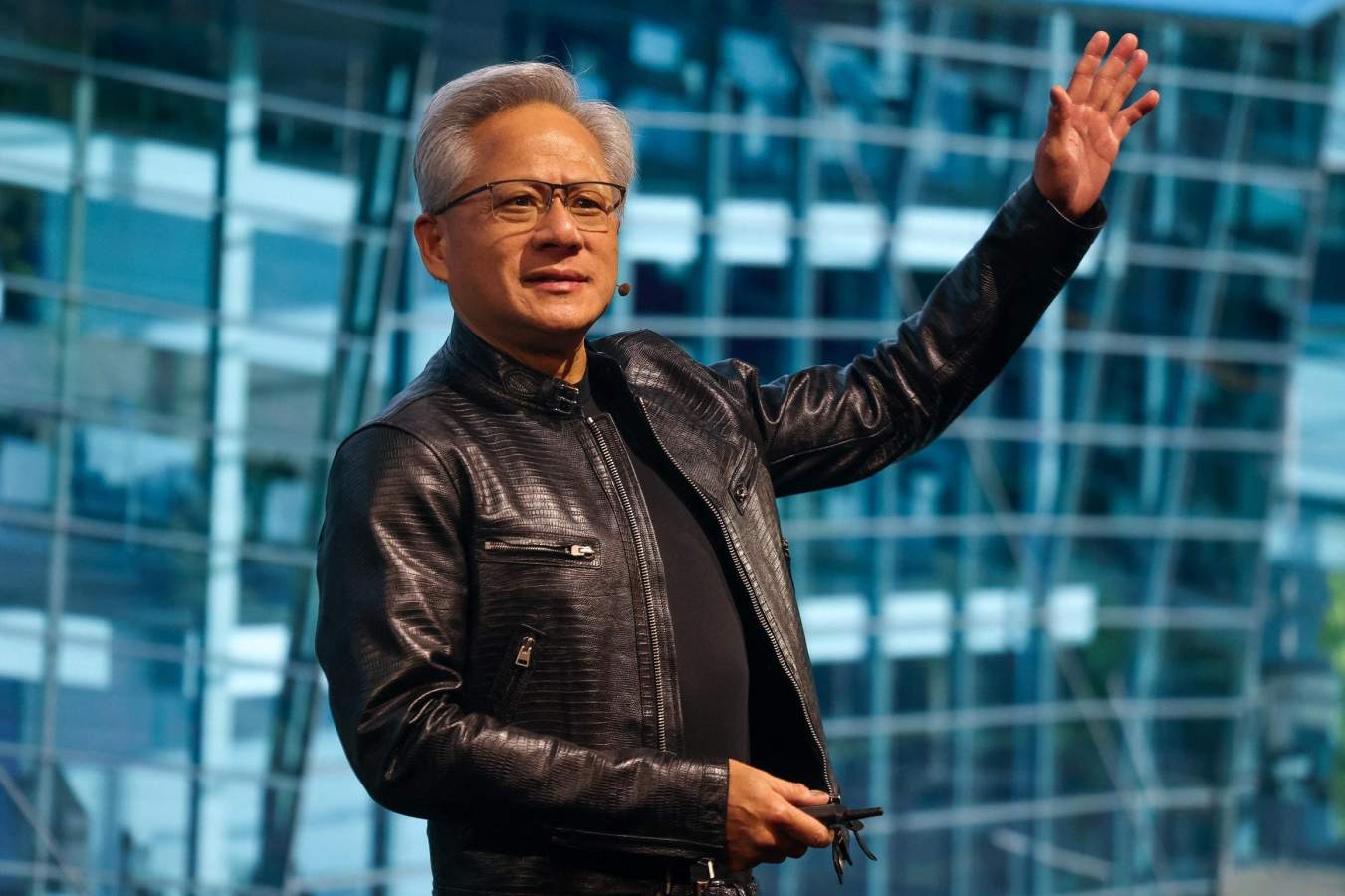
Nvidia reported $115.8 billion (A$171.9 billion) in quarterly revenue in its first earnings report since co-founder and CEO Jensen Huang’s abrupt resignation last week, beating investor expectations as the company navigates a leadership crisis, national security scrutiny and mounting questions about its ties to China on top of broader AI spending concerns.
Key Facts
The figure beat analysts’ $109.1 billion (A$162 billion) prediction and the $108 billion (A$160.4 billion), plus or minus 2%, it forecasted back in August.
Earnings per diluted share came in at $2.68 (A$3.98), above analysts’ $2.47 (A$3.67) prediction.
Its data centre business, by far its largest source of revenue, generated $107.6 billion (A$159.8 billion), with $60.1 billion (A$89.2 billion) attributable to hyperscale and $47.5 (A$70.53) attributable to billion AI clouds, industrial and enterprise.
The company is forecasting fourth-quarter revenue of $130 billion (A$193 billion), plus or minus 3%.
Shares closed the day down 0.4% at $155.46 (A$231) after a brutal stretch for the stock, and rose around 2% after-hours following the report’s release.
The results marked Nvidia’s first earnings report since its board announced Huang’s resignation on Thursday, with chief financial officer and interim CEO Collete Kress set to lead her first earnings call at 5 p.m. EST as investors seek information not only on revenue guidance but also the company’s succession plan.
Investors will also be looking for reassurance about the strength of Nvidia’s future business in China as the US works to close a loophole that allowed for chip smuggling, with the board announcing a new committee Tuesday that will oversee national security policies and export-control.
Key Background
Nvidia’s earnings come at a tumultuous time not just for Nvidia, but the broader AI industry, which faced a rough October as a series of disappointing earnings heightened investor fears about massive capital expenditures.
Nvidia hit a $5.7 trillion (A$8.5 trillion) market capitalisation early in the month, with analysts predicting before November it would become the first company to hit a $6 trillion (A$8.9 trillion) market cap, but instead shares fell with the broader AI selloff.
Democrats taking the House and Senate in the midterms worsened fears about the future of data centres, triggering a multi-day selloff. The majority of AI-linked stocks began recovering last week, with the exception of Nvidia, which fell dramatically after Huang disclosed to his staff on Nov. 8 he had been “unfaithful,” following a report he had an affair with an alleged Chinese spy.
The board launched an independent investigation, and new reporting came out on Wednesday about a second affair he had with an executive at Nvidia. The board announced his resignation as president, CEO and board member on Thursday morning.
The stock, which had started to recover on Wednesday thanks to CoreWeave’s strong earnings, fell on Thursday, Friday and again on Monday and Tuesday. Nvidia beat investor expectations last quarter, reporting revenue at $96.2 billion (A$142.8 billion), up 106% from $46.7 billion (A$69.3 billion) a year earlier, with net income at $59.7 billion (A$88.6 billion), earnings per share at $2.22 (A$3.30) and data centre revenue at $89 billion (A$132.1 billion).
It has grown massively with the AI boom since its founding in 1993 – generating $27 billion (A$40.1 billion) in revenue in fiscal year 2023 compared to $215.9 billion (A$320.6 billion) in fiscal year 2026 – as its graphics processing unit, initially designed for video games, became the foundational hardware for running models.
Tangent
Since Thursday’s resignation announcement, a report came out about an alleged third affair with another Nvidia employee, and the Commerce Department announced its closing a loophole that granted China access to chips.
On Tuesday, the board announced it is forming a “National Security and Export Control Oversight Committee” to oversee national security policies, export control compliance and global trade risk management.
Huang also agreed to testify before Congress on Dec. 1, and Nvidia general counsel Tim Teter agreed to do so as well on Dec. 2. The scandal first began when The New York Times reported on Huang’s connection to Alice Huang, the former tech executive who US intelligence suspects is a Chinese spy, at the end of October.
She worked for Megaspeed, which partners with Nvidia and supplies its technology in the Asia-Pacific region. The company has been the subject of US investigations into China’s access to Nvidia’s chips, which began in 2024 when an official found equipment still in boxes at a data centre site in Malaysia, suggesting it could be getting shipped out.
Lawmakers from both parties are now calling for tighter export restrictions and seeking information from Nvidia on smuggling and Huang’s connection to Alice Huang.
What We Don’t Know
If Huang will return to Nvidia as CEO. He released a statement on Tuesday saying he’d be “honored” to return if the board decides it’s “in the best interest of our shareholders, our employees, the company, and America.”
He noted an “outpouring of calls from Nvidia’s employees, investors, business partners, and customers for me to return as CEO” – among those who have defended Huang and signalled wanting him to return are President Donald Trump and Elon Musk.
A high-level Nvidia employee also circulated a letter calling for him to come back as CEO. But the Wall Street Journal reported on Monday that Nvidia’s board isn’t considering reinstating him. Huang, who had led Nvidia since its founding in 1993, has become what many consider to be the face of the AI boom.
Forbes Valuation
Huang ended the trading day with an estimated net worth of $134.2 billion (A$199.3 billion), down $2 billion (A$3 billion) for the day. He lost 16% of his wealth in the six trading sessions after he disclosed the affair to his staff and the board announced an investigation.
He owns around 3.5% of the company, so a tumultuous week for the stock hit his net worth substantially. Kress has an estimated net worth of $900 million (A$1,336 million), having lost $300 million (A$445.4 million) in the wake of the scandal, pushing her out of billionaire status, according to Forbes calculations.
What to Watch for
Nvidia’s earnings are critical for the broader AI industry, serving as a key indicator of infrastructure investment and overall investor sentiment. Anthropic’s highly anticipated initial public offering will be another major test of the AI boom.
It is expected to price its IPO on Wednesday and start trading on Thursday. CNBC has reported Anthropic is expected to price its IPO above the $70 to $78 (A$104-116) range.
Want to see more Forbes articles on your feed? Tap here to make Forbes Australia a preferred source on Google.
Look back on the week that was with hand-picked articles from Australia and around the world. Sign up to the Forbes Australia newsletter here or become a member here.