The Wildlife Photographer of the Year 2026 competition has issued a sneak peek of wonderful photographs from this year’s record-breaking 65,000 entries from 121 countries and territories.
This release kickstarts the 62nd year of the leading wildlife photography competition by the Natural History Museum, which selects 100 winning images for 2026.
The full set, showing the wonder of our planet through the eyes of some of the world’s most talented photographers, will be showcased in an exhibition at the Museum in London that starts on October 16 and runs until July 11, 2027.
Wildlife Photographer of the Year is developed and produced by the Natural History Museum, London.
The exhibition will spotlight inspiring and powerful images of our natural world that were judged anonymously on their creativity, originality, technical excellence and the powerful stories they tell, by an international panel of expert judges across wildlife photography, filmmaking, science and conservation.
Inspiring And Powerful Images of Wildlife
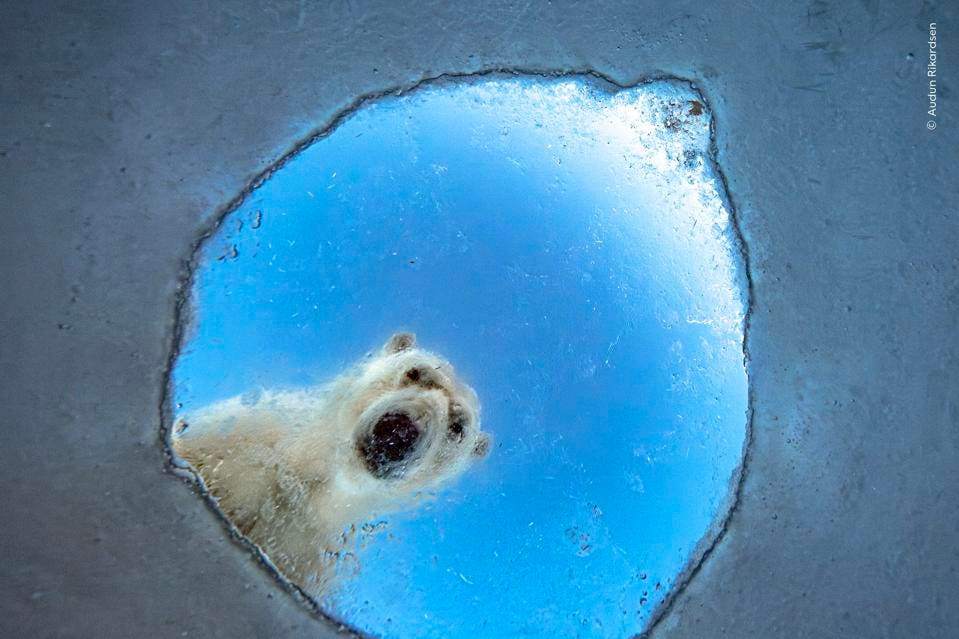
The newly-released images include an inquisitive polar bear gazing down a seal’s breathing hole in the Arctic sea ice by photographer Audun Rikardsen and the beautifully intertwined lives of a rhino and an oxpecker by Ernest Porter showing the bird as it cleans its bill against the rhino’s skin in the soft afternoon light.
Others of the released wildlife images include young photographer Jack Crockford’s swift silhouetted against an incoming plane to London’s Heathrow Airport and Allegra Hutton’s shot of a young leopard chasing a squirrel up a tree in Botswana’s Okavango Delta.
Wildlife Photographer of the Year Winners
The category winners and the prestigious Grand Title and Young Grand Title awards will be announced on October 13 at a ceremony hosted at the Natural History Museum.
“Every year I think the entries to our competition can’t get any stronger – and every year I am proven wrong!” said Kathy Moran, chair of the Wildlife Photographer of the Year Jury. “Selected from a record-breaking 65,403 images, this preview presents just a small insight into the 100 incredible images in store for visitors to our exhibition in October. These images pave the way for a deepened appreciation and commitment to our natural world.”
The exhibition will also embark on a U.K. and international tour to inspire people to appreciate and conserve the natural world.
“At a time when nature is under more pressure than ever before, these photographs remind us of both what is at stake and what is worth protecting,” said Doug Gurr, Director of the Natural History Museum. “It will be impossible to leave without feeling a renewed sense of wonder for our incredible planet.”
The next competition opens for entries at 11.30am GMT on October 19, 2026, and closes at 11.30am GMT on December 3, 2026.
Mutual Friends
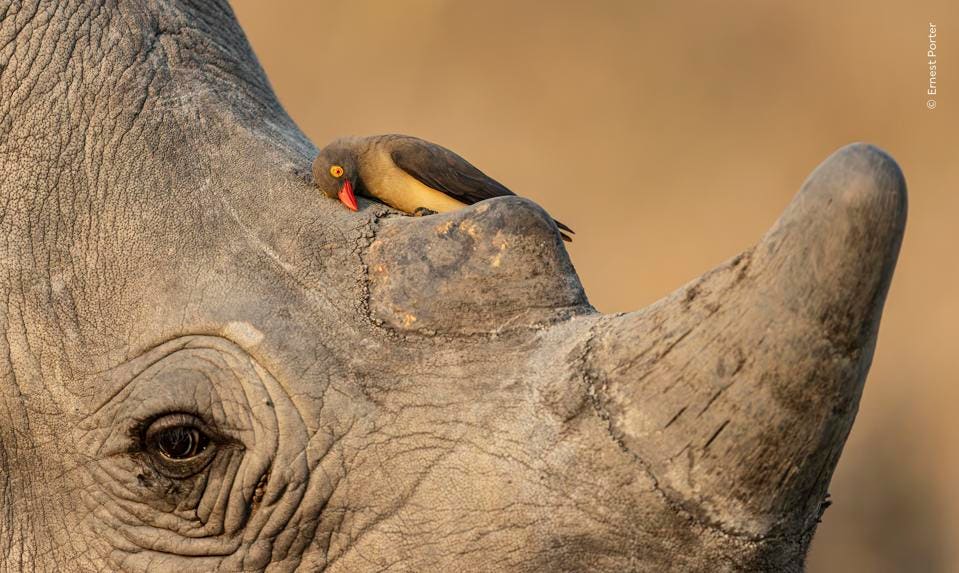
Photographer: Ernest Porter (South Africa)
Category: Highly Commended, Behaviour: Birds
Location: Manyeleti Game Reserve, Mpumalanga, South Africa
A red-billed oxpecker cleans its bill against a rhino’s skin in the soft afternoon light after feeding on the insects that infests its skin. In Swahili, the bird is called askari wa kifaru — ‘the rhino’s guard’. Oxpeckers act as sentinels, calling out to alert their hosts to the approach of other dangerous animals.
Icy Window
Photographer: Audun Rikardsen (Norway)
Category: Highly Commended, Animal Portraits
Location: Arctic sea ice north of Svalbard, Norway
When Audun spotted polar bear tracks close to a seal hole, he drilled an adjacent hole for his underwater camera and connected it to a motion sensor on the ice above. After eight hours, the polar bear approached and looked down.
With a diet largely dependent on seals, polar bears spend much of their time searching for breathing holes and waiting for prey to surface. In areas where sea ice melts completely each summer, they are forced to spend several months on land, surviving on their stored fat reserves.
Up a Tree without a Squirrel
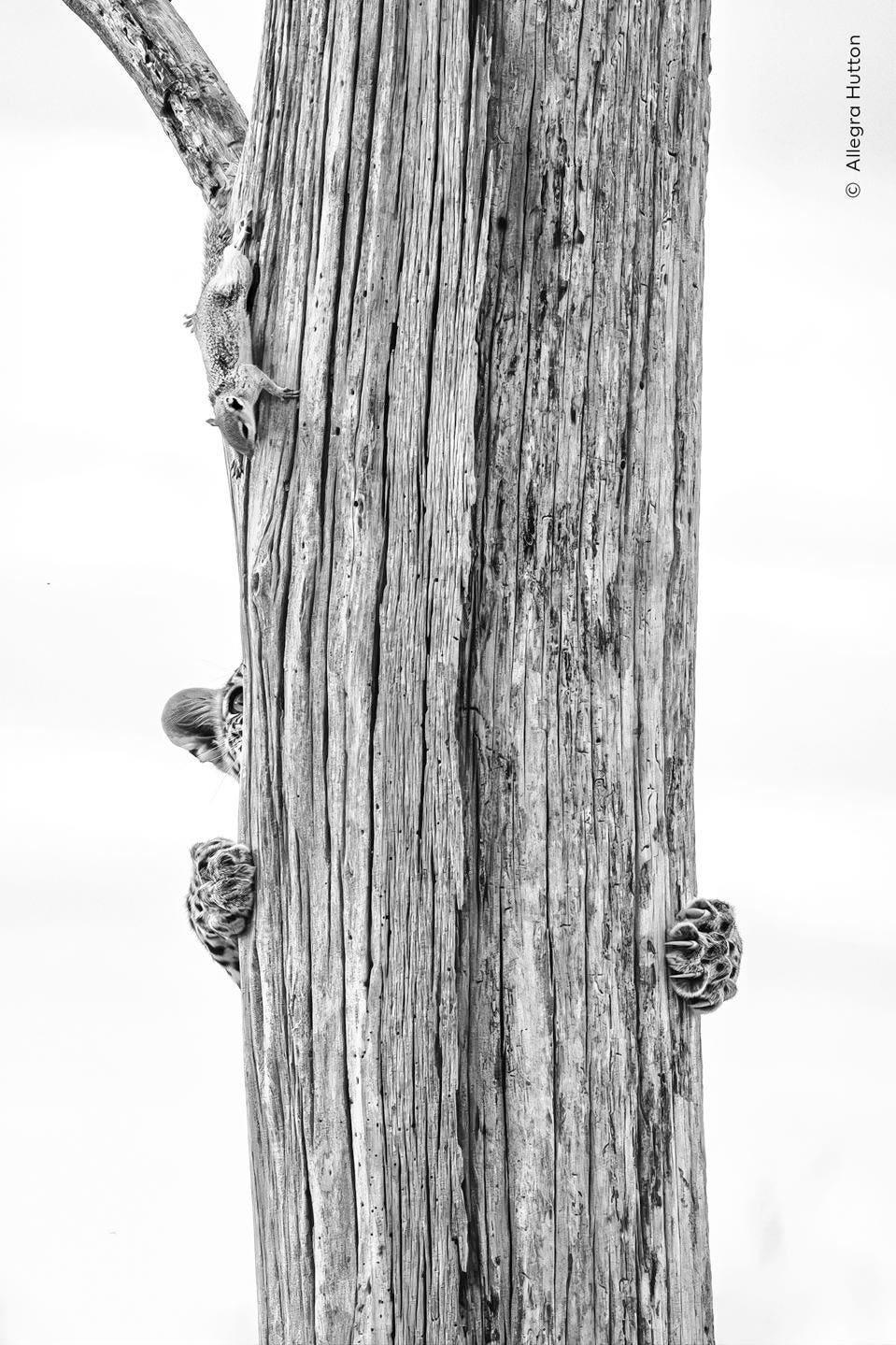
Photographer: Allegra Hutton (USA)
Category: Highly Commended, Behaviour: Mammals
Location: Okavango Delta, Botswana
Allegra had already watched this leopard try – and fail – to stalk a rabbit. The squirrel also avoided the leopard’s clumsy maneuvers, eventually ascending too high for the leopard to follow. By then, the cat could barely hang on. An awkward backward retreat ensued.
The world is a dangerous place for young leopards. Fewer than half of cubs survive to independence. Many are killed by male leopards or fall prey to lions and other predators.
Biting Back
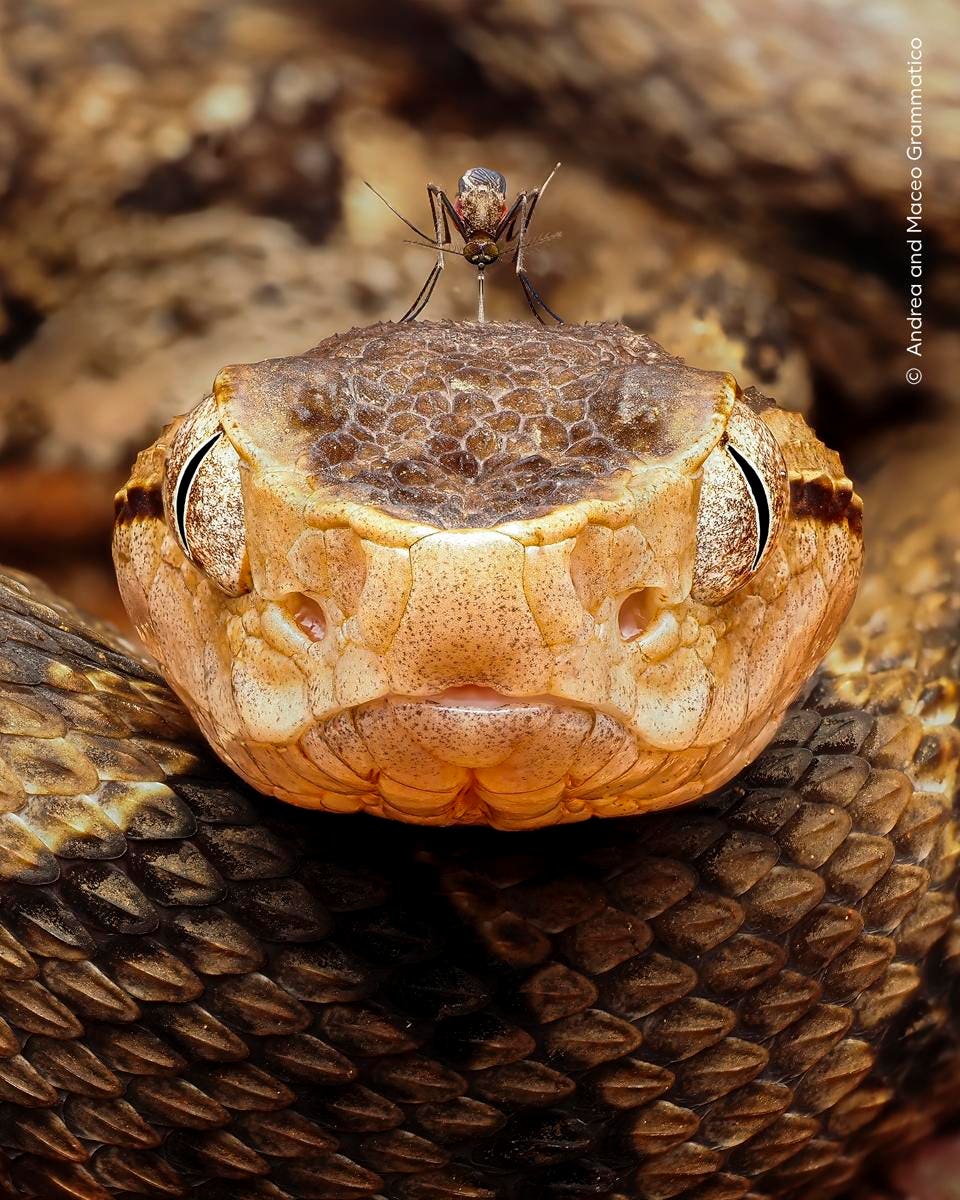
Photographer: Andrea & Maceo Grammatico (France)
Category: Highly Commended, Animal Portraits
Location: Sierpe, South Puntarenas, Costa Rica
Twins Andrea and Maceo describe this image as “one of the most demanding focus stacks we’ve ever created.” It required immense concentration and care. It wasn’t until they reviewed their photographs that they noticed the mosquito on the snake’s head.
The fer-de-lance is a highly venomous viper, responsible for the greatest number of fatal snake bites in Central America. The snake’s effective camouflage and adaptability in plantation habitats occasionally surprises unsuspecting workers.
Hidden Dragon
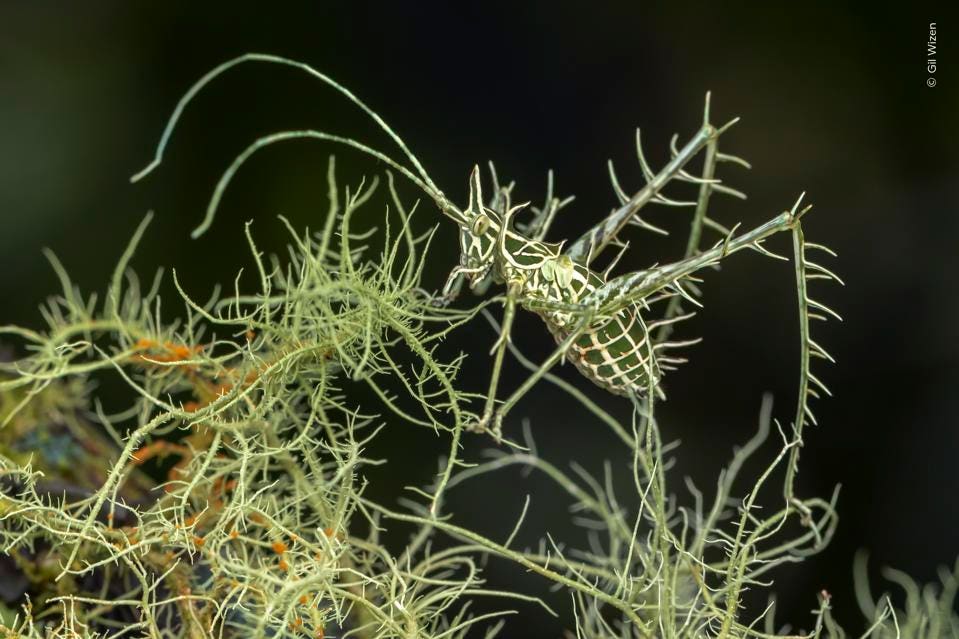
Photographer: Gil Wizen (Israel/Canada)
Category: Highly Commended, Behaviour: Invertebrates
Location: Wildsumaco Biological Station, Napo Province, Ecuador
At only 15 millimetres (3/5 of an inch) long, this little lichen dragon katydid was not easy to find. Luckily, Gil was able to spot it when it moved slightly, though distinguishing between the katydid and the lichen in the camera’s viewfinder made it challenging to photograph.
Found only in the Ecuadorean Andes, Lichenodraculus matti, or ‘Matt’s little lichen dragon’, takes part of its scientific name from its discoverer. ‘Dragon’ alludes to the spiny armour that protects it against eagle-eyed predators that see through its disguise.
The Art of Flying
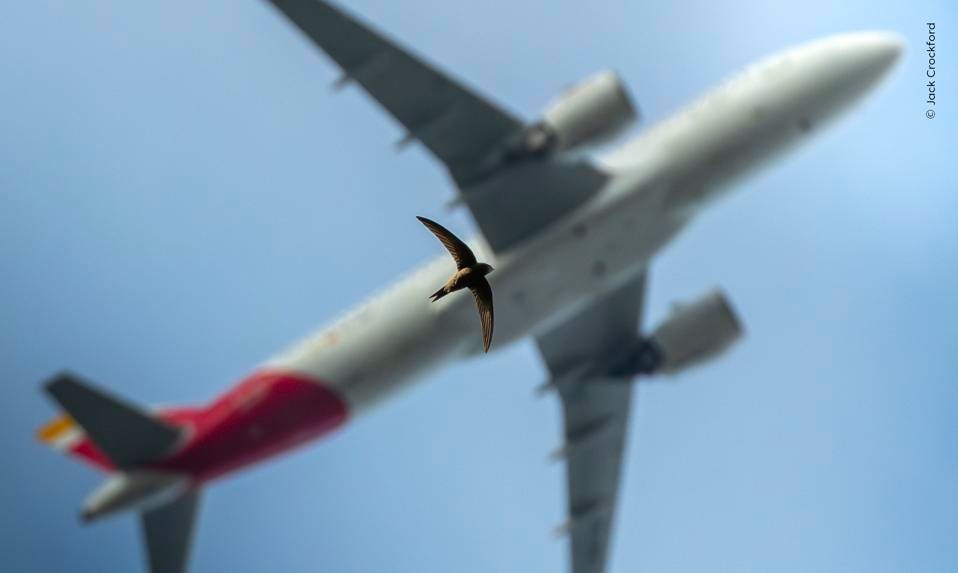
Photographer: Jack Crockford (UK)
Category: Highly Commended, 15-17 Years
Location: London, England, UK
Jack observed swifts flying overhead, completing their yearly migration back to London and filling the air with their piercing, high-pitched calls. Most were flying too high to photograph, but occasional low-flyers allowed Jack to get the composition he’d been hoping for.
Swifts’ physical characteristics allow them to migrate from equatorial and southern Africa to breeding grounds in northern Europe. Their long, scythe-shaped wings enable exceptional speed and maneuverability. Living almost their entire lives in the air, they usually land only to breed.
Wings of Darkness
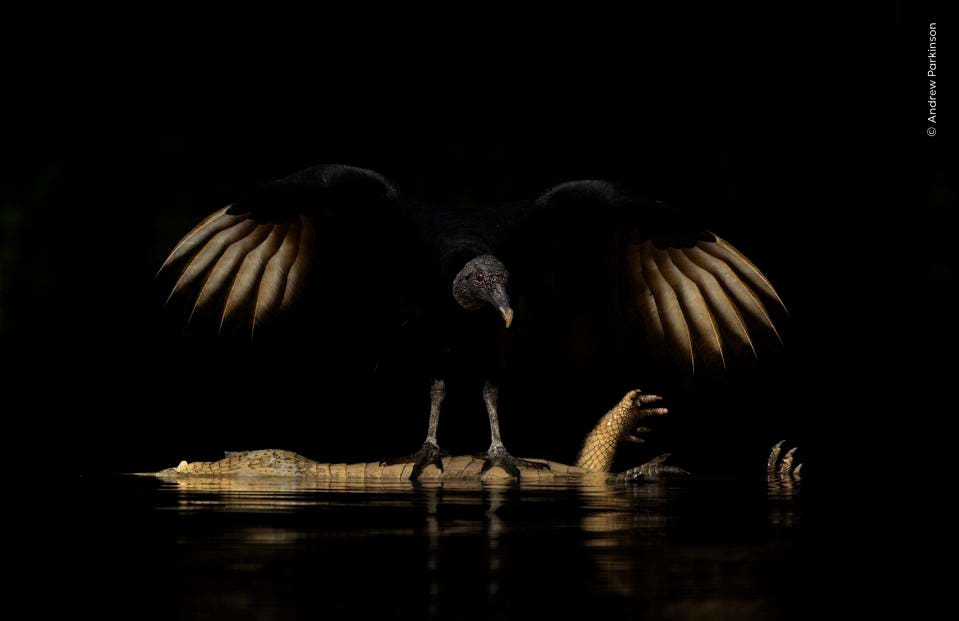
Photographer: Andrew Parkinson (UK)
Category: Highly Commended, Animal Portraits
Location: Meeting of the Waters State Park, Northern Pantanal, Brazil
When Andrew spotted this vulture, it was too good an opportunity to miss. He kept his boat back and used a long telephoto lens to frame what he saw as “the menacing nature” of the vulture. Out of frame, a jaguar was waiting to retrieve the caiman from the water.
After the vulture flew away, the jaguar claimed its prize. It was then that Andrew noticed “a suspiciously clean, straight wound” on the back of the caiman’s head, possibly caused by a blow from a speeding boat.
Flock of Gold
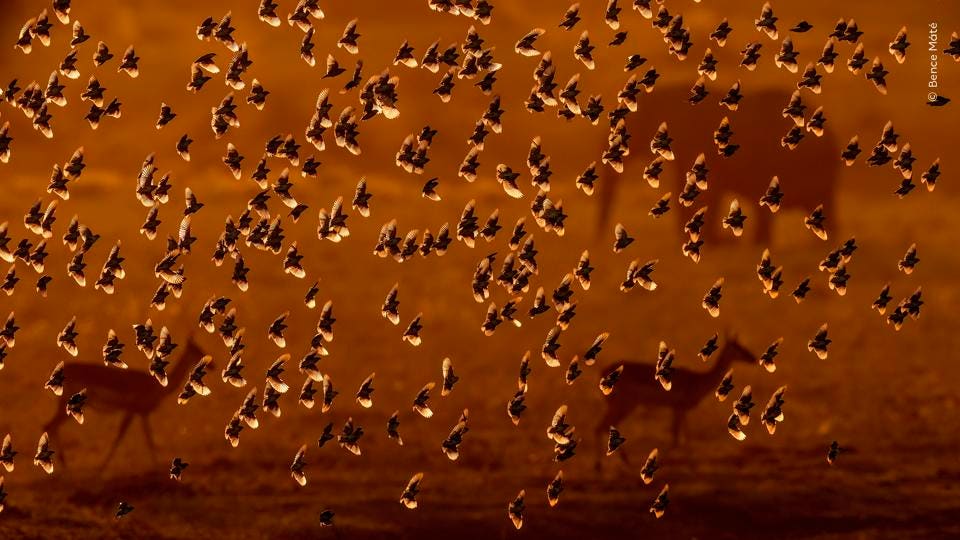
Photographer: Bence Máté (Hungary)
Category: Highly Commended, Behaviour: Birds
Location: Ashnil Aruba Lodge, Tsavo East National Park, Kenya
For Bence, watching in the golden light of a late afternoon, the sight of this swirling mass was breathtaking: “You could feel the rush of air from tens of thousands of wings beating in unison, even from 30 meters (98 feet) away.”
Red-billed queleas are found in almost every part of central, eastern and southern Africa apart from tropical forests. They gather in groups as large as two million, and the global adult breeding population is estimated to number 1.5 billion, making them the most abundant wild bird on Earth.
Eye of the Storm
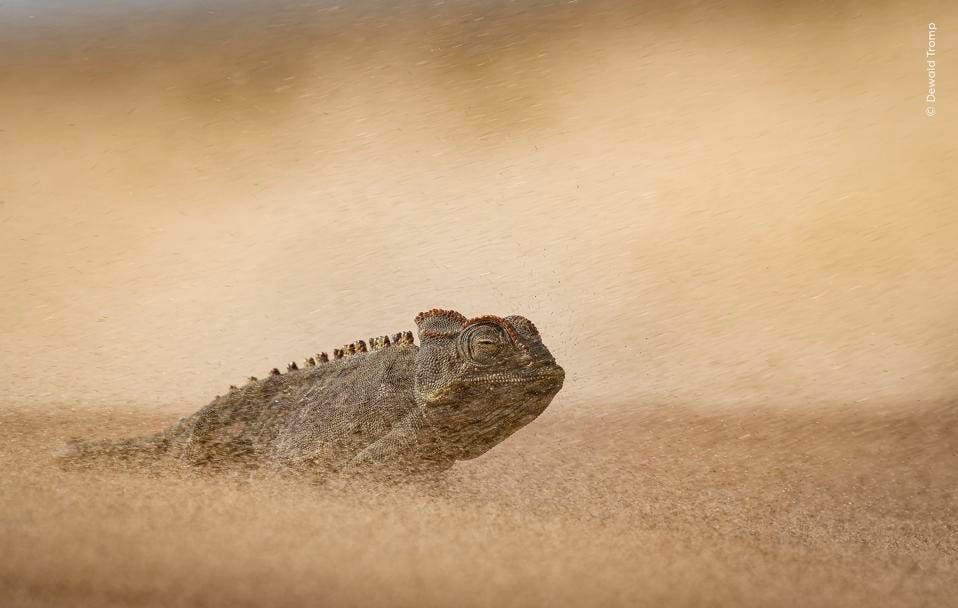
Photographer: Dewald Tromp (South Africa)
Category: Highly Commended, Animals in their Environment
Location: Namib Desert, near Swakopmund, Namibia
The wind picked up as Dewald was photographing this Namaqua chameleon weathering the sudden storm. Soon it became difficult to breathe and “in a matter of seconds, you could hardly see the person next to you,” Dewald recalls.
The Namib desert is one of the most extreme environments on earth, with a total lack of surface water and temperatures exceeding 113°F in the daytime.
Despite this, life is abundant if one knows where to look.
Sandstorms are frequent, with wind blowing down from inland mountains that stirs up fine sediment and particles. A Namaqua chameleon has to endure the sting of pebbles blowing against its skin. They are insectivorous desert specialists, harvesting moisture from the air directly.
Droplets that collect on their skin as dew are channelled to their mouths via microscopic surface grooves. They also use their tongues to collect fog water condensed on vegetation, sand and rocks.
Pooltime Pastime
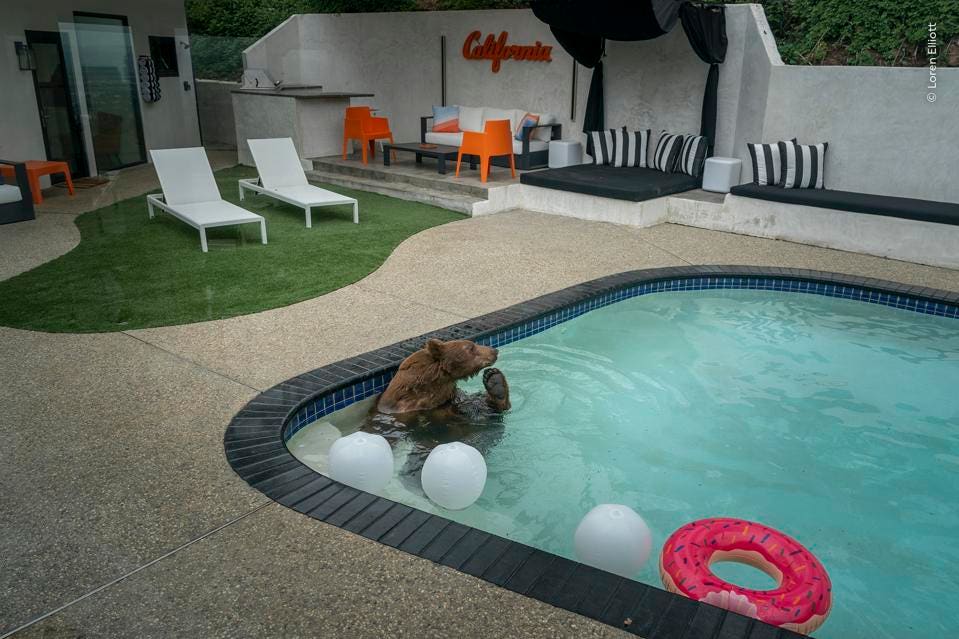
Photographer: Loren Elliott (USA)
Category: Highly Commended, Urban Wildlife
Location: Monrovia, California, USA
Loren spent many hours watching through the kitchen window of a local resident’s home to photograph bears that frequently pass through this yard. “I most like how it shows the very common overlap of wildlife and residential living in Los Angeles,” he says.
The black bear cools off by taking a dip in the swimming pool behind a home nestled against the San Gabriel Mountains where the bears frequent the residential neighborhoods of the area.
Where housing developments have spread into the bear’s habitat, human–bear co-existence is increasingly challenging. The owner recognizes that he’s living in ‘bear country’ and endeavours to be a responsible resident, ensuring no food is left out and doors and windows are kept shut.
Split-Second Escape
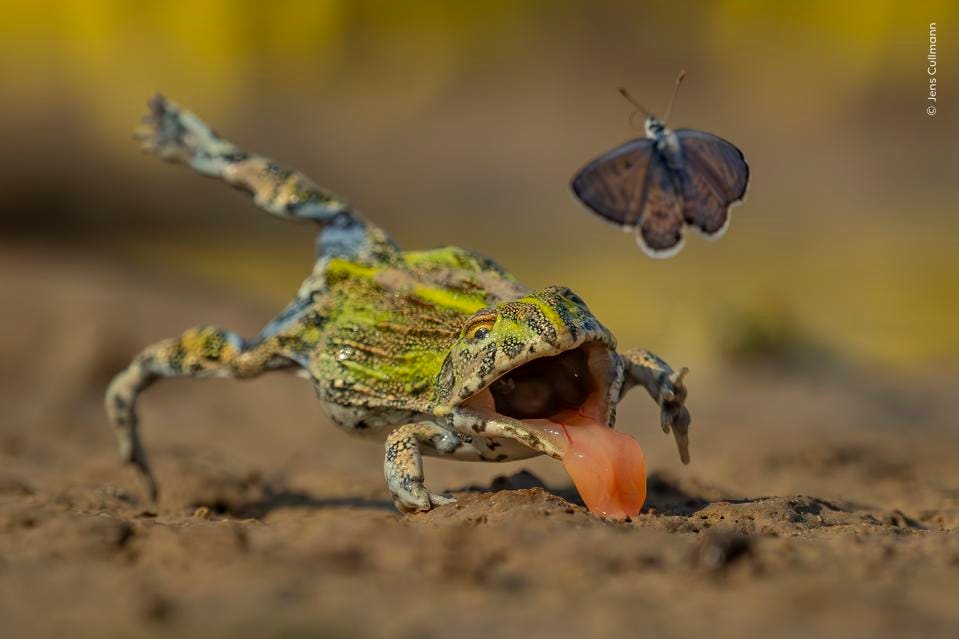
Photographer: Jens Cullmann (Germany)
Category: Highly Commended, Behaviour: Amphibians and Reptiles
Location: Central Kalahari Game Reserve, Botswana
Jens noticed tadpoles on a previous visit after heavy rains and returned the following month to find ponds and puddles full of young bullfrogs. He spent more than two weeks watching the young frogs “eat everything that moved.”
As adults, African bullfrogs grow up to five inches in length, turn a drab green and spend 10 months of the year in a dormant state underground, emerging only after the rains to breed and eat voraciously.
Lifted to the Surface
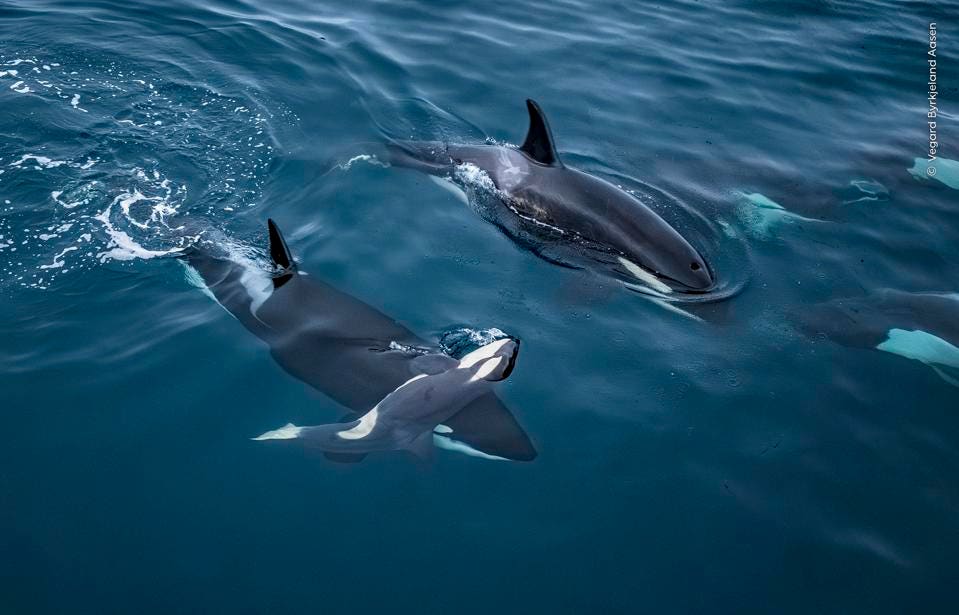
Photographer: Vegard Byrkjeland Aasen (Norway)
Category: Highly Commended, Behaviour: Mammals
Location: Kvænangen, Troms County, Norway
Vegard had just launched a drone to document sightings for the Norwegian Orca Survey when something caught his attention: an adult orca carrying a deceased calf, occasionally dropping it and then retrieving it as it sank. Although difficult to witness, Vegard felt it was “important to document the moment.”
Cetacean mothers have been known to use their heads to lift newborns to the surface to breathe, raising the possibility that Vegard was witnessing efforts to revive the calf. Some researchers interpret this behavior as a reflection of the deep bond between mothers and calves.
The Show Goes On
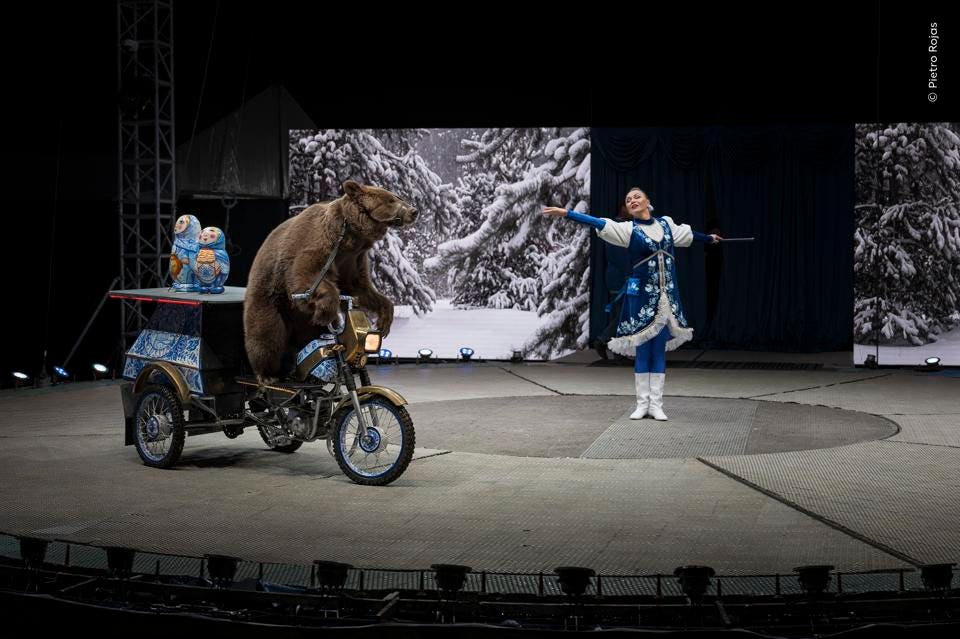
Photographer: Pietro Rojas (Guatemala)
Category: Highly Commended, Photojournalism
Location: Doha, Qatar
Noticing that a circus with animal acts was in town, Pietro decided to document it. What he found most compelling about this image was “the contrast between the wild nature of the animal and the human environment imposed upon it.”
Many countries have banned the use of wild animals in circuses. Where brown bears are used, they often are trained to perform in unnatural postures like standing upright for long periods of time, contributing to health and behavioral problems.
Ocean Protector
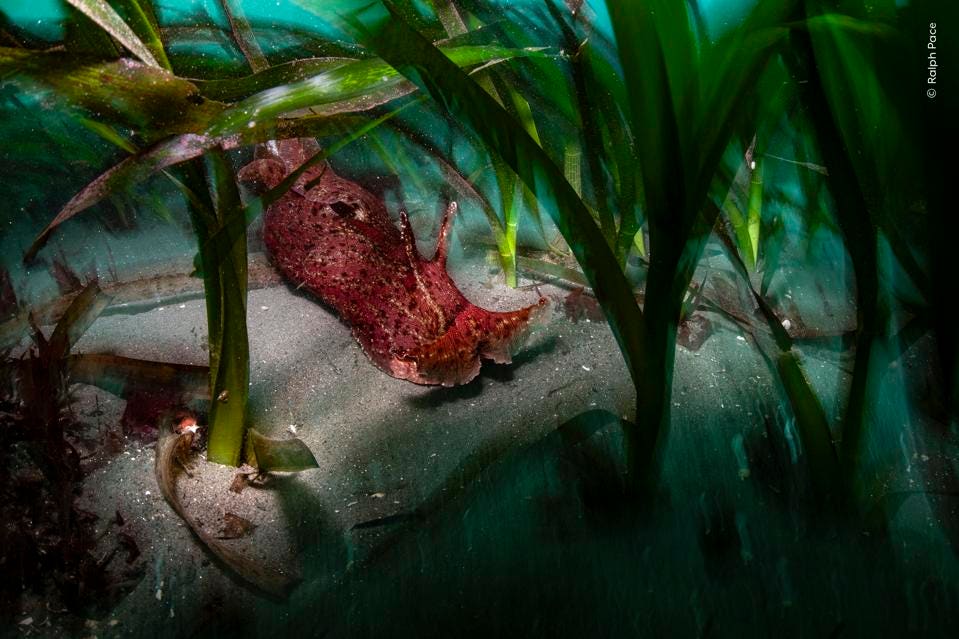
Photographer: Ralph Pace (USA)
Category: Highly Commended, Wetlands: The Bigger Picture
Location: Monterey Bay, California, USA
In the shallows of Monterey Bay on the U.S. Pacific coast the evening light traces the silhouette that earned this sea slug its name – sea hare. Ralph wanted to depict an unexpected, hopeful scene of “a gentle giant safeguarding the last green meadows of the sea.”
Sea hares play an important role in the restoration of eelgrass meadows by grazing on the red algae that block sunlight to the meadow. Eelgrass is vital for coastal ecosystems and is an important carbon sink.
Calm Amid the Storm
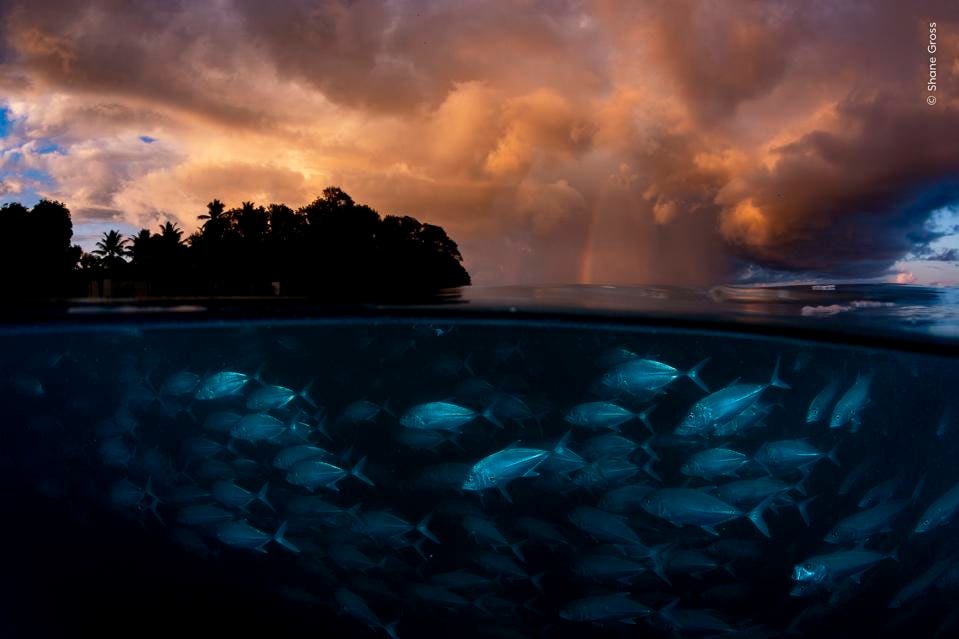
Photographer: Shane Gross (Canada)
Category: Highly Commended, Oceans: The Bigger Picture
Location: D’Arros Island, Seychelles
Shane noticed this school of fish swimming near the shore every morning at sunrise. Aiming for a split shot, he flipped the camera upside down to aid buoyancy distribution and adjusted his position, slowly approaching the curious school swimming calmly as a storm approaches.
Bigeye trevally are fished in many parts of the world, but here they’re relatively safe. In 2023, the waters surrounding D’Arros Island were made a Marine Protected Area and designated as no-take zones as part of the worldwide initiative for governments to protect 30% of Earth’s land and ocean by 2030.
Urban Wanderer
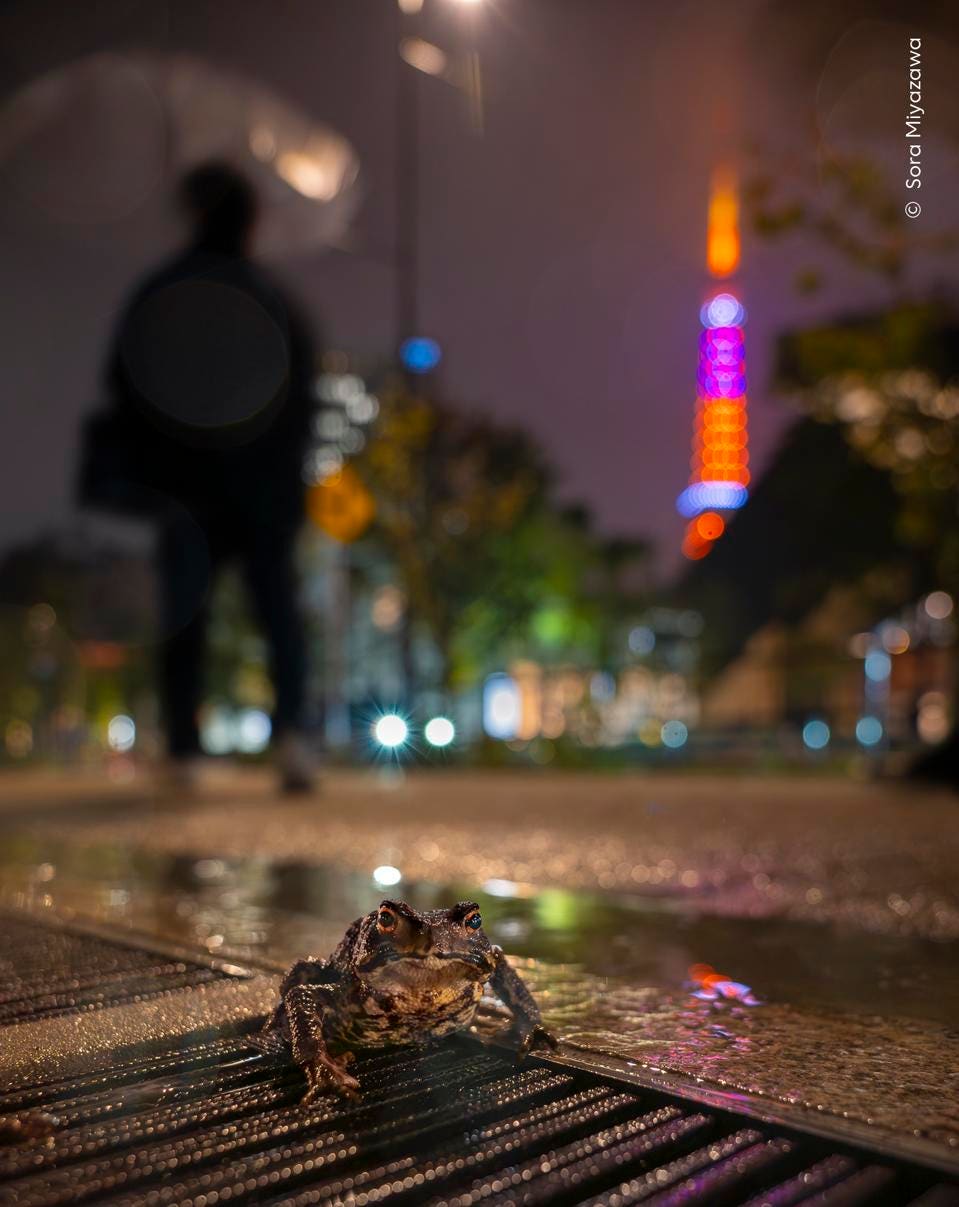
Photographer: Sora Miyazawa (Japan)
Category: Highly Commended, 11-14 Years
Location: Tokyo, Japan
Sora chanced upon this toad in the heart of Tokyo, one of the world’s largest cities. With a slow shutter speed, he composed the image before the toad hopped back into the bushes from where it had emerged.
Exactly how this species thrives in a city of 14 million people is unclear. Toads are more successful than other amphibians at dispersing and surviving in new habitats, including in urban environments like this one.
Tickets are on sale now for the 62nd edition of Wildlife Photographer of the Year which launches on October 16, 2026, and runs until July 11, 2027.
This article was originally published on forbes.com.