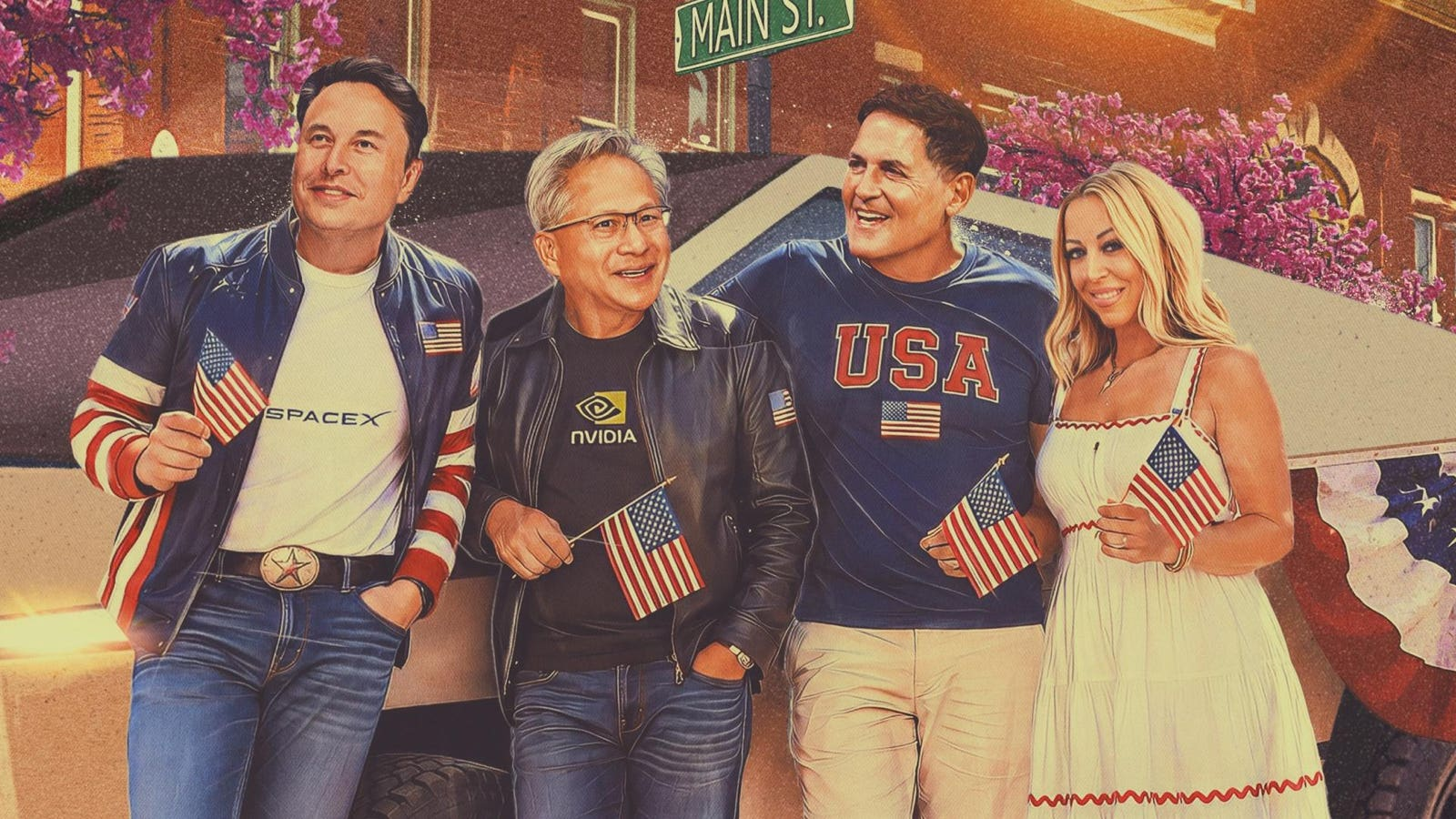
These billionaires have found a spot among the 400 richest Americans—before turning 40.

Illustration by Neil Jamieson for Forbes
There’s no better glimpse of the future than looking to the youth.
That’s particularly true of the Forbes 400 list of America’s richest people, where the AI revolution is upending the ranks, catapulting super-young moguls into the nation’s most exclusive club at a dizzying rate.
Last year, just four billionaires under the age of 40 were rich enough to make The Forbes 400. This year, there are ten.
Seven thirtysomethings muscled their way onto the list as newcomers this year—despite needing a record $4.4 billion minimum net worth to make the cut—and all seven owe their fortunes to the AI boom.
Four of these seven hail from just one company, Anthropic, which was founded in 2021 when seven OpenAI employees walked away from the company, convinced it was building AI too fast without regard for safety or trust. Now four of them rank among the ten youngest members of this year’s Forbes 400 (two others are in their early 40s and also newcomers to the ranking, while one is a Canadian citizen). All seven cofounders—including Tom Brown (age 39), Daniela Amodei (39), Jack Clark (37) and Sam McClandish (36)—are now worth an estimated $15.5 billion, and tied for No. 75 on the list. Anthropic, which created the AI model Claude, was most recently valued at $965 billion after a $65 billion funding round in May. (Earlier this year, all seven cofounders pledged to eventually give away 80% of their wealth.)
The Forbes 400

The Definitive Ranking Of America’s Richest People 2026
VIEW THE FULL LIST
OpenAI is doing just fine, too. Cofounder and president Greg Brockman, age 38, is the richest new member of The Forbes 400, joining the ranks after he admitted under oath during a court trial in May—as part of the ChatGPT-maker’s legal battle with Elon Musk—that his stake in OpenAI is worth more than $20 billion. OpenAI was valued at $852 billion in March, and both OpenAI and Anthropic confidentially filed this summer to eventually go public.
Then there’s Anduril’s Palmer Luckey, who ranks second youngest on the list, at age 33, after his autonomous drone maker raised $5 billion from venture capitalists at a $61 billion valuation in May. The youngest Forbes 400 member of all: Steven Hao, the 30-year-old cofounder and chief technology officer of Cognition, maker of AI software engineer Devin. In September, Cognition announced a $2 billion private funding round at a $48 billion valuation, less than three years after its founding.
Only three billionaires who ranked among the ten youngest members of The Forbes 400 in 2025 kept their spot this year: Edwin Chen (38), founder of AI training company Surge AI; Vlad Tenev (39), cofounder of trading app Robinhood; and Lukas Walton (also 39), an heir to the Walmart fortune. Walton is the only one of the ten who inherited his fortune, and, with an estimated $44.4 billion fortune, he is the richest of the group—followed by Brockman, who is worth an estimated $25.5 billion.
In all, the ten youngest billionaires on this year’s Forbes 400 ranking are worth $169 billion, down from $357 billion in 2025. The decline is almost entirely because a few very rich moguls— notably Meta’s 42-year-old cofounder and CEO Mark Zuckerberg (estimated fortune: $212 billion), 41-year-old venture capitalist Josh Kushner ($16.7 billion) and 43-year-old Airbnb cofounder Nathan Blecharczyk ($11.9 billion)—aged out. The list ranges in age from 30-year-old newcomer Hao all the way to 97-year-old timber baron Archie Aldis Emmerson ($6 billion), with an average age of 70.
Here are the ten youngest members of the 2026 Forbes 400, listed from oldest to youngest.
Net worths are as of September 4, 2026
10. Lukas Walton, 39
Net Worth: $44.4 billion
Source of Wealth: Walmart
The grandson of Walmart founder Sam Walton (d. 1992) and the only child of Sam’s son John Walton (d. 2005), Lukas Walton inherited roughly a third of his father’s estate, mostly Walmart stock. He runs Chicago-based Builders Vision, an investment and philanthropy firm managing more than $15 billion across clean energy, sustainable food and ocean conservation. In June, he acquired a minority stake in the NBA’s Chicago Bulls.
9. Vlad Tenev, 39
Net Worth: $7.1 billion
Source of wealth: Robinhood
Tenev was born in Bulgaria to two World Bank staffers and met his cofounder and fellow Forbes 400 member Baiju Bhatt (who is 41) at Stanford. In 2013, they launched Robinhood, the app that eliminated stock trading commissions and pushed the rest of the brokerage industry to follow. They took the company public in 2021, and Tenev’s roughly 6% stake forms the bulk of his fortune. Robinhood’s fastest-growing business is now prediction markets, where users buy contracts on future events including elections, Federal Reserve decisions, sports and even the weather. In the second quarter of this year, prediction markets drove more than $156 million in revenue, blowing past stock and crypto trading. Tenev also chairs Harmonic, an AI startup he founded in 2023 that is focused on mathematical reasoning.
8. Tom Brown, 39
Net Worth: $15.5 billion
Source of wealth: Anthropic
Brown, who studied computer science and cognitive science at MIT, was one of OpenAI’s first 20 employees. He was lead author of the 2020 paper introducing GPT-3, the language model that demonstrated such systems could write fluently and triggered the current investment boom in artificial intelligence. In 2021, Brown left OpenAI with six colleagues to found Anthropic, a rival AI lab that makes the chatbot Claude, where he oversees the computing infrastructure used to train it.
7. Daniela Amodei, 39
Net Worth: $15.5 billion
Source of Wealth: Anthropic
Amodei graduated from UC Santa Cruz and worked at the payments company Stripe before joining OpenAI, where she oversaw safety and policy. In 2021, she left with her brother Dario—now Anthropic’s CEO and also a newcomer on this year’s Forbes 400 at age 43—and five other colleagues to found Anthropic. She serves as president and board chair, overseeing research, engineering, product and commercial operations.
6. Edwin Chen, 38
Net Worth: $18 billion
Source of Wealth: Surge AI
Chen grew up in a Florida town of 3,400, where his Taiwanese immigrant parents ran a Chinese-Thai restaurant. He went on to study math, linguistics and computer science at MIT before working at Google, Facebook and Twitter. In 2020, he founded Surge AI, which employs people to label data, as well as rate and correct AI-generated answers to train models. Customers including Google and Anthropic have helped push Surge beyond $1 billion in annual revenue with no venture funding. Chen is estimated to own roughly 75% of the company.
5. Greg Brockman, 37
Net Worth: $25.5 billion
Source of Wealth: OpenAI
Brockman left both Harvard and MIT without completing his undergraduate studies, became chief technology officer of the payments company Stripe at 25, then cofounded OpenAI with Elon Musk and CEO Sam Altman as a nonprofit in 2015, at 28. As the company’s president, Brockman oversees the infrastructure behind OpenAI’s models and, since July, its product business as well—making him the company’s second-in-command ahead of a possible IPO. In 2024, Musk sued Brockman and Altman over OpenAI’s conversion to a for-profit structure, leading to the disclosure of Brockman’s stake in the company in May. Brockman also disclosed a nearly $500 million of stock in Stripe, plus small investments in semiconductor maker Cerebras and compute provider CoreWeave, both OpenAI suppliers.
4. Jack Clark, 37
Net Worth: $15.5 billion
Source of Wealth: Anthropic
Clark covered artificial intelligence as a Bloomberg reporter before joining OpenAI as its policy director. Since leaving OpenAI with his Anthropic cofounders in 2021, he has served as one of the sector’s more prominent advocates for government regulation of AI. Today, he runs Anthropic’s in-house think tank, which studies the technology’s societal effects, and writes a widely read industry newsletter.
3. Sam McCandlish, 36
Net Worth: $15.5 billion
Source of Wealth: Anthropic
McCandlish earned a Ph.D. in theoretical physics at Stanford before joining OpenAI, where he worked on scaling laws—the discovery that AI systems get predictably smarter the more data and computing power you feed them. After cofounding Anthropic, he served as chief technology officer until October, when he transitioned to the role of chief architect. He now oversees how the company’s models are built and trained.
2. Palmer Luckey, 33
Net Worth: $5.9 billion
Source of Wealth: Anduril
Luckey built an early virtual-reality headset as a teenager, then sold the company, Oculus, to Facebook for $2 billion in cash and stock at 21, but left the company now known as Meta in 2017 amid outcry over his support of President Donald Trump. That year, he founded Anduril, which makes autonomous drones and sensors, and the AI-powered software coordinating them. In March, the U.S. Army awarded Anduril a 10-year contract for its software, hardware and related services worth up to $20 billion. Two months later, Anduril raised $5 billion at a $61 billion valuation.
1. Steven Hao, 30
Net Worth: $5.8 billion
Source of Wealth: Cognition
Hao and his two Cognition cofounders each won gold medals at the International Olympiad in Informatics, the global competitive-programming championship (Hao won his in 2014). He went on to work as an engineer at data labeling startup Scale AI, which was cofounded by 29-year-old billionaire Alex Wang (estimated fortune: $3.2 billion) and has been 49% owned by Meta since 2025. Hao left before that to start Cognition in 2023. The company’s main product is Devin, an AI agent that writes and repairs code, used by customers including Citibank and fintech Ramp. In September, Cognition raised $2 billion at a $48 billion valuation, making all three of its cofounders billionaires. Hao—Cognition’s CTO and largest founder shareholder—is the only one rich enough to make this year’s Forbes 400.
Want to see more Forbes articles on your feed? Tap here to make Forbes Australia a preferred source on Google.
Look back on the week that was with hand-picked articles from Australia and around the world. Sign up to the Forbes Australia newsletter here or become a member here.