Ash Kansakaar and Jaideep Upadhyay met in Melbourne after growing up in Nepal and India, respectively. They’ve raised $3 million for their Syncrowin startup, which develops AI to help power providers predict disruptions before they happen.
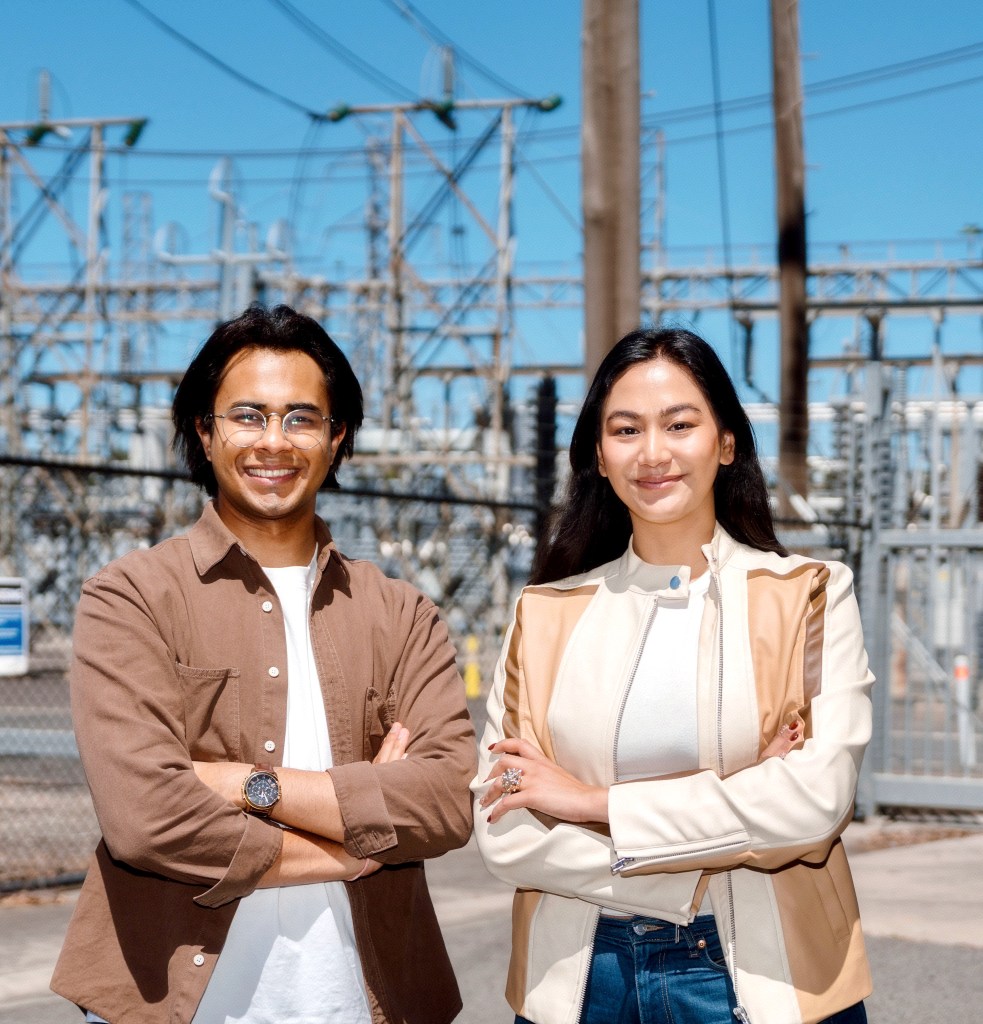
Aisshwarya “Ash” Kansakaar and Jaideep Upadhyay. Credit: Syncrowin.
Millions were plunged into chaos last April when a freak grid failure led to blackouts across Spain and parts of Portugal. And as storms raged across the American South, tens of thousands in Georgia were left without electricity just last month.
Aisshwarya Kansakaar, a Forbes Australia 30 Under 30 alum, pointed to that second example as proof that power outages are not just a developing-world problem.
She is no stranger to them, having grown up in Nepal during a civil war that caused over a decade of energy instability. Nor is her business partner Jaideep Upadhyay, who remembers eating dinner by candlelight in India during regularly scheduled “load shedding” outages.
The job of a power grid is to balance electricity generation with demand, but that simple objective is becoming fiendishly complex. The system’s composition changes as new batteries, wind turbines and solar panels are connected. And that says nothing of the many enormous data centres being built around Australia and the world.
The pair’s solution is Syncrowin, an “operational intelligence” startup that helps energy generators and heavy industry proactively anticipate instability in the grid rather than react haplessly. Its AI software is designed to predict power irregularities by analysing data from power generators, transmission infrastructure and batteries.
“Industrial sites have multiple variables at play, and humans try to balance those variables to keep the site running efficiently,” Upadhyay said. “A lot of times, they will react to something that has already happened. What we enable them to do is see what is going to happen… and based on that, they can take actions right now.”
The vision, Upadhyay said, is for the AI to eventually operate on autopilot. The system could take action on behalf of operators, optimising power generation, storage and transmission to both guard against outages and improve efficiency.
That vision is now backed by $3 million in pre-seed funding from investors across the United States and Australia. The round was led by Collide Capital, a New York VC that counts Google, Amazon, JPMorgan Chase and Goldman Sachs as backers. San Francisco’s Hustle Fund and POV Ventures plus Sydney firms Ventari and CoVentures also participated in the round.
The fundraise is roughly twice the median $1.6 million angel and pre-seed infusion raised by Australian startups in 2026, according to Cut Through Venture’s latest report. The money is going towards recruiting engineers who specialise in AI and machine learning, who will be split between San Francisco, Sydney and Melbourne.
AI engineers are not cheap, nor is the infrastructure the pair are intending to build. Upadhyay expects upcoming funding rounds to be above the median, just like their pre-seed was.
“It’s enough to get us to the next milestone to unlock more funding, that’s how we are looking at it,” Upadhyay said of the $3 million. “This is going to be capital intensive, and then we’re going to need more capital. So we’ll have to raise subsequent rounds that are significantly larger than the current one.”
The pair met at the University of Melbourne eight years ago and founded Syncrowin in 2024. Kansakaar earned her spot on Forbes Australia’s 2025 30 Under 30 list for her contributions to creating STEM pathways for women. She co-led a Monash University program that teaches basic engineering to preschoolers, and acts as COO of the not-for-profit Women 4 STEM.
The product itself works in the background, connecting to existing software, systems and dashboards used at industrial sites. It will take years and many millions for Syncrowin to develop fully, but the pair don’t expect to remain pre-revenue for long.
“There are customer engagements that are in progress at the moment as we speak,” Kansakaar said. “The ultimate customer for us would be national grids, utility scale independent power producers [and] data centres.”
Forbes Women is a global network of female business owners, entrepreneurs and changemakers. Sign up to Forbes Women here
Look back on the week that was with hand-picked articles from Australia and around the world. Sign up to the Forbes Australia newsletter here or become a member here.