Claude is used in Australia six times more than what was expected, according to the Anthropic Economic Index. Now, Daniela and Dario Amodei want the Anthropic/Australia “values overlap” to extend to physical infrastructure.

Claude, the AI model developed by trillion-dollar startup Anthropic, is being used for almost everything imaginable.
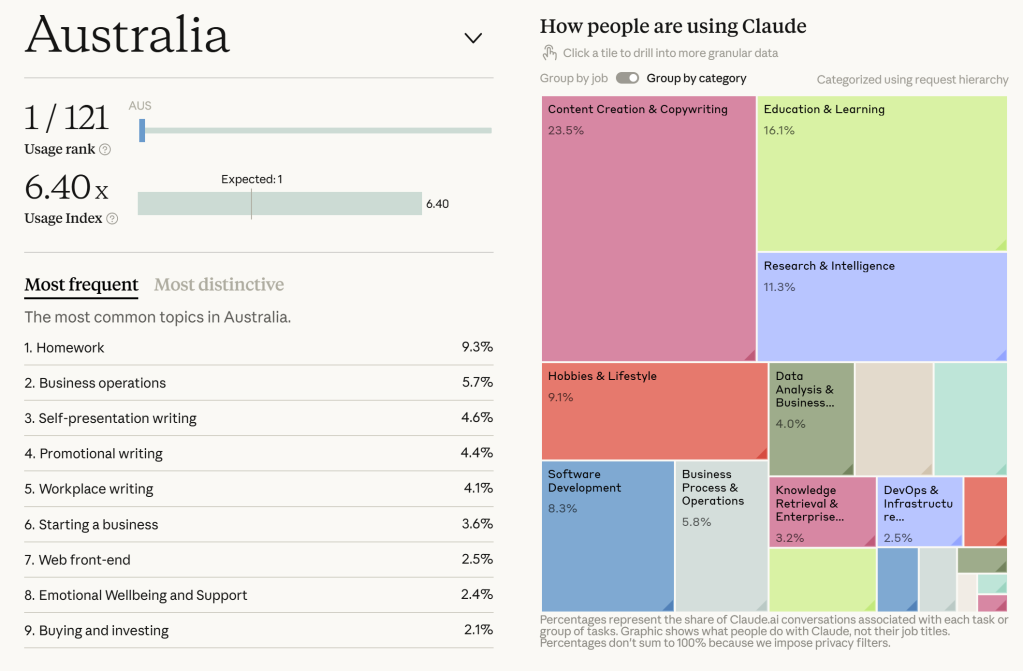
According to the company’s recently released Economic Index, Australians are its most prolific users anywhere around the world. And our most pressing use case?
Homework.
Almost 10 per cent of topics “Claude-d” by Australians come from students looking for a leg-up on assigned individual work, specifically, to aid with course deliverables, study materials, quiz assistance, and math tutoring.
Rounding out the top five use cases are business operations (almost 6 per cent of Claude conversations in Australia, self-presentation writing (4.6 per cent), promotional writing (4.4 per cent), and workplace writing (4 per cent).
Number one by usage, and a target for growth
The data comes on the heels of news that Anthropic is looking to further its local footprint.
“We’re exploring adding local capacity through our third-party partners in Australia, using infrastructure already in place,” a company statement reads. “This is among the most consistent requests we hear from Australian enterprises and government agencies, particularly those with data residency requirements.”
Anthropic President Daniela Amodei tells Forbes Australia that Australia has a “values overlap” with what her company is working to achieve in the AI realm.
“There’s a long-standing history and overlap of Australia being a technological leader alongside the US and a small number of other countries,” says Amodei. “Australia has been very smart and very tech-forward. There’s a very strong developer community of great people with big ideas that are generative and creative, and that’s also a part of what Anthropic values, a part of our DNA.”
Recent reports suggested that the company is looking to water down Australian copyright restrictions. Senior government officials have pushed back on that idea, noting that “the government has ruled out a text and data mining exception” and that the Australian position on copyright has not changed.
An Anthropic spokesperson confirmed that it signed a Memorandum of Understanding with the Australian government this year, committing it to “operating within the Data Centre Expectations set out by the government.”
Those expectations include prioritising Australia’s national interest and protecting “sensitive and personal data” and “limiting physical and digital access to their data centres to those with a right to it.” As such, data centres on Australian land need to abide by our uniquely strong copyright law, unless an aforementioned text and data mining exception is negotiated with the government.
The jobs Claude is working hardest in
While content creation and copywriting is the job category we are most heavily leaning on Claude for, the technology is also used heavily in Australia for education and learning, research and intelligence, and hobbies and lifestyle.

When digging into the data, Anthropic researchers found that Australians are distinctive in the way they use Claude to write in the workplace, showing a higher propensity to augment instructional design, business operations, reference documentation, editing and rewriting, and wellness and fitness.
We also ask more medical questions, and turn to Claude for emotional wellbeing and support more than other countries do.
The countries using – and automating – Claude the most
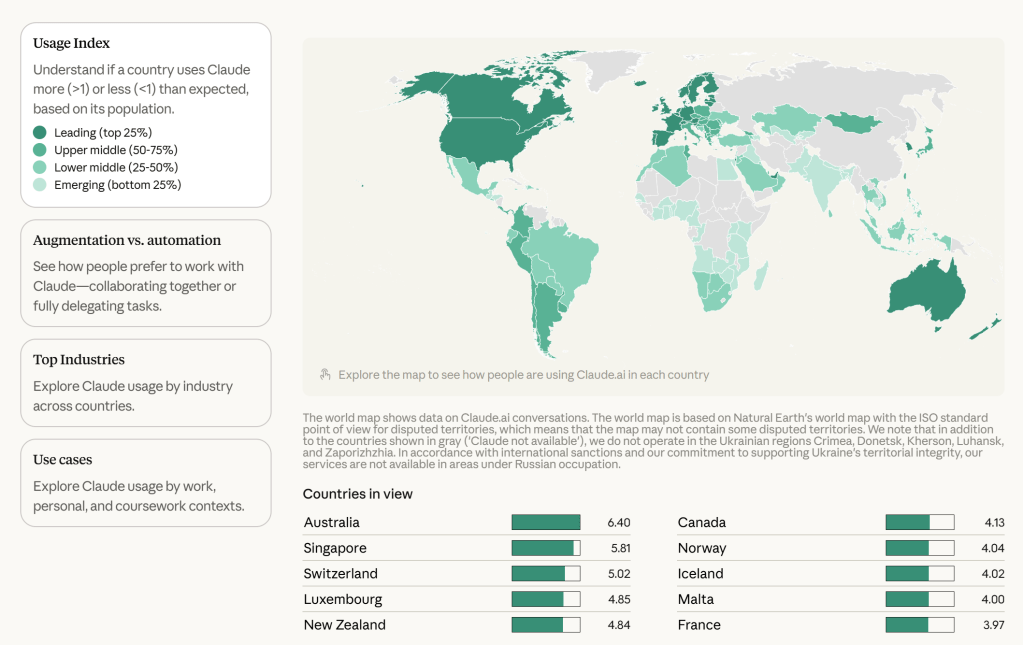
Singapore, Switzerland and Luxembourg are the other countries using Claude most frequently. New Zealand and Canada are in fifth and sixth position, followed by Norway, Iceland, Malta and France.
Globally, Claude is used for personal reasons – i.e. emotional support, medical questions, and investment advice – more on weekends than on weekdays. During the work week, the conversations most often relate to business correspondence, marketing copy, and slide decks.
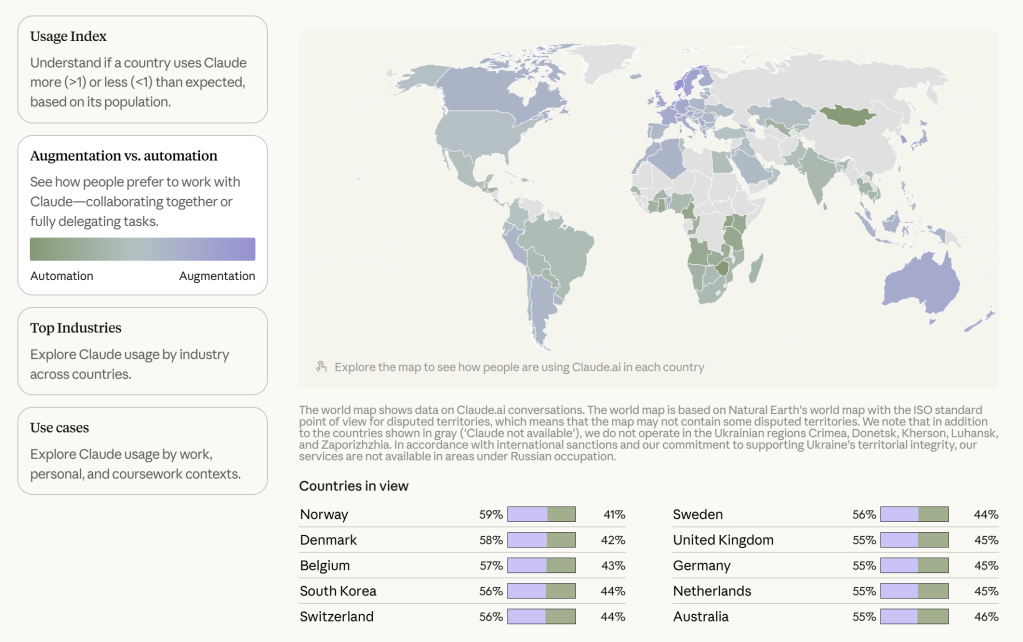
While Australians, Canadians, and many Europeans mostly use Claude to augment rather than automate tasks, the opposite is true in Mongolia, Zimbabwe and Uzbekistan.
“News requests peak around 7am,” the research reveals. “Business email drafting hits its stride mid-morning, recipe requests spike to 2.3x their average at 6pm, and sleep advice clusters in the small hours before dawn.”
Want to see more Forbes articles on your feed? Tap here to make Forbes Australia a preferred source on Google.
Look back on the week that was with hand-picked articles from Australia and around the world. Sign up to the Forbes Australia newsletter here or become a member here.