
Mark Zuckerberg’s social media juggernaut has pushed back on the federal government’s landmark social media ban, saying that despite wiping more than half a million accounts, the new law is failing to improve online safety and may be creating new risks for teenagers.
Key Takeaways
- Australia’s under-16 social media ban came into force on 10 December, making platforms legally responsible for preventing children from holding accounts or facing fines of up to $49.5 million.
- Meta says since then it has removed 544,052 Australian accounts belonging to users believed to be under 16 in the first week of enforcement.
- The takedowns span Instagram, Facebook and Threads, following the introduction of Australia’s under-16 social media ban.
- In a blog post released Monday morning, the tech juggernaut says it does not believe the policy has not necessarily improved teen safety or wellbeing.
- It argues inconsistent age verification across platforms weakens the law – and warns some teenagers are shifting to less regulated apps not covered by the ban.
Key background
Australia’s under-16 social media ban places the responsibility for enforcement squarely on platforms, rather than parents or users. Companies that fail to take “reasonable steps” to prevent underage access can face civil penalties of up to $49.5 million.
The legislation was passed after a short consultation period and applies to major platforms including Facebook, Instagram, TikTok, Snapchat, X and YouTube, though messaging and gaming services are largely exempt.
Communications Minister Anika Wells previously said the government does not expect immediate perfection from age-assurance systems and that enforcement will take time to bed down.
Related

What has Meta said?
In a compliance update published on its Australia policy blog Monday, Meta said it more than half-a-million Australian accounts it believes belonged to users under the age of 16 in the first week of enforcement.
That included 330,639 Instagram accounts, 173,497 Facebook profiles and 39,916 Threads accounts, removed between December 4 and December 11 as the company moved to comply with the new law.
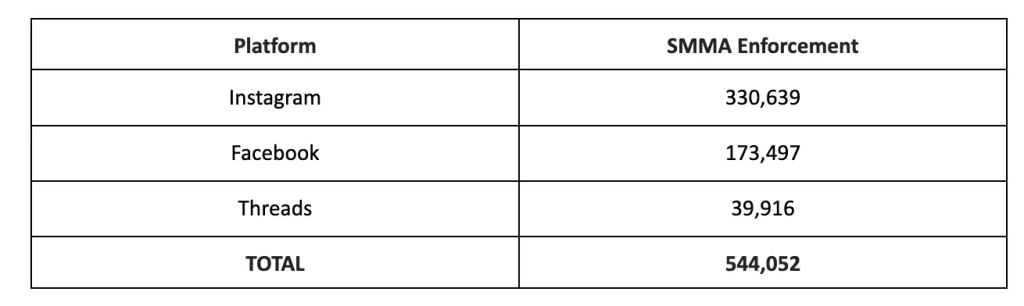
Meta said the data provides an early indication of how the ban is operating, but warned the results so far do not show an improvement in safety or wellbeing for young Australians.
The company said inconsistent age-verification methods across platforms undermine the effectiveness of the ban, arguing that enforcement varies widely depending on the app being used.
Meta also warned that some teenagers are being pushed towards smaller or less regulated platforms not covered by the law, while others are still able to consume algorithmically selected content by using services in a logged-out state.
“The premise of the law, which prevents under-16s from holding a social media account so they aren’t exposed to an algorithmic experience, is false,” Meta said, arguing that algorithms still influence content recommendations even when users are not signed in.
The company again called on the government to pursue app-store-level age verification and parental consent requirements, saying a single, industry-wide approach would provide more consistent protections for young people.
Crucial Quote
“Since the implementation of Australia’s social media ban law, a number of concerns have been raised by experts, youth groups, and many parents,” Meta said in its blog post.
Big number
544,052 – The number of Australian social media accounts Meta says it removed in one week under the under-16 ban.
What to watch for
The federal government is expected to release consolidated data from the eSafety Commissioner detailing how many accounts have been blocked across all affected platforms since the ban took effect.
Tangent
France is preparing draft legislation that would block under-15s from using major social media platforms from the start of the 2026 school year, explicitly citing Australia’s approach as a reference point.
President Emmanuel Macron has publicly backed the move, arguing there is growing agreement that heavy social media use is linked to poorer mental health and lower school performance among teenagers.
Look back on the week that was with hand-picked articles from Australia and around the world. Sign up to the Forbes Australia newsletter here or become a member here.